Governor’s May Revision Continues Cautious Approach

Governor Brown released his revised 2015–16 budget last week. It includes $8 billion more in new spending than his January proposal but continues his cautious approach to taking on new spending commitments. The new funding proposals are the result of setting modest expectations for future revenue growth. Because actual growth from the improving state economy has far exceeded forecasts, the administration has significant additional funds available.

Only about two-thirds of the $8 billion increase comes from the General Fund. The other third stems from increased special funds and revenues from bonds.

  • General Fund. General Fund revenues are estimated to increase by about $6.3 billion—$4 billion to reflect the major influx of tax receipts collected since January 2015 and $2.3 billion next year. Almost all of that—$5.8 billion—must be spent on K–12 education and community colleges. This leaves little room for spending in other areas.
  • Cap-and-Trade Funds. The May Revision proposes to more than double spending of cap-and-trade revenues, going from $1 billion in the January budget to $2.2 billion today. Under the state’s greenhouse gas reduction program, businesses pay fees for the right to emit carbon into the atmosphere. In 2015, producers of transportation fuels joined the program, significantly boosting revenues. As a consequence, revenues are expected to jump $1.2 billion above the level proposed in January. The additional funds would be spent for transportation, housing, energy, and natural resources programs—consistent with the long-term expenditure plan approved by the legislature in 2014.
  • Proposition 1 Bond Funds. The May Revision also significantly increases spending for water quality and conservation projects. Proposition 1, approved by voters in 2014, includes $7.5 billion in bond funds for a variety of water quality, flood protection, and storage programs. The budget proposes to dedicate $1.8 billion in bond funds over the next three years. This increase builds on $1.9 billion in spending (from a variety of funding sources) approved by the legislature in the spring of 2015.

The $8 billion growth in revenues and expenditures represents a 4.8% increase from January, and an 8.1% increase from the 2014–15 budget passed by the legislature last June. So how can this be considered cautious? The answer is that the administration uses modest assumptions about future growth in revenues—until there is solid evidence of additional available resources.

The pattern of projected revenues for 2014–15 reveals how this strategy works. The following chart illustrates how recent budget projections have grown as revenues have increased.

In January 2014, the administration estimated revenues of $106 billion—up 6% from 2013–14 anticipated revenues. The 2014 May Revision boosted that figure to $107 billion. Actual revenue collection was up significantly in the fall of 2014, which led to a January 2015 estimate increase to $109.7 billion. From January to April 2015, revenues exceeded expectations by $3.2 billion, bringing the most recent estimate of General Fund revenues to $112.9 billion. This is truly exceptional revenue growth. Compared to 6% growth projected in January 2014, the May Revision figure for 2014–15 translates into General Fund revenue gains of 12.8%.

Despite the projected gains for this year, the current May Revision continues to take a cautious approach to revenue estimates for the coming year. The administration’s initial revenue estimates for 2015–16 are quite modest—the May Revision anticipates 4.1% growth in General Fund revenues. This low growth estimate limits the amount of new spending that can be added to the base budget. At the same time, the large increase in current-year revenues gives the governor flexibility to boost support for education and other critical areas. In this way, Governor Brown can significantly increase spending today while maintaining a cautious approach to the future.


Chart Source: California Department of Finance, 2015-16 May Revision.

“The Central Valley Needs a New Narrative”

photo of Dan Dooley
Dan Dooley’s expertise on the nexus between water and agriculture runs deep: fifth-generation Tulare County rancher, water lawyer, former deputy director of the California Department of Food and Agriculture,  former chair of the state Water Commission, and former member of the National Academy of Sciences’ board on agriculture. So when he says the Valley needs a new narrative on water, we’d be wise to pay attention.

I’ve had the privilege of working with Dooley during one of his most recent gigs, as head of external affairs for the University of California, and we are fortunate to have him as an inaugural member of the PPIC Water Policy Center’s Advisory Council. Recently, I held a conversation with him following his recent lecture on the future of agriculture in the Central Valley, an event hosted by the Water Education Foundation.

Dooley began by describing key drivers of change that are already affecting farming in the Central Valley—and the San Joaquin Valley, in particular—from declining groundwater and less-reliable surface water, to a fast-growing population. Add to that the various water stressors that climate change is expected to bring, and it’s clear that change is inevitable. The billion-dollar question is how best to manage these changes well.

Especially during the drought, good management has not always carried the day. He emphasized that long-term over-drafting of groundwater can’t be sustained and regretted that farmers missed their opportunity to be more involved in last year’s legislation to regulate groundwater. “The new state law on groundwater could result in a 15-20 percent contraction in agricultural water use in the Southern San Joaquin valley,” he said.

At the same time, Dooley notes, water demand has “hardened” because of conversion of row crops (which can be fallowed in dry years) to perennial crops. The growth in dairies has also had a big impact on groundwater.

Despite these major challenges, Dooley emphasized that the Valley is an incredibly productive place, teeming with innovation and able to adapt to scarce water. His main point—that the Central Valley needs a new narrative—is a positive one.

As we talked about potential solutions, a few beacons of hope stood out. First, these myriad challenges are likely to force change in some of the state’s outdated policy and regulatory approaches to water. New policies will be needed to incentivize more efficient water use, and to improve the marketing of conserved water to others with unmet demand. Second, better integration of surface and groundwater—critical to sustainable management—is inevitable in light of tight supplies and the new groundwater law. Third, the culture of innovation that has made the Valley an agricultural powerhouse can serve the region well as it adapts to water scarcity, population growth, and a changing climate.

His big-picture advice to both his fellow farmers and water-law colleagues: Get more involved in groundwater management and manage it for the long-term. Stop scapegoating the environment. Stop the skirmishing, keep your eyes on where you want to be 10 years from now, and implement practical solutions.

Learn more about the annual Anna J. Schneider lecture series and its focus on water law.

Testimony: Improvements Needed in Water Information

How is the state government handling the drought? And what more could be done? A hearing convened by the Senate Natural Resources and Water subcommittee earlier this week delved into the topic, with updates by leaders from the administration on the implementation of drought actions in the urban and rural sectors and in the state’s diverse ecosystems. In a second panel, I joined several other non-governmental experts to describe additional ways forward to solve our short- and long-term water challenges.

My testimony focused on a number of policy priorities that we highlighted in a recent report on drought management. In particular, I emphasized the need for better information as a basis for better water management.

Compared to most other western states and other dry places like Australia, California’s water monitoring and accounting systems are primitive, with significant gaps in information. Without a better understanding of how much water is available in our rivers and groundwater basins, as well as who’s using what, we’re saddled with inefficiencies, inadequate transparency, and greater potential for conflict. This especially matters during droughts, when every drop counts.

On the plus side, the state has recently made some progress in improving water information. Legislation enacted in 2009 requires all surface-water users to report the volumes of water they divert and also requires local agencies to report groundwater levels. Since the drought emergency was declared in January 2014, the State Water Resources Control Board has progressively amped up water-use reporting requirements.

But more should be done to fill the gaps. This includes gathering information on groundwater use—an important component of overall water use, especially during droughts. We also need to account for the volumes of water that cities and farms discharge back into streams as treated wastewater or irrigation runoff; these discharges make up a large share of water supplies in some of our rivers and streams.

Because information is only really useful if it is well organized, the state needs to pay particular attention to developing a coherent water information management system. Currently, agencies and offices that oversee different pieces of the puzzle have different tracking systems and accounting standards, which makes it very hard to get an overall picture of what’s happening in anything close to real time. The last official estimates of water supply and water use for California date back to 2010.

Funds from the state water bond could help pay for this work. In devising our system, we should draw lessons from other states and countries that are further along in this area. And given that California is a global center for the information economy, it may make sense to tap into local “big data” expertise to help build data solutions.

There’s a saying that “You can’t manage what you don’t measure.” The drought is making it ever more important to manage our scarce water supplies for the benefit of our economy, society, and the environment. So we’d better get better at measuring it.

Watch the hearing on Cal Channel.

Video: Addressing California’s Water Challenge

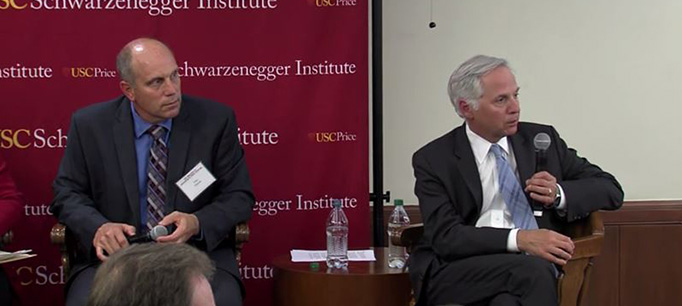
Last week the PPIC Water Policy Center partnered with the USC Schwarzenegger Institute for an important and timely discussion on the current drought and long-term solutions to California’s water challenges. The forum brought together water, business, university, and community leaders from around the state. Former governor Arnold Schwarzenegger, whose remarks opened and closed the event, emphasized the need for a big vision to tackle the drought, accompanied by strong leadership to ensure the timely implementation of creative solutions.

The event provided an opportunity to go beyond the current finger-pointing of who uses how much water, resulting in a more productive conversation about what can be done in key sectors and regions of California. In her presentation introducing key facts about the state’s big water issues, Ellen Hanak, director of the PPIC Water Policy Center, introduced two main themes that helped guide further discussions: “We’re all in this together” and “There are no silver bullets” to tackle major droughts. There was widespread agreement among speakers that a more sustainable future for water in California will benefit both our economy and environment, but we need an “all of the above” approach. We need to increase supplies, reduce demand, and modernize our approach.

More than 20 participants shared their views in a series of three panel discussions, including two members of the PPIC Water Policy Center advisory council, Tim Quinn and Lester Snow, and a member of our research network, Dan Sumner. Mark Baldassare, president and CEO of PPIC, served as moderator for a discussion on the state’s most important drought-based challenges, the role of agriculture, and solutions for addressing the drought.

Video: Press Club Focuses on Water

California’s drought has gone on long enough that many of the state’s reporters­—whether or not they cover the environment—have found they need to learn more about how water is managed in the state. The Sacramento Press Club helped close this information gap yesterday by hosting PPIC’s Water Policy Center director Ellen Hanak, who talked about the five things you need to know about water.

One of her points, that there are no silver bullets to solve our long-term water policy challenges, prompted the most conversation. While many reporters in the room may have already understood this, their questions were tinged with hope that there might be some solutions that could help make this drought go away (silver-plated bullets, perhaps?).

What about desalination, one reporter asked? The constraint, noted Hanak, is the cost. Seawater desalination is still a very expensive option for most water agencies. Using recycled wastewater (including to recharge groundwater) is a somewhat cheaper way to get “more water” for parched urban areas. But in some areas—like San Diego and some Central Coast communities—residents are already willing to pay the higher price tag for desalination to improve reliability Hanak said.

Another member of the audience asked about two proposed storage reservoirs, Temperance Flat (Fresno County) and Sites (Colusa-Glenn counties), both of which would be built off-stream in the Central Valley. “Our current system of reservoirs can collect roughly 40 million acre-feet, or about what we use in a year, statewide,” Hanak said. “Our groundwater basins can store at least three times that amount, and they can be recharged.” Hanak noted that storage investments will be needed to capture more water in wet years and make up for the shrinking snowpack. Surface reservoirs provide more flexibility, but groundwater storage is often much less costly. Operating the two types of storage in combination—and putting more drought storage into the ground—is an especially promising approach. “We need to think about managing water as a system.”

Another immutable water fact that Hanak shared is that the situation is hard but not hopeless. California has made steady progress in improving water management and systems, though much remains to be done—especially for maintaining healthy ecosystems and the wildlife they support. Water used to maintain environmental stability has become quite contentious, yet there are some promising stories, including in the Sacramento area. She described how water managers have introduced more natural flows in Putah Creek (a major stream that is part of the greater Sacramento River watershed)—using much less water than nature used to provide—with the result that native fish species are doing much better. This past year, even salmon returned after many decades’ absence.

Good reporting on the current drought, and on longer term water challenges, can help us all gain greater understanding of the highly complex world of water use in the state. We thank the Sacramento Press Club for the opportunity to help take the conversation forward.

ABOVE: PPIC’s Ellen Hanak greets Juliet Williams, Associated Press correspondent and president of the Sacramento Press Club, at the recent Press Club event. Photo: Phil Kampel Photography8.

Video: Water in Silicon Valley

Once a productive farming region, today Silicon Valley is a high-tech hub for the world, and a major driver of the state’s economy. As the valley has transitioned from fruits and nuts to bits and bytes, its water challenges have evolved—along with the approaches to dealing with them.

To explore how the region is coping with the current drought and preparing for future challenges, the PPIC Water Policy Center, with Cal Water and the Silicon Valley Leadership Group, hosted an event on April 24 with local leaders and experts. Ellen Hanak, center director, set the stage with an introductory talk on the statewide drought, opportunities for more water conservation in Silicon Valley, and regional climate-related concerns such as floods and sea level rise.

The mayor of San Jose, Sam Liccardo, brought it back to the local perspective. To achieve its 30% conservation target for 2015, he noted that the city of San Jose is taking innovative small and large steps, including a summer jobs program for youth focused on turf removal and the development of city-wide recycled water re-use system. The mayor emphasized that strong leadership at the local and statewide levels is needed to remove barriers to better-integrated and more advanced water management that can sustain the region through the coming challenges.

A panel of experts then offered wide-ranging views on the current drought, and posed a host of common-sense solutions, from increased public education to greater adoption of proven technologies such as using recycled wastewater to recharge groundwater basins. The impact of climate change on water systems, from increased temperatures to a reduced snowpack, was a major topic, with panelists agreeing that we will need to adjust to a new normal.

The participants were Angela Cheung, deputy operating officer of the Santa Clara Valley Water District; Juliet Christian-Smith, climate scientist at the Union of Concerned Scientists; and David Sedlak, co-director of the Berkeley Water Center at UC Berkeley. The panel’s moderator was Paul Rogers, an environment writer with the San Jose Mercury News and managing editor of the KQED Science Unit. As the drought continues, the PPIC Water Policy Center will be partnering with other local organizations and experts to bring similar conversations to other parts of the state.

Experts Weigh In on Drought Solutions

Along with their morning coffee, readers of Sunday’s Los Angeles Times were treated to an offering of nine bite-sized opinion pieces on solutions to help California better manage droughts. Contributors included representatives of urban and agricultural water agencies, environmental organizations, the private sector, and research institutions. The topics were equally broad. We both participated in this forum, and our two pieces highlight the importance of strategic investments in a couple of key areas: water storage and water accounting systems.

On storage, the message is that we need to think comprehensively about our water system when deciding how to invest the $2.7 billion in state bonds that voters recently authorized for new projects. People often assume that these funds will go to expanding surface reservoirs and tend to forget that storing water underground in the state’s aquifers is often more cost-effective. An especially promising approach to preparing for future droughts and adapting to our warming climate is to manage our storage network as an integrated system. This means putting more water for dry years into groundwater basins, which can free up space in surface reservoirs for summer irrigation needs and the higher flood flows likely to come with a shrinking snowpack.

On accounting, the message is that California has some serious catching up to do to better understand where, when, and how much water is used in different watersheds. This drought has exposed the tremendous challenges in managing scarce supplies because of an antiquated, incomplete, and inconsistent set of water use and water availability measurements. Updating our water accounting systems is a top priority we identified in a recent check-up on how California is faring during this drought. State officials have begun to take up this challenge. But more work is required to make this information sufficiently transparent, consistent, and integrated across the various state agencies and offices that deal with water management to facilitate allocation decisions that benefit the state’s economy, society, and environment during droughts.

Farms that Help Wildlife

When we hear that agriculture accounts for 80% of human uses of water in California, attention often turns to water intensive crops like rice and alfalfa (almonds—a water intensive but high revenue crop—have been much in the news as well). The suggestion is often made that farmers stop growing low revenue crops in order to conserve water. There are many reasons not to dictate what crops to plant. One not often discussed is that some crops that generate low revenues per unit of water may actually have high environmental value, particularly for birds and fish.

California’s freshwater landscape has been transformed, most notably in the Central Valley where less than 5% of native habitat remains. This transformation has reduced the habitat for waterfowl and shorebirds in the region. Land conversion, in conjunction with water resource development, is also the principal cause of the decline of native fishes such as salmon and steelhead.

Yet the very agricultural fields that contributed to the decline of these species may today provide the opportunity to ensure their future.

It turns out that some agricultural fields offer good habitat for both birds and fish. Farmers who flood their rice fields in the winter to help break down rice straw provide valuable wetland habitat for waterfowl and shorebirds that migrate to the Central Valley during the winter. Decades of research have helped develop practices that benefit both farmers and birds.

Researchers at UC Davis and the nonprofit California Trout have recently shown that these same rice fields can be used to rear juvenile salmon, mimicking the habitat that floodplains provided in the past. Thanks to unlimited food availability, juveniles in rice fields grow at three times the rate of those confined to river channels. They can also find their way back to rivers if given the opportunity. Their larger size increases the likelihood of survival as they pass through the Delta and head to sea.

Even alfalfa—much maligned for its high water use and low revenues—has habitat value. Swainson’s hawks—listed as threatened under the state endangered species act—and long-billed curlews make extensive use of alfalfa fields because these fields house their favorite insect and rodent prey. Alfalfa also provides nesting and foraging habitat for many other birds and has been reported to support some of the highest biodiversity among row crops.

There are many other examples of farmers providing valuable habitat for birds and fish. With modest changes in farming practices they can increase the quality and extent of this habitat. This prospect lies at the root of efforts made by the Natural Resources Conservation Service, Central Valley Joint Venture, and TNC Birdreturns, which help farmers improve the value of habitat on working lands. And projects like the Central Valley Habitat Exchange are providing incentives to farmers to set aside lands for wildlife habitat.

Increasing water scarcity and high commodity prices are creating pressure to shift to crops that generate higher revenue per unit of water used—most notably perennial crops like nuts, fruits, and grapes, which generally don’t provide good habitat. This pressure is likely to have the unwanted consequence of reducing the extent and quality of wildlife and fish habitat. Financial and other incentives may be needed to encourage farmers to plant annual crops that have environmental benefits—even if those crops are low revenue and water intensive.

Californians Can Save Water—and Preserve Quality of Life

This commentary was published on Time.com on April 10, 2015.

When California Governor Jerry Brown announced a sweeping set of policies to address a fourth year of severe drought, he stood on a bare mountain meadow that most years would have been covered in five feet of snow. But the dry winter, combined with record heat, means the state has almost no snow in reserve. No snow in April is a big deal for California. Like many western states, California relies on mountain snowpack for a large share of annual water supplies – in California’s case, about a third. The snow melts into rivers and streams just as the long, dry summer rolls in.

State officials are right to be concerned that the current weather pattern is a glimpse of the future – or what some have called the “new normal.” Climate change models predict increasing temperatures (3 F to 8 F by the late 21st century) and declining snowpack in this part of the country, as well as more variability—longer droughts and more frequent floods. Indeed, this year’s record-low snowpack resembles modeling predictions for the late 21st century. This makes it prudent to improve California’s ability not only to get through this drought, but also to better handle the next one.

Many of Brown’s new policies aim to prepare California by making lasting changes in how the state uses and manages water. Most newsworthy is a first-ever statewide mandate requiring Californians to reduce water use in cities and suburbs by 25%. Last January, Brown asked Californians to voluntarily reduce water use by 20%, but they only got about halfway there. The new mandate ups the ante, and makes it likely that some communities – and some residents – will face fines if they don’t comply.

So, does this mean California is ushering in an era with fewer showers, dusty yards, and no room for newcomers, as some pundits have suggested? Not quite. On average, residential water use is still quite high in California – at around 110 gallons per person per day. And the regulations will ask for smaller reductions in places where water use is already low, like the coastal cities of Santa Cruz and San Francisco. As a point of comparison, California households still use more than twice more per person than Australians, who have a similar climate and economy.

How can people save water in ways that preserve quality of life? There’s still room for reducing indoor water use. Over the past two decades, most California communities have made great progress in this area, thanks to the installation of low-flow plumbing devices and appliances, like toilets, showerheads, and washing machines. But for buildings that haven’t yet made the switch, this is a great time to upgrade, because many utilities are offering rebates to help cover the costs.

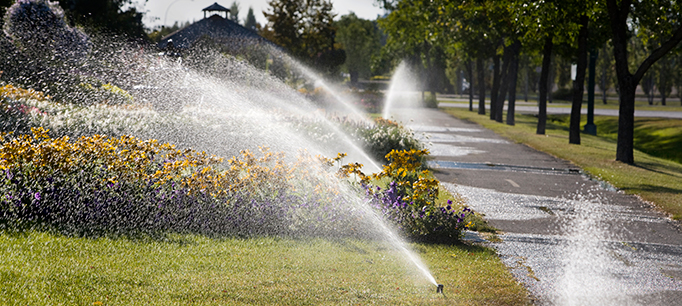
Even bigger savings can come from trimming back on outdoor watering. Most Californians don’t realize that fully half of all water use in the state’s cities and suburbs goes to landscaping, and in many of the hotter, inland communities, such as Bakersfield or Palm Springs, that share is even higher. This has happened because Californians have been accustomed to landscaping with thirsty plants like lawns that are better suited for regions where it rains in the summer. One technological innovation of the 1970s—the automatic sprinkler—compounds the problem by encouraging overwatering. People don’t think to turn it off when the weather is milder and the plants need less water.

Californians are starting to realize that it’s possible to have beautiful communities while using much less water for landscaping. This means switching out lawns and other thirsty plants for more “California friendly” plants that do well with less water, and turning to more modern irrigation systems like drip irrigation and “smart sprinklers” that don’t overwater. This doesn’t mean getting rid of all lawns, but rather keeping lawns where people use them, such as in the back yard, and replacing lawns that are just for show with beautiful, drought-tolerant plants. Here, too, it’s a good time to look for rebates, as many utilities are offering “cash for grass.” The results: a beautiful facelift for landscapes in our communities, significant water savings, and a way to be ready for the new normal.

Nine Policy Challenges for California Water

Two bills recently signed by Governor Brown—AB 91 and 92—will provide drought relief and help to enforce prescriptions for reducing water use that were outlined in the governor’s recent executive order. However most of the bills’ funds are allocated to efforts aimed at improving water management in general. Indeed, most of the funding goes to flood management.

These bills are a reminder that while drought is the crisis of the day, the state must grapple with multiple issues to put water policy on a sustainable and constructive path. These issues include improving water quality, restoring degraded ecosystems, finding new funding mechanisms, adapting to climate change, and reducing the risk of floods.

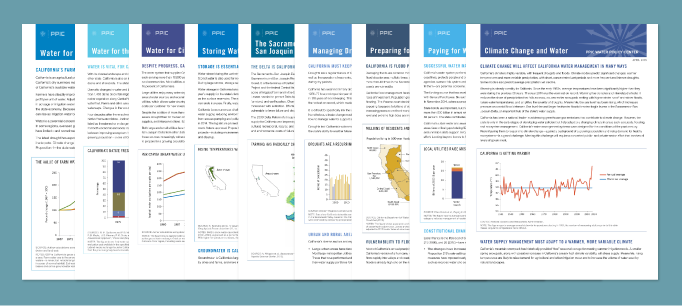
In reality, water management in California is a perpetual work-in-progress—never to be fully resolved. To help inform this process, the newly launched PPIC Water Policy Center has just published California’s Water, a collection of nine short policy briefs. The center’s research network—made up of more than 40 top experts in biology, economics, earth science, engineering, and the law—collaborated to prepare these briefs.

A common theme running through these briefs is California’s tremendous capacity to adapt to changing conditions and tackle new challenges. We hope this collection will be a useful resource for those who wish to become more familiar with California water policy and to join the conversation about solutions.

The nine topics include:

Climate Change and Water. California’s climate is changing, becoming warmer and more variable, while sea level continues to rise. The state is in the early stages of devising water policies to adapt to these changes.

Managing Droughts. The current drought is one of many in the history of the state, with more to come. Reducing harm to cities, farms, and the environment will require creative approaches to improving supply and reducing demand.

Paying for Water. Funding improvements in California’s water management systems has proven difficult, leading to funding gaps of $2-$3 billion annually. Although the recently approved state bond can help, new funding tools are needed to fill critical gaps.

Preparing for Floods. One in five California homes and more than $700 billion in structures are vulnerable to flooding. Reducing flood risk will require improving flood infrastructure while creating incentives to insure existing development against risk and keep new development out of harm’s way.

The Sacramento–San Joaquin Delta. The Delta is the fragile hub of California’s water supply system. The state will need to make strategic decisions about the future of the Delta that consider water supply reliability, ecosystem health, and the Delta economy.

Storing Water. California’s variable climate makes the state very dependent upon storage of water in surface reservoirs and groundwater basins. The state faces big choices in how to increase and manage storage capacity to adapt to a changing climate and shrinking snowpack.

Water for Cities. California’s cities have made considerable progress in managing water resources and reducing per-capita water use. Still, new efforts to reduce demand and to diversify water sources will be needed as the population grows.

Water for the Environment. Forty years after enactment of major environmental laws, California’s freshwater biodiversity is still in decline. Efficient allocation of water for the environment will be one of the biggest water challenges of the 21st century.

Water for Farms. California’s farms are the most productive in the nation, but they are increasingly vulnerable to water shortages. Major changes in groundwater and surface water management, including expanding water markets, will be needed to create a sustainable future for agriculture.