Commentary: California Should Plan as if Drought Has Returned

This commentary was published in the Sacramento Bee on December 20, 2017.

The unusually warm, dry start to this winter—along with intense wildfires in southern California—has many Californians experiencing “drought deja vu.” Despite this uneasy feeling, we are not in drought. But it might be prudent to act as if this is the beginning of the next one. Here are some short-term priority areas for drought planning that we think can help the state prepare.

Read the full commentary on sacbee.com.

High Housing Costs Hurt College Affordability

A majority of Californians say affordability is a problem in the state’s public colleges and universities, according to the PPIC Statewide Survey. In addition, three-quarters of residents in the survey agree that the price of college prevents students who are qualified and motivated from going to college. Not surprisingly, state leaders are exploring new strategies to help students and families better cope with college costs. Most current approaches, such as state and institutional financial aid, focus primarily on tuition relief. This makes sense, as tuition more than doubled at California universities from 2006 to 2012—and is on the rise again.

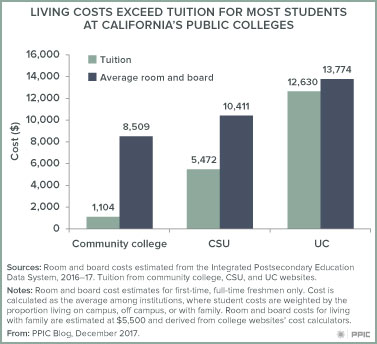
However, housing costs also play a significant role in the total cost of attending college. Californians are well aware of the issue: 85% of residents in the PPIC survey say colleges and universities should do more to make sure that all students have affordable housing options. Indeed, even with the rapid increases in tuition, living costs for many students exceed tuition at California’s public institutions—the state’s community colleges, California State University (CSU), and the University of California (UC). Average room and board costs also differ substantially across the three systems, from $8,509 per year at the community colleges to $13,774 at UC.

These differences in costs are related to whether students live on campus, off campus on their own, or off campus with family. Estimated average costs of housing and food for students living on campus top $13,000 per year, and those living off campus pay an average of $10,000 to $13,000 in room and board. The costs associated with living with family are not estimated in the available federal data, but most college websites suggest these costs range from $5,000 to $6,000—about half the cost of living on or off campus.

Students’ housing choices also partially depend on where they go to school. Only nine cities in California have UC campuses (excluding UCSF which only enrolls graduate students), and most UC freshmen live on campus in their first year. Historically, the 113 community colleges and 23 CSU campuses have been seen as local and low-cost options. Indeed, both systems show about 30% or more of freshmen living with their families, which helps keep average room and board costs lower than at UC. But it is worth noting that the share of CSU freshmen living on campus may grow. More dorms are being built on CSU campuses as administrators see on-campus housing as a strategy to increase graduation rates. Data on students’ living arrangements are based on institutional reporting on freshmen who receive some sort of federal financial aid, which includes more than 60% of students at most institutions.

As state leaders reexamine the goals in the 1960 Master Plan for Higher Education and consider changes to financial aid, they should take into account the role that living costs play in the total cost of education.

Learn moreRead the PPIC Statewide Survey: Californians and Higher Education
Visit the PPIC Higher Education Center

Modernizing Water Systems in Disadvantaged Communities

The water supply problems of disadvantaged rural communities can reflect not only a lack of resources, but also weak connections to the broader professional water community. The Mojave Water Agency in California’s southern desert has an innovative program to help small systems under its jurisdiction make improvements. We talked to Lance Eckhart, the agency’s director of basin management and resource planning, about this program.

PPIC: Describe the program.

Lance Eckhart: It started a few years ago when we to updated the agency’s regional water management plan, which included getting public input. Our agency covers 5,000 square miles—so we took our planning process on the road and visited many disadvantaged communities that previously had been underrepresented.

We have 40 small water districts scattered across the region, which are a backbone of these rural desert communities. We learned that they needed a lot of help. They hadn’t been keeping up with system upkeep. The rules had changed over time, and they weren’t always aware of best management practices. Maybe they hadn’t raised water rates in 20 years. They didn’t have the capacity to make many upgrades that the county wanted.

We’re a water wholesaler—we have no experience running very small community water systems, and we needed help. We engaged a local nonprofit, the California Rural Water Association, to join us. They help build technical, managerial, and financial capacity. We initially asked our board for $200,000 in “seed money” for the program. Half of that was to “get stuff done”—basic engineering, legal analysis, audits, system checks—anything that can be stapled to a grant application to help raise funds for capital improvements. One condition to get our help is that agencies have to upgrade their technical, managerial, and financial practices. It’s more of a leg up than a handout.

Another really important element was to develop training systems so these agencies can manage themselves. We hold free quarterly operator trainings on skills tailored to the region’s needs. This allows people who were fairly isolated to talk to each other in one place, and gives us a venue to share information about the program.

PPIC: What are some problems that rural water suppliers in your basin need help with?

LE: There’s a general lack of maintenance. Many have inadequate flow to fight fires. Too many have no redundancy if the local reservoir fails. Some are dealing with natural contaminants. Many systems have no financial reserves, so if a pump breaks they have to pass the hat. Many don’t have emergency plans if the well goes down or a fire or power outage cuts off water. A lot of these systems don’t have meters, so they don’t know if they have leaks or when to conserve.

With our help, water suppliers are now talking to each other and looking for ways to back up neighboring systems—for example, with interties. We are starting to bundle many systems in to one grant for the region.  For example we grouped 26 disadvantaged systems together for a leak detection grant program, which will be the foundation for future capital improvement grants—something likely not possible if individually pursued.  Also, some systems are realizing their best path forward is to consider consolidation with bigger agencies, which is a big change.

PPIC: What are your hopes for the future with this program?

LE: We’re excited that this model is now being adopted for a much bigger area. The granting agencies and state Department of Water Resources are beginning to encourage local nonprofits to partner with water agencies. I’d like to see this kind of partnership expand even more. While each underserved water system is unique, there are repeating problems. We know we can create a formula that can be used over and over again. We’ve shown how to bundle different small systems into a single grant. Being efficient in addressing this problem is good for the state, and good for the locals.

I also hope that the disadvantaged communities continue to realize they are not alone. I hope they continue to have a collective voice and stay cohesive—because that’s the best way to keep this issue alive and on the radar of the state and bigger agencies.

Read Priorities for California’s Water (PPIC policy brief)

Video: The Impact of Realignment on Recidivism

California embarked on a major public safety reform in 2011, when it shifted responsibility for lower-level felony offenders from the state to the counties. Prompted by a federal court order to reduce prison overcrowding, this realignment resulted in a dramatic drop in the prison population and a decline in overall incarceration levels. A related goal was to reduce the state’s persistently high recidivism rates. Has it worked it out that way?

A new PPIC report looking at the first two years of realignment finds that it has had a modest effect on recidivism, which has varied across counties and groups of offenders. The report is based on data from 12 counties that are representative of the state. It examines recidivism through two measures—rearrest and reconviction rates—for offenders affected by the change. Mia Bird, report coauthor presented the results at a Sacramento briefing last week.

Bird outlined several key findings, including:

  • Slightly higher recidivism rates among individuals on post-release community supervision (PRCS). These offenders were released from state prison after serving time for certain low-level felonies and then supervised by county probation agencies. Higher rates of recidivism in some counties—notably Los Angeles County, the largest—are a major factor.
  • No consistent effect on recidivism among individuals sentenced under section 1170(h) of the California Penal Code. These offenders were sentenced for a specific set of lower-level felonies and, under realignment, served time in county jail rather than state prison.
  • Lower recidivism among 1170(h) offenders who received “straight sentences”—but mixed results among those with “split sentences.” The group serving “straight sentences”—jail time only—had the best outcomes: the same two-year rearrest rates and two-year reconviction rates that are lower. Those who got “split sentences”—jail time followed by probation supervision—had higher rates of rearrest but lower rates of reconviction compared with similar individuals before realignment.

Bird said she expects these results to vary over time as the composition of offenders changes and counties gain experience with evidence-based practices to reduce recidivism. In addition, further study is needed of the higher recidivism rates for groups that are supervised after their release. It could be that more individuals are reoffending—or it could be that their misconduct is more likely to be detected because they are being monitored more closely under probation supervision, Bird said.

Bricks and Mortarboards: Capital Investment in Colleges

PPIC has documented California’s need to increase the number of resident college graduates to meet the economy’s future needs. While the state’s public higher education systems are taking steps to increase the number of students who complete their degrees in a timely manner, these improvements alone will not fill the gap. At some point, the UC and CSU systems will have to expand their capacity, and such an expansion is likely to require long-term capital investment in buildings, technology, and campus infrastructure.

It is important to note that capital investment encompasses more than new classrooms or dormitories. Earlier this week, the College Futures Foundation released a report by Patrick Lenz in which the California Community Colleges, the University of California (UC), and the California State University (CSU) estimate that they will need a combined $47.2 billion to modernize and maintain their facilities in the next five years alone. Their needs include ensuring the safety and accessibility of aging buildings and investment in the less visible systems—heating, cooling, electrical, and water—that enable a campus to function.

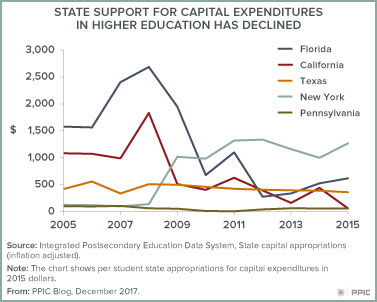
A look at some historical data suggests that economic pressures and policy decisions have led California to underinvest in higher education infrastructure over the past decade compared to four other large states. From 2005 to 2015, the period for which we have data, state support for capital investment in both California and Florida dropped sharply as a consequence of the Great Recession. Interestingly, New York increased its support, while support in Pennsylvania and Texas stayed the same.

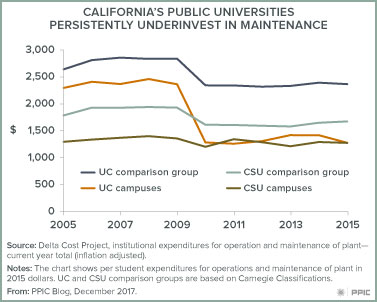
In 2000, California voters approved Proposition 39, which makes it easier for community colleges to pass bond measures. Since then, local community college districts have been relatively successful in funding their capital needs. The state’s four-year universities, however, face a different situation. To compare how much UC and CSU spent (per student) on maintaining and operating their campuses between 2005 and 2015, we separated and compared each system to a nationwide group of similar institutions. As the state cut its investment in higher education infrastructure, UC cut its infrastructure spending dramatically, while CSU’s spending remained relatively constant. But average maintenance spending by both systems was significantly below that of their peers.

These comparisons suggest that California has been systematically underinvesting in its higher education infrastructure, at least at its four-year public universities. Even if California were not facing a degree gap, it could benefit from rethinking its higher education capital finance strategy. But a new approach becomes imperative when one considers that larger shares of high school graduates are expected to complete the a–g requirements and that many of those students will seek admission to UC and CSU. Efforts by the state’s community colleges to increase the number of students who transfer to four-year institutions will also heighten the need to expand capacity, necessitating further capital investment.

Over the coming months, PPIC will be focusing on capital finance, a key component in maintaining access for all students and producing an educated workforce. We hope to inform state decision making in this critical area.

Learn more
Visit the PPIC Higher Education Center

How California’s Water Bond Is Being Spent

California has many unmet needs in its water system—most notably in the areas of flood protection, safe drinking water, stormwater treatment, and ecosystem support. While dedicated funding over the long term has been hard to come by, water bonds have helped fill some gaps in these areas. Looking at how the 2014 water bond is being spent can give us some insights into how bonds are turned into projects on the ground. This is particularly important as three new bond proposals are floated for 2018.

The state’s 2014 bond, Proposition 1, provides $7.5 billion in funding. The money is broken into seven funding categories. The bond language preauthorized $2.7 billion for water storage projects. For the other six areas, spending must be appropriated in the state budget. Once the funds are appropriated in the budget, the state agencies distribute them to selected projects.

With the 2017–18 budget, the legislature has now appropriated more than 86% of Proposition 1 funds. The largest new appropriation is more than $200 million for “Integrated Regional Water Management,” a grant program for collaborative regional projects to address complex water management challenges. In addition, more than $111 million was appropriated for flood management, reflecting statewide concerns about dam and levee infrastructure after the Oroville dam incident.
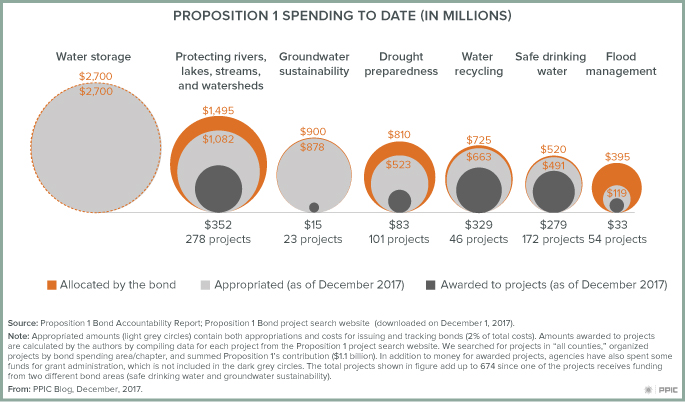
Of the Proposition 1 money appropriated, approximately $1.1 billion has been awarded for spending. That is roughly a billion dollars since June 2016. The number of projects has spiked since then as well, from 117 to 673. Even with this large increase in spending, only 14% of the bond has been awarded so far. This pace of water bond spending—about $785 million per year—is on par with patterns observed since the early 2000s.

Ecosystems in decline and disadvantaged communities that lack access to safe drinking water—problems made worse by the latest drought—lead the way in number of projects awarded, with 278 and 172 grants, respectively. Fifty-four grants have been awarded for the maintenance of Delta levees. Another 101 grants will foster regional drought preparedness. And 46 grants will be used for urban wastewater recycling projects.

The largest pot of money—$2.7 billion for water storage—is expected to be awarded in June 2018. In total, 12 projects—seven for surface water storage and five for projects that focus on storing more water underground—are competing for some portion of the money. The California Water Commission is now reviewing proposals. The winning bids will only receive funding for “public benefits” resulting from the new storage. At least half of these benefits must be for improving ecosystem conditions. Other qualifying benefits include flood protection, recreation, emergency water supplies, and water quality improvements.

About $900 million is allocated for groundwater sustainability—an area in which there is a growing need for funding to implement the 2014 Sustainable Groundwater Management Act. Of this total, $100 million is allocated to help the more than 250 newly formed Groundwater Sustainability Agencies (GSAs) develop their plans. The Department of Water Resources is now receiving proposals for these grants.

Looking beyond Proposition 1, three other water bonds have been proposed for the ballot in 2018. The $4 billion California Parks, Environment, and Water Bond was approved by the legislature, signed by the governor in September, and will appear on the June 2018 ballot. This bond would distribute a third of its revenue to park improvements, and the rest to environmental restoration and water and flood infrastructure. Specific areas include Salton Sea restoration, ecosystem improvements in the Sacramento and San Joaquin River watersheds, groundwater recharge, and safe drinking water.

Two other bonds—which would be put on the November 2018 ballot through the initiative process—are still under consideration. A bond proposal from Gerald Meral, a former state water official, would authorize $8.9 billion for various water supply and water quality projects, including water infrastructure improvements, safe drinking water projects, habitat protection, groundwater replenishment, and dam repairs. And a $7.99 billion bond proposed by environmental lawyer Joseph Caves would award half of its funds to drinking water safety improvements, and the rest to ecosystem restoration, and state and local park projects.

Clearly, bonds are an important source of one-time funding for some of the problems dogging the state’s water system. But state bonds only make up about 2% of total annual spending in California’s water sector. California must look beyond bonds to fill persistent funding gaps.
Learn more
Read our June 2016 blog post, “How is California Spending the Water Bond?”
Read California’s Water: Paying for Water (from California’s Water briefing kit)

Video: John Cox’s Priorities

Businessman John Cox, candidate for governor in 2018, was asked in a San Francisco forum last week to name the top three issues that will have major consequences in California’s future. Mark Baldassare, PPIC president and CEO, posed the question, which has been answered by all gubernatorial candidates appearing before PPIC audiences.

Cox said his top priorities are:

  • Removing the “corruptive” influence of special interest money. “The idea that special interests fund the campaigns of people they are looking to to get things done—it’s an indefensible system,” he said. “I don’t necessarily think that we send a whole bunch of corrupt people to Sacramento,” he said. “The trouble is, it’s a corrupt structure.” Legislators, he said, “are almost required to be professional fundraisers.”
  • Making the state more affordable and improving the business climate. The cost of housing, electricity, gasoline—the essentials to quality of life—are pushing the middle class into “almost-poverty situations,” Cox said, adding that improving the business climate is also essential so that the state can grow.
  • Addressing state employee pension debt. Cox said an overly generous legislature as well as governors and special interests have created a “debt bomb.” Our unfounded pension debt is a “sword of Damocles hanging over our economy,” he said.

How would Cox diminish the influence of special interests? He is sponsoring the Neighborhood Legislature Reform Act, which he hopes to qualify for the statewide ballot. The initiative calls for carving up each assembly and state senate district into 100 neighborhoods, each with its own representative. The 100 representatives in each neighborhood district would meet to choose one to go to Sacramento. In other words, there would still be just 120 legislators meeting in the Capitol. With districts that number just a few thousand households, candidates could run campaigns with a few hundred dollars, Cox said. The idea, he said, is that “you don’t need money to run a race.”

The conversation with Cox is part of the PPIC Speaker Series on California’s Future. PPIC is inviting all major candidates for governor to participate if they reach a certain threshold in the polls. The goal is to give Californians a better understanding of how the candidates intend to address the challenges facing our state.

Watch all candidate videos.

More than a Million California Children Rely on CHIP

Some 1.3 million Californians age 18 and under—about 13% of the state’s children—rely on the Children’s Health Insurance Program (CHIP) for their health coverage. Federal funding for CHIP expired on September 30 when Congress failed to reauthorize the program. While both the House and Senate have proposed bills that would reauthorize and fund the program for another five years, other legislative priorities and a deep partisan divide have complicated their passage.

In the last few months, some states, including California, have received additional CHIP funding from the federal government to maintain their current programs. But according to the state’s Legislative Analyst’s Office, California will likely run out of CHIP funds by the end of the year in the absence of federal reauthorization.

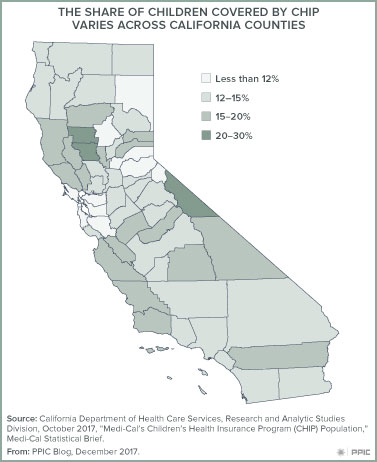
As of May 2017, a quarter of the more than 5.2 million California children covered by Medi-Cal (the state’s Medicaid program) are funded through CHIP. More than 300,000 children in Los Angeles County, over 100,000 children in Orange County, and another 100,000 in San Diego County rely on the program. In a few small counties (such as Glenn, Colusa, and Mono) more than 20% of children are covered under CHIP (see figure). Some counties in the Central Valley (Merced, Madera, and Tulare) and the Central Coast have 15– 20% of children covered by CHIP, while most Bay Area counties have relatively low shares (less than 12%).

Created in 1997 by federal legislation, CHIP provides federal matching funds to states to insure children with family incomes too high to qualify for Medicaid but too low to afford private insurance. In 1998, California established a new program under CHIP called the Healthy Families program, which covered children with family incomes above the Medicaid eligibility threshold and below 250% of the federal poverty level. In 2013, the state transitioned children from the Healthy Families program into Medi-Cal. Under current state law, children with family incomes up to 266% of the federal poverty level (about $65,500 for a family of four) are eligible for Medi-Cal coverage.

Under the Affordable Care Act, states received an enhanced federal matching rate for their CHIP programs that started October 1, 2015 and was supposed to extend until September 30, 2019. California’s enhanced federal matching rate increased the share of CHIP costs covered by the federal government from 65% to 88%. According to Medi-Cal estimates for the 2016–17 state fiscal year, the CHIP component of Medi-Cal cost about $2.6 billion, with federal funds covering about $2.3 billion.

The 2017–18 enacted state budget assumed California’s CHIP matching rate would drop back to 65%, resulting in increased state General Fund spending of about $400 million. While congressional proposals currently under consideration maintain the enhanced federal matching rate through 2019, it remains uncertain how the federal reauthorization process may play out and what impacts that could have on California’s CHIP funding.

Video: Preview of the Statewide Election

Setting the stage for a year of crucial decisions, the December PPIC Statewide Survey took a first look at the 2018 governor’s race. Two Democrats—Gavin Newsom, the state’s lieutenant governor, and Antonio Villaraigosa, former mayor of Los Angeles—lead among likely voters. But the survey also underscored that it’s early in the campaign to replace retiring governor Jerry Brown. Among likely voters, a third are undecided and just a quarter are following news about the candidates fairly or very closely.

In the US Senate primary, incumbent Dianne Feinstein leads fellow Democrat Kevin de León, state senate president pro tempore, by a two-to-one margin in a matchup of the two candidates. A third of likely voters are undecided in this race, as well.

Dean Bonner, associate survey director at PPIC, presented the key findings at a Sacramento briefing last week. As he noted, the survey findings reflect a divided and unsettled electorate. Likely voters are split on what is more important in a candidate for statewide office: new ideas and a different approach (48%) or experience and a proven record (42%). Asked about how candidates for statewide office should interact with the federal government, half of likely voters (51%) prefer that candidates push back against the Trump administration and 41% prefer that candidates work with the administration.

New Water Rules for Marijuana Growers

Marijuana growers who plan on growing cannabis on private land next season will encounter new state requirements to address the crop’s impact on California’s creeks and streams. The success of the policy will be tested by the state’s ability to bring growers into the legal cannabis sector. Currently, an estimated 80% of the state’s cannabis crop is grown for the black market.

The CalCannabis cultivation licensing system is a new program by the California Department of Food and Agriculture (CDFA) for permitting the crop to be grown legally on private land. The State Water Board recently adopted interim policies that will affect the license, including checks on a grower’s water rights, restrictions on the diversion of water for irrigating cannabis crops, and site-specific requirements to control runoff into local streams from growing operations. Many elements of the new statewide requirements are based on pioneering regional efforts to regulate cannabis cultivation in the North Coast.

As a prerequisite for the cultivation license, growers relying on water from local tributaries must have valid water rights or apply for a new surface water right that allows them to divert and store water. This requirement is critical to the State Water Board’s new policies that compel growers to divert surface water to storage in winter for irrigating cannabis during the dry months when streams are low. Diversions are allowed to resume in winter once a stream’s minimum flow target is met. Many growers will need to obtain necessary permits and capital for constructing water storage on site. Water measuring and recording requirements will also compel growers to install devices to track their stream diversions and usage.

The new statewide requirements also seek to reduce the risk of contamination to tributaries from cannabis farm runoff. For example, licensed growers across the state will be required to provide adequate distance between cultivation operations and streams and wetlands. The requirements also establish rules for reducing erosion from access roads, increasing irrigation efficiency, minimizing runoff, and handling fertilizers, pesticides, and herbicides safely.

These new requirements will result in additional costs to many growers looking to enter the legal market, on top of new compliance costs, taxes, and reduced revenues that legalization could bring. Some experts suggest that the high cost of “going legal” could jeopardize the state’s ability to enroll enough growers to make the policies effective.

Van Butsic, an assistant cooperative extension specialist at UC Berkeley and a member of the PPIC Water Policy Center research network, conducts research on cannabis cultivation in the state. “The State Water Board’s interim policy may have a better chance of achieving desired environmental outcomes if compliance can be obtained at a reasonable price,” Butsic says. He suggests that small growers—the majority of cannabis operations in the state—will especially find it difficult to absorb the costs of compliance.

This raises difficult public policy questions on how to reduce the cost of compliance while continuing to protect water quality and the environment, how to encourage small farmers to join the legal sector, and how to effectively enforce the new rules in a sector dominated by very small farms. Resolving these issues will be vital to meeting water quality objectives in the emerging legal cannabis sector.

Learn more
Read “California Streams Going to Pot from Marijuana Boom” (PPIC Blog)
Read the report Regulating Marijuana in California (PPIC, April 2016)
Visit the PPIC Water Policy Center