Medi-Cal Expansion for Undocumented Seniors

Under the proposed expansion of Medi-Cal to undocumented seniors, vulnerable Californians would gain comprehensive health insurance. The policy improves access to care for individual seniors and could alleviate the financial burden on counties that serve undocumented immigrants in indigent care programs, increasing resources for other low-income groups.

The senior population in California is projected to increase by over 2 million in the next decade, dramatically outpacing growth of younger groups in a demographic shift known as the Silver Tsunami. This increase, in particular among those in older age groups (75 to 84), will test California’s health care delivery and financing systems, because seniors are more likely to be disabled and to have complex or multiple health conditions than younger groups.
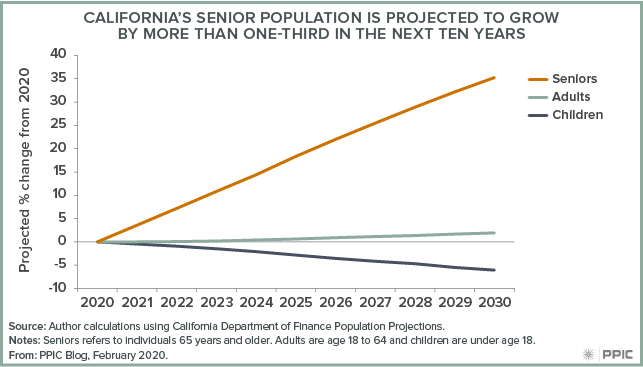
Figure - California’s Senior Population Is Projected to Grow by More than One-Third in the Next Ten Years

While most California seniors have health insurance—with Medicare being the most common—not all seniors have coverage. Many uninsured seniors are likely to be undocumented, making them ineligible for Medicare or to purchase coverage through Covered California, the state’s health insurance marketplace. These same seniors may have limited finances and therefore also are likely to struggle to access and afford health care.

Currently, most uninsured, undocumented seniors rely on safety net providers and a limited form of Medi-Cal that covers only emergencies, along with indigent care programs in certain counties that choose to cover undocumented immigrants. Under the expansion, these seniors would gain access to full-scope Medi-Cal, connecting them to preventive care and to programs to improve their disease management. Some expansion funds would also apply to the In-Home Supportive Services (IHSS) program, which pays for a caregiver—often a relative—to provide support for a senior to continue living at home rather than entering a costly long-term care facility.

The budget estimates state costs of $320 million for the expansion, which would benefit 27,000 individuals. If enacted, the policy could have implications for local finances. Counties in California provide health care and mental health services to the medically indigent, with some areas—most notably Los Angeles—serving undocumented immigrants. These county programs, together with community clinics and emergency rooms, are essential access points to health care for undocumented, uninsured seniors. If undocumented seniors become eligible for full-scope Medi-Cal, the state would finance their care instead of the county, where applicable. This shift could free up funding that could then be invested in other health-related county responsibilities, such as disaster preparedness, prevention activities, and substance use disorder treatment.

A complicated fiscal relationship between the state and counties, however, makes it difficult to estimate how much funding could be redirected if this group of seniors gain access to Medi-Cal. As state lawmakers consider the policy change, it will be important to consider how it may affect local and state finances.

Improving Equity in Mental Health Services

California has seen historic declines in the number of residents without health coverage—since 2014, the state’s uninsured rate has decreased from 17.3% to 10.3% percent among adults  younger than 65. Expansions in the Medi-Cal program account for most of this expanded coverage; since 2014 enrollment in Medi-Cal has increased more than 50% and now provides coverage to nearly one-third of Californians. However, many challenges remain to ensure that coverage translates into access, particularly in the area of mental health.

Over one million Californians use the state’s public mental health system, which includes services provided through Medi-Cal managed care plans and county mental health plans. For many patients, the system is difficult to navigate. The fragmented delivery system is part of the issue, but there are also concerns that mental health providers are unable to meet the needs of California’s diverse communities—and those needs are notable. In a recent survey, 11.2% of Latinos were identified as likely to have experienced serious psychological distress during the past year.

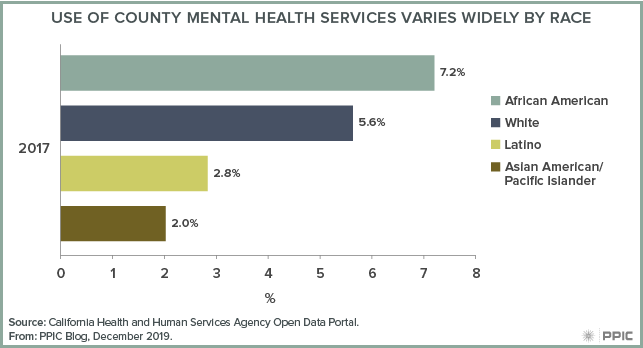
The disparities in access for underrepresented communities may be reflected by current utilization patterns of county mental health services. Among adult Medi-Cal enrollees, fewer Latinos and Asian/Pacific Islanders use these services than African Americans and whites.

figure - Use of County Mental Health Services Varies Widely by Race

These disparities are similar nationwide—and are likely to be related to a variety of factors. One possibility is the higher share of Latinos and Asian Americans/Pacific Islanders who may experience language barriers, compared to African Americans and whites.

A primary vehicle for reducing these disparities are Cultural Competence Plans, which are intended to guide county mental health plans in meeting the cultural competence and linguistic requirements already mandated by law. Recent legislation seeking to codify these requirements for county mental health plans did not make it past the governor’s desk. But its advancement through the legislature signals growing recognition of the need for communities of color to have access to culturally and linguistically appropriate mental health services. As California’s population becomes more diverse, culturally competent care will become even more important in the coming years.

Health Care Access for California’s Immigrants

Governor Newsom is proposing to expand access to Medi-Cal—the state’s Medicaid program—for low-income young adults up to age 26, regardless of their immigration status. This could help a vulnerable segment of the immigrant population. Californians are signaling broad support.

Overall, immigrants make up about 27% of the state’s population and are less likely to have health insurance than US-born Californians. Immigrants are also less likely to have private insurance, partly due to differences in employment industries and income.

Figure - Health Care Coverage Rates are Lower For California Immigrants in All Age Groups

Documented immigrants—including those with green cards and visas—may qualify for Medi-Cal without being subject to the five-year waiting period required by federal law. They can also purchase private health plans through Covered California, the health insurance exchange that was created as part of the Affordable Care Act (ACA). However, most recently-arrived elderly immigrants are not eligible for Medicare because they have not paid Medicare taxes over a long enough period.

California offers a patchwork of health care options for undocumented immigrants, who are not covered by the ACA. For instance, low-income children and pregnant residents are eligible for Medi-Cal regardless of immigration status, and some counties include undocumented immigrants in programs for those who cannot afford medical care. Additional options for undocumented immigrants include community clinics, rural health clinics, emergency rooms, or a limited version of Medi-Cal for medical emergencies.

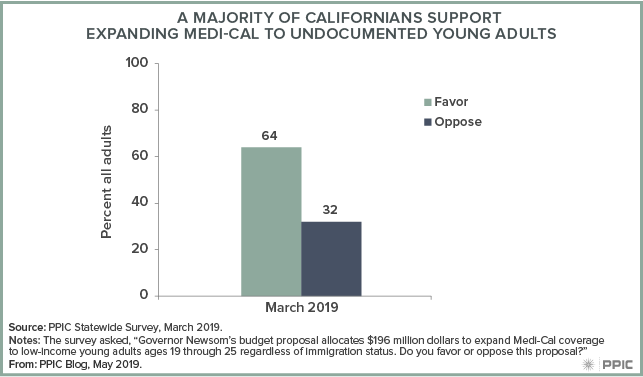
Californians support health care access for undocumented immigrants. In a 2015 PPIC Statewide Survey, a slim majority of Californians (54%) supported the idea of providing health care coverage to undocumented immigrants. In March 2019, about two-thirds (64%) expressed support for the governor’s proposed expansion of Medi-Cal coverage to low-income young adults, including those who are undocumented.

Figure - A Majority of Californians Support Expanding Medi-Cal to Undocumented Young Adults

The governor’s May budget revision delays implementation of the expansion, but it would still have an impact: by providing coverage to approximately 90,000 undocumented young adults in the first year, it could help make the health care landscape less complicated for an important share of California’s immigrant population.

Federal Immigration Proposal Could Have Widespread Impact

The Department of Homeland Security (DHS) has recently proposed changing how it decides whether a person is or will likely become dependent on government assistance. If implemented, this change would make it harder for immigrants to meet the government’s standard of self-sufficiency—and may deter them and others from using government services for which they are eligible. Through December 10, DHS is requesting public comments on the proposal, which could potentially have wide-ranging impacts on California and its large immigrant population.

The federal government can typically deny applications for green cards or entry into the United States to people who are or will likely become “public charges,” i.e., dependent on government assistance. Under current guidance, DHS considers an immigrant a public charge if they receive more than half of their income from cash assistance—which includes TANF (known as CalWORKs in California), General Assistance (GA), and Supplemental Security Income (SSI)—or are in government-funded, long-term institutional care (like a nursing home).

The proposed rule is much broader: it defines dependence as receiving more than about $1,800 (for 2018) in assistance from not only the current programs but also the food assistance program SNAP (CalFresh) and/or Section 8 housing vouchers and rental assistance. DHS also proposes that an income of less than 125% of the federal poverty level ($25,100 in 2018 for a family of four) would be a strong predictor of becoming a public charge and recommends length of enrollment in certain health programs as another factor to consider.

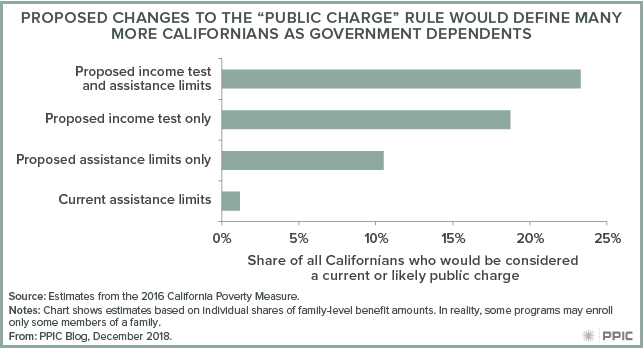
How big of a change is this? While data aren’t available to examine safety net participation among the noncitizens whose immigration cases would be affected by the rule, we estimate that even before including health programs, as many as 23% of all Californians would be considered public charges, or likely to become so—which gives a sense of how broad the proposed rule is. Some 18.7% of Californians would be considered likely to become public charges based on their income level alone. By contrast, at most 1.2% of all Californians receive more than half their income from CalWORKs, GA, and SSI, and would be considered public charges under the current rule. These calculations are based on the California Poverty Measure (CPM), a joint effort of PPIC and the Stanford Center on Poverty and Inequality.

California has more immigrants than any other state—and hence much at stake. For those on visas, the proposed rule would make it harder to qualify for a green card or extend their stay. But in practice, the largest impact would likely be on immigrants and their families who, purely out of caution, forego safety net benefits for which they are eligible. DHS cites this sort of disenrollment as a source of long-term savings—but notes that these savings are liable to be offset by worse public health outcomes and increased poverty rates. Based on studies of welfare reform in the 1990s, the UCLA Center for Health Policy Research estimates that if the rule change takes place, 15% to 35% of families with noncitizens might disenroll from safety net programs. At the high end, as many as 765,000 people could disenroll from CalFresh and Medi-Cal, leading to around $1 billion less in federal aid to California each year.

California’s attorney general and some local governments have already voiced their opposition to the proposed changes, which come at a time when the state has been expanding access to health and social safety net programs. Reduced participation in these programs, whether from reasonable or unnecessary caution, would directly counteract the state’s efforts to reduce poverty. Public comment for the proposal closes on December 10.

Emergency Departments and the Affordable Care Act

Coverage expansions under the Affordable Care Act (ACA) have resulted in a dramatic decline in the uninsured population in California. Much of the coverage gains have been driven by expanded eligibility for Medi-Cal, the state’s Medicaid program, which has seen a nearly 60% increase in enrollment since January 2014. With this large Medi-Cal expansion comes concerns about controlling costs, ensuring adequate access to care, and supporting the state’s health care safety net.

Monitoring how often people seek care in California’s emergency departments offers important insights—in part because frequent use can signal poor access to other medical care options. Hospitals in some parts of the state have reported growing demand for emergency care services in recent years. In a new study published this month in the journal Health Affairs, we examined emergency department use to understand how things have changed since the implementation of the ACA.

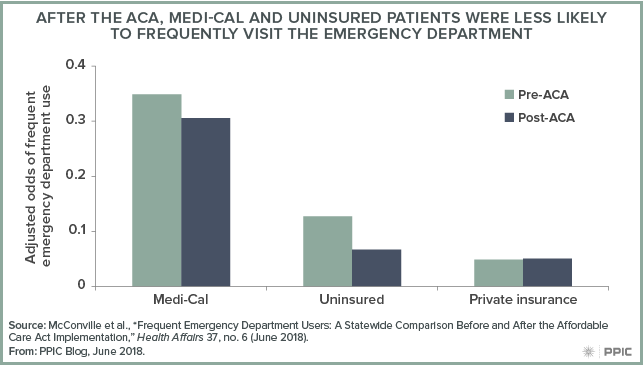
After controlling for factors such as patient age and health status, we found the odds of being a frequent emergency department user—with four or more annual emergency department visits—were significantly lower for Medi-Cal patients after the ACA. The odds of frequent use among the uninsured declined even more, while those with private insurance experienced little change. At the same time, however, there has been an overall increase in both the share and the absolute number of emergency department patients who are frequent users—despite the lower odds of frequent emergency department use after the ACA. We found that frequent users accounted for 7.9% of emergency department patients in the two years before the ACA, compared to 8.5% in the two years after.

Both before and after the ACA, the largest predictors of frequent emergency department use were having a diagnosed mental health condition or substance use disorder. This finding suggests state efforts to better integrate physical and behavioral health services for Medi-Cal enrollees could help lower frequent emergency department visits. Given that Medi-Cal is now the primary coverage source for more than two-thirds of frequent emergency department users, care plans managed by Medi-Cal will be a key player in efforts to manage emergency care moving forward.

In future work, we will be studying in more depth how changes in insurance coverage affected emergency department use across the state—with a particular focus on regions that saw the largest declines in their uninsured rates.

Expanding Health Care Coverage for Undocumented Immigrants

As efforts to create a state-based single-payer health system confront complex questions of costs and federal uncertainty, advocates and state lawmakers are pushing forward with incremental policy measures to expand access to health coverage. The largest group of Californians that remain without comprehensive health insurance are undocumented immigrants, who were largely excluded from the coverage expansions created by the Affordable Care Act. Estimates suggest that almost 60% of uninsured Californians are undocumented.

Today, the Senate Health Committee is holding a hearing on SB 974 (Lara), which would allow all income-eligible California residents, regardless of immigration status, to enroll in comprehensive coverage through Medi-Cal (the state’s Medicaid program). California has already extended Medi-Cal coverage to undocumented children under 19, who have been eligible for comprehensive health benefits since May 2016. At the end of last year, nearly 220,000 undocumented children were enrolled in Medi-Cal, with costs estimated at $280 million in the recent fiscal year’s budget. No cost estimates are available yet for covering undocumented adults. But comprehensive coverage for the undocumented population must come from state funds, since federal Medi-Cal funding can only be used to support emergency services for undocumented immigrants.

In previous research, we estimated that about half of California’s undocumented population would likely qualify for Medi-Cal based on their income levels if restrictions on immigration status were removed. But this varied across regions. In Los Angeles County and parts of the Central Valley, more than half of undocumented immigrants had incomes below the Medi-Cal eligibility threshold of 138% of the federal poverty level, or FPL ($34,600 for a family of four). Bay Area counties had lower shares of income-eligible undocumented immigrants.

Currently, undocumented adults rely on the health care safety net—including community clinics, public hospital systems, and emergency departments—to access needed medical care. These providers play an integral role in caring for both those that remain uninsured and those covered by our vastly expanded Medi-Cal program. As policymakers consider ways to expand comprehensive health coverage, it is important that they continue to support the state’s safety net providers.

More than a Million California Children Rely on CHIP

Some 1.3 million Californians age 18 and under—about 13% of the state’s children—rely on the Children’s Health Insurance Program (CHIP) for their health coverage. Federal funding for CHIP expired on September 30 when Congress failed to reauthorize the program. While both the House and Senate have proposed bills that would reauthorize and fund the program for another five years, other legislative priorities and a deep partisan divide have complicated their passage.

In the last few months, some states, including California, have received additional CHIP funding from the federal government to maintain their current programs. But according to the state’s Legislative Analyst’s Office, California will likely run out of CHIP funds by the end of the year in the absence of federal reauthorization.

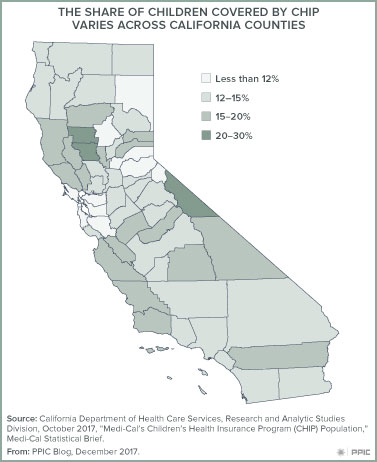
As of May 2017, a quarter of the more than 5.2 million California children covered by Medi-Cal (the state’s Medicaid program) are funded through CHIP. More than 300,000 children in Los Angeles County, over 100,000 children in Orange County, and another 100,000 in San Diego County rely on the program. In a few small counties (such as Glenn, Colusa, and Mono) more than 20% of children are covered under CHIP (see figure). Some counties in the Central Valley (Merced, Madera, and Tulare) and the Central Coast have 15– 20% of children covered by CHIP, while most Bay Area counties have relatively low shares (less than 12%).

Created in 1997 by federal legislation, CHIP provides federal matching funds to states to insure children with family incomes too high to qualify for Medicaid but too low to afford private insurance. In 1998, California established a new program under CHIP called the Healthy Families program, which covered children with family incomes above the Medicaid eligibility threshold and below 250% of the federal poverty level. In 2013, the state transitioned children from the Healthy Families program into Medi-Cal. Under current state law, children with family incomes up to 266% of the federal poverty level (about $65,500 for a family of four) are eligible for Medi-Cal coverage.

Under the Affordable Care Act, states received an enhanced federal matching rate for their CHIP programs that started October 1, 2015 and was supposed to extend until September 30, 2019. California’s enhanced federal matching rate increased the share of CHIP costs covered by the federal government from 65% to 88%. According to Medi-Cal estimates for the 2016–17 state fiscal year, the CHIP component of Medi-Cal cost about $2.6 billion, with federal funds covering about $2.3 billion.

The 2017–18 enacted state budget assumed California’s CHIP matching rate would drop back to 65%, resulting in increased state General Fund spending of about $400 million. While congressional proposals currently under consideration maintain the enhanced federal matching rate through 2019, it remains uncertain how the federal reauthorization process may play out and what impacts that could have on California’s CHIP funding.

Medi-Cal and the Fall Election

Lost in the sound and fury of the national election are the results of four statewide ballot initiatives that aimed to bolster financing of the Medi-Cal program. Medi-Cal is California’s version of Medicaid, which pays for the health care of low-income families, many elderly who live in nursing homes, and—with the passage of the Affordable Care Act—single low-income adults. The state spends nearly $19 billion annually from the General Fund (and $87 billion from all sources) to provide medical coverage for 13.5 million Californians through Medi-Cal.

Three of the four initiatives passed on November 8, providing up to $3 billion in additional funds for Medi-Cal each year. But it will take a while for Californians to see the concrete outcomes of their votes. And, as is often the case with initiatives, the impact of these measures will depend on questions that have yet to be answered. The three measures that passed include:

  • Proposition 52: This initiative permanently extends the fees hospitals pay to the state, which the state then uses to get federal matching funds to support Medi-Cal. This translates to about $1 billion in state General Fund savings annually – providing this system continues to be allowed under federal law. There wasn’t much doubt that the state would seek to extend these fees past the sunset date of January 1, 2018, since they reduce pressure on the General Fund. But the initiative makes it more difficult for the legislature to modify the hospital fee program.
  • Proposition 55: Extending the tax on high-income earners will generate between $4 billion and $9 billion each year to pay for K–12 education and community colleges, Medi-Cal, and other budget priorities. For Medi-Cal, this is expected to provide up to $2 billion annually starting in 2018. But the amount may vary significantly from year to year for several reasons. First, K–12 education gets first call on the new revenue. In addition, the amount of new revenue will be affected by the volatility in what high-income taxpayers earn. Thus, the governor and legislature will have to learn to cope with an undependable funding source for Medi-Cal.
  • Proposition 56: Higher tobacco taxes will generate up to $1 billion for Medi-Cal in 2017–18. Revenue from tobacco taxes has generally fallen each year as the number of smokers in California has declined, and the new tax may accelerate that trend. While building these funds into the Medi-Cal budget may strengthen the program now, the state’s General Fund could face increasing pressure in the future if this source of funding declines. The state legislature and governor will determine how to use these funds as part of budget discussions next spring.

The fourth initiative affecting the Medi-Cal program, Proposition 61, failed to garner a majority of votes. Perhaps not surprisingly, more questions were raised about the impact of this initiative than the other three. Proposition 61 prohibited the state from paying more for prescription drugs than the federal US Department of Veterans Affairs, which typically pays the lowest prices of any public or private entity. The measure’s intent was to reduce the cost of prescription drugs in California, but the fiscal analysis by the Legislative Analyst’s Office suggested that the savings were uncertain.

While the new funds for Medi-Cal will be welcome, it remains to be seen whether they will provide reliable support for the program. Plus, there are questions about how the new president and Congress will alter the Affordable Care Act and how that will affect the state’s program. For instance, the law allowed California to extend Medi-Cal coverage to single low-income adults. In the 2016–17 state budget, coverage for this group cost about $15 billion annually, with the federal government picking up 95% of the tab. If the federal government significantly reduces or eliminates this enhanced funding rate, the $3 billion in new revenues generated by the three initiatives will not be enough to operate California’s expanded Medi-Cal program without other fiscal support.

Video: County Jails and the ACA

A majority of inmates in California’s jail system are likely to be eligible for Medi-Cal, and providing health care coverage for them could have multiple benefits. These are the key findings of a new PPIC report, Expanding Health Coverage in California: County Jails as Enrollment Sites.

Coauthor Shannon McConville presented the report to a Sacramento audience last week. She noted that the 4 million state residents who are still uninsured will probably be the toughest to reach. The legislature has allocated money to target these Californians and increase enrollment in health coverage under the Affordable Care Act (ACA).

At the same time, counties—which have gained new responsibilities for low-level criminal offenders—have new incentives to help inmates successfully transition back into the community and avoid further contact with the criminal justice system.

“Health coverage, newly available under the ACA, could be part of a more comprehensive reentry strategy,” McConville said.

Managed care plans are also increasingly focused on better integrating physical health and behavioral health, providing more mental health and substance abuse treatment—services needed by the jail population.

These policy changes add up to an opportunity to leverage federal and state Medi-Cal resources to improve both public health and safety. Enrolling inmates could improve health care in the jail system, lower county corrections costs, and reduce recidivism.

McConville said the work to achieve these goals is just beginning. Counties are still adjusting to their new responsibilities. As a first step, they will need to identify effective enrollment strategies that improve reentry and reduce recidivism.

Video: Health Coverage & Undocumented Immigrants

Legislative efforts, executive decisions, and public opinion all suggest interest in expanding health coverage to California’s undocumented immigrants. The state’s decision to provide Medi-Cal benefits to undocumented children reflects that support. But the vast majority of undocumented residents in California are adults, and they make up a sizable share of residents without health insurance.

A new PPIC report finds that half of California’s undocumented immigrants—about 1.4 million—have incomes low enough to qualify for full Medi-Cal benefits should legislative proposals to offer coverage be enacted.

This week at a briefing in Sacramento, PPIC research associates Shannon McConville and Iwunze Ugo presented their report, which includes estimates of the number of undocumented immigrants across family income levels and the Covered California insurance regions. These estimates can help policymakers plan for the increase in Medi-Cal participants if coverage is expanded—which will depend on the legislature, governor, and federal courts.