Voting Matters to Most Californians, but Many Don’t Show Up

Most Californians see voting as critical to a healthy democracy. In our February Statewide Survey, overwhelming majorities of adults (86%) and likely voters (96%) said voting in the 2020 elections is very important, a view held among those registered (90%) and not registered (76%) to vote.

However, while most hold this view, we know that 85% of California adults are eligible to vote but only 70% are registered. Low political participation is cause for worry in and of itself. If a small electorate does not represent the population—as is the case in California—there is even greater cause for concern.

Today, California’s adult population is 42% white and 35% Latino; the remainder are Asian American (15%), African American (6%), and other (3%). Yet 57% of California likely voters are white—only 20% are Latino, and the balance are Asian American, African American, and other. The percentage flips among nonvoters: 56% are Latino and only 22% are white.

figure - Likely Voters Do Not Represent California’s Diversity

And while a third of adults are foreign born, 83% of Californians who frequently vote in state elections are US born. Among nonvoters, 34% are US born (California Department of Finance 2019).

Differences between likely voters and nonvoters sharpen along age and socioeconomic lines. Frequent California voters are age 45 and older (65%), own their home (64%), have attended (39%) or graduated (41%) college, and have annual household incomes of $60,000 or more (59%). Nonvoters are younger than age 45 (65%) and renters (65%); about one in five are college graduates, and one in four earn $60,000 or more.

The political attitudes of voters and nonvoters also differ markedly and often reflect their socioeconomic conditions. Although the many nonvoters in the state may make their preferences known in public opinion surveys on issues, the views of likely voters prevail at the ballot box, when they decide on important matters that affect all Californians.

For example, single-payer healthcare has been a topic of robust discussion leading into the Democratic primary. In California, a split has emerged between nonvoters and likely voters over the question of whether health care coverage should be the responsibility of the federal government. While most nonvoters (72%) say it is the government’s responsibility, fewer likely voters (55%) hold this view.

figure - Nonvoters View Healthcare as a Government Responsibility

On Election Day, it’s important for all Californians eligible to vote make their voices heard. The state has made participating in elections more seamless than ever—even those not yet registered can take advantage of same-day voter registration at a local polling place. Californians overwhelmingly believe in the importance of elections. Today is the day to act on that belief.

Medi-Cal Expansion for Undocumented Seniors

Under the proposed expansion of Medi-Cal to undocumented seniors, vulnerable Californians would gain comprehensive health insurance. The policy improves access to care for individual seniors and could alleviate the financial burden on counties that serve undocumented immigrants in indigent care programs, increasing resources for other low-income groups.

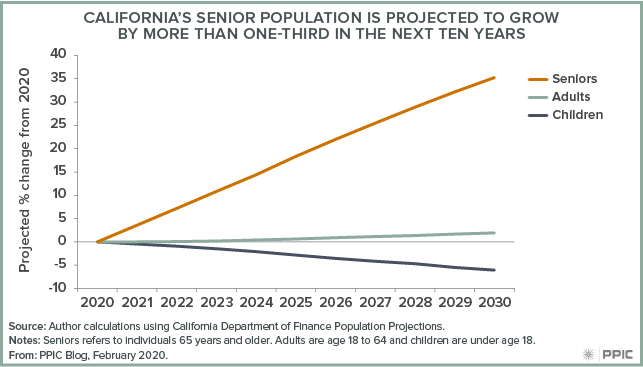
The senior population in California is projected to increase by over 2 million in the next decade, dramatically outpacing growth of younger groups in a demographic shift known as the Silver Tsunami. This increase, in particular among those in older age groups (75 to 84), will test California’s health care delivery and financing systems, because seniors are more likely to be disabled and to have complex or multiple health conditions than younger groups.

Figure - California’s Senior Population Is Projected to Grow by More than One-Third in the Next Ten Years

While most California seniors have health insurance—with Medicare being the most common—not all seniors have coverage. Many uninsured seniors are likely to be undocumented, making them ineligible for Medicare or to purchase coverage through Covered California, the state’s health insurance marketplace. These same seniors may have limited finances and therefore also are likely to struggle to access and afford health care.

Currently, most uninsured, undocumented seniors rely on safety net providers and a limited form of Medi-Cal that covers only emergencies, along with indigent care programs in certain counties that choose to cover undocumented immigrants. Under the expansion, these seniors would gain access to full-scope Medi-Cal, connecting them to preventive care and to programs to improve their disease management. Some expansion funds would also apply to the In-Home Supportive Services (IHSS) program, which pays for a caregiver—often a relative—to provide support for a senior to continue living at home rather than entering a costly long-term care facility.

The budget estimates state costs of $320 million for the expansion, which would benefit 27,000 individuals. If enacted, the policy could have implications for local finances. Counties in California provide health care and mental health services to the medically indigent, with some areas—most notably Los Angeles—serving undocumented immigrants. These county programs, together with community clinics and emergency rooms, are essential access points to health care for undocumented, uninsured seniors. If undocumented seniors become eligible for full-scope Medi-Cal, the state would finance their care instead of the county, where applicable. This shift could free up funding that could then be invested in other health-related county responsibilities, such as disaster preparedness, prevention activities, and substance use disorder treatment.

A complicated fiscal relationship between the state and counties, however, makes it difficult to estimate how much funding could be redirected if this group of seniors gain access to Medi-Cal. As state lawmakers consider the policy change, it will be important to consider how it may affect local and state finances.

Improving Equity in Mental Health Services

California has seen historic declines in the number of residents without health coverage—since 2014, the state’s uninsured rate has decreased from 17.3% to 10.3% percent among adults  younger than 65. Expansions in the Medi-Cal program account for most of this expanded coverage; since 2014 enrollment in Medi-Cal has increased more than 50% and now provides coverage to nearly one-third of Californians. However, many challenges remain to ensure that coverage translates into access, particularly in the area of mental health.

Over one million Californians use the state’s public mental health system, which includes services provided through Medi-Cal managed care plans and county mental health plans. For many patients, the system is difficult to navigate. The fragmented delivery system is part of the issue, but there are also concerns that mental health providers are unable to meet the needs of California’s diverse communities—and those needs are notable. In a recent survey, 11.2% of Latinos were identified as likely to have experienced serious psychological distress during the past year.

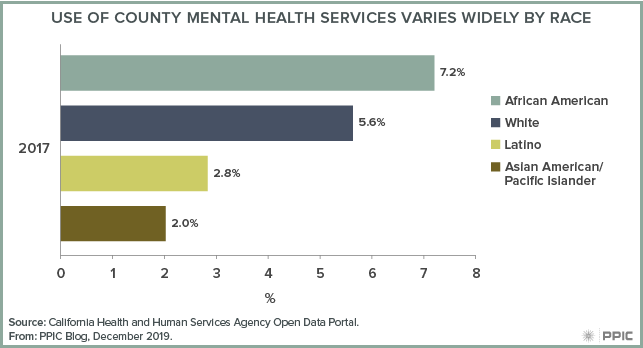
The disparities in access for underrepresented communities may be reflected by current utilization patterns of county mental health services. Among adult Medi-Cal enrollees, fewer Latinos and Asian/Pacific Islanders use these services than African Americans and whites.

figure - Use of County Mental Health Services Varies Widely by Race

These disparities are similar nationwide—and are likely to be related to a variety of factors. One possibility is the higher share of Latinos and Asian Americans/Pacific Islanders who may experience language barriers, compared to African Americans and whites.

A primary vehicle for reducing these disparities are Cultural Competence Plans, which are intended to guide county mental health plans in meeting the cultural competence and linguistic requirements already mandated by law. Recent legislation seeking to codify these requirements for county mental health plans did not make it past the governor’s desk. But its advancement through the legislature signals growing recognition of the need for communities of color to have access to culturally and linguistically appropriate mental health services. As California’s population becomes more diverse, culturally competent care will become even more important in the coming years.

Health Care Access for California’s Immigrants

Governor Newsom is proposing to expand access to Medi-Cal—the state’s Medicaid program—for low-income young adults up to age 26, regardless of their immigration status. This could help a vulnerable segment of the immigrant population. Californians are signaling broad support.

Overall, immigrants make up about 27% of the state’s population and are less likely to have health insurance than US-born Californians. Immigrants are also less likely to have private insurance, partly due to differences in employment industries and income.

Figure - Health Care Coverage Rates are Lower For California Immigrants in All Age Groups

Documented immigrants—including those with green cards and visas—may qualify for Medi-Cal without being subject to the five-year waiting period required by federal law. They can also purchase private health plans through Covered California, the health insurance exchange that was created as part of the Affordable Care Act (ACA). However, most recently-arrived elderly immigrants are not eligible for Medicare because they have not paid Medicare taxes over a long enough period.

California offers a patchwork of health care options for undocumented immigrants, who are not covered by the ACA. For instance, low-income children and pregnant residents are eligible for Medi-Cal regardless of immigration status, and some counties include undocumented immigrants in programs for those who cannot afford medical care. Additional options for undocumented immigrants include community clinics, rural health clinics, emergency rooms, or a limited version of Medi-Cal for medical emergencies.

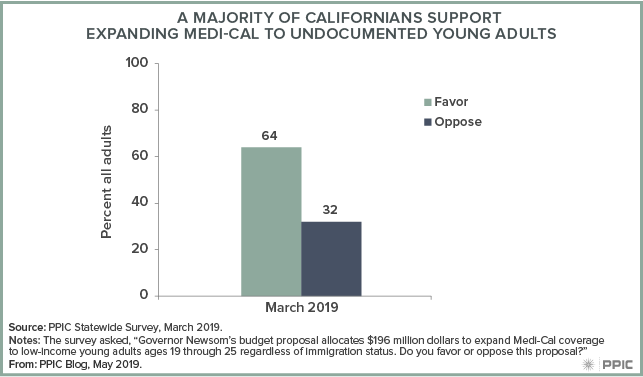
Californians support health care access for undocumented immigrants. In a 2015 PPIC Statewide Survey, a slim majority of Californians (54%) supported the idea of providing health care coverage to undocumented immigrants. In March 2019, about two-thirds (64%) expressed support for the governor’s proposed expansion of Medi-Cal coverage to low-income young adults, including those who are undocumented.

Figure - A Majority of Californians Support Expanding Medi-Cal to Undocumented Young Adults

The governor’s May budget revision delays implementation of the expansion, but it would still have an impact: by providing coverage to approximately 90,000 undocumented young adults in the first year, it could help make the health care landscape less complicated for an important share of California’s immigrant population.

Reviving the Health Care Mandate: Who Pays?

Governor Newsom has proposed creating a state individual mandate to help fund increased health insurance subsidies for low- and middle-income Californians. One of the major reforms ushered in by the Affordable Care Act, the federal individual mandate—which was rolled back in the federal tax bill passed in 2017—required most individuals to have comprehensive health insurance or pay a tax penalty. The governor’s administration projects approximately $500 million in revenue from the mandate, based on the total amount paid by Californians in 2016.

As the governor and legislature consider a state mandate, it’s worth examining which Californians paid the federal mandate penalty.

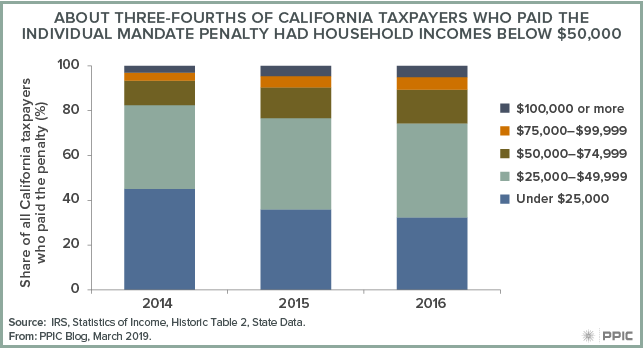
Between 2014 and 2016, taxpayers with incomes below $50,000 accounted for a vast majority of returns that included the individual mandate penalty. In 2014, the first year the individual mandate went into effect, the penalty was 1% of income or a maximum of $285 per family ($95 per adult and $47.50 per child). More than 1 million tax returns in California paid the penalty. Taxpayers with incomes below $25,000 accounted for about 45% of returns subject to the penalty, while those with incomes between $25,000 and $50,000 accounted for another 37%. Even more low-income individuals would have been subject to the penalty if not for certain exemptions—such as having an income below the tax filing threshold ($12,500 for a single adult) or facing hardships like bankruptcy and eviction.

In 2016, the minimum payment rose to 2.5% of income or a maximum of $2,085 per family ($695 per adult and $347.50 per child). The total number of taxpayers subject to the penalty dropped to about 600,000. Those with incomes below $50,000 still accounted for nearly three-fourths of all payments, though this was down from 83% in 2014.

About Three-fourths of California Taxpayers Who Paid the Individual Mandate Penalty Had Household Incomes Below $50,000

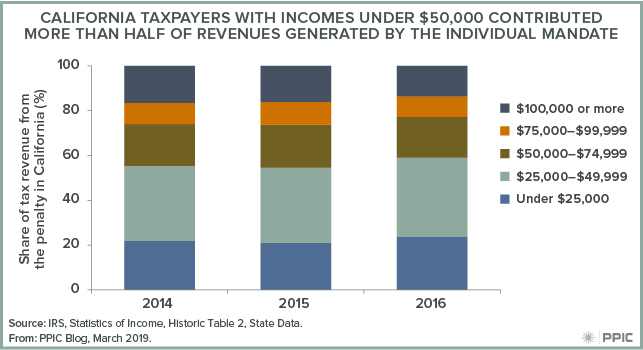
The revenues generated also disproportionately came from taxpayers in lower income brackets. In 2014, taxpayers with incomes below $50,000 accounted for more than 55% of the $222 million in total payments from California taxpayers. Those with incomes under $25,000 paid more than $48 million and those with incomes between $25,000 and $50,000 paid more than $74 million.

Although the number of taxpayers subject to the penalty dropped from 2014 to 2016, tax revenue doubled—in part because the penalty amount increased—and reached $446 million in 2016. Over this time, the share of the total amount paid by households with incomes of $100,000 or more decreased, from 17% to 14%. Meanwhile, the share of revenue paid by those with incomes below $50,000 rose, from 55% in 2014 to 59% in 2016.

California Taxpayers with Incomes Under $50,000 Contribute More Than Half of Revenues Generated by the Individual Mandate

If the state does implement the governor’s proposal, the revenue would increase subsidies currently available for individuals with incomes between 250% and 400% of the federal poverty level ($31,225–$49,960 for a single adult) and expand subsidies to individuals with incomes between 400% and 600% of the federal poverty level ($49,960–$74,940). Most Californians with lower incomes are eligible either for no-cost Medi-Cal or heavily subsidized coverage through Covered California—though not everyone who is eligible enrolls in these programs.

The repeal of the federal individual mandate is expected to lead to an increase in the number of uninsured individuals and higher insurance premiums. A state individual mandate might help counteract those effects by encouraging healthy individuals to enroll in coverage—but at a cost.

In an otherwise progressive state tax structure, the implementation of the federal mandate disproportionately affected low-income Californians. There’s also evidence that some Californians paid the penalty even though they should have been exempt. If the state revives the mandate, the governor and legislature should consider how to improve awareness about eligibility and exemptions so this problem can be avoided. At the same time, reducing the number of people paying the penalty also means that the governor’s revenue estimate may need to be lowered. As policymakers engage in discussions over a state individual mandate, assessing who bears the burden of the tax and who benefits will be an important consideration.

Single-Payer Health Care and the Governor’s Race

One issue that may prove decisive for Democrats in the 2018 governor’s race is single-payer health care. With the leading Democratic candidates supporting a single-payer system—and the leading Republican candidates in opposition—the race has shed light on the financial, political, and regulatory challenges associated with expanding health coverage across the state.

Last year, the state senate passed a bill (SB 562) that would establish a single-payer health insurance program to cover all Californians. However, the bill was shelved in the state assembly until further notice. According to estimates by the nonpartisan Legislative Analyst’s Office, the bill’s total annual costs would be about $400 billion. Democratic gubernatorial candidates Gavin Newsom and Delaine Eastin have been the most vocal proponents of single-payer health care and have publicly backed the bill. Democratic candidates Antonio Villaraigosa and John Chiang, while supportive of the idea, have expressed concerns over financing and implementation. Both the leading Republican candidates, John Cox and Travis Allen, strongly oppose single-payer health care and have emphasized the need for more competition in the marketplace.

With candidates’ differing positions, how are Californians feeling about single-payer health care today?

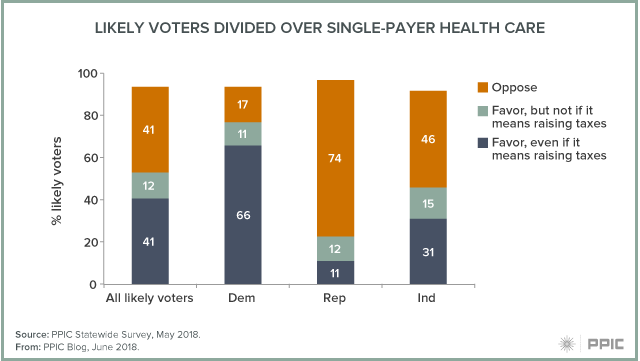
The May PPIC Statewide Survey found a majority of California’s likely voters (53%) favor a single-payer state plan. However, if this plan requires raising taxes, support declines to 41%. Across parties, an overwhelming majority of Democratic likely voters (77%) are in favor, while an overwhelming majority of Republicans (74%) are opposed; independent likely voters are divided (46% favor, 46% oppose). Notably, 66% of Democratic likely voters would favor a single-payer system—even if it means higher taxes.

The issue has become a litmus test for Democrats—pitting progressives against pragmatists—but, overall, Democrats express strong support for a single-payer system. Among likely voters who call themselves strong Democrats, 81% are in favor, compared to 69% who say they are not very strong Democrats. Among likely voters who call themselves strong Republicans, 83% are opposed to a single-payer system (the sample size for those calling themselves not very strong Republicans is too small for analysis).

Given partisan divides, the next governor may face significant political hurdles moving forward with single-payer health care. Coupled with statewide challenges, California would need to collaborate with the federal government to implement such a system. In consideration of these factors, the June primary is an opportunity for Californians to determine their future leadership and the state’s policy directions—including a possible step toward single-payer coverage.

Video: Attorney General Becerra on the Issues

The Trump administration has clashed with California on a range of issues, and the state’s new attorney general, Xavier Becerra, is at the forefront of the legal battles with Washington. Before a large crowd in Sacramento, Becerra talked about his views and what he has done so far on a range of issues. He spoke with Mark Baldassare, PPIC president and CEO.

Some key highlights:

  • Environment: Becerra said he has been most active so far on this issue and vowed to continue to be aggressive, whether it is initiating lawsuits, joining other suits, or moving forward with the Paris climate agreement, to the extent the state can do so. “I’ve got the governor’s back on anything he wants to do on the environment,” he said.
  • Immigration: Becerra said he favors legislation to make California a sanctuary state as long as it does not undermine the ability of local law enforcement to protect public safety by, for example, combating drug and sex trafficking.
  • Health care: Becerra said that single-payer health care is ultimately the right approach to coverage. “I hope California gets further along in recognizing that affordability only comes when you have universality,” he said.

Closing California’s Health Insurance Gap

California has made great strides toward closing the health insurance coverage gap under the Affordable Care Act (ACA). In 2014, the state reduced the share of the population that was uninsured by 5 percentage points, or about 2 million people. Early evidence suggests the state made additional gains in 2015, but more than 3 million California residents continue to lack health insurance and many are eligible for free or subsidized coverage. Reaching them may have benefits beyond meeting the state’s health coverage goals, including the potential to improve public safety and public health.

The characteristics of the remaining uninsured are striking. Younger men (those under age 45) make up less than one-fifth of California’s adult population but represent more than one-third of the uninsured. When we examine other characteristics of Californians who continue to lack coverage, we find the highest uninsured rates among those facing high levels of disadvantage. Uninsured rates among adults with low levels of income, education, or employment are above 30 percent. And when we focus more closely on young men with high levels of disadvantage, uninsured rates are well above 50 percent.

Because highly disadvantaged young men are detached from educational and labor market institutions, they are likely to be among the hardest to reach through traditional sites of enrollment. They are also disproportionately represented among people who are arrested and incarcerated in county jails and state prisons.

In our study of a subset of California counties, we find that more than three-fourths of individuals booked into jail are men under age 45. Within the counties under study, nearly half a million individuals flowed through the jail system in 2014. Given the substantial overlap in the characteristics of the uninsured and the characteristics of individuals who have contact with the criminal justice system, county jails may provide an opportunity to target a share of the remaining uninsured.

Enrolling county correctional populations in health coverage may also support efforts to improve reentry outcomes under Public Safety Realignment by reducing the likelihood of recidivism. Specifically, chemical dependency treatment and outpatient mental health programs have been associated with reductions in repeat arrests and fewer total arrests.

Many county jail systems are engaged in some form of enrollment assistance. However, approaches and resources vary across the state. Counties may take a “front door” approach, offering enrollment screening to the large group of individuals being booked into jail. Or they may take a “back door” approach, offering enrollment assistance to a much smaller group of individuals nearing the end of their sentences, as part of reentry planning. When resources are limited—and they almost certainly are—counties face trade-offs between providing some form of assistance to a large population and providing in-depth assistance to a smaller group.

This variation across counties creates an opportunity to identify best practices in providing enrollment assistance. Further, we can help counties that successfully enroll a substantial share of their correctional populations to evaluate the effects of enrollment on recidivism. This kind of research can inform efforts to make the most cost-effective use of criminal justice resources.


Chart Source: American Community Survey, Public Use Microdata Sample, 2014.
Chart Note: Insurance coverage is measured at the time of the survey. Results shown are for all California adults ages 18–64. Income levels are presented as poverty rates based on federal poverty level (FPL) thresholds related to income eligibility cutoffs for health insurance coverage programs including Medi-Cal (under 138% FPL), premium and copayment subsidies available for coverage purchased through Covered California (138%–250% FPL), and premium subsidies only for coverage purchased through Covered California (250%–400% FPL).


Immigrants and Health Insurance

California has made major strides in reducing the number of state residents without health insurance coverage. With the state’s Medicaid expansion and the creation of Covered California under the Affordable Care Act (ACA), the percentage of Californians without insurance dropped nearly 5 percentage points in 2014—the first year of ACA implementation. Declines occurred across all racial and ethnic groups, with Latinos registering the largest drop at 9 percentage points. Nevertheless, Latinos continue to experience the highest uninsured rate, in part because the ACA coverage expansions exclude California’s estimated 2.7 million undocumented immigrants.
But there is more to the story of insurance coverage and California’s immigrants: we also observe large declines in the uninsured rate among all noncitizens, a group that includes an estimated 2.6 million people who are legally residing in the state (with green cards, temporary visas, work visas, etc.), as well as those who are undocumented. When we look at uninsured rates across different citizenship categories, we see the drop was larger among noncitizens than among US-born and naturalized citizens—noncitizens had nearly a nine percentage point decline in their uninsured rate.

Noncitizens who legally reside in the state have access to ACA coverage expansions either through the Medi-Cal program—if their household income is below 138 percent of the federal poverty level, about $33,500 for a family of four—or through Covered California, with financial assistance available to help pay for coverage. Still, about 35% of California’s more than five million noncitizen residents currently lack comprehensive health insurance coverage—most are likely to be undocumented, with limited sources for affordable insurance coverage.

Undocumented residents sometimes have private health insurance, most often through their employers. National estimates suggest between 30–40% of undocumented immigrants have coverage. This number could grow if federal immigration reforms are implemented, by providing undocumented immigrants who qualify (between 1.1 and 1.3 million in California) with work permits and better job opportunities that could offer increased access to employment-based insurance.

Along with pending federal action on immigration reform, state legislative proposals are also focusing on expanding affordable insurance coverage options to the undocumented. In our new report, we discuss these potential options and provide new regional estimates of the undocumented population in California by income thresholds to assist policymakers in planning for potential coverage expansions to this group.

Health Insurance for the Undocumented

California continues to have at least 3 million uninsured residents, even after the coverage gains from the Affordable Care Act (ACA). Estimates suggest that between 1 million and 1.5 million of them are undocumented immigrants who are not eligible for federally subsidized coverage.

But there may be two opportunities for California’s undocumented population to gain access to coverage – depending on the legislature, governor, and courts. We estimate that as many as half of the state’s undocumented immigrants have incomes that are low enough to qualify for Medi-Cal coverage—with some variation across regions. To qualify for Medi-Cal, household income must be below 138% of the federal poverty level (about $16,000 for a single person or about $28,000 for a family of 3). Those with higher incomes may gain access to insurance through a state exchange.

First, the governor’s recently released proposal for the state budget includes funding to provide full Medi-Cal coverage to low-income undocumented immigrants who register for the federal Deferred Action for Parental Accountability (DAPA) program, which offers protected status to undocumented immigrants who have resided continuously in the U.S. for the past five years and are parents of children who are either U.S. citizens or legal permanent residents. This proposal is dependent on DAPA surviving current legal challenges.

Second, the Senate Appropriations Committee has approved state legislation that proposes to expand insurance coverage options to undocumented immigrants not eligible for DAPA. The bill (SB 4) would extend Medi-Cal to low-income undocumented immigrants under age 19. The number of adults who are eligible would depend on the state budget. The bill also includes provisions to allow those with higher incomes to purchase coverage through a state-based insurance exchange.

How many undocumented immigrants might be affected by these actions? Estimating the number is not straightforward. To help in the policy and planning process, we have recently updated our county estimates of undocumented immigrants for 2013 using zip code level tax records (filed with Individual Taxpayer Identification Numbers, or ITINs) and the analytic methods we have used in past work. We extend our earlier analysis to estimate how many undocumented immigrants might be eligible for insurance coverage based on family income for the pricing regions used by Covered California. To do this, we rely on information available from tax filings—we estimate income levels from adjusted gross income groupings and family size from tax filing status and the use of the federal child tax credit. PPIC expects to publish more results based on these analyses in the near future.

Statewide, our preliminary estimates indicate that just over half of undocumented immigrants (51%) are likely to be under the 138% poverty threshold used for Medi-Cal income eligibility. This share varies widely across regions. Nearly 60% in Los Angeles County and the Central Valley have incomes below the 138% threshold. Most Bay Area counties have lower shares below this threshold—from 36% in Santa Clara County to 44% in Contra Costa County. These findings are generally consistent with other work that uses different methods to profile California’s undocumented immigrants (MPI (2014), Marcelli and Pastor (2014), Warren (2015)).

We also estimate shares, by region, of undocumented immigrants that fall between 138% and 400% of the federal poverty level, the income range used by Covered California for its current enrollees to receive premium subsidies. Across most regions, between 40% and 60% of the undocumented population falls within this range, potentially making them eligible to purchase coverage through a state insurance marketplace.

Finally, about 85,000 undocumented have incomes above 400% of the federal poverty level – with most residing either in Bay Area counties or the coastal Southern California counties of Orange and San Diego.

Regional differences in health plans, provider capacity, and insurance costs make information on the size and distribution of the state’s undocumented population by income level crucial to planning effectively for coverage expansions. We expect to contribute regularly to the discussion as these planning efforts unfold.

Table source: Author’s analysis of tax data.
Table note: Counts are rounded to the nearest 500 and may not add to the statewide total as a result. Regions correspond to the insurance pricing regions used by Covered California, with one exception. Region 15 in the table includes all of Los Angeles County.