Reforming California’s Community College System

California’s community colleges have a strong record of providing access to higher education—they enroll more students than any other college system in the country, including large shares from groups that have been historically underrepresented. But improving student outcomes has long been a challenge: fewer than half (48%) of students earn a degree or certificate or transfer to a four-year college. The community college system is implementing a broad range of reforms designed to address these high rates of incompletion. These reforms focus on improving the student experience from initial enrollment to graduation and beyond.

From our perspective, the most dramatic reforms are in developmental (or remedial) education. In the past, a large majority of students entering the community college system have been placed in developmental education courses in English and/or math, and relatively few have gone on to complete transfer level courses. But the passage of Assembly Bill (AB) 705 in 2017 has required colleges to implement assessment and placement procedures, including new curricula that result in more students completing transfer-level courses in English and math within one year of entering. Our work has shown substantial improvements at colleges that have been early implementers of these new procedures. For example, 70% of students who entered directly into transfer-level courses in English with co-requisite support (a form of concurrent remediation) successfully completed the course, compared to 29% of those who began in a prerequisite developmental education course. Full implementation of AB 705 will occur this fall.

Other reforms aim to improve student pathways throughout community college and beyond. For example, the Guided Pathways program is designed to help students navigate through community college by helping them choose programs of study, mapping pathways to their end goals, and ensuring that they stay on those pathways. Another new program, the Associate Degree for Transfer, guarantees admission to a California State University campus in a major aligned to a student’s community college course of study. All of these reforms make equity a primary consideration. The student-centered funding formula links these efforts by tying a portion of district funding to equity and success outcomes, including completion of transfer-level math and English within the first year, certificates or degrees granted, and transfers to four-year universities, among others.

Implementing new programs and policies is not easy, and it will take time to assess the results. But, as PPIC has shown, many of these reforms are showing early promise.

California’s Growing Demand for Recycled Water Has Ripple Effects

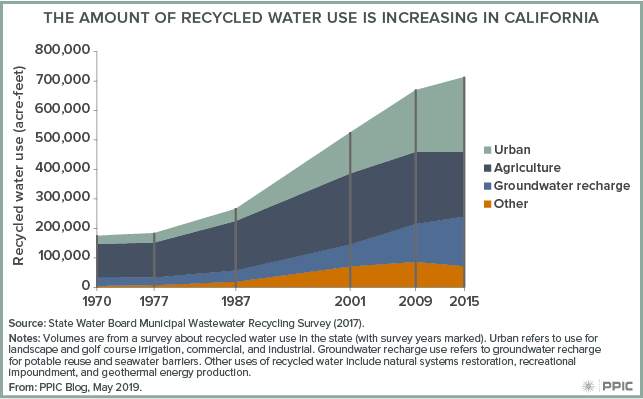
Wastewater agencies produce highly treated water that is increasingly being reused as a water supply. While it’s still only a small portion of overall water use, the use of recycled water has nearly tripled since the 1980s―and is continuing to rise as water agencies seek to meet the demands of a growing population and improve the resilience of their water supplies.

Recycled water production is closely related to water use and wastewater management. It also directly influences flows for ecosystems and downstream water users in some watersheds. As its use expands, weighing the trade-offs involved will help avoid conflict. Meeting current and future demands requires careful consideration of several issues, including the impact of water use on wastewater management, changing types of demand for recycled water, and the needs of ecosystems and downstream users.

Recycled water production is affected by reductions in water use. In other words, recycled water is not completely “drought proof.” The drought of 2012‒16 provides a clear example of this. The rapid reduction of urban indoor water use in this period resulted in a reduced quantity and quality of wastewater for most of the state’s wastewater agencies. In a survey conducted by the PPIC Water Policy Center, just over 40% of wastewater agencies that recycle wastewater reported that their ability to produce recycled water was impaired during the drought. The long-term efficiency of water use and related declines in wastewater quality may also affect recycled water production in the future. For example, as households become more water-efficient, the wastewater they discharge to sewers can have higher concentrations of salts, which are not removed in most treatment processes. Saltier water may not be suitable for outdoor irrigation of golf courses or lawns—common uses of recycled water. If this issue grows in severity, agencies may be forced to incorporate desalination into wastewater treatment, which is likely to add cost and complexity.

Demand for recycled water is growing and changing. Recycled water is increasingly being used in urban areas for public landscape irrigation, golf courses, industrial cooling, and groundwater recharge. Replenishing sources of drinking water is the biggest growth opportunity for water recyclers. New state rules allowing replenishment of groundwater and surface water storage with recycled water—and eventually the direct connection of recycled water to drinking water infrastructure—will create opportunities for recyclers to cost-effectively meet growing demands well into the future. This will require close coordination between water suppliers and wastewater agencies. Some wastewater agencies will also need to increase their treatment capacity to meet the higher water quality standards required for potable reuse.

figure - The Amount of Recycled Water Use Is Increasing in California

Expanding use of recycled water may reduce flows of treated wastewater in rivers, streams, and estuaries. Treated wastewater is an important water source for some ecosystems and downstream water users. Watersheds where wastewater makes up a significant amount of the flow that supports ecosystems and downstream users are especially vulnerable to conflict. For example, a proposal to increase the use of recycled water in Coachella Valley would decrease flows to the already shrinking and vulnerable Salton Sea. Managing recycled water so that it avoids harm to ecosystems and downstream users will require additional collaboration and thoughtful planning.

Closer coordination between wastewater agencies and water suppliers can help minimize impacts from changing patterns of water use on wastewater quantity and quality. Regional planning can also help agencies make smart recycled-water investments that take advantage of opportunities to more directly replenish drinking water supplies. New projects should be based on a careful consideration of local demands and costs, and also how well the investment fits into the overall regional supply of water for both human and environmental uses. Taking such steps now can help water managers in this growing sector make the most of this once-maligned resource.


Expanding Enrollment at UC and CSU

California’s economy is increasingly demanding highly educated workers. To meet this demand, and to ensure that more Californians are successful in the 21st century economy, the state’s universities will need to admit and graduate greater numbers of students than they do today.

Governor Newsom’s budget proposal offers a step in the right direction, but it could go further.

The governor’s budget provides General Fund increases of 7% for the University of California (UC) and 8% for the California State University (CSU), including funding for enrollment increases of 1,000 and 7,000 students respectively.  The budget also provides $95 million ($50 million for UC and $45 million for CSU) in ongoing funding to improve student success efforts at both systems. This is good news and represents substantial reinvestment in the state’s public universities.

But the enrollment increases fall short of what CSU and UC had been hoping for, and more importantly, short of student demand. In its 2019-2020 budget plan, UC had sought enrollment increases for 2,500 California resident undergraduates in order “to maintain access for projected increases in UC-eligible high school graduates and transfer-ready California Community College students.” CSU had sought an even more ambitious increase of more than 18,000 in order to accommodate more freshmen and transfer students.

As the state moves into the eleventh straight year of economic growth, ensuring investments in higher education is critical—especially in the face of an eventual downturn. Higher education is often one of the first budget areas to be cut during a recession. Today, even after a decade of reinvestment and one of the largest economic expansions in state history, funding per student at UC and CSU still remains below pre-Great Recession levels. And it is far below the funding peaks of the late 1990s and early 2000s.

As the legislature and governor negotiate over the budget, it may be time to consider creating a long-term funding plan for public higher education. An effective multi-year plan would account for increased enrollment, incentivize student success, prioritize equity, and provide a sensible tuition growth plan.  This would allow students and their families, as well as universities, to better plan for the future—and would put the state on a path to meeting the economic demands of the future.

Health Care Access for California’s Immigrants

Governor Newsom is proposing to expand access to Medi-Cal—the state’s Medicaid program—for low-income young adults up to age 26, regardless of their immigration status. This could help a vulnerable segment of the immigrant population. Californians are signaling broad support.

Overall, immigrants make up about 27% of the state’s population and are less likely to have health insurance than US-born Californians. Immigrants are also less likely to have private insurance, partly due to differences in employment industries and income.

Figure - Health Care Coverage Rates are Lower For California Immigrants in All Age Groups

Documented immigrants—including those with green cards and visas—may qualify for Medi-Cal without being subject to the five-year waiting period required by federal law. They can also purchase private health plans through Covered California, the health insurance exchange that was created as part of the Affordable Care Act (ACA). However, most recently-arrived elderly immigrants are not eligible for Medicare because they have not paid Medicare taxes over a long enough period.

California offers a patchwork of health care options for undocumented immigrants, who are not covered by the ACA. For instance, low-income children and pregnant residents are eligible for Medi-Cal regardless of immigration status, and some counties include undocumented immigrants in programs for those who cannot afford medical care. Additional options for undocumented immigrants include community clinics, rural health clinics, emergency rooms, or a limited version of Medi-Cal for medical emergencies.

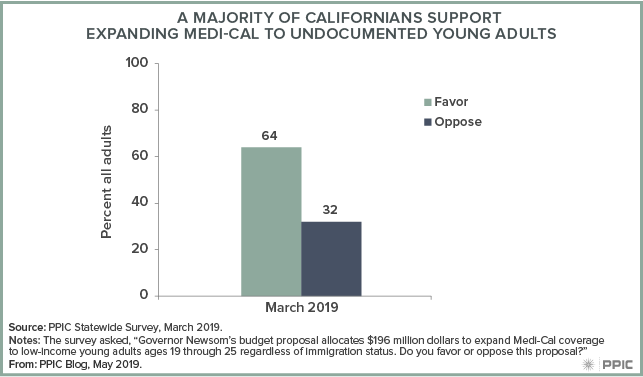
Californians support health care access for undocumented immigrants. In a 2015 PPIC Statewide Survey, a slim majority of Californians (54%) supported the idea of providing health care coverage to undocumented immigrants. In March 2019, about two-thirds (64%) expressed support for the governor’s proposed expansion of Medi-Cal coverage to low-income young adults, including those who are undocumented.

Figure - A Majority of Californians Support Expanding Medi-Cal to Undocumented Young Adults

The governor’s May budget revision delays implementation of the expansion, but it would still have an impact: by providing coverage to approximately 90,000 undocumented young adults in the first year, it could help make the health care landscape less complicated for an important share of California’s immigrant population.

California’s Digital Divide and the 2020 Census

The 2020 Census will be the first decennial census with a fully online component. Rather than mailing forms to every household, the US Census Bureau will instead send out postcards asking households to take the census online, hoping to achieve a 55% online response rate. Then, as in years past, census workers will visit those who did not respond and conduct in-person interviews.

California’s size and diversity present unique challenges to this effort. One significant challenge lies in how many households report having reliable high speed internet—essential to completing the census online.

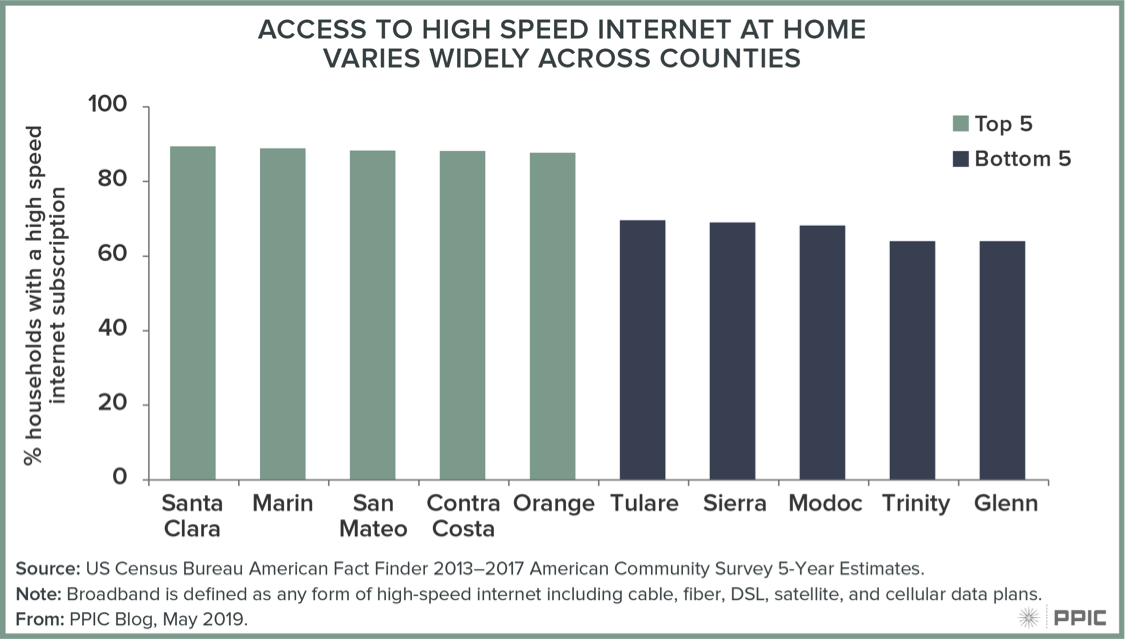
The contrasts across counties are stark. For example, according to the most recent estimates, more than 89% of households in Santa Clara County report having high speed access at home. In contrast, in Trinity, Glenn, Modoc, Sierra, Tulare, and Imperial Counties, more than 30% of households say they do not.

What’s more, these estimates actually understate the disparity. In the counties of Colusa, Sierra, Yuba, Tulare, and Plumas more than 15% of households report having high speed internet only through their cell phone data plans and no other source, and in 11 other counties at least 10% of households report the same.

Figure - Access to High Speed Internet at Home Varies Widely Across Counties

Of further concern is that these counties are the very ones that have been identified as being hard to count. In addition to sparse internet access, communities may be hard to count because they contain higher rates of historically undercounted groups, such as noncitizens and African Americans, or because large shares of their residents rent rather than own their households.

These challenges are real, but California is working hard to overcome them. State agencies were allocated over $100 million in 2018-19—with another $54 million proposed—so they may partner with the Census Bureau to help identify hard to count communities, encourage participation, and better ensure an accurate count of all Californians.

California’s Dairy Industry Faces Water Quality Challenges

Contaminated groundwater is an ongoing problem in some of the state’s poorest rural communities, particularly in the San Joaquin Valley. One big threat is nitrate, caused mainly by many decades of crop fertilization with chemical fertilizers and dairy manure. For dairy farms, solutions are especially difficult and expensive. We talked to Anja Raudabaugh of Western United Dairymen about what can be done to address these challenges.

photo - Anja Raudabaugh

PPIC: What is the relationship between the San Joaquin Valley dairy industry and water quality?

Anja Raudabaugh: The entire valley faces significant water quality problems. Arsenic, which occurs naturally, is the number one contaminate. The second most widespread problem is nitrate. We’ve had these issues for many decades. Animal agriculture, aging wells, certain soil types, and heavy reliance on groundwater all add to the problem.

We recognize that the dairy industry is part of the problem—and we also want to be part of the solution. The public perception is that our manure lagoons are particularly problematic, but most lagoons in the valley are heavily lined and can’t affect groundwater. It’s also important to note that the industry’s manure management requires a state permit—we’re regulated as to how much nitrogen we can apply and how we store it. California’s standards for operating a dairy are the strongest in the nation.

With the help of studies by UC Davis, monitoring from the Regional Water Board, and industry-designated monitoring wells, we’ve found that 94% of the nitrate pollution surrounding dairies is coming from applying manure to land. Manure is collected in lagoons, diluted with water, and then applied to row crops that feed our cows.

PPIC: What are some promising approaches to help address these water quality problems?

AR: This is a big, statewide challenge, and all parties need to be at the table to work on comprehensive solutions. The dairy industry has been working on solutions to nitrate for about a decade. For the short term we need to use less manure on lands where nitrate leaching is a problem. And we must ensure communities have access to clean drinking water.

New technologies can help. For example, a new filtration system that can remove a lot of nitrate out of lagoons has been installed on 100 valley dairies so far. We’re also working with Sustainable Conservation on some promising biological solutions―including a pilot project to use high quantities of earthworms to decompose nitrate coming from manure. The worms digest up to half the nitrogen and leave a very pure fertilizer. But it’s an expensive solution―a million earthworms is costly. It’s been installed on four dairies, but they haven’t yet been able to scale it. We’re also trying to build markets and incentives to move organic manure off dairies to other farms where it can be used.

Agriculture alone can’t afford to bear the full costs of permanent long-term water quality solutions to the range of contaminants in the state’s water. There remains an overarching need for public funding to address these problems, such as covering costs for operation and maintenance of small water systems in disadvantaged communities. A 2012 report discussed two ways to remediate nitrate in groundwater: pump and treat the water, then reinject it into the ground; or treat it in place. Both approaches are very costly.

We believe the proposed “safe and affordable drinking water fund” is the most elegant and fairest solution proposed so far. This fund spreads the costs out across the whole state. Agriculture would pay a significant portion but not all of it. This type of fund is the blueprint for how we get there—and would ensure the dairy industry is able to participate and still remain a viable financing partner into the future.

PPIC: What gives you hope for the dairy industry?

AR: The state’s dairies are producing some of the most sought-after agricultural products in an environmentally sustainable fashion.

Our dairy families want to produce healthy products, and want to work and live in healthy communities. This is our drinking water, too―99% of the valley’s dairies are family owned, and these folks are raising their families in these communities. Clean drinking water is a moral issue for this organization. I’m really proud of the dairy men and women who’ve stepped up to work on this problem. I’m optimistic because our industry is proactively helping to deliver solutions to these problems.

Watch a video of Anja Raudabaugh and other panelists discussing water quality management in the San Joaquin Valley.

Coping with High Housing Costs in College

California’s housing crisis affects college students around the state. Over the past eight years—even as tuition has been stable at California’s public colleges and universities—the cost of attending college has risen because housing costs have gone up. Most students at California’s community colleges and in the California State University system pay more for housing than they do for tuition. At the University of California, housing costs are on par with tuition (for those who pay full tuition).

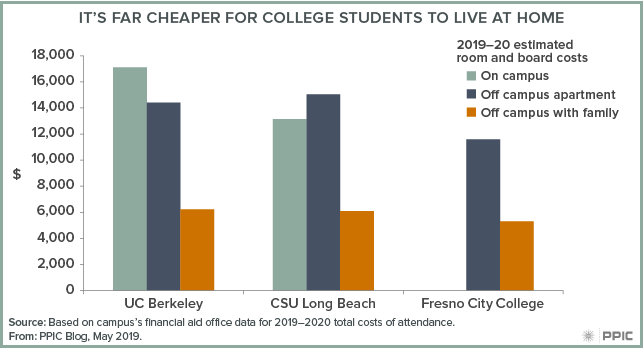
One way students limit their housing costs is by living with their parents or other family members. For most students, living at home is much cheaper than living in housing provided by the university or in an apartment off campus. Housing costs vary across systems, but in every case living with family is much less expensive than other housing options. And the savings are large—as much as $10,000 a year.

figure - It’s Far Cheaper for College Students to Live at Home

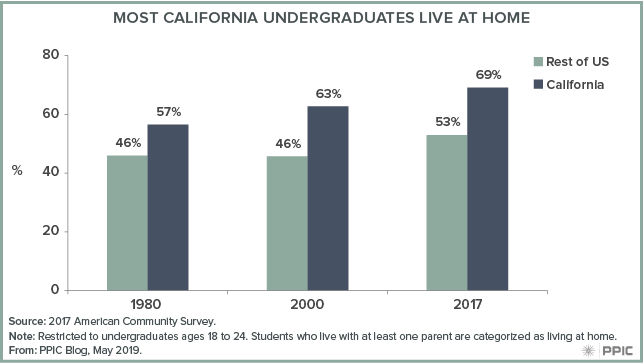
In fact, the large majority of California undergraduates do live at home (69% in 2017), and that share has been increasing over the past few decades, according to the American Community Survey. Moreover, California college students are substantially more likely to live at home than their counterparts in the rest of the nation.

figure - Most California Undergraduates Live at Home

Partly, this difference reflects the mix of colleges in California. Community college students are especially likely to live with parents—not surprising given the broad geographic coverage of this system. And CSU students are more likely to live at home than UC students. But the difference in living situations between California students and their peers nationwide almost certainly reflects California’s higher housing costs.

Living at home while attending college can be a great way to reduce costs. But it also has a downside. Research suggests that students who live at home are less connected to their college—and less likely to graduate.

California’s colleges and universities cannot solve the state’s housing crisis, but many of them are working to expand on-campus housing opportunities. They are also working with the state to develop ways to expand grants to cover housing costs as well as tuition. The governor’s proposed budget includes $40 million to provide emergency housing support for UC and CSU students (including those struggling with homelessness).

With no quick solution to the high cost of housing in California, thoughtful actions will be critical to providing support to college students across the state.

Californians See Preschool as Important

Early childhood education, a policy priority for Governor Newsom, is viewed as important by an overwhelming majority of Californians. In the April 2019 PPIC Statewide Survey, 78% of Californians and 88% of public school parents said that attending preschool is important to a student’s academic success in kindergarten through grade 12.

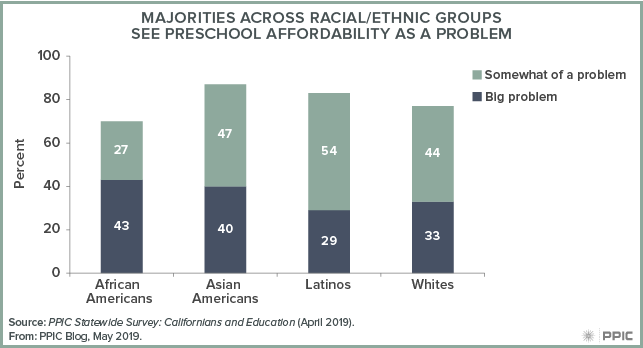
A similar share of Californians (80%) see the affordability of preschool as a problem. Democrats (46%) and Independents (38%) are much more likely than Republicans (25%) to say that it is a big problem. A majority across regions see affordability as a problem, with San Francisco Bay Area residents (42%) most likely to feel that it is a big problem. Across racial/ethnic groups, African Americans and Asian Americans are more likely than whites and Latinos to say that affordability is a big problem.

figure 1 - Majorities across Racial/ethnic Groups See Preschool Affordability as a Problem

Governor Newsom has proposed new funding that would address some of these affordability concerns. In April, we asked Californians if they were in favor of or opposed to the governor’s initial budget proposal from January, which allocated $125 million to expand full-day, full-year preschool to all eligible low-income four-year-olds. A majority of Californians—about two in three adults and three in four public school parents—favored this proposal. In addition, majorities across all demographic groups and regions favored it. In the May budget revision, the proposed funding was reduced to $31 million, which would pay for 10,000 new full-day preschool slots starting April 2020.

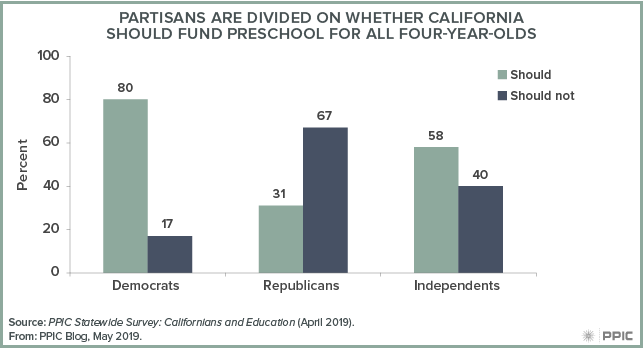
There is slightly less support for state-funded preschool in general: six in ten adults say that the government should fund voluntary preschool programs for all four-year-olds. State-sponsored preschool is a highly partisan issue, with Democrats much more likely than independents or Republicans to express support.

figure 2 - Partisans Are Divided on Whether California Should Fund Preschool for all Four-year-olds

With the release of the governor’s revised spending plan on May 9, the state budget process is well under way; the deadline for enacting the final budget is June 15. PPIC will continue to monitor the governor’s proposed allocations for early childhood education and the opinions of Californians on the issue.

What Does the Colorado River Drought Plan Mean for California?

A much-anticipated plan to address chronic water shortages in the Colorado River Basin was recently signed into law by President Trump. This drought contingency plan (DCP) aims to slow the long-term decline in Lake Mead’s water levels caused by over-allocation of Colorado River water and 19 years of drought, as well as address future water shortages in the basin.

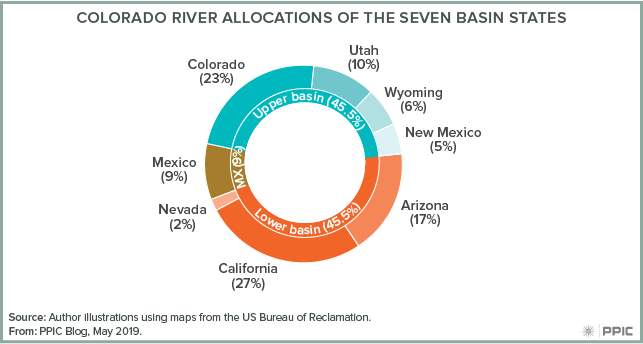
The DCP is the fruit of a decade of negotiations among the seven basin states to resolve the over-allocation problem through cuts and water storage. (Mexico receives water from the river but is not part of this plan.) California has the largest share of the Colorado, with senior rights to more than a quarter of the river’s average annual flow.

figure - Colorado River Allocations of the Seven Basin States

Lake Mead is a water source for 600,000 acres of farmland and 19 million people in Southern California. California agencies can also store up to 250,000 acre-feet of water in Lake Mead.

Without the DCP, Lake Mead’s water level could drop too low to allow releases from Hoover Dam. As the lake nears this threshold, senior water right-holders in California might be tempted to withdraw their water before it becomes inaccessible. While such a move would be permissible, it would accelerate the drop in the lake level and affect future deliveries for junior water right-holders in the other lower-basin states.

The DCP eliminates this concern and delivers an orderly and mutually agreed upon method to manage shortages until 2026. It provides assurance against curtailments for water stored behind the dam. This is especially important for the Southern California water agencies, whose ability to store water in Lake Mead is crucial for managing seasonal demands.

Some significant challenges must still be addressed, however. The Imperial Irrigation District, the largest Colorado River water user, opted out of the plan due to a dispute over funding to restore the shrinking Salton Sea. The district also filed a lawsuit that calls for the DCP to be suspended until an environmental review of the plan is completed.

The lawsuit alleges that the Metropolitan Water District (MWD), which would contribute most of the water required to fulfill California’s obligations under the DCP in times of system-wide shortage, unlawfully approved the DCP. IID claims that MWD did not consider the “sources of water that would be necessary for [it] to fulfill its commitment and the environmental effects associated with obtaining water for those sources.” The outcome of this lawsuit is uncertain.

Currently, the Colorado supplies about a third of all water used in Southern California’s urban areas. The region’s water agencies are taking steps to develop more local supplies and increase water efficiency to help them meet water demand if DCP cuts are triggered during a future water shortage.

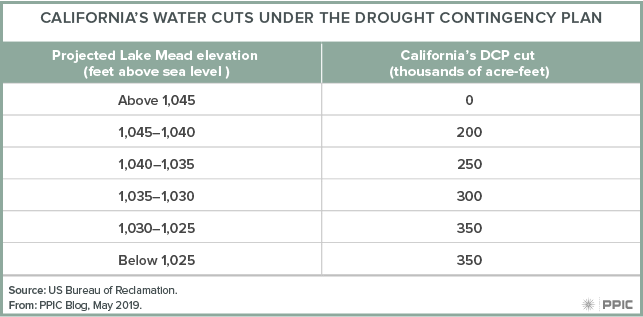
The plan won’t cause immediate water cuts. This year’s wet winter means that Lake Mead’s elevation, currently 1,090 feet above sea level, may remain above the 1,045-foot threshold at which the mandate is triggered for California. But the basin states now have a plan in place to address the next dry spell.

table - California’s Water Cuts Under the Drought Contingency Plan

Food Assistance Linked to Student Success in College

Student hunger on college campuses is a serious concern, potentially affecting students’ health and academic achievement. At the University of California (UC), as many as 42% of students faced some degree of food insecurity in 2016, with one in five reporting reduced food intake due to limited resources. With funding provided by the UC system, individual campuses have undertaken a range of strategies to address the problem—including food pantries, free food cafes, and efforts to increase enrollment in CalFresh, the state’s food assistance program for low-income residents.

Increasing CalFresh enrollment among college students has also been the focus of recent state legislation, which has eased work requirements and removed barriers to enrollment. For example, low-income or first-generation students who qualify for California’s Educational Opportunity Program (EOP) are now automatically eligible for CalFresh. In 2016, just 2% of UC students were enrolled in CalFresh, but we don’t yet know how recent changes to eligibility have affected enrollment.

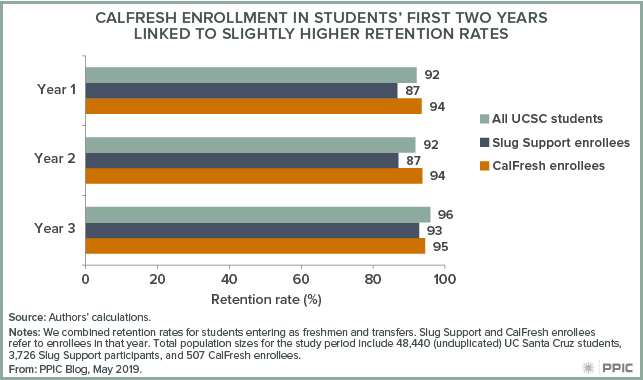
In addition to providing food assistance, enrolling in CalFresh appears to be a promising strategy to promote student success, according to our research at the University of California, Santa Cruz (UCSC). Our study of students who participated in the campus’s Slug Support program—a basic-needs program that provides food, housing, financial, and crisis assistance for students—shows that CalFresh enrollment is associated with improved retention in students’ first two years.

The first-year retention rate for Slug Support students (87%) is substantially lower than the overall retention rate at UCSC (92%), but CalFresh enrollees experienced a slightly higher-than-average first-year retention rate (94%). These results are especially encouraging as students who are eligible for CalFresh are socioeconomically disadvantaged and more likely to come from under-resourced high schools—characteristics typically associated with lower retention. This pattern persists for those enrolling in CalFresh their second year but wanes after that: students who wait to enroll in CalFresh until their third year have slightly lower retention rates than third-year UCSC students overall.

figure - CalFresh Enrollment in Students' First Two Years Linked to Slight Higher Retention Rates

Compared to Slug Support students who used other services but did not enroll in CalFresh, CalFresh enrollees were consistently more likely to return to campus the following fall. About a third (34%) of UCSC students are EOP-eligible—and therefore now eligible for CalFresh—suggesting that recent legislative changes have the potential to greatly improve food security and student outcomes.

Governor Newsom’s revised budget for 2019–20 allocates $18.5 million to address hunger and housing in the UC system. To build upon recent efforts, policymakers and higher education leaders should consider additional mechanisms to support access to CalFresh—such as tracking CalFresh enrollment among eligible students, confirming students are aware of their eligibility, and streamlining the enrollment process. These steps could help further ensure that California students have access to the resources that will help them complete their degrees.

Brandon Balzer Carr is a doctoral candidate in psychology at UC Santa Cruz. Rebecca London is an adjunct fellow at PPIC and an assistant professor in sociology at UC Santa Cruz.