Video: Broadening Access to Transfer-Level Courses at California’s Community Colleges

The majority of California community college students never complete their education. For many students, the biggest barrier to success has been the traditional approach to remedial education. Until recently, the vast majority of entering students were placed in remedial—or developmental—courses, and relatively few of them went on to receive a degree or transfer to a four-year institution. In recent years, several colleges have responded to this longstanding challenge by experimenting with placement and curricular reforms, and state legislation enacted in 2017 aimed to accelerate the pace of change.

A new PPIC report examines what happened at colleges that were early in implementing large-scale reforms, focusing on student access to and completion of transfer-level courses in English and math. Marisol Cuellar Mejia, PPIC senior research associate and report coauthor, reported on the findings at a briefing in Sacramento last week, followed by a panel discussion of higher education experts moderated by coauthor Hans Johnson, PPIC senior fellow and director of the PPIC Higher Education Center.

Panelists included Julianna Barnes, president, Cuyamaca College; Laura Metune, vice chancellor for external relations, California Community Colleges Chancellor’s Office; and John Stanskas, president, Academic Senate for California Community Colleges.

The three panelists emphasized the equity implications of placing students in transfer-level classes, as opposed to remedial courses.

Barnes said that “we cannot deny the data” showing that placement and curricular reforms are particularly helpful to students who are historically underrepresented in college. Making these changes became “an equity imperative” at Cuyamaca College.

Thoughtful leadership and a commitment to addressing equity gaps are particularly important in managing change, according to Metune. She noted that “we need to just be careful that it’s not our own implicit bias that’s resulting in differences in student outcomes.”

All community colleges now have a plan for implementing reform, Stanskas said. He pointed to the importance of tailoring programs to specific student populations. Colleges should be ready to “get down to being more nuanced about who [their] students are and what they need from us to be successful.”

Reforming California’s Community College System

California’s community colleges have a strong record of providing access to higher education—they enroll more students than any other college system in the country, including large shares from groups that have been historically underrepresented. But improving student outcomes has long been a challenge: fewer than half (48%) of students earn a degree or certificate or transfer to a four-year college. The community college system is implementing a broad range of reforms designed to address these high rates of incompletion. These reforms focus on improving the student experience from initial enrollment to graduation and beyond.

From our perspective, the most dramatic reforms are in developmental (or remedial) education. In the past, a large majority of students entering the community college system have been placed in developmental education courses in English and/or math, and relatively few have gone on to complete transfer level courses. But the passage of Assembly Bill (AB) 705 in 2017 has required colleges to implement assessment and placement procedures, including new curricula that result in more students completing transfer-level courses in English and math within one year of entering. Our work has shown substantial improvements at colleges that have been early implementers of these new procedures. For example, 70% of students who entered directly into transfer-level courses in English with co-requisite support (a form of concurrent remediation) successfully completed the course, compared to 29% of those who began in a prerequisite developmental education course. Full implementation of AB 705 will occur this fall.

Other reforms aim to improve student pathways throughout community college and beyond. For example, the Guided Pathways program is designed to help students navigate through community college by helping them choose programs of study, mapping pathways to their end goals, and ensuring that they stay on those pathways. Another new program, the Associate Degree for Transfer, guarantees admission to a California State University campus in a major aligned to a student’s community college course of study. All of these reforms make equity a primary consideration. The student-centered funding formula links these efforts by tying a portion of district funding to equity and success outcomes, including completion of transfer-level math and English within the first year, certificates or degrees granted, and transfers to four-year universities, among others.

Implementing new programs and policies is not easy, and it will take time to assess the results. But, as PPIC has shown, many of these reforms are showing early promise.

Helping Community College Students Succeed

California’s community colleges are implementing new policies in developmental (or remedial) education that could improve completion of transfer-level courses for tens of thousands of students every year. Recently passed legislation should result in the vast majority of entering community college students bypassing developmental education and enrolling directly into transfer-level courses in English and math. Many of these students will be provided with concurrent remedial support to help them succeed—namely, co-requisite courses, which feature group work to reinforce difficult concepts, just-in-time remediation, and other activities.

These reforms mark a dramatic change from the traditional approach, which required most students to complete developmental English and math before they could take transfer-level courses. In fact, as of the 2017–18 academic year only half of students enrolling in an English course for the first time and about one-third of first-time math students were able enroll in a transfer-level course. Previous PPIC research shows that students who start college in developmental education are significantly less likely to successfully complete transfer-level courses.

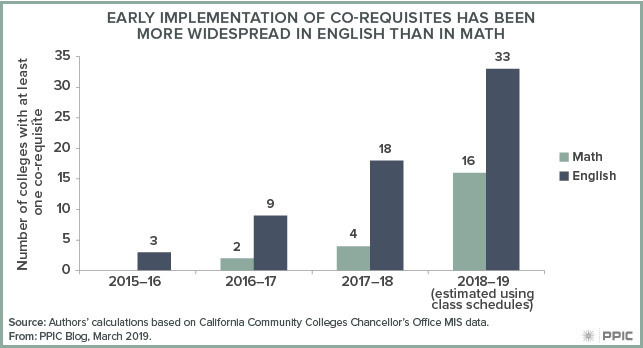
The new policies will be implemented systemwide by fall of 2019, but some colleges began offering co-requisite courses ahead of schedule—as early as 2015–16. Implementation has been faster in English than math: as of 2017–18, 33 of the state’s 115 community colleges were offering English co-requisites, while only 16 offered math co-requisites. This is not surprising, considering that co-requisite support in math must be tailored to the transfer-level courses required for different majors (e.g., statistics, business calculus, pre-calculus, college algebra, math for liberal arts). Between 2016–17 and 2017–18, enrollment in English co-requisites more than doubled (to 8,200), while enrollment in math co-requisites increased 36% (to 1,300).

figure - Early Implementation of Co-requisites Has Been More Widespread in English than in Math

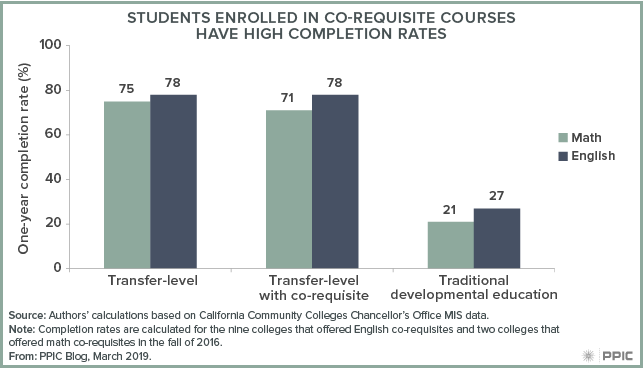
A recent PPIC report found that students enrolled in co-requisite courses are significantly more likely to successfully complete transfer-level courses in math and English than students who started in traditional prerequisite developmental education courses. And they are as likely as those who do not receive co-requisite support to complete transfer-level courses within a year. This is notable because students who take transfer-level courses without co-requisites have been identified as college ready.

figure - Students Enrolled in Co-requisite Courses Have High Completion Rates

The early evidence on co-requisites is promising. As colleges move into the full implementation phase, ongoing research can help them understand what happens as they broaden access to transfer-level courses to a diverse group of students, what types of concurrent support work best, and how co-requisite students perform in subsequent college-level courses.

Video: Remedial Education Reform in Community College

Since the passage of Assembly Bill (AB) 705, California community colleges have been transforming their approach to remedial—or developmental—education. AB 705 requires community colleges to maximize the probability of their students completing transfer-level courses in the one-year time frame. To comply with AB 705, colleges are revising the way they assess student readiness for college-level courses—giving priority to high school GPA rather than tests. They are also changing course offerings and classroom approaches. How will the reforms affect student outcomes, and how are colleges dealing with the challenges of implementation?

At an event in Sacramento last week, PPIC researcher Marisol Cuellar Mejia outlined the findings of a new report that sheds light on AB 705’s potential impact by looking at the efforts of “early implementers”—colleges that began experimenting with reforms before AB 705 was signed into law. A panel of experts then offered a range of perspectives on AB 705 implementation.

Roanna Bennie, interim president of Las Positas College—an early implementer—noted that only a small fraction of students who start at the beginning of a traditional, multi-course math remediation pathway end up taking transfer-level courses. “It’s the data that’s been really influencing our campus to take measures,” she added. But she also said that her college is wrestling with full-scale implementation. The challenges include covering the cost of additional courses, getting input from faculty and other staff across campus, and helping students adjust to the changes.

Laura Metune, vice chancellor for external relations in the California Community Colleges Chancellor’s Office, emphasized the importance of professional development for both faculty and staff: “Everybody needs to understand what these changes are that we’re asking for, the research behind them, and what their individual roles are in helping them be successful.”

What comes next? As Katie Hern, an English instructor at Chabot College who co-founded the California Acceleration Project, put it: “The debate up until now has been whether to make these changes. That debate is over—the legislature settled that one. Now we have to make these changes and now we get to really study how to do it as effectively as possible.”

Trends in Math Reforms at Community Colleges

The landscape of developmental (also known as remedial) math at California’s community colleges has changed dramatically in recent years. With the passage of Assembly Bill 705, community colleges will be required to maximize entering students’ likelihood of completing college-level math and English within a year. This is a critical goal. Our research has shown that developmental course sequences are lengthy, delaying students’ academic careers and sometimes affecting their ability to advance to college-level coursework.

The new law goes into effect in fall 2019, but many colleges have already started implementing reforms to improve the accuracy of placement into developmental education and to shorten developmental sequences while making them more relevant to students. In the 2017–18 school year, 83% of community colleges offered new developmental math courses in addition to or in place of traditional courses. Example course reforms include:

  • Offering statistics pathways for students in majors that only require statistics (e.g., liberal arts and humanities fields)
  • Compressing the traditional multi-course developmental sequence into a single course
  • Providing lab time or supplemental instruction in a co-requisite course while allowing students to enroll directly into college-level math
  • Designing curricula aligned with students’ programs of study
  • Dividing courses into modules that represent discrete math competencies

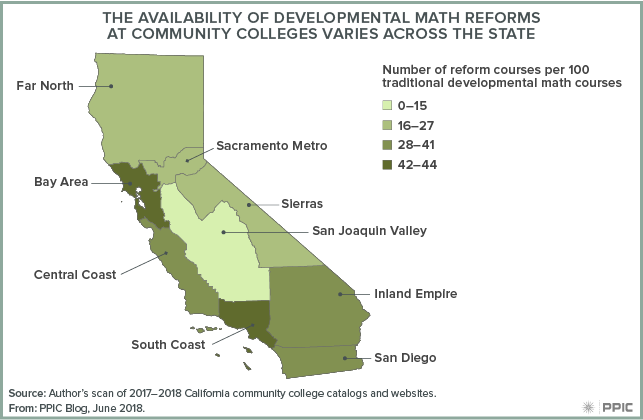
However, the availability of these new courses varies greatly within colleges and across the state. As illustrated in the map below, for every 100 traditional math courses offered in each region of California, less than 50 reform courses are offered, indicating that on the whole reform courses are still not as available as traditional courses. Moreover, reform courses tend to have fewer sections, which further limits enrollment.

Colleges that are adopting course reforms are mostly concentrated in highly populated regions such as the Bay Area and South Coast, which collectively serve about 56% of full-time community college students in the state. In contrast, the San Joaquin Valley stands out as having the smallest ratio of reform to traditional developmental math courses, while serving roughly 10% of full-time community college students in the state. Only six out of the thirteen colleges located in the San Joaquin Valley offer at least one course-level reform.

Although some California community colleges have already implemented developmental math reforms, overall, these efforts have reached only a small fraction of the students that could potentially benefit. Math guidelines for AB 705 are still pending, but the legislation may offer the leverage needed to implement effective reforms at scale and dramatically improve student completion of college-level math courses.

Testimony: Reforming Key Policies at the Community Colleges

Olga Rodriguez, research fellow at the PPIC Higher Education Center, testified before the Assembly Higher Education Committee in Sacramento today (April 3, 2018). Here are her prepared remarks:

Thank you for the opportunity to testify this afternoon. My name is Olga Rodriguez and I am a research fellow at the Public Policy Institute of California. PPIC is a nonpartisan policy research organization and does not take positions on legislation. My comments are based on research we have conducted at PPIC on California’s community colleges.

Every year, California’s community colleges identify hundreds of thousands of students as not ready for transfer-level courses in math and English. Since these courses are required to transfer to a four-year college, students deemed underprepared are placed in developmental (also known as remedial or basic skills) courses to prepare for college work. These placement decisions have profound effects: our study finds that 80% of entering students take at least one developmental course in math, English, or both, and very few of those students complete a college-level math or English course, or transfer to a four-year college after six years.

Despite the critical role of assessment and placement, historically there has been little clarity about how colleges across the state assess and place students into math, English, and English as a Second Language (ESL) sequences. The overwhelming majority of colleges do not have this information publicly available in their college catalog or on their website. To help fill this information gap, in spring 2016 we surveyed all 113 community colleges in the state; 82 of the colleges participated in the survey. They reported on the policies used to assess and place students into transfer-level math and English as well as the highest level of ESL during the 2014–15 academic year. The broad goal of the survey was to provide policymakers and practitioners with a descriptive landscape to improve understanding of the policies used across the state to assess and place students into math, English, and ESL courses. These results provide an important baseline prior to the implementation of assessment and placement reforms. I describe our findings below.

  • First, community colleges varied in how they identified college-ready students. We find that the use of assessment tests was widespread; 100% of colleges reported using assessment tests for math, English, and ESL placement. However, there was variation in the types of tests used and how they were used. For example, while more than half of colleges reported using the Accuplacer test to assess college readiness in math, cut scores ranged from 25 to 96 out of 120. A student with a score of 58 (the median score used by colleges) would be deemed college ready at half of these colleges, but not at the other half. The lack of consistency means that access to college courses—credit-bearing courses that students need in order to transfer to four-year colleges—is determined not only by students’ performance on the test, but also by the policies at the college where they enroll. This wide variation may be especially challenging for the 40% of students who eventually enroll in more than one community college campus, as they could be deemed college ready at one college but referred to remediation in another. These policies end up undermining opportunities to transfer between campuses and provide mixed signals about what it means to be ready for college-level courses. Furthermore, assessment and placement practices have implications for equity. Students of color are more likely to attend colleges that set higher math cutoff scores, which means these students have less access to the math classes they need to advance.
  • Second, the use of multiple measures was sparse and unsystematic. In California, the use of other measures in addition to placement exams (known as multiple measures) is mandated by law. In fact, research shows that measures such as high school achievement data do a comparable or better job at predicting college success compared to assessment tests. But while assessment tests were standard practice, there was substantial variation in the types of other measures used across colleges and across subjects. Additional measures included high school GPA, grades in prior English and math coursework, results from the Early Assessment Program (EAP), and counselor or instructor recommendations, among others. Overall, we find that 61% of colleges used grade in last math course, and 40% used grade in last English course; but only about one-third of colleges used high school GPA for placement into math and English courses. Even fewer colleges used these measures for ESL placement (8–12%). In addition, while some colleges used multiple measures in a systematic way for all students, up to 30% of colleges only used multiple measures if students requested it or challenged their placement. Uneven implementation of multiple measures may aggravate inequities if students with cultural and social capital are more likely to take advantage of these policies.
  • Third, assessment and placement in ESL needs more attention. Each year, about 30,000 students enroll in ESL, and these students may be especially disadvantaged by current policies. Compared to English and math, in ESL, fewer colleges offered exemption opportunities and test preparation activities. Additionally, our findings suggest that a lower proportion of colleges used high school achievement data for ESL placement, indicating that English Learners may not be benefitting from one of the most promising methods of improving placement accuracy.
  • Finally, ongoing reforms aim to promote more consistent and accurate placement policies. With the support of the governor, the legislature, and the system office, a significant amount of resources have been devoted to improving assessment and placement at community colleges. The passage of Assembly Bill 705 will help address this issue by mandating that all colleges use high school achievement data for the assessment and placement of all students. Still, if colleges have the autonomy to set their own rules for placement, and if colleges do not fully inform students of their placement rules, this will be a cause for concern as uneven access to transfer-level courses has significant implications for student success.

In sum, assessment and placement policies should help students reach their academic goals—not stand in the way of those goals. As colleges work to enhance the efficacy of developmental education, implementing evidence-based practices that accurately assess students’ college readiness will be critical. A more equitable and efficient system for assessment and placement is a vital step in helping all students achieve their academic goals.

Video: Improving English Courses at California’s Community Colleges

California’s community colleges are in the midst of numerous reforms to improve developmental—or remedial—education. Developmental education is supposed to help prepare students for college work but it has long been an obstacle to student success: most students in developmental classes never go on to complete a college-level course in English or math. A recent report by the Public Policy Institute of California (PPIC) looks at the effectiveness of some of these reforms in English. It finds that one reform in particular shows real promise. Called one-semester acceleration, it’s a highly intensive course that leads directly to a college composition class. Still, there is much room for improvement, especially for underrepresented students.

PPIC researcher Marisol Cuellar Mejia presented findings from the report in Sacramento this week. In a discussion following the presentation, panelists talked about promising initiatives underway in developmental education. Many of the current efforts to more accurately place students in appropriate classes and transform course sequences are motivated by AB 705, a legislative proposal signed into law by Governor Jerry Brown last fall. Assemblymember Jacqui Irwin, who authored the bill, said it provides flexibility to the state’s individual community colleges “but with clear requirements that colleges use the best of multiple measures—including high school performance—in placing students.” The bill also instructs colleges to maximize the possibility that students pass a transfer level class within a year.

Laura Hope, executive vice chancellor for educational services at the California Community Colleges Chancellor’s Office, described the central challenge involved in full-scale implementation of reforms across the state’s 114 community colleges as an instructional paradigm shift. “It’s about changing minds and hearts about student capacity and the belief that they don’t come to us just a jumble of deficits . . . It’s about shifting that mindset away from fixing students into activating students.”

Summer Serpas, assistant director of the California Acceleration Project, underscored the professional support that teachers will need as a larger and more diverse group of students move out of developmental courses and into transfer-level ones: “These students are capable of doing the work, but they come in needing [additional] support.” Serpas said it will be critical to learn from colleges that have already adopted successful reforms, including accelerated pathways and the “co-requisite” model, in which students enroll directly in college composition with concurrent support.

Video: Keeping Students on Track for College

Only about 30% of California 9th graders are expected to earn a bachelor’s degree—a startling statistic in a state that faces a shortfall of college graduates. A new PPIC report finds that the vast majority fall off the path to a college degree in the last two years of high school or the first two years of college.

Report coauthor Niu Gao presented the analysis in Sacramento last week, along with recommendations for tackling the problem. Among them: updating high school graduation requirements, offering more of the college preparatory courses required for admission to California State University (CSU) or the University of California (UC), and improving placement policies in both high schools and community colleges to ensure that students take the classes needed to progress.

Gao’s presentation was followed by a panel discussion among experts who work in this area. In a conversation moderated by Hans Johnson—report coauthor, and director and senior fellow at the PPIC Higher Education Center—participants touched on challenges, as well as potential solutions.

Jorge A. Aguilar, superintendent of the Sacramento City Unified School District, noted that while more students are completing college prep courses—known as a–g courses—many aren’t making it to or through college. Part of the problem, he said, is the “fundamental disconnect between K–12 and higher education.” Having worked in both sectors, he noted there are insufficient incentives for school districts to focus on persistence in higher education and for higher education to work with K–12 on the issue.

Kimberly Rodriguez, chief education advisor to Kevin de León, state senate president pro tempore, addressed one of the report’s key recommendations: increasing state high school graduation requirements in math. She noted that requiring a–g courses for graduation has been much discussed at the state level.

“The biggest barrier has always been money,” she said. “Because once you require it, the state is on the hook.” Implementation is also complicated, she said, requiring planning and attention to infrastructure—as districts that have already adopted these requirements have found.

The third panelist, Jim Dragna, talked about a promising initiative. Known as the “graduation czar” at CSU Sacramento, he supervises the Finish in Four program. Students are asked to pledge to take 15 credits a semester—the number needed to graduate in four years—and are provided extra resources to ensure they stay on track.

“Student progression problems have been with us so long that they’ve become part of the culture,” he said. So, he continued, “we tackled the culture.”

Video: Reforming Remedial Math in Community College

Developmental—or remedial—education is one of the largest barriers to student success in California’s community colleges. The good news is that reforms are underway, and a new report by the Public Policy Institute of California (PPIC) looks at the effectiveness of some of these reforms in math. PPIC researcher Olga Rodriguez presented the report in Sacramento this week. One reform the researchers studied is an alternative to traditional algebra-based courses and is designed for students in majors—particularly those in the liberal arts and humanities—that require only statistics. The report finds that students in this statistics sequence substantially outperform their peers who take traditional developmental math.

In a discussion following the presentation, panelists addressed the issue of why this math alternative is not more widely available. Myra Snell, math professor at Los Medanos College and cofounder of the California Acceleration Project, said the reasons range from the logistical to the cultural. Most math professors are not trained in statistics. Further, there is a deeply held belief among faculty that intermediate algebra is essential. She said that this “gets in the way of them rethinking what might be best for students.”

Laura Metune, vice chancellor of external relations at the California Community Colleges Chancellor’s Office, noted the necessary shift in emphasis from encouraging campuses to try multiple interventions to investing in alternatives with the best chance of helping more students achieve their academic goals.

Nikki Edgecombe, senior research scientist at the Community College Research Center at Teachers College, Columbia University, noted: “If we know that students who are completing a statistics-level pathway are completing their transfer-level math at a significantly higher rate, but we hold on to the old system as well, it’s safe to say we’re doing a lot of students a disservice.”

She continued: “To be honest, there are a lot of bad ideas out there. We need to have the moral courage to identify what those are and fashion solutions for students.”

Learn more

Read the report Reforming Math Pathways at California Community Colleges
Visit the PPIC Higher Education Center

Reforming Remedial Education in Community College

Reforming developmental, or remedial, education is essential to improving student outcomes in community colleges. Why? Developmental education is supposed to help underprepared students, but currently it may be one of the largest impediments to success. As PPIC research has shown, 80 percent of incoming California community college students—and a disproportionate share of students of color—enroll in at least one developmental course, but relatively few successfully move on to complete a college-level course. The good news is that over the last few years, there has been a tremendous amount of support for reform.

Reforming Assessment and Placement
Assessment and placement reforms generally involve moving away from the traditional reliance on standardized tests and toward a more holistic measure of prior achievement such as high school course grades. Research finds that test-based assessment and placement policies assign many students into remediation unnecessarily. Indeed, students’ high school performance as measured by GPA and course grades—even when self-reported by students—is a much more accurate indication of student readiness. A recent report by the California Acceleration Project shows that the use of high school measures has dramatically broadened access to and completion of college-level math and English courses, significantly reduced equity gaps, and has had little impact on course success rates.

But implementation is key. Several decisions will determine the impact of new policies in increasing access to college-level courses and reducing unnecessary remediation: What GPA or course grades will qualify a student for access to college-level courses? If a college uses multiple measures, how will they be combined into a single placement decision? Will colleges accept students’ self-reports of their GPA and grades? Furthermore, as campuses expand access to college-level courses, it is critical that they provide supports to students who need to brush up on their math or English skills. Guidance provided by the Multiple Measures Assessment Project, the California Acceleration Project, and others will be central to helping colleges make these important decisions.

Reforming Developmental Courses
Changes to developmental coursework can also help more students progress to college-level courses.  Some colleges are transforming traditional developmental education into accelerated pathways that are relevant to students’ programs of study using the design principles of guided pathways introduced by Bailey, Jaggars, and Jenkins, which allow colleges to cluster hundreds of programs of study into a handful of broad areas (e.g., liberal arts, STEM, business, and health). For example, in math, there are statistics, quantitative reasoning, and STEM/precalculus pathways. In English, reforms often entail integrating reading and writing courses and contextualizing classes within broad fields of study. Additionally, colleges have shortened developmental pathways or offered concurrent support courses instead of requiring students to take prerequisites. This reduces the number of students who drop out because they fail to reenroll in long developmental course sequences, while providing just-in-time support to help students succeed in college-level work.

Across the state, PPIC has found that a growing number of developmental education reforms are underway—led by the California Acceleration Project and the Carnegie Foundation, among others. These initiatives are well positioned to implement reforms using the guided pathways framework. Emerging research suggests that providing accelerated math pathways that are more aligned with students’ programs of study helps improve early academic outcomes, including completion of college-level math. Less is known about the impact of developmental English reforms on student outcomes, but recent evidence on compressed and co-requisite English courses is encouraging.

Research and Policy Opportunities
Support for developmental education reform and guided pathways at community colleges has been spearheaded by the multimillion-dollar investments made through the Community College Chancellor’s Office, the governor’s annual budget, and legislative proposals, including AB 705 and SB 539. As colleges continue to adopt and scale placement and course reforms, it will be imperative to assess students’ perspectives and outcomes to determine if new policies improve student success and reduce equity gaps.