California’s Immigrants and the 2018 Election Context

This piece is excerpted from a presentation at the USC Annenberg School for Communication and Journalism given on March 30, 2018, in Los Angeles.

Many eyes will be on California in this midterm election year, especially since control of Congress may hinge on the outcome of 10 competitive House races in the Golden State. Currently, more than a quarter of the state’s residents are born outside the US—and one in five immigrants make up what we consider likely voters in California elections. With federal immigration policy playing a lead role in today’s polarized political discussions, will California’s immigrants have an impact—and to who’s advantage—in the 2018 election?

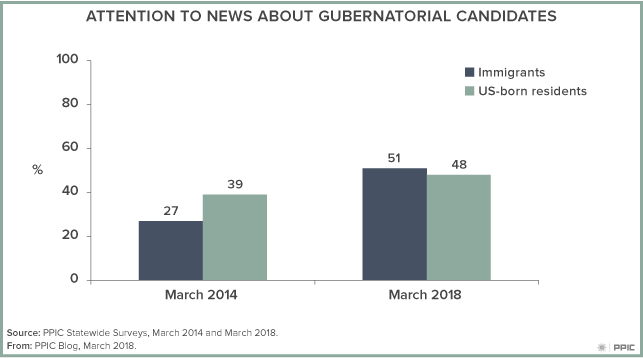
Typically, California’s immigrants are less interested in politics than their US born counterparts. But not when it comes to the 2018 election cycle. Among likely voters in our current survey, immigrants and nonimmigrants are similarly likely to be following the news about gubernatorial candidates “very” or “fairly” closely (51% immigrants, 48% US born). Both groups say that voting this year is more important than in past midterm elections (47% immigrants, 51% US born). Perhaps most telling for this year, both likely voter groups mention immigration and illegal immigration when asked about the issue that they would most like to hear the gubernatorial candidates talk about before the June primary (23% immigrants, 23% US born).

When it comes to current candidate choices, we do see some divergence between immigrant and US-born likely voters:

  • Democrat Gavin Newsom slightly trails Democrat Antonio Villaraigosa among immigrants (17% to 23%), while he is favored by three to one over Villaraigosa among nonimmigrants (30% to 9%).
  • Republican John Cox does equally well with both groups (15% immigrants, 14% US born).
  • Democrat Dianne Feinstein is favored by large margins over Democrat Kevin de León both among immigrants (50% to 18%) and nonimmigrants (40% to 16%). She has a higher approval rating among immigrants than nonimmigrants (68% to 51%).
  • Immigrants are more likely than nonimmigrants to favor the Democratic candidates in their local House races (63% to 51%) and less likely to favor the Republican candidates (30% to 41%). Immigrants also give higher approval ratings than nonimmigrants to their current local House member (59% to 51%).

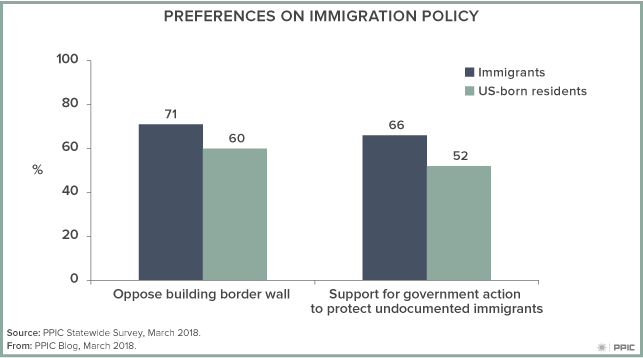
Despite these differences, immigrant and nonimmigrant Californians are aligned in their views of the current policy landscape. Majorities in both likely voter groups disapprove of President Donald Trump (63% immigrants, 60% US born), oppose the new federal tax law (65% immigrants, 56% US born), want gun laws to be stricter (82% immigrants, 67% US born), and oppose building a wall along the entire border with Mexico (71% immigrants, 60% US born). When it comes to state and local governments making their own policies and taking action separate from the federal government, majorities in both likely voter groups say they are in favor of protecting the legal rights of undocumented immigrants (66% immigrants, 52% US born).

One of the political wildcards in this California mid-term election is whether the strong opposition to federal immigration policy will motivate more naturalized citizens to vote and more noncitizens to become citizens and register to vote. As noted earlier, immigrants make up a larger share of the state’s population than is reflected in the likely voter group—leaving much room for growth that could transform the state’s electorate. The PPIC Statewide Survey will be closely monitoring the trends in political engagement and ballot choices in this consequential election for California and the nation.

Five Factors for Successful Online Learning

Governor Brown’s budget proposal requested a $100 million initial investment, along with $20 million annually, to establish a new online college that would be part of the state’s community college system. This college would initially focus on short-term certificate programs for non-traditional students ages 25–34 who are already in the workforce. In the long term, this college would seek accreditation, provide pathways to transfer to a four-year college, and compete with established online course providers like Arizona State Online and the for-profit University of Phoenix.

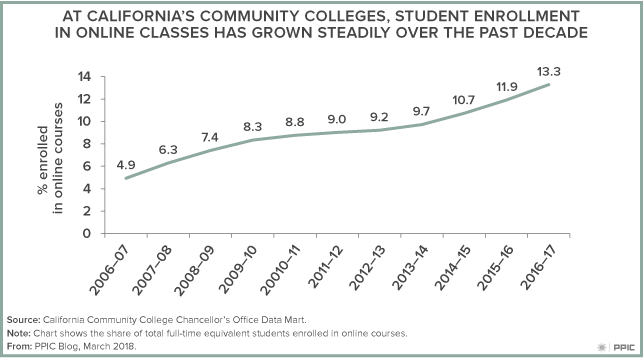
Tens of thousands of students already take online courses offered by California’s community colleges. In fact, the share of student enrollment in these courses has increased 9 percentage points over the past decade to more than 13% in 2016–17. The new online college, if established, is likely to accelerate this trend.

Previous PPIC research has identified five key factors to help ensure student success in online programs:

  1. Use a systems approach to course design. In this model, an instructional designer works with faculty, media developers, and programmers to develop an online course. This approach recognizes the fundamental differences between online and face-to-face instruction and allows instructors to focus on the subject matter and student engagement.
  2. Provide professional development. Effective online instruction requires distinct strategies. For example, to guide discussion online, instructors must gauge student engagement and develop appropriate norms without the usual visual and auditory cues. Rapid changes in technology and the isolated nature of online instruction also make professional development and mentorship particularly important.
  3. Set student expectations. There is a common misconception that online courses are easy. On the contrary, students in online courses often struggle with the autonomy, time management, and digital literacy necessary to succeed. Successful online programs use orientation courses to set expectations and clarify the differences between online and face-to-face education.
  4. Create community. Communication is essential to foster a constructive learning environment and positive peer interactions. Online courses that encourage regular and effective communication among students and between students and their instructor develop a better sense of community and improve the likelihood of student success.
  5. Take advantage of the online environment. Online tools offer unique insights not available in face-to-face pedagogy. Data on student engagement (e.g., did students view the syllabus or access additional course resources?) can provide clues for how to improve student outcomes. Online learning also facilitates personalization and can be adapted to different learning styles and special needs.

In 2013–14, the community college system launched the Online Education Initiative (OEI), which promotes these best practices and has established online course standards and faculty training in pedagogy and course design. As the state moves forward with its proposal to create a new online college, the OEI could play a key role. Overall, the line separating online and face-to-face learning is not as stark as many suppose. Most college courses already incorporate some online aspects, whether it’s an online course management system, chat room, or video conferencing. As the online and face-to-face worlds continue to merge, furthering our understanding of best practices for online instruction will be critical to student success in higher education as a whole.

How Oroville Is Changing Dam Safety in California

California’s 1,500 dams are regularly inspected and most have been safe for generations. Before last year’s Oroville Dam spillway crisis, the last dam disaster was the deadly 1928 Saint Francis Dam failure in Southern California. But the scale and drama of the Oroville crisis jolted the state into action, resulting in a stream of safety reviews, forensic analyses, and policy changes.

Within weeks of Oroville’s spillway incident, Governor Brown announced a 4-point plan to bolster dam safety and flood protection. And with the enactment of Senate Bill 92, a new dam safety regime has strengthened the state’s existing system.

We asked two experts about the lessons of Oroville for dam safety in California: Jeff Mount, a senior fellow at the PPIC Water Policy Center and an expert in hydrology and geology; and Jay Lund, director of the Center for Watershed Sciences at UC Davis, a member of the National Academy of Engineering, and an adjunct fellow at PPIC.

“First, we have to do a more complete job of assessing infrastructure,” said Lund. “We need to look for potential cascades of failures, which is what happened at Oroville. And we need to look at all of the outlet structures, which are essentially a dam’s safety valves.”

He noted that all federally regulated dams are subject to safety analysis every seven years, “yet they didn’t pick up the problems of Oroville. The lessons here are that you can never stop worrying about infrastructure and that we have to be prepared for things to fail.”

Mount seconded the need to stay vigilant, noting, “Water has a way of finding weaknesses in planning, design, and maintenance. If you miss something, eventually water will find a way to tell you so.”

Another new dam safety bill, Assembly Bill 1270, requires the state to consult with independent experts to update dam safety practices every 10 years. Lund said that will encourage the use of new kinds of technologies and practices. “But I think more important than the law itself is the culture of the people in charge of dams and dam safety, and whether they’re given the right resources and the mission to do more thorough assessments of old problems lurking in these structures.”

Mount noted that climate change is a complicating factor. “The inspections and upgrades are a good start,” he said. “But many of our dams―including Oroville―were designed more than 50 years ago. We need to evaluate how to operate them under changing hydrologic conditions.”

He added that many large dams try to fulfill multiple, conflicting objectives. “For example, a flood manager wants an empty reservoir during flood season while a water supply manager wants to fill the reservoir as much as possible. We’ll need to take a second look at how we manage dams for competing objectives and will likely face some tough trade-offs.”

Oroville also raises the question of how to pay for dam safety over the long term. “The Oroville episode will probably end up costing slightly less than $1 billion,” Lund said. “At 5% interest, that’s $50 million a year. A $50 million annual flood safety program might have avoided this. There is probably a good financial argument to increase spending on maintenance and inspection of major infrastructure.”

The 2020 Census Is Critical for California

The decennial census plays an essential role in American democracy. Most fundamentally, it ensures that communities get the right number of representatives in government. Less well known is the role it plays in determining how hundreds of billions of federal dollars are allocated to states and localities for a wide range of public services, including health care and child nutrition programs.

Although census information is essential, the Census Bureau is currently budget constrained, behind schedule, and scaling back the number of full-scale test runs it was planning. This is of particular concern since several key changes to the census process are in the works: the majority of census information will be collected online, resources for door-to-door outreach may be reduced, and a question about immigration status will be added to the official questionnaire. These and other factors increase the potential for an undercount, especially among vulnerable populations. Just today, California Attorney General Xavier Becerra has filed a lawsuit over this issue.

Why are the stakes so high? A significant undercount could cost California political representation in Congress at a time of record polarization and a deep partisan divide over the direction of the state and the nation. Critical decisions that affect California’s future will be determined to a large extent by federal rules on such issues as climate change, health care, and immigration.

An undercount also means that an important amount of federal funding could dry up. Federal, state, and local government programs that target disadvantaged neighborhoods or populations rely critically on census surveys to identify those in need and distribute funds accordingly. For example, two programs crucial to the health and well-being of children in California—the Children’s Health Insurance Program and the Women, Infants, and Children program—rely on population estimates that use the decennial census count as a baseline for population estimates with which they aim to accurately allocate funds across states.

The impact on California could be huge—and 2020 is fast approaching. At a time when objective facts and information are in short supply, PPIC will be working to raise awareness about the importance of the 2020 Census for California and motivate elected leaders and organizations across the state to work together to ensure an accurate count. Stay tuned for more facts and analysis of the 2020 Census from PPIC.

Video: Preview of the California Primary

As California’s June 5 primary approaches, the latest PPIC survey finds Democrat Gavin Newsom gaining ground over Antonio Villaraigosa in the governor’s race, while support for Republican John Cox rises among likely voters. In the US Senate race, Dianne Feinstein holds her double-digit lead over fellow Democrat Kevin de León.

Dean Bonner, PPIC associate survey director, detailed the findings at a Sacramento briefing last week.

The survey shows Newsom (28%) as the top choice among likely voters, followed by Cox (14%), Democrat Villaraigosa (12%), Republican Travis Allen (10%), and Democrats John Chiang (6%) and Delaine Eastin (5%). Yet a quarter of likely voters are still undecided, which raises questions about what will happen in the top-two primary.

A few other highlights include:

  • Governor Jerry Brown’s approval rating (54%) has held steady, despite state-federal tension over immigration policy. The legislature’s approval rating (45%) has also stayed consistent, in spite of sexual misconduct reports last fall.
  • The top issue voters would like gubernatorial candidates to talk about before the June primary is immigration, followed by guns or school safety.
  • Nearly half of Republicans (48%) are now joining an overwhelming number of Democrats (87%) and independents (68%) in saying there should be stricter gun controls.
  • Bipartisan support emerged for a water bond measure, with two-thirds of likely voters saying they would vote yes. Partisans were more divided on affordable housing projects.

World Water Day through a California Lens

Happy World Water Day―a day that brings attention and, hopefully, action to some of the world’s most pressing water challenges. This year’s theme is “exploring nature-based solutions to the water challenges we face in the 21st century.” It’s a concept that shows the deep linkages among many water problems—and the need to tackle these problems jointly.

California’s complex array of water challenges make it something of a policy lab for trying out a “portfolio approach” that addresses issues in an integrated way. Although California has one of the world’s largest economies, the state faces many of the same water problems seen around the world. Too many communities don’t have access to safe drinking water. Some critical water infrastructure is in poor shape. The state’s ecosystems are in decline, with many aquatic species hovering near extinction. To complicate things, we have an extremely variable climate—so both droughts and floods are a reality Californians live with.

Our recent policy brief, Priorities for California’s Water, provides a road map for taking on some of these challenges. The report highlights linkages among key issues and points to integrated solutions that can bring multiple benefits—approaches that are especially important in light of the changing climate.

For example, wildlife-friendly farming can support ecosystems while maintaining the economic viability of farms. Cooperation on storing and releasing water from reservoirs can benefit fish while meeting downstream users’ needs. Investing in healthy watersheds can help protect drinking water supplies and reduce the risk of extreme wildfire. Flood protection projects that reconnect rivers to their floodplains can provide fish and wildlife habitat. By capturing and treating stormwater runoff, cities can improve water quality, augment their water supplies, and enhance wetlands or open space. Across California, there are promising examples of such approaches, but they are still the exception rather than the rule.

Here at the PPIC Water Policy Center, we could be accused of thinking every day is California Water Day. But we’re happy to be reminded that there’s a global effort to tackle critical water issues and growing understanding of the linkages among the world’s biggest water challenges. Finding solutions that can work in unison won’t happen overnight. It will take creative thinking and bold action from all quarters—water managers, governments, agricultural and urban water users, community and environmental advocates, business and scientific leaders. World Water Day reminds us we all live on the same blue planet and that solutions are within our reach.

Video: Assessing California’s Redistricting Commission

The creation of the Citizen Redistricting Commission (CRC) in 2008 marked a radical departure for California. This shift of responsibility for drawing state assembly, state senate, and US congressional districts from the state legislature to an independent commission also put California ahead of the national curve. Very few states have adopted a similar model, though many may be considering it—particularly in light of two US Supreme Court cases that could establish a legal standard for partisan gerrymandering. For California and for other states, partisan fairness and competitiveness should be important aims of redistricting reform.

A new PPIC report examines whether the commission’s first plan achieved these aims by analyzing recent election outcomes and putting them in national context. Researcher Eric McGhee described his analysis in Sacramento last week and outlined some key findings.

  • The CRC largely satisfied expectations that it would draw state legislative and congressional districts that are fair to the major parties and increase electoral competitiveness.
  • While Democrats have a greater advantage under the CRC plan than they did under the 2001 plan drawn by the legislature, this advantage is very small.
  • The CRC districts are somewhat more competitive than the districts drawn by the legislature. Competitiveness in state legislative districts remains low compared to other states, but the CRC congressional plan is among the most competitive in the country.

The report also notes that the CRC has moved California in the opposite direction from the rest of the country: other state plans are on average more favorable to Republicans and less competitive than plans from the last round of redistricting.

McGhee recommends that future commissions use more data to help them produce competitive and fair maps. He also recommends using sophisticated methods for automatically drawing redistricting plans.

Testimony: Transfer Is Key to Closing the Workforce Skills Gap

Hans Johnson, director and senior fellow at the PPIC Higher Education Center, testified March 20, 2018, before the Senate Select Committee on Student Success.

Here are his prepared remarks.

California faces a shortage of highly educated workers. Specifically, economic projections to 2030 show that about two in five jobs will require at least a bachelor’s degree, while demographic projections suggest that only about one in three Californians will attain this level of education. This shortfall equates to 1.1 million workers. To close the gap, all higher education systems will need to play a role, increasing access, transfer, and completion. Improving access and outcomes among groups historically underrepresented in higher education—including low-income students, first-generation college students, Latinos, and African Americans—is essential if we are to close the workforce skills gap.

The good news is that California’s students are rising to the challenge. College preparation among high school graduates has increased, with the share of students completing the college preparatory requirements of UC and CSU now at an all-time high. Strong demand for UC and CSU is likely to continue as college preparation improves and the transfer pathway becomes more efficient and effective. In addition, new initiatives, including reforms in remedial education at the community colleges and CSU, have the potential to substantially improve student success rates and boost transfer. Finding ways to accommodate all these students remains a central challenge, but one that must be met in order to ensure a better future for all Californians.

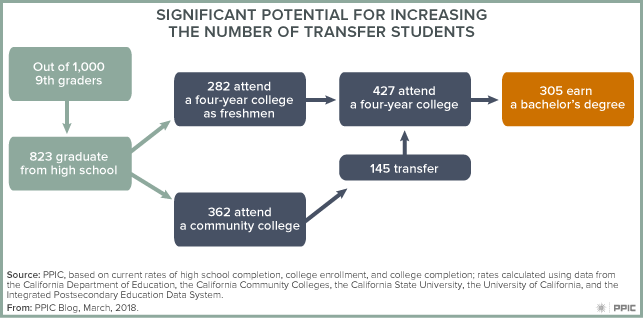
In this testimony, I will focus on the importance of transfer. California enrolls a disproportionate share of students in community college. We rank 47th in the nation in the share of recent high school graduates enrolling in four-year colleges and 5th in the nation in the share enrolling in community colleges. This means that we must do more to ensure that community college students reach their educational goals—since the vast majority of recent high school graduates attending community colleges say that they want to transfer and earn a bachelor’s degree. As shown in the chart below, there is a lot of room for improvement—only 40% of recent high school graduates who go to community college will end up transferring to a four-year institution.
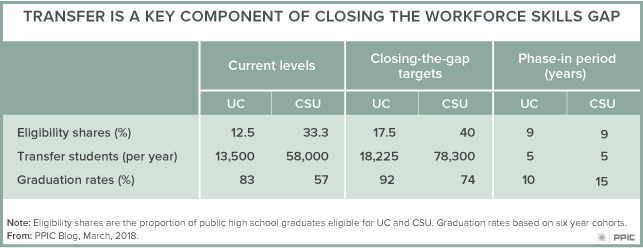
PPIC has identified ambitious targets that would close the workforce skills gap. As shown in the table below, doing so will require large increases in access to UC and CSU, both for first time freshmen and for transfer students. In its Vision for Success, a blueprint for improving student outcomes, the community colleges have established new goals for transfer that align exactly with the PPIC targets. Those targets include a 35% increase in the number of transfer students at UC and CSU, increasing from about 72,000 combined in 2015 to almost 100,000 by 2020.
I’m pleased to say that the colleges are currently on track to meet those targets. We are now two years into PPIC’s projections, and both UC and CSU have met the closing-the-gap targets (see charts below). The concerted efforts of policymakers, higher education officials—including staff and faculty—and, of course, students have led to these early gains.  State general fund allocations for each system have increased since the Great Recession, allowing for increased enrollment. At UC, those budget allocations were partially tied to increasing enrollment, hence the sharp rise in transfers from 2015 to 2016.  New articulation agreements, such as the Associate Degree for Transfer (ADT), have streamlined the pathway from community colleges to four-year colleges, especially CSU. And an increased focus on improving student outcomes in the community colleges has led to multiple substantive reforms designed to increase persistence and completion (including transfer).

These early successes are very promising. Still, California needs to build on them if it is to close the degree gap.  We offer the following recommendations for moving forward:

  • First, the state should work with the systems to ensure that students who are eligible for transfer successfully make the transition. Some students who are eligible to transfer never even apply to do so. More work needs to be done to understand factors that prevent those students from moving on, including an assessment of equity implications. At the same time, many transfer-eligible students do apply to transfer, but are not admitted because of insufficient resources at UC and CSU. Because of budget constraints, CSU reports turning away more than 32,000 transfer applicants from 2013–14 through 2016–17, even though they had met CSU admission requirements (based on systemwide unduplicated counts of California resident applications). UC does not report how many qualified applicants have been turned away, partly because UC eligibility is less clearly defined. UC has general transfer requirements, including courses and grade point average requirements, but advises students that “meeting these basic requirements doesn’t guarantee admission to the campus or major of your choice.” Enrolling more students will almost certainly require more funding, either from the state via the general fund or from students and their families through tuition increases.
  • Second, the pathway from community college to UC and CSU needs to become systematically and comprehensively streamlined. The Associate Degree for Transfer is a step in the right direction. Students earning an ADT are guaranteed admission to CSU in a major aligned to their course of study. But these degrees are offered only in some majors at some colleges. While the number of students earning an ADT has grown rapidly, it is still the case that the majority of transfers to CSU do not have the degree. As shown in the chart below, institutional participation in the program varies by college and by major. Some majors, including engineering, have no ADT at all.  Moreover, UC does not formally participate in the ADT guarantee. At UC, transfer admission requirements vary by campus and by majors within campuses.  For example, UC Berkeley’s College of Engineering has much higher standards than the UC minimum requirements for transfer, including a 3.5 grade point average and the completion of courses that are not offered at all community colleges.

  • Third, the state and its higher education institutions need to plan for potentially large increases in the number of community college students prepared and ready to transfer. New reforms in the community colleges hold the promise of dramatically increasing persistence and completion. Assessment and placement reform, spurred by AB 705, is likely to lead to an enormous increase in the number of students placed directly into college-level English and math courses—bypassing traditional remedial classes that have been the single largest impediment to student success. Other new initiatives, including “guided pathways” intended to provide a clear road map to students on courses of study and the supports needed to succeed, could lead to further gains. Because most transfer students enroll in CSU and UC, capacity issues at those institutions must be addressed. The state’s private nonprofit colleges are also an important destination for transfer students, and continued efforts should seek to gain greater participation and enrollment in that vital sector.

Through thoughtful planning—and yes, additional funding—closing the workforce skills gap is possible. Improving the transfer pathway is a necessary and critical component. And because community colleges are highly representative of California’s economic and demographic diversity, improving transfer pathways will ensure that more low-income, first-generation, and underrepresented students have access to a four-year degree.

California Makes Progress on Water Accounting

California’s water accounting system—the balance sheet of where and when water is available and how it is being used—lacks common standards, suffers from major data gaps, and is in need of modernization. A 2016 law, the Open and Transparent Water Data Act (AB 1755), directed several state agencies to improve this system. The Department of Water Resources (DWR)―in concert with other state agencies, non-governmental organizations, and universities―is taking the charge seriously and has set ambitious objectives to be completed within a tight timeframe.

The law requires California to create a statewide system for organizing and sharing water data by September 2019. Currently, water-related datasets are stored in many ways, including on public websites, on non-public servers, and even in paper filing systems. The proposed system will make it easier to find and use the data needed for water management, consolidating datasets into several agency-level collections and allowing users to search from a centralized search engine―similar to how an inter-library loan system works.

DWR collaborated with several research institutions to develop guidance for implementing AB 1755. The researchers examined how local, state, and federal water managers, businesses, community groups, and environmental organizations currently use water data to make decisions. Their findings highlighted situations where better data organization could lead to more efficient and effective decision making.

“We recommend that the new system be designed to reflect real-world water management decisions, to ensure that the final product is relevant and useful to water managers and other stakeholders,” said Alida Cantor of Portland State University, who led the research on behalf of UC Berkeley’s Center for Law, Energy & the Environment.

Beyond problems of data organization, California also has some major data gaps, including accounting for groundwater use and recharge, managing water for ecosystems, and assessing rural communities’ access to safe drinking water.

While AB 1755 doesn’t require the state to fill these data gaps, the new guidance by research institutions has improved understanding and flagged some specific gaps that hinder management decisions.

For example, information on surface water rights and the location of many groundwater wells is not in easily accessible formats. And streamflow monitoring is unavailable for many important aquatic ecosystems. These three data gaps make it difficult for regulatory agencies to permit water trading between water users and the environment—a way to dedicate water to improve the in-stream environment. A current legislative proposal would have the state take a closer look at where more stream gages are needed.

AB 1755 is a “foundational first step” in the path toward better accounting for California’s water, according to Mike Kiparsky, director of UC Berkeley’s Wheeler Water Institute, who helped develop the new guidance. DWR and its partners will prepare a final strategic plan for the new statewide data system in spring 2018. This may also be an opportune moment to take a closer look at high-priority data gaps and develop concrete plans to address them.

Learn more


The Rising Cost of College: Student Fees

Students, parents, and lawmakers often express concern about tuition increases at California’s public universities. But tuition is not the only college cost that has been rising. Students also pay fees that cover many non-instructional costs, and between 2013 and 2016, student fees increased an average of 21% at both the UC and CSU systems, even as tuition itself stayed flat.

UC charges a systemwide fee ($1,228 for 2017‒18) to cover student affairs operations, and UC campuses can assess their own fees. CSU does not assess a systemwide fee; instead, the Chancellor’s Office allows campuses to decide how much to charge for each of seven fee categories, ranging from health services and facilities to instructionally related activities to the student association. When students vote to approve referenda, they are agreeing to implement fees for new or expanded services.

Fees typically pay for things like student affairs services, health center services, campus gym services and facilities (initiated at UCLA and UC Irvine in the early 2000s), and student union seismic retrofit fees. Today, student-advocated fees commonly pay for expanded psychological health services and recruitment and retention centers.

Campus-based and systemwide fees add from 15% to 25% to tuition at UC and 15% to 65% at CSU. Total fees assessed in 2017‒18 range from $1,759 (UCLA) to $2,949 (UC Santa Barbara) in the UC system and from $843 (Fresno State) to $3,718 (Cal Poly San Luis Obispo) at CSU schools.

While financial aid protects low income students from tuition increases, it doesn’t always cover fees. State and institutional aid programs cover only tuition and systemwide fees, so most campus-based fees must be paid by all students. This lack of coverage is becoming a bigger issue now that fees are on the rise. The UC Regents systemwide fee increased more than 10% from 2013 to 2016, and campus-based fees increased an average of 24%. At CSU, campus-specific fees increased by an average of 23%. This has increased the total cost of attending college even though the state and the two systems made a deal to freeze tuition.

Fees have become an important source of revenue for campuses, enabling them to provide non-instructional services. But, along with high housing costs, rising college fees are having an impact on students and families. As policymakers consider revising the master plan and the administration of state financial aid, they need to address growing non-tuition costs.

Learn more