Making Homes More Water Efficient

Outside water use varies dramatically in California depending on location—hot, dry places use more than cool, coastal cities, for example. But the state also has huge variation for inside water use. We talked to Dave Cogdill—CEO and president of the California Building Industry Association and a member of the PPIC Water Policy Center Advisory Council—who explains how California could save billions of gallons a year if older homes were as water efficient as newer ones.
PPIC: How water efficient is the state’s current housing stock?

Dave Cogdill: New homes are quite water efficient, but about two-thirds of the state’s homes were built prior to water-efficiency standards. Our studies show that homes built after 1980 are two times more efficient in water use than those built prior to these standards—mostly due to water-efficient fixtures that are required for new construction. We could save 300 billion gallons annually—enough to supply 2.5 to 3 million homes—if the state’s existing homes had to comply with these standards. We estimate it would cost $1,500 per home to convert older homes with water-saving plumbing fixtures such as toilets, showerheads, and faucets.

PPIC: What policy changes would help ensure California’s inside-home water use continues to be as efficient as possible for the long term?

DC: Finding ways to get people to retrofit is the big challenge. Better incentives would help. The drought-relief legislation passed in recent years included some money for these sorts of things, but nowhere near enough. We have to get more creative with incentive programs. It’s the old carrot-and-stick argument. Building standards for new homes are easier than addressing the problems with existing housing. The state has started to address issues with existing homes by requiring point-of-sale improvements for earthquake retrofits and pest inspections; maybe something like that would make sense for water-saving plumbing fixtures too. It wouldn’t add a lot to the cost of a house—and maybe the state could make it a deductible item.

PPIC: What steps can home builders take to increase water efficiency in housing?

DC: Inside the home we’re pretty much there—new homes save as much water as possible without requiring people to change their standard of living. While there’s not a lot more we can do inside the home, outside water use is a different story. The state’s model landscape ordinance was substantially revised this year to help respond to the drought. Our members have been very involved to make it as workable as possible. Massive savings are possible in outside water use, and in new developments we’ll be seeing a lot more hardscaping, drought-tolerant plants, less lawn, more efficient irrigation. There’s also an evolution toward using more recycled water and graywater in homes. By July 2018 homebuilders will be required to install “purple pipe” for recycled water to be used in landscape irrigation in those areas of California served by water recycling plants. In addition, the state has already taken steps to allow for on-site water recycling technologies. These more expensive “on-site” systems can add anywhere from $3,000 to $15,000 to the cost of a home, but they bring a substantial savings in water. Just to give you an idea of what’s possible, one on-site water recycling system we’re familiar with in El Dorado Hills recycles approximately 65 percent of the water used indoors. Given the price of water in many communities, these systems will pay for themselves over time.

Learn more

Read California’s Water: Water for Cities (from California’s Water briefing kit, April 2015)
Read “Water and Growth in the West” (PPIC Blog, February 18, 2016)
Visit the PPIC Water Policy Center’s water supply resource page

Video: A High-Interest Election

By many measures, this is an unusual election year. In the presidential race between a businessman/reality TV star and the first woman nominated by a major party, most likely voters have made up their minds, the latest PPIC Statewide Survey shows. Yet interest in the election is high and satisfaction with the choice of candidates is low.

Two candidates from the same party are vying for an open US Senate for the first time since the state adopted the top-two primary system. About a quarter of likely voters say they won’t vote for either Democrat, and 19 percent are still undecided.

These are just two of the consequential choices Californians are being asked to make. There are 17 statewide initiatives on the ballot and in many communities, a number of local measures.

This all adds up to an election worth watching.

Dean Bonner, associate survey director, presented key findings from the survey to a Sacramento audience last week.

The Promise of a Four-Year Degree in California

Fewer than one in five first-time freshmen graduate from California State University (CSU) within four years. Because students who graduate on time require less state investment, tend to graduate with lower loan amounts and start earning income sooner, and open up space for other students, CSU has made it a priority to boost four-year graduation rates.

Senate Bill 412, known as the California Promise and recently signed by Governor Brown, aims to help more students graduate on time. Under the law, CSU campuses will promise priority course registration and additional academic advising as long as participating students pledge to take 15 units (usually four courses) per semester—while 12 units per semester is considered full-time for financial aid purposes, students need to accumulate 30 credits per year to graduate in four years.

How can the California Promise help CSU campuses increase four-year graduation?

In our research on CSU graduation rates, we have identified major factors related to low graduation rates and longer times to degree. Among the most common roadblocks are bottleneck courses—for which there is more demand than seats available. Another common problem is that students who change majors or simply don’t take the right combination of courses end up accumulating more units than they need to graduate.

Campuses have implemented several strategies to help students avoid bottlenecks, such as eliminating or streamlining course requirements, as well as increasing the number of sections offered for courses in high demand. Campuses have also focused on engaging students, improving and expanding advising, standardizing requirements across majors, and adjusting major-switching policies to address students accumulating extra units. Campuses expect their focus on four-year graduation to increase with the implementation of the new Graduation Initiative, which sets specific targets for on-time graduation rates. The California Promise also aims to help campuses address these roadblocks. Students who participate in the program will be able to enroll in the courses they need through priority registration. Participating students will receive advising and monitoring to help them take the right number and types of courses. The contracts will also stress the importance of taking enough units to graduate on time.

Who will benefit from the California Promise?

Students have to apply for the program, but automatic acceptance will be offered to any eligible applicant who graduated from an underserved high school, comes from a low-income family (defined as being eligible for a federal Pell Grant), or is a transfer student or first-generation college student. Other students may be accepted as well, as money permits. The California Promise may shorten times to degree for students in the targeted groups who are ready for college-level courses and able to take a full load but who would normally struggle to graduate on time due to course availability, a lack of advising, or who might otherwise take less than a full load without the promise. It is difficult to estimate how many students will fit into this group.

We know that about 40% of freshmen require remediation and may not be able to participate in the promise. Other students may work too many hours to enroll in 30 units per year. Another potential challenge is that high participation levels may make it harder for students who aren’t part of the program to graduate on time. Since no new funding is attached to the law, there are no new courses or advisers. Students without priority registration are likely to have less of a chance of getting in-demand courses that they need. And advising resources could also shift away from those students who are not a part of the contract.

Some campuses, such as CSU San Bernardino, already offer similar contracts. While initial results from some of these contracts suggest a positive impact, the programs are generally small in scope and still need rigorous evaluation. As campuses consider how to structure these agreements, they need to prevent students who don’t or can’t meet the terms of the contract from getting left behind. It will also be important for policymakers to consult with CSU campus leaders, faculty, and students to ensure that there is sufficient support for the program.

Learn more

Read the report Improving College Graduation Rates: A Closer Look at California State University
Visit the PPIC Higher Education Center

Ruling Muddies Waters on Clean Water Act

The California Supreme Court recently decided a case that could have profound consequences for the state’s efforts to protect water quality. The case reveals the challenges California faces in keeping polluted runoff out of waterways and coasts.

The court ruled that the state must reimburse Los Angeles and 83 other Southern California cities for certain costs of complying with a stormwater permit issued by the Los Angeles Regional Water Quality Control Board. Stormwater permits are part of the regulatory system created by the federal Clean Water Act and its California counterpart, the Porter-Cologne Act, to protect water quality. These laws regulate discharges of pollutants into the state’s rivers, bays, and estuaries, as well as the Pacific Ocean.

In this case, the permit directed the local governments to comply with a variety of conditions to clean up their stormwater discharges. The governments objected to two of them. The first required inspections of some commercial and industrial facilities and construction sites, as contaminated runoff from these areas can impair water quality. The second ordered the governments to install trash receptacles at transit stops to minimize trash washing into storm drains.

At issue is who should pay for implementing the programs. Constitutional reforms enacted by California voters in 1978 (Proposition 13) and 1996 (Proposition 218) place significant constraints on the ability of local governments to levy taxes and fees. Stormwater programs are particularly difficult to fund. New fees typically require a two-thirds vote of local residents. This can be an especially tough sell for stormwater improvements, because the reductions in pollution mostly benefit communities downstream. Because stormwater compliance lacks a steady funding source, it is one of California’s “fiscal orphans,” with an annual funding gap of $500–800 million.

In recognition of the constraints on local public finances introduced by Proposition 13, the voters amended the California Constitution in 1979 to compel the state to reimburse local governments for the costs of complying with new programs or higher levels of service required by state statute or regulation. The law makes an exception for programs or services mandated by federal law.

The Supreme Court held that the contested stormwater permit conditions were state policy choices of how to implement the Clean Water Act, but were not themselves federal mandates. Therefore, the state must pay for the costs of their implementation. All three of Governor Brown’s appointees dissented, arguing that the majority gave insufficient deference to the regional board’s determination that these conditions were the best means of achieving the federal pollution control directives.

The consequences of the court’s decision are uncertain. State reimbursement of a portion of permit costs would make stormwater improvements more affordable for local governments and their taxpayers. Yet, by shifting funding responsibility to the state, the decision assigns regional stormwater improvement costs to all California taxpayers, regardless of their contribution to stormwater discharges and pollution. With annual funding costs in excess of half a billion dollars, it is unclear whether the legislature would be willing to allocate sufficient funds to cover these costs.

Perhaps the greatest concern, though, is that the decision will deter the regional boards from imposing permit conditions not specifically required by federal law. This could have major consequences for stormwater management in California because most of the Clean Water Act’s stormwater directives are written in general terms. Therefore, it is likely that the decision will require the state to reimburse local governments for almost all specific regulatory mandates needed to implement the federal law.

For example, although the act requires stormwater dischargers to use “management practices” and “control techniques” to reduce pollutants “to the maximum extent practicable,” it neither defines those actions nor sets specific discharge limitations. Rather, federal law expressly delegates these decisions to the regional boards, which under the court’s decision makes their costs reimbursable to local governments.

If the legislature does not allocate sufficient funding to cover these costs, or if the regional boards issue permits without the specific conditions needed to achieve the federal mandates, California risks losing its authority to administer federal stormwater permitting. That means the EPA would assume permitting responsibility. Ironically, the EPA would be unconstrained by California’s prohibition against unfunded mandates and would have the power to impose all stormwater permit costs on local governments.

The Supreme Court’s effort to reconcile the realities of modern water quality protection with California’s unique constitutional fiscal constraints will likely generate more questions than answers. Yet, it is essential that the improvements needed to modernize California’s stormwater systems be adequately funded. We must hope that the court’s precarious balancing of the responsibilities of the state and local governments to pay for these improvements does not undermine the shared goal of protecting the quality of California’s waters.

Learn more

Read “California’s Water Quality Challenges” (PPIC Water Policy Center fact sheet, October 2015)
Visit the PPIC Water Policy Center water quality resource page

Chet Hewitt Joins PPIC Board, Mas Masumoto Named Chair

PPIC welcomed two accomplished Californians to key leadership roles today. Chet Hewitt, president and CEO of Sierra Health Foundation, joined our board of directors, and Mas Masumoto, noted author and third-generation farmer, was elected board chair. Each brings a strong record of public service and a deep knowledge of the forces shaping our state. Both share PPIC’s commitment to shaping a better future for all Californians. ·

Chet Hewitt has expanded the impact of the Sierra Health Foundation, a private philanthropy focused on improving health and quality of life in Northern California. Since he joined the foundation in 2007, he has focused on investments in four areas: health disparities, social determinants of health, health care access, and the well-being of vulnerable youth populations. He is also president and CEO of the foundation’s independent operating unit, the Center for Health Program Management, which works to eradicate health inequities across the state, with a special focus on the San Joaquin Valley.

Previously, Chet worked for five years as the director of Alameda County’s Social Services Agency, where he was credited with using technology to improve the delivery of services and transforming the agency’s child welfare system into a national model. He has also served as associate director for the Rockefeller Foundation in New York and program director for the Center on Juvenile and Criminal Justice in San Francisco. He was named administrator of the year by the Black Administrators in Child Welfare and has received several national honors, including the Annie E. Casey Foundation Child and Family Leaders Fellowship and Child Welfare Administrator of the Year. Recently, he helped found—and now serves as a co-chair—of the California Executives’ Alliance, a consortium of foundations focused on improving the life chances of boys and young men of color in California.

While he is new to the board, Chet is not new to PPIC. As a member of the PPIC Statewide Leadership Council, he has provided our management team with insights and advice about the state’s policy environment and our own programs and activities.

Mas Masumoto grows organic peaches, nectarines, and raisins on an 80-acre farm south of Fresno. Mas is the author of many books, including Epitaph for a Peach, Heirlooms, Letters to the Valley, Four Seasons in Five Senses, Harvest Son, Country Voices, and Silent Strength. In 2013, his family farm cookbook, The Perfect Peach—written with his wife, Marcy, and his daughter, Nikiko—was named one of best summer cookbooks by USA Today. The National Resources Defense Council selected another of his books, Wisdom of the Last Farmer, for its list of the Best Environmental Journalism of 2009. He is also a columnist for the Fresno Bee and the Sacramento Bee.

Mas was a Kellogg Foundation Food and Society Policy Fellow from 2006 to 2008. His writing awards include Commonwealth Club Silver Medal and Julia Child Cookbook Award. He was also a finalist for a James Beard Foundation Award. UC Davis honored him with an Award of Distinction in 2003, and he received the California Central Valley Excellence in Business Award in 2007.

Mas serves on the board of the Central Valley Community Foundation. He was on the James Irvine Foundation board from 2002 to 2014 and is the former chair of the California Council for the Humanities board. In 2013, President Obama appointed him to the National Council on the Arts, the board for the National Endowment for the Arts.

Changing Season, a documentary about succession on the Masumoto family farm, has been featured in film festivals and was nationally broadcast by PBS in May 2016.

Chet was elected to a three-year term and is eligible to serve three terms. Mas was first elected to the PPIC board in 2009. He takes over as chair from Donna Lucas, chief executive officer of Lucas Public Affairs. She remains on the board.

The other members of the board are myself; Ruben Barrales, president and CEO of GROW Elect; María Blanco, executive director of the Undocumented Student Legal Services Center in the University of California Office of the President; Louise Henry Bryson, chair emerita of the Board of Trustees of the J. Paul Getty Trust; A. Marisa Chun, partner at McDermott Will & Emery LLP; Phil Isenberg, former chair of the Delta Stewardship Council; Steven A. Merksamer, senior partner of Nielsen, Merksamer, Parrinello, Gross & Leoni, LLP; Gerald L. Parsky, chairman of the Aurora Capital Group; Kim Polese, chair of ClearStreet, Inc.; and Gaddi H. Vasquez, senior vice president of government affairs for Edison International and Southern California Edison.


Water Marketing That Helps Nature

California urgently needs more practical, effective ways to improve conditions for struggling populations of native fish and waterbirds. A key ingredient is to add more water to rivers and wetlands at critical times of the year. Water trading is a proven way to do this—it brings necessary flexibility for environmental water managers while also reducing conflicts over the allocation of scarce supplies.

Buying water to support nature is not a novel concept in California. In fact, federal and state agencies helped jumpstart California’s water market during the 1987–92 drought by purchasing water for wildlife refuges and fish hatcheries. Today, environmental water purchases support wildlife refuges, increase flows for fish in the Sacramento–San Joaquin Delta and other watersheds, and reduce salt build-up in the Salton Sea.

Most of the water comes from irrigation supplies. Farmers are paid to release water they have in storage or to change the timing or amount of water they use on their fields. This offsets the farmers’ own costs and gives environmental managers access to water to support habitat priorities. In the early years, most environmental water deals were for a year or less. Starting in the 1990s, multiyear leases—lasting anywhere from 8 to 15 years—became more common.

Although both buyers and sellers have become more comfortable with environmental water trading, the trends suggest waning momentum for this approach. Environmental water purchases peaked in early 2000s, at around 400,000 acre-feet annually. They fell to just half that level during the latest drought. Environmental purchases fell from 30 percent to just 15 percent of all water trades—despite continued market growth.

Instead, the decline reflects a drying up of funding. In today’s dollars, roughly $620 million was spent on environmental water acquisitions from 1984 to 2014. Almost three-quarters of this sum came from state (53%) and federal (20%) taxes—mostly state general obligation bonds that are repaid with general tax revenues. Water users have provided most of the remainder. Notably, 23% is from an ecosystem restoration surcharge on water sold to Central Valley Project (CVP) contractors that is used to acquire water for wildlife refuges and some instream flows. Participants in a large water trade between the Imperial Irrigation District and San Diego are funding mitigation for the Salton Sea.

In the near term, funding constraints are likely to further reduce environmental water purchases. One large multiyear deal funded by past water bonds—a 60,000 acre-feet/year lease to support Delta flows for endangered smelt and salmon—is set to expire later this year, and no funds have been identified to continue the program.

To reverse the trends, California needs to develop more stable approaches for acquiring environmental water. One way is to permanently buy water rights, rather than just leasing them. Proposition 1, passed by voters in late 2014, sets aside $200 million for this purpose. Permanent acquisitions of water rights entail greater up-front costs, but they give environmental managers an asset they can count on.

Another way is to create a stable pool of funds, so that environmental managers can flexibly lease water when and where it’s most needed. Bonds are not the right vehicle for this. Instead, a small surcharge on water use—similar to the CVP ecosystem restoration fund—is what’s needed.

Either way, California needs to unleash the potential of water trading to improve conditions in the state’s rivers and wetlands. Australia, facing similar challenges and conflicts over the use of scarce water supplies, invested several billion dollars to permanently buy back water for the environment. This process has given the environment an equal seat at the table and taken much of the heat out of day-to-day management decisions. As a result, river and wetland species have a much better shot at thriving in a variable, drought-prone climate.

Figure source: Updated from E. Hanak and E. Stryjewski. California’s Water Market, By the Numbers: Update 2012 (PPIC, 2012).
Figure notes: Dry years are those classified as critical or dry for the Sacramento Valley. Wildlife refuges includes water purchased by the state Department of Fish and Wildlife and the federal Central Valley Project Improvement Act’s Water Acquisition Program (WAP). San Joaquin River flows, also funded through WAP, are for an experimental program to support salmon. Delta flows are for CALFED’s Environmental Water Account, continued as part of the Yuba Accord from 2008 to 2016. Other instream flows include water dedicated to the environment under section 1707 of the Water Code. Salton Sea mitigation includes water from the Imperial Irrigation District to mitigate the impacts of Colorado River water transfers to San Diego.

Learn more

Read “California’s Water Market” (PPIC Water Policy Center fact sheet, March 2016)
Read “Lessons on Sustaining the Environment During Drought” (PPIC Blog, June 23, 2016)
Read “California’s Ecosystems in Perpetual Drought” (PPIC Blog, August 30, 2016)

Drinking Water Quality: Perceptions and Challenges

Months after lead contamination in the drinking water of Flint, Michigan, gained national attention, the PPIC Statewide Survey asked if Californians think drinking water pollution is a more serious health threat in lower-income areas than in other parts of their regions. In the July survey, about 6 in 10 adults statewide said “yes,” including majorities across regions.

There is evidence to support this view. Contamination of drinking water continues to be a serious health risk for small water districts serving low-income customers, especially in rural parts of the state. Despite recent progress in building a stronger water safety net, this is a problem lacking a long-term policy solution.

As estimated in the PPIC Water Policy Center’s report Paying for Water, roughly 80,000 to 160,000 Californians live in small economically disadvantaged communities that struggle to provide safe drinking water on a consistent basis. A key part of this challenge is the dependence of many small rural water districts on groundwater that contains naturally occurring or man-made contaminants at levels unsafe for human consumption.

Cost is a key factor. Removing contaminants like arsenic or nitrate from groundwater requires large up-front expenditures, technical and managerial expertise, and the ability to cover long-term operational costs. In most water districts, these costs are borne by rate-paying customers. Small water districts serving low-income communities struggle to pay for this kind of ongoing drinking water treatment because they have higher costs per household than their much larger counterparts, and their customers can’t afford high rates.

In recent years, California has increased the amount of financial and technical assistance for improving access to safe drinking water in these communities. The state provides financial assistance through emergency spending (in response to the ongoing drought, for example), competitive grant-based awards from multiyear general obligation bonds such as Proposition 1, or low-interest loans and grants through the state revolving fund. But long-term solutions will require funding mechanisms that are more accessible, reliable, and sustainable. For example, the state General Fund or a statewide surcharge on water use could help solve this social equity issue. It will also be important to invest in solutions that are cost-effective and that communities can manage well over time. That’s an argument in favor of connecting these small systems to larger ones wherever feasible—something now under way in East Porterville and some other Central Valley communities.

The PPIC Statewide Survey finds that, while a majority of Californians see drinking water quality in lower-income areas as a serious health threat, there are wide differences among demographic and voter groups. Fewer than half of Republicans, whites, high-income Californians, or likely voters see this as a problem. On the subject of drought response, however, solid majorities across these groups (and 6 in 10 adults overall) say state and local governments are not doing enough. This eagerness for government action, coupled with policymakers’ willingness to address long-term water problems, may pave the way for solutions to drinking water contamination in vulnerable communities.

Learn more

Read “California’s Water Quality Challenges” (PPIC Water Policy Center fact sheet, October 2015)
Read “Building a Better Water Safety Net” (PPIC Blog, October 21, 2015)
Read “Flint, a Water Quality Reminder for California” (PPIC Blog, January 27, 2016)

Free University Tuition: How Many California Students Would Benefit?

During this election cycle, several candidates have proposed making public college tuition free. While some at the state and national levels are supporting tuition-free community college, Hillary Clinton has outlined a plan that includes four-year colleges—she proposes free tuition for students whose families earn less than $85,000. By 2021 that income threshold would rise to $125,000. How many students in California might benefit from such a plan?

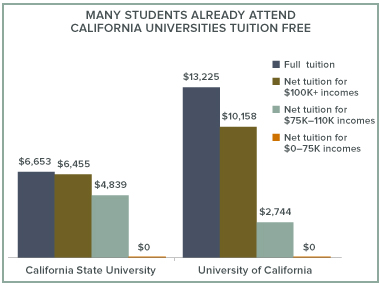
Many students already attend California universities tuition free

California’s financial aid program, Cal Grants, provides grants (funding that students do not have to pay back) for full tuition for the state’s lowest-income students, as well money toward books and living expenses for some of them. Through a combination of Cal Grants, federal aid, and institutional aid, UC’s Blue and Gold Opportunity plan guarantees free tuition for any family making $80,000 a year or less. CSU has a similar plan, the State University Grant, which bases the amount a family will pay on a number of factors. On average, students who receive financial aid pay no tuition at UC or CSU if their families make $75,000 or less.
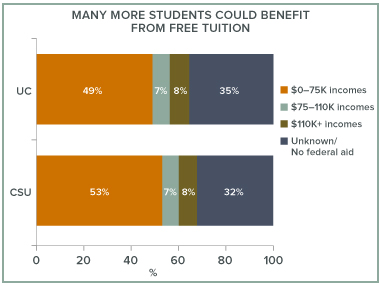
Expanding free tuition could impact thousands of California families

While the data on family income are not perfect, they can help us estimate how many students we might expect to benefit from free tuition. Right now, students from families in the $0 to $75,000 range make up about 49% of entering students at UC and 53% at CSU.

Raising the cap to $110,000—or beyond—would cover at least another 7% of students entering UC (2,300 students) and CSU (3,900 students) in 2014. The average student whose family income is between $75,000 and $110,000 would save about $4,839 at CSU or $2,744 at UC, resulting in more than $25 million in combined tuition savings for those thousands of families.

These estimates may be low, as many middle-class students who currently do not qualify for financial aid may have income levels that that would fall below the cap of an expanded program. Also, a nationwide free tuition program might encourage many low-income students who are currently scared off by the high sticker prices to apply to college or university.

The details of the plan would matter, of course. But if the federal government were to cover all of the $25 million needed to expand full-tuition guarantees at UC and CSU, it’s possible that thousands of low- and middle-income California students could benefit.

Notes: Data for both figures are from IPEDS for entering first-time California resident freshmen in fall 2014. Net tuition applies only to students who received some form of federal aid (grants or loans), which includes 68% of students at CSU and 65% of the students at UC.

Learn more

Visit the PPIC Higher Education Center