High School Graduation during the COVID-19 Crisis

With schools closed for in-person instruction in California through the end of the school year, the state has asked districts to implement distance learning. As a result, many students—particularly high school juniors and seniors—are concerned about falling behind or failing to graduate.

Nearly half of students from low-income families do not have broadband access at home. Given this reality, along with the uneven distribution of learning opportunities within and outside of schools across the state, it will be important to address the equity implications of the shift to distance learning during the coronavirus pandemic.

In response to school closures, the California Department of Education is allowing districts to request waivers that exempt individual students from the state’s minimum graduation requirements, which include three years of English, two years of math and two years of science.

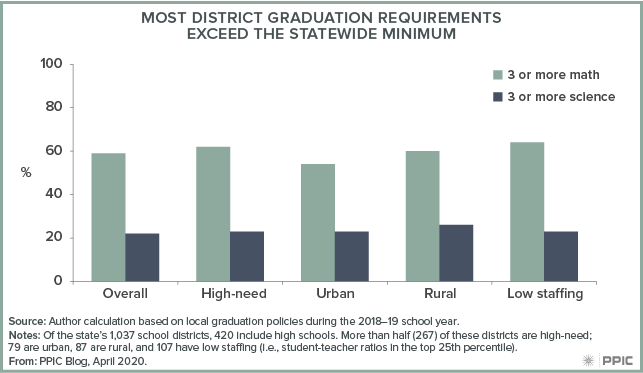
In addition, many districts have graduation requirements that exceed the state minimum. In the 2018–19 school year, 59% of districts required a third year of math, and 22% required a third year of science.

These requirements are prevalent across all types of districts—including high-need districts, in which more than 55% of students are low-income, English Learners, homeless, or foster youth; rural districts; and districts with high student-teacher ratios.

figure - Most District Graduation Requirements Exceed the Statewide Minimum

Moreover, students in six large districts—including Los Angeles Unified, San Diego Unified, San Jose Unified, and San Francisco Unified—must complete the entire A–G sequence required for admission to University of California (UC) or California State University (CSU) schools in order to graduate.

Districts with graduation requirements that exceed the state minimum will need to work with school boards to modify local policies. UC and CSU have already responded to school closures by temporarily suspending letter grade requirements for A–G courses completed in winter, spring, and summer 2020.

However, it will be challenging to help students stay on the A–G pathway. The waiver and temporary suspension of GPA requirements do not necessarily make it easier for students to take more A-G courses. PPIC research has shown that most students exit this pathway in the last two years of high school, and groups that are historically underrepresented in higher education are more likely to drop off at every stage. As districts develop distance learning plans and ways to provide flexibility to high school students, considerations of equity and access should be front and center.

Testimony: California Is on Track to Close the Degree Gap

[vc_row][vc_column][vc_column_text]Hans Johnson, director and senior fellow at the PPIC Higher Education Center, testified February 25, 2020, before the Assembly Budget Subcommittee (No. 2) on Education Finance, chaired by Assemblymember Kevin McCarty. Here are his prepared remarks.

At the PPIC Higher Education Policy Center, we have long been concerned about the future of California’s workforce. Would the state have enough college graduates to meet evolving economic demands? We have produced a series of reports addressing the dynamics of this issue.

Five years ago, we projected a shortage of highly educated workers in California. Specifically, our economic projections to 2030 showed that about two in five jobs would require at least a bachelor’s degree, while demographic projections suggested that only about one in three Californians would attain this level of education. This shortfall amounts to 1.1 million bachelor’s degrees.

PPIC noted that to fill this shortfall, the state and its higher education systems would need to act—increasing access, transfer, and completion especially among groups historically underrepresented in higher education, including low-income students, first-generation college students, Latinos, and African Americans.

We identified ambitious targets that—if met—would close the degree gap. Those targets included large increases in access to the University of California (UC) and California State University (CSU), both for first-time freshmen and for transfer students. They also included substantial increases in graduation rates. At the request of the legislature, UC and CSU both issued reports on how they might meet those targets.

Today, I’m pleased to say that California is currently on track to close the gap. The concerted efforts of policymakers, higher education officials—including staff and faculty—and, of course, students have led to these early gains.

State General Fund allocations for each system have increased substantially since the Great Recession, allowing for increased enrollment and renewed efforts to improve student persistence and completion. Both UC and CSU have exceeded PPIC’s closing-the-gap targets. These early gains have reduced the degree gap by almost 80,000.
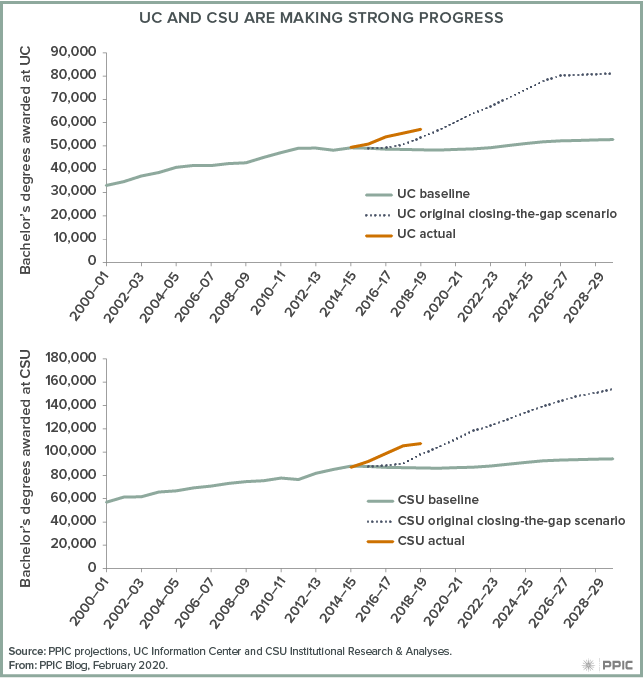
figure - UC and CSU Are Making Strong Progress

Two primary actions have led to these gains.

First, increases in state funding have allowed UC and CSU to enroll substantially more first-time students from California—both freshmen and transfer students. At UC, enrollment of transfer students went up 16% between fall 2010 and fall 2019. Enrollment of freshmen grew 14%. At CSU, enrollment increased 41% for transfer students and 33% among freshmen over the same time period. Notably, UC’s gains occurred primarily in one year, from 2015 to 2016, when the legislature and governor tied a $25 million allocation to increasing enrollment by 5,000 students. In that single year, total first-time enrollment of freshmen and transfer students went up 10%, with gains concentrated among African Americans (36%) and Latinos (25%).
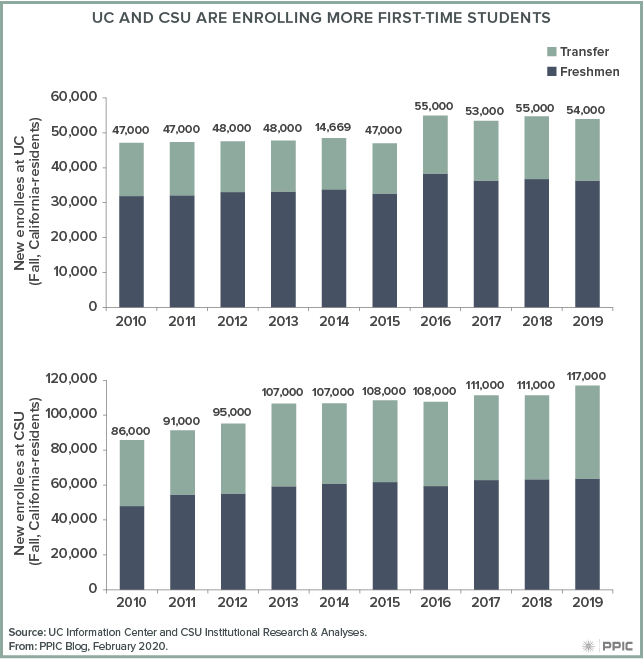
figure - UC and CSU Are Enrolling More First-Time Students

Second, programs to improve student persistence and graduation rates have also paid off—and contributed to enrollment growth. These gains have been especially sharp at CSU, which has received substantial funding from the state to support its graduation initiative. At CSU, six-year graduation rates for California-residency students have increased from 57% for 2009 entering freshmen to 67% for the 2013 cohort. At UC, four-year graduation rates for California-residency students have increased from 62% for 2010 entering freshmen to 68% for the 2014 cohort. (Six-year graduation rates at UC remain very high, around 85%). Graduation rates for transfer students have also increased at both systems.

These early successes are very promising. Still, California needs to build on them if it is to close the degree gap fully. The demand for college remains high. PPIC’s statewide surveys show that the vast majority of parents (79%) want their child to earn at least a bachelor’s degree. College preparation among high school graduates has increased, with the share of students completing the college preparatory requirements of UC and CSU now at an all-time high. And while applications to UC and CSU have levelled off or even declined a bit recently, application levels are still near record highs. All but one UC campus and many CSU campuses already do not have room to admit all eligible applicants.

Looking ahead, strong demand for UC and CSU is likely to continue as college preparation improves and the transfer pathway becomes more efficient and effective. New initiatives, including reforms in remedial education at the community colleges and CSU, have the potential to substantially improve student success rates and boost transfer. New articulation agreements, such as the Associate Degree for Transfer, have streamlined the pathway from community colleges to four-year colleges, especially CSU. (PPIC will be issuing a report on transfer trends later this year.) And an increased focus on improving student outcomes has led to multiple substantive reforms designed to increase persistence and completion at UC and CSU.

Finding ways to accommodate all eligible students is a pressing challenge, but one that must be met in order to ensure a better future for all Californians. Through thoughtful planning—and yes, additional funding—closing the degree gap is possible. Improving access and completion is a necessary and critical component to ensuring that more low-income, first-generation, and underrepresented students enjoy the benefits of a college degree. The early progress I’ve highlighted here has led to greater access and success for underrepresented students, creating momentum to improve the wellbeing of all Californians.[/vc_column_text][/vc_column][/vc_row]

Testimony: California’s Future Need for Bachelor’s Degrees


Patrick Murphy, PPIC research director, testified before the Senate Budget Subcommittee Number 1 on Education at San Diego City College in San Diego today (November 1, 2016). Here are his prepared remarks.

The Public Policy Institute of California (PPIC) projects that between now and 2030 California will fall 1.1 million bachelor’s degrees short of workforce demand. Closing this gap will require substantial improvements in access to four-year colleges, transfer rates from community colleges, and completion rates among college students. This testimony describes specific targets for California’s public and private colleges and universities to help ensure that the state will have a sufficient number of highly educated workers in the future. It also briefly describes a recent pilot program in California that offers bachelor’s degrees at community colleges and similar efforts in other states in the context of closing the workforce skills gap.

PPIC senior fellow Hans Johnson, in testimony before the Assembly Budget Subcommittee Number 2, has offered a scenario for how the state might close the workforce skills gap relative to its current baseline. Assuming that college enrollment rates, completion rates, and transfer rates remain at current levels, the state will produce 3.1 million bachelor’s degrees over the next 15 years. Our closing-the-gap scenario charts a course to producing 4.2 million bachelor’s degrees by 2030—a 36% increase over the baseline for the entire projection period. It should be emphasized that this goal cannot be realized unless the state substantially improves the attainment of degrees by currently underrepresented groups, including first-generation college students, low-income students, Latinos, and African Americans.

There are two important issues to note regarding our closing-the-gap scenario. First, successfully reaching this goal requires contributions from all three of the state’s higher education systems as well as private colleges. Our scenario sets the following targets:

  • Access to four-year public institutions will increase, with eligibility increasing 5 percentage points over current levels at UC (the top 17.5% of high school graduates will be eligible for UC, up from the 12.5% set by California’s Master Plan for Higher Education) and 6.7 percentage points at CSU (the top 40% will be eligible for CSU, up from the top third). These new eligibility levels will be phased in over an eight-year period.
  • The number of transfer students from community colleges will grow incrementally to 35% above baseline levels over a five-year period.
  • Completion rates will increase 9 percentage points at UC and 17 percentage points at CSU. At UC, completion rates for students who enroll as freshmen will increase incrementally from 83% in 2016 to 92% by 2026. Completion rates for freshmen at CSU will increase incrementally from 57% in 2016 to 74% by 2030.
  • Private nonprofit colleges, which produce about one-third of all bachelor’s degrees annually, will keep pace with the relative rate of growth, increasing their production of degrees by 26% over baseline levels.

The second notable point is that there is no single solution to closing this gap. Our scenario represents only one path toward reaching the number of bachelor’s-degree holders the state needs. Based on the structure and performance of the current system, our scenario estimates the relative contribution that higher education segments could make in the future. Other combinations are conceivable. For example, a smaller expansion in eligibility and greater improvements in completion rates could also close the gap.

The assumptions underpinning our closing-the-gap scenario are clearly ambitious. Are the assumptions realistic? Is it possible to, for example, raise the completion rate at CSUs by 17 percentage points? Based on recent improvements, we think so. In another PPIC report, my colleagues Jacob Jackson and Kevin Cook observed that, from 2009 to 2015, the CSU system increased its six-year graduation rate 6 percentage points, from 51% to 57%. These increases came at a time when the system was focused on improving completion as part of its 2015 Graduation Initiative. This past September, Chancellor White announced that CSU seeks even greater improvements as part of its 2025 Graduation Initiative. The recently announced goals, including achieving a six-year graduation rate of 70% by 2025, are consistent with our closing-the-gap scenario.

We did not include in our scenario any assumptions regarding the potential for California’s community colleges to produce bachelor’s degrees. Beginning in 2015, the California Community Colleges Chancellor’s Office granted approval to 15 colleges to offer bachelor’s degrees in specific majors as a pilot program under Senate Bill 850. At this time, these programs are quite small and it is difficult to predict what impact they may have on the long-term production of bachelor’s degrees. A brief review of the experiences of two other states provides examples of different trajectories this pilot program could take.

Community colleges in Washington State began a pilot program offering applied bachelor’s degrees following legislation passed in 2005. The program, which focuses on fields currently not addressed by the state’s four-year public institutions, became part of the state’s regular programming in 2010. Community colleges currently offer bachelor’s degrees in 30 fields but produced only about 300 (less than 1%) of the more than 33,000 bachelor’s degrees conferred in the state in 2015.

In Florida, legislation authorizing community colleges to begin offering bachelor’s degrees passed in 2001. Florida has been quite aggressive in expanding the programs and schools offering bachelor’s degrees, with 24 of the state’s 28 colleges offering a total of 170 such programs. In 2015, these colleges produced 6,900 (about 7%) of the state’s 100,500 bachelor’s degrees.

As it is currently configured, California’s pilot program resembles the Washington approach. It has the potential to supply applied degrees in specific fields, making a contribution to the demand for skilled labor in some professions. But, due to its small scale, it is unlikely to have a significant impact on the overall workforce skills gap in the near term.

This is not to suggest that community colleges do not play a role in meeting the growing demand for bachelor’s degrees. In fact, about 103,000 community college students in California transfer to four-year institutions each year. Our closing-the-gap scenario assumes an increase in the number of transfers of 35% over five years—which would mean an additional 36,000 students moving on to four-year institutions. Should those students complete their bachelor’s degrees at rates similar to today’s transfer students, this would lead to tens of thousands of additional bachelor’s-degree holders by 2025.

Community colleges, UC, CSU, and private colleges must all play a role in the state’s efforts to meet the demands of a changing economy. Closing the workforce skills gap will lead to better economic outcomes for all Californians, increased state revenues, and reduced social service demands.

The Growing Gender Divide in Higher Education

In California and across the nation, women have surpassed men in educational attainment. In 2006, for the first time ever, a majority of college graduates in the state were women. By 2014, 52% of California adults ages 18 to 64 with at least a bachelor’s degree were women, up from 45% in 1990. This gender divide in educational attainment is likely to continue to grow because the disparity is especially notable among younger adults: in 2014, 718,000 (55%) of California’s college graduates under 30 were women, compared to only 588,000 men.

Why are women now more likely to earn a college degree than men? The most direct and obvious answer is that women are more likely to be prepared for college, and thus more likely to enroll in college and graduate from college once enrolled. For example, among high school graduates in California, women are more likely to have completed the courses required for admission to the University of California and California State University. In 2014–15, almost half (49%) of female high school graduates completed these college preparatory courses, compared to only 38% of their male peers. This gap has grown since 2004–05, when 39% of female and 31% of male high school graduates completed these college preparatory courses.

Better academic preparation among women leads to higher college enrollment and graduation rates. According to US Department of Education data, 55% of all undergraduates enrolled in California’s colleges and universities in 2014 were women. And once enrolled, women are more likely to graduate. Six-year bachelor’s degree completion rates in the state were 61% for women and 57% percent for men.

The strong progress that women have made in higher education is good news. Yet inequities remain. Female college graduates earn less than their male peers. Women also have lower rates of employment than men. Policies that promote pay equity, flexible work schedules, and parental leave may help address these issues.

Women are especially underrepresented in important fields such as computer science and engineering—as are African American and Latino men. For California to meet the challenges of the 21st century economy, we need even more women and men—including those from groups traditionally underrepresented in higher education—to earn a college degree.

Learn more

Visit the PPIC Higher Education Center

The Promise of a Four-Year Degree in California

Fewer than one in five first-time freshmen graduate from California State University (CSU) within four years. Because students who graduate on time require less state investment, tend to graduate with lower loan amounts and start earning income sooner, and open up space for other students, CSU has made it a priority to boost four-year graduation rates.

Senate Bill 412, known as the California Promise and recently signed by Governor Brown, aims to help more students graduate on time. Under the law, CSU campuses will promise priority course registration and additional academic advising as long as participating students pledge to take 15 units (usually four courses) per semester—while 12 units per semester is considered full-time for financial aid purposes, students need to accumulate 30 credits per year to graduate in four years.

How can the California Promise help CSU campuses increase four-year graduation?

In our research on CSU graduation rates, we have identified major factors related to low graduation rates and longer times to degree. Among the most common roadblocks are bottleneck courses—for which there is more demand than seats available. Another common problem is that students who change majors or simply don’t take the right combination of courses end up accumulating more units than they need to graduate.

Campuses have implemented several strategies to help students avoid bottlenecks, such as eliminating or streamlining course requirements, as well as increasing the number of sections offered for courses in high demand. Campuses have also focused on engaging students, improving and expanding advising, standardizing requirements across majors, and adjusting major-switching policies to address students accumulating extra units. Campuses expect their focus on four-year graduation to increase with the implementation of the new Graduation Initiative, which sets specific targets for on-time graduation rates. The California Promise also aims to help campuses address these roadblocks. Students who participate in the program will be able to enroll in the courses they need through priority registration. Participating students will receive advising and monitoring to help them take the right number and types of courses. The contracts will also stress the importance of taking enough units to graduate on time.

Who will benefit from the California Promise?

Students have to apply for the program, but automatic acceptance will be offered to any eligible applicant who graduated from an underserved high school, comes from a low-income family (defined as being eligible for a federal Pell Grant), or is a transfer student or first-generation college student. Other students may be accepted as well, as money permits. The California Promise may shorten times to degree for students in the targeted groups who are ready for college-level courses and able to take a full load but who would normally struggle to graduate on time due to course availability, a lack of advising, or who might otherwise take less than a full load without the promise. It is difficult to estimate how many students will fit into this group.

We know that about 40% of freshmen require remediation and may not be able to participate in the promise. Other students may work too many hours to enroll in 30 units per year. Another potential challenge is that high participation levels may make it harder for students who aren’t part of the program to graduate on time. Since no new funding is attached to the law, there are no new courses or advisers. Students without priority registration are likely to have less of a chance of getting in-demand courses that they need. And advising resources could also shift away from those students who are not a part of the contract.

Some campuses, such as CSU San Bernardino, already offer similar contracts. While initial results from some of these contracts suggest a positive impact, the programs are generally small in scope and still need rigorous evaluation. As campuses consider how to structure these agreements, they need to prevent students who don’t or can’t meet the terms of the contract from getting left behind. It will also be important for policymakers to consult with CSU campus leaders, faculty, and students to ensure that there is sufficient support for the program.

Learn more

Read the report Improving College Graduation Rates: A Closer Look at California State University
Visit the PPIC Higher Education Center

A Generational Challenge for Higher Education

Generational progress in educational attainment has long been a critical component of societal improvements in well-being and economic mobility. For many decades in California and the United States, the expectation has been that children will eventually attain a higher level of education than their parents. And for many decades, that is exactly what occurred.

In recent years, however, generational progress has stalled. The share of Californians ages 25–34 with at least a bachelor’s degree (33%) is only very slightly higher than the share of bachelor’s-degree holders among the 55–64 age group (31%). Compared to countries that are part of the Organisation for Economic Co-operation and Development (OECD), an international organization of 34 member countries that provides data on economic and education trends, California ranks 1st in the share of older adults holding at least a bachelor’s degree (or equivalent), but only 22nd among younger adults.

Unlike almost all OECD countries, California has seen very little generational progress (2 percentage points). In stark contrast, Korea, Poland, and Ireland witnessed gains of 23 or more percentage points in the share of bachelor’s-degree holders among younger adults, relative to older adults. Because educational attainment is the single most important determinant of employment and wages, this lack of progress has implications not only for individuals but also for the state’s economy.

Not all states share California’s lack of progress. Among the 30 largest states, California ranks 21st in generational gains. New York, Iowa, and Illinois have all seen some of the largest improvements (10 to 12 percentage points) in the share of bachelor’s-degree holders among younger adults, compared to older adults. In Massachusetts (not shown), half of all young adults have a bachelor’s degree, compared to 40% of older adults.

A few states, including Arizona, Colorado, and Oklahoma, actually saw generational regress, meaning older adults are more highly educated than younger adults. Despite the lack of generational progress, Colorado still has a relatively high share of young adults (37%) with at least a bachelor’s degree.

What is most worrisome for California is that the lack of generational progress is coupled with a relatively low share (33%) of young adults with college degrees. Connecticut (not shown) has not seen much generational progress either, but even so, over 40% of young adults in that state have a college degree.
These differences in generational progress (or lack thereof) are not necessarily attributable to differences in education systems across states. For example, in Colorado, many highly educated older adults have migrated to the state from elsewhere.

The tremendous challenge facing California and the key to improving economic well-being in the state is to increase educational attainment among young adults. PPIC has identified key strategies to do this:

  • Improve access to four-year colleges.
  • Increase transfers from community colleges to four-year colleges.
  • Raise graduation rates for those already in college.

By taking steps now, the state and higher education leaders can put California back on the path of strong generational progress.

Chart source: OECD and American Community Survey.
Figure notes: Charts display select countries or states, including those with the highest and lowest generational gains.

Learn more

Read Higher Education in California: Addressing California’s Skills Gap
Visit the PPIC Higher Education Center

Increasing On-Time Graduation Rates in Hawai‘i


This post is part of an occasional series examining how California can learn from policies in other states.

While 57 percent of students at California State University (CSU) earn a bachelor’s degree, only 19 percent of first-time freshmen graduate in four years. Taking longer to graduate increases the cost of the degree and delays entry into the workforce.

One reason students are not graduating in four years is because they are not taking a full course load of 15 units—about five classes—per term. For financial aid purposes, students are considered full-time if they enroll in 12 units per term—about four classes. But taking 12 units means taking an extra year to graduate. Students have many reasons for taking less than a full load: family obligations, employment, inadequate preparation for the rigor of college courses, or the cost of extra books. It is also possible that students do not realize they need 15 units per term to graduate in four years. UCLA’s Cooperative Institutional Research Program found that 86 percent of freshmen nationwide believe they will graduate in four years, but only about 55 percent actually do so. CSU may be able to learn from 15 to Finish, a campaign adopted by the University of Hawai‘i in 2011 to increase student enrollment in 15 units per term and increase their four-year graduation rates.

Policy: University of Hawai‘i’s 15 to Finish Campaign

In 2010, the University of Hawai‘i system (UH) launched the Hawai‘i Graduation Initiative (HGI) to increase college participation and completion. One of HGI’s strategies is a 15 to Finish campaign to encourage university and community college students to enroll in 15 units a term so they can graduate in four years. Other HGI strategies include creating block or cohort scheduling so that groups of students take the same courses together; reducing summer tuition; and developing academic roadmaps to help freshmen plan their course sequences to graduate on-time. The 15 to Finish campaign’s communication strategy highlights the need to take 15 credits per term and the benefits of graduating in four years in television commercials, informational handouts, and student orientations. It also markets the additional three units as “free” because tuition is the same for 12 and 15 units.

Policy Impact

The early results of UH’s 15 to Finish campaign look promising. Between 2011 and 2013, enrollment in 15 units per term rose by about 5 percentage points, to 25 percent of the UH student population enrolled in 15 units. More important, the system’s four-year graduation rate has risen 7.2 percentage points since the graduating class of 2012, to 25 percent. At CSU, the four-year graduation rate has improved just 2.9 percentage points, to 19 percent, over the same period.

Lessons for California

CSU’s 2015 Graduation Initiative was successful in raising six-year graduation rates. As the system launches a new 2025 Graduation Initiative, which focuses in part on increasing four-year graduation rates, campuses should consider implementing a media strategy to inform students about the three “free” units per term that will help them graduate on-time. One campus, Cal State LA, has already started: it launched a 15 to Finish campaign in August 2015, in anticipation of its transition to a semester calendar.

A system-wide 15 to Finish campaign could also persuade some campuses to stop discouraging students from taking 15 units if they work. It would be more helpful for campuses to inform students they need 15 units a semester to graduate in four years and give them estimates of the number of homework hours created by this course load, so they can make their own decisions about how many units to take each term.

This kind of messaging could also help UC and the community colleges increase on-time completion rates. It could be a relatively simple way to create more room for new students and increase the number of college graduates in our state.

Learn more

Visit the PPIC Higher Education Center

Video: Improving Graduation Rates at California State University

California State University (CSU), the nation’s largest university system, has steadily improved graduation rates, but there is more work to be done, PPIC researcher Jacob Jackson told a Sacramento audience last week.

The system still struggles with graduation gaps. Historically underrepresented students are much less likely than their peers to get degrees. Even though the system has higher six-year graduation rates than similar universities, it lags behind in the share of students who graduate in four years. This comes at a high cost to both the state and CSU students.

As CSU launches a new initiative to improve graduation rates, Jackson and fellow PPIC researcher Kevin Cook coauthored a report analyzing the system’s progress to date. The authors also describe promising strategies that could help CSU reach its goal of increasing graduation rates and cutting graduation gaps in half by 2025.

Learn more

Read the report, Improving College Graduation Rates: A Closer Look at California State University
Visit the PPIC Higher Education Center

Calculating High School Graduation Rates

We are republishing this blog post to correct the number of students in the Class of 2014 who are not counted in a school graduation rate and the graduation rate of alternative high schools. As a result, the impact of including alternative school student data in the graduation rates of regular high schools also changes.

The federal Every Student Succeeds Act (ESSA), which was recently signed into law by President Obama, aims to offer states more flexibility in designing K–12 accountability programs than they had under No Child Left Behind. But one of ESSA’s lesser known provisions—a requirement that states identify and assist high schools with graduation rates below 67 percent—might force California to revise the way it deals with graduation rates at alternative high schools. Currently, the California Department of Education (CDE) excludes students attending most of the 640 alternative high schools across the state from its graduation rate calculations. Alternative schools—also known as district continuation schools, county community schools, and district and charter alternative “schools of choice”—are designed to help dropouts, students with behavior problems, pregnant or parenting teens, and truants. About 75 percent of the students at alternative high schools are juniors and seniors, according to CDE data.

ESSA requires states to calculate “cohort” graduation rates—which involve tracking students from 9th through 12th grade. The cohort graduation rate means something different at alternative schools than it does for regular schools. Students often transfer to alternative schools because they are struggling in school. CDE also reports that students attend alternative schools for an average of less than four months. Even so, CDE assigns students who transfer to alternative schools to those schools’ cohorts. Since CDE does not calculate graduation rates for most alternative schools, 59,300 high school seniors—or 12 percent of the Class of 2014—are excluded from statewide data (although these students are usually included in their districts’ graduation rates).

There are two main options for including all students in California’s school graduation rates. First, graduation rates for alternative schools could be published, although it is likely that their rates would be much lower than those of regular schools—and would fall below ESSA’s 67 percent threshold. According to PPIC estimates, alternative school graduation rates average about 37 percent, far below the statewide rate of 81 percent. The problem with this option is that, given the role alternative schools play in helping at-risk students, these low rates do not necessarily mean that alternative schools are underperforming.

The other option is to include alternative school students in the graduation rates of their “home” high schools. After all, students generally spend most of their high school years at their regular high school, attending alternative schools for short spells. In fact, excluding a large proportion of at-risk students from the calculation of school graduation rates does not accurately represent the performance of the state’s high schools. Using 2013–14 data, we estimate this option would reduce “regular” high school graduation rates an average of 6 percent. CDE’s current graduation rate methodology appears to be at odds with the federal approach to accountability. It also makes it more difficult for educators, parents, and other interested community members to get accurate information about the success of local schools. Moreover, the methodology creates an incentive for educators to send low-performing students to alternative schools. Thus, there are several important reasons to revisit the way CDE calculates school graduation rates.

The High School Exit Exam: What’s Next?

The California High School Exit Examination (CAHSEE) is likely to be a topic of discussion in the next legislative session. Enacted in 1999, the CAHSEE involves tests in English and mathematics that high school students must pass in order to graduate. Testing started in 2001, but the graduation requirement was held up for several years by legal challenges that resulted in an exemption for special education students.

The immediate issue for the legislature has to do with the adoption of the Common Core State Standards, which take effect this school year. The state overhauled its testing program in 2013, eliminating most testing in high school except grade 11 English and math tests in that are aligned to the new standards. Because CAHSEE is based on the previous standards, the question is whether to update it so that it aligns better with Common Core, find an alternative measure, or eliminate the requirement altogether. For now, passing the CAHSEE continues to be a requirement for graduation.

The question of the CAHSEE’s impact on students and schools is also an important discussion item. The proportion of 10th graders who pass the test has increased significantly, suggesting that students are better prepared in math and English. The chart below shows that 10th grade pass rates on the math test by students in the four largest racial/ethnic groups has increased each year since 2004. Gains made by Latino and black students are especially significant—their passage rates have increased 18 percent and 20 percent, respectively.

Despite these gains, recent research suggests that exit examinations do little to boost student achievement but create costs in the form of lower graduation rates. In total, 95.5 percent of 12th graders in California passed both the English and math sections of the test, meaning that 4.5 percent of students did not graduate on time at least in part because they did not pass the test. This has a bigger impact on black and Latino students, whose 12th grade pass rates remain about 5 percent below those of white and Asian students. Moreover, because these rates do not include students who dropped out of school, they may understate the impact of the CAHSEE requirement on lower-performing students.

In a 2013 report, state education superintendent Tom Torlakson recommended a number of alternatives to the CAHSEE, including successful completion of specific high school courses, new tests that would be given at the conclusion of specific English and math courses, or the new Common Core tests given in 11th grade. Any discussion of updating the requirement would raise the question of the skills students should be expected to demonstrate. The current exam tests students at an 8th or 9th grade level; making the test more difficult would put more students at risk of finishing high school without a diploma. Thus, instead of focusing on aligning the exit exam to the new standards, the legislative discussion may revolve around the benefits and costs of minimum graduation standards to schools, students, and society.