Testimony: California Is on Track to Close the Degree Gap

[vc_row][vc_column][vc_column_text]Hans Johnson, director and senior fellow at the PPIC Higher Education Center, testified February 25, 2020, before the Assembly Budget Subcommittee (No. 2) on Education Finance, chaired by Assemblymember Kevin McCarty. Here are his prepared remarks.

At the PPIC Higher Education Policy Center, we have long been concerned about the future of California’s workforce. Would the state have enough college graduates to meet evolving economic demands? We have produced a series of reports addressing the dynamics of this issue.

Five years ago, we projected a shortage of highly educated workers in California. Specifically, our economic projections to 2030 showed that about two in five jobs would require at least a bachelor’s degree, while demographic projections suggested that only about one in three Californians would attain this level of education. This shortfall amounts to 1.1 million bachelor’s degrees.

PPIC noted that to fill this shortfall, the state and its higher education systems would need to act—increasing access, transfer, and completion especially among groups historically underrepresented in higher education, including low-income students, first-generation college students, Latinos, and African Americans.

We identified ambitious targets that—if met—would close the degree gap. Those targets included large increases in access to the University of California (UC) and California State University (CSU), both for first-time freshmen and for transfer students. They also included substantial increases in graduation rates. At the request of the legislature, UC and CSU both issued reports on how they might meet those targets.

Today, I’m pleased to say that California is currently on track to close the gap. The concerted efforts of policymakers, higher education officials—including staff and faculty—and, of course, students have led to these early gains.

State General Fund allocations for each system have increased substantially since the Great Recession, allowing for increased enrollment and renewed efforts to improve student persistence and completion. Both UC and CSU have exceeded PPIC’s closing-the-gap targets. These early gains have reduced the degree gap by almost 80,000.
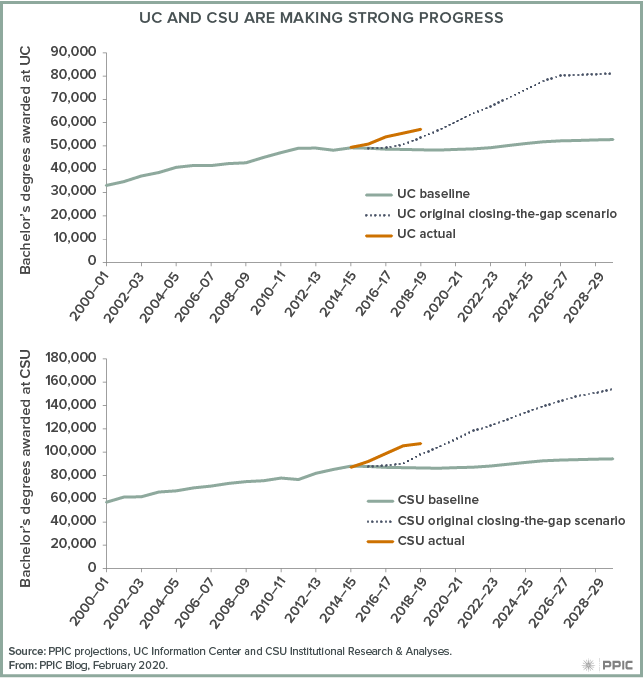
figure - UC and CSU Are Making Strong Progress

Two primary actions have led to these gains.

First, increases in state funding have allowed UC and CSU to enroll substantially more first-time students from California—both freshmen and transfer students. At UC, enrollment of transfer students went up 16% between fall 2010 and fall 2019. Enrollment of freshmen grew 14%. At CSU, enrollment increased 41% for transfer students and 33% among freshmen over the same time period. Notably, UC’s gains occurred primarily in one year, from 2015 to 2016, when the legislature and governor tied a $25 million allocation to increasing enrollment by 5,000 students. In that single year, total first-time enrollment of freshmen and transfer students went up 10%, with gains concentrated among African Americans (36%) and Latinos (25%).
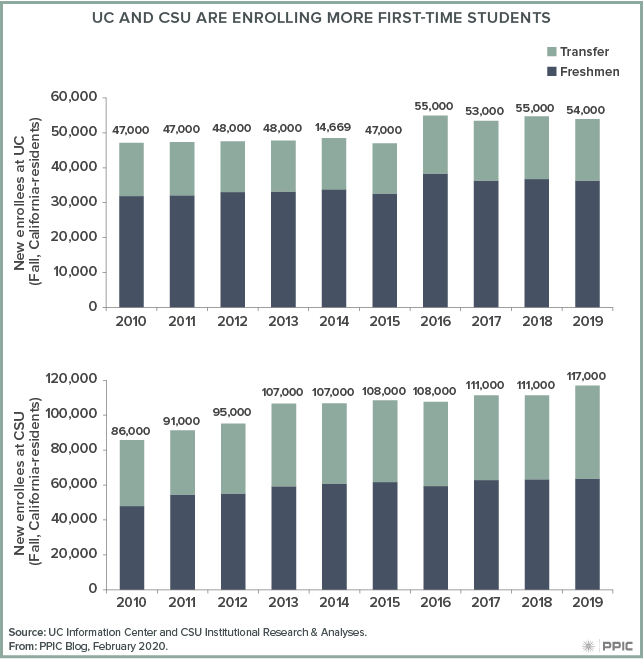
figure - UC and CSU Are Enrolling More First-Time Students

Second, programs to improve student persistence and graduation rates have also paid off—and contributed to enrollment growth. These gains have been especially sharp at CSU, which has received substantial funding from the state to support its graduation initiative. At CSU, six-year graduation rates for California-residency students have increased from 57% for 2009 entering freshmen to 67% for the 2013 cohort. At UC, four-year graduation rates for California-residency students have increased from 62% for 2010 entering freshmen to 68% for the 2014 cohort. (Six-year graduation rates at UC remain very high, around 85%). Graduation rates for transfer students have also increased at both systems.

These early successes are very promising. Still, California needs to build on them if it is to close the degree gap fully. The demand for college remains high. PPIC’s statewide surveys show that the vast majority of parents (79%) want their child to earn at least a bachelor’s degree. College preparation among high school graduates has increased, with the share of students completing the college preparatory requirements of UC and CSU now at an all-time high. And while applications to UC and CSU have levelled off or even declined a bit recently, application levels are still near record highs. All but one UC campus and many CSU campuses already do not have room to admit all eligible applicants.

Looking ahead, strong demand for UC and CSU is likely to continue as college preparation improves and the transfer pathway becomes more efficient and effective. New initiatives, including reforms in remedial education at the community colleges and CSU, have the potential to substantially improve student success rates and boost transfer. New articulation agreements, such as the Associate Degree for Transfer, have streamlined the pathway from community colleges to four-year colleges, especially CSU. (PPIC will be issuing a report on transfer trends later this year.) And an increased focus on improving student outcomes has led to multiple substantive reforms designed to increase persistence and completion at UC and CSU.

Finding ways to accommodate all eligible students is a pressing challenge, but one that must be met in order to ensure a better future for all Californians. Through thoughtful planning—and yes, additional funding—closing the degree gap is possible. Improving access and completion is a necessary and critical component to ensuring that more low-income, first-generation, and underrepresented students enjoy the benefits of a college degree. The early progress I’ve highlighted here has led to greater access and success for underrepresented students, creating momentum to improve the wellbeing of all Californians.[/vc_column_text][/vc_column][/vc_row]

Pointing Eligible Students to Available CSU Campuses

Large numbers of students are turned away from their campus of choice each year because many California universities receive more freshman and transfer applications than they can admit. At the California State University (CSU), campuses with more applications than they can admit are called “impacted.” All but 2 of the 23 CSU campuses have at least one program of study impacted for the 2020–2021 school year; at 7 campuses every program is impacted.

For CSU, students can easily apply to more than one campus. One application covers all campuses, and students pay a $70 per-campus fee for each school they select (although about half receive fee waivers). First-time freshman applicants and transfer applicants both apply to around 3 CSU campuses on average (3.3 campuses for freshmen, 2.6 for transfers).

About 32,000 eligible freshmen and transfer applicants were denied admission to their preferred CSU campus due to capacity issues in 2018. In 2019, CSU started a program to redirect denied students, offering admission to one of ten campuses with space. In the first year, about 20,000 students were offered admission at an alternate campus, and about 900 enrolled (4.5%), according the CSU Chancellor’s Office. The program was most successful among redirected transfer students, who enrolled at an 8.2% rate compared to freshmen at 1.9%.

We don’t know what happened to the students who did not enroll, as the state has no way of tracking student records between institutions. Some may have ended up at a UC, a private college, or other institution. Freshmen applicants may have decided to attend a community college with plans to transfer later. A statewide longitudinal data system can help the state create better policy around capacity in higher education.

As the CSU redirection program continues and applicants understand the process better, interest in the program—and enrollment rates—may increase. However, a similar long-standing program at the University of California has had similar low rates of enrollment from redirected students. CSU is considering ways to improve program timing and delivery; using their excess capacity to put almost 900 extra students on the road to a bachelor’s degree in the first year of the policy is already an important step.

Demand for UC and CSU Enrollment Remains Strong

The number of high school graduates has remained steady for several years, with no expectation of significant increases any time soon. And yet demand for admission to the state’s public universities continues to grow.

A quick look at trends among California’s high school graduates—in particular, their preparation for college—helps explain this paradox. Other sources of enrollment growth, including increases in transfer students and improved retention, also play an important role. Understanding these trends is critical, since annual state funding for the University of California (UC) and the California State University (CSU) depends partly on anticipated enrollment growth.

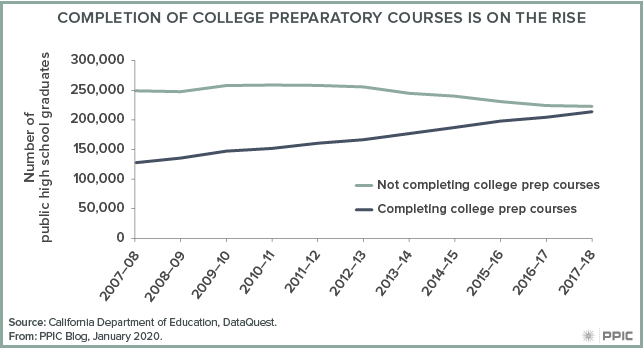
The good news is that more and more of California’s high school graduates have passed the college preparatory curriculum (known as the “A-G” courses) required by UC and CSU. Over the past five years, the number of high school graduates completing the A-G courses has increased 28%, even as the total number of high school graduates has remained largely unchanged.

By 2017–18 (the most recent data available), almost half (49%) of California’s high school graduates had completed the A-G courses, a remarkable increase from just ten years earlier when only about one-third (34%) did so. As a consequence, the number of high school graduates eligible for UC and CSU has reached record numbers.

figure - Completion of College Preparatory Courses Is on the Rise

Of course, enrollment demand depends on more than just new freshmen. The number of students that transfer from the state’s community colleges also adds to enrollment growth. Over the past five years, that number has also grown (up 25% at UC and 14% at CSU).

Improvements in persistence and completion also lead to greater enrollment, as fewer students drop out. At both UC and CSU, persistence and graduation rates are increasing. For example, at CSU the share of freshmen that graduate within six years has increased from 54% (fall 2008 entering cohort) to 62% (fall 2013 entering cohort).

Accommodating this enrollment growth is good for the state. College graduates are in high demand in the state’s labor market and—on average—earn far higher wages than less educated workers. PPIC has projected that demand for highly educated workers will keep growing as the state’s economy continues to change. Finding ways for California students to attend and graduate from college improves their well-being—and that of the state.

Video: Broadening Access to Transfer-Level Courses at California’s Community Colleges

The majority of California community college students never complete their education. For many students, the biggest barrier to success has been the traditional approach to remedial education. Until recently, the vast majority of entering students were placed in remedial—or developmental—courses, and relatively few of them went on to receive a degree or transfer to a four-year institution. In recent years, several colleges have responded to this longstanding challenge by experimenting with placement and curricular reforms, and state legislation enacted in 2017 aimed to accelerate the pace of change.

A new PPIC report examines what happened at colleges that were early in implementing large-scale reforms, focusing on student access to and completion of transfer-level courses in English and math. Marisol Cuellar Mejia, PPIC senior research associate and report coauthor, reported on the findings at a briefing in Sacramento last week, followed by a panel discussion of higher education experts moderated by coauthor Hans Johnson, PPIC senior fellow and director of the PPIC Higher Education Center.

Panelists included Julianna Barnes, president, Cuyamaca College; Laura Metune, vice chancellor for external relations, California Community Colleges Chancellor’s Office; and John Stanskas, president, Academic Senate for California Community Colleges.

The three panelists emphasized the equity implications of placing students in transfer-level classes, as opposed to remedial courses.

Barnes said that “we cannot deny the data” showing that placement and curricular reforms are particularly helpful to students who are historically underrepresented in college. Making these changes became “an equity imperative” at Cuyamaca College.

Thoughtful leadership and a commitment to addressing equity gaps are particularly important in managing change, according to Metune. She noted that “we need to just be careful that it’s not our own implicit bias that’s resulting in differences in student outcomes.”

All community colleges now have a plan for implementing reform, Stanskas said. He pointed to the importance of tailoring programs to specific student populations. Colleges should be ready to “get down to being more nuanced about who [their] students are and what they need from us to be successful.”

How Community College Reforms Could Help English Learners

[vc_row][vc_column][vc_column_text]Due in large part to their mission of access and affordability, community colleges play a key role in educating immigrant students, especially those who are English Learners. In 2016–17, more than 58,000 first-time community college students in California enrolled in English as a Second Language (ESL) courses.

For many students, taking ESL courses may be linked to the desire to improve their socioeconomic prospects. Indeed, community college students who earn a credential or transfer to get a four-year degree are well positioned to climb the economic ladder. In an economy that increasingly demands skilled workers, there is tremendous untapped potential in increasing the educational attainment—and economic trajectories—of ESL students.

California’s community colleges have undertaken several reforms that aim to improve student success and close equity gaps. These reforms—spurred by AB 705 and the new Guided Pathways framework—present a ripe opportunity to help more ESL students get on the path to completing college composition, a requirement to earn a college credential or transfer.

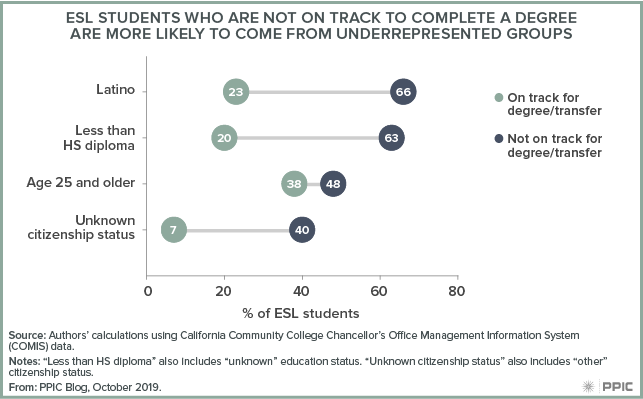
These initiatives are primarily focused on addressing the needs of students who intend to pursue a degree or transfer. However, our most recent research finds that about two-thirds of ESL students (66%) are not on track to do so—and may consequently be left out of the reforms. (We consider students on track if they take any ESL course required to access college composition and at least one course other than ESL or English.)

ESL students who are not on track are more likely to come from historically underrepresented groups. For instance, we find that compared to students taking ESL courses needed for college composition, those not taking these courses are more likely to be older and Latino. They are also more likely to have unknown citizenship status (a possible signal of being undocumented) and to have not graduated high school.

figure - ESL Students Who Are Not on Track To Complete a Degree Are More Likely To Come from Underrepresented Groups

As colleges across the state reform their ESL sequences and programs of study, it will be critical to ensure that all students have the opportunity to earn a degree or transfer. The two-thirds of ESL students currently not on track to do so are the most vulnerable. These students have already taken the major step of enrolling in college. To improve their likelihood of advancing, colleges could provide clearer and more effective ESL sequences and degree and transfer pathways, as well as stronger student supports, including advising, placement, and information about available degrees and certificates.

Some colleges are already working on these issues. Initiatives like the Guided Pathways ESL Milestone certificates at Cypress College—the result of AB 705 and Guided Pathways efforts—present a unique example of how colleges can structure ESL programs and certificates to help English Learners get on a pathway toward a college credential.

Finally, it is important to acknowledge that there are some ESL students who take ESL coursework for reasons unrelated to a degree. As colleges redesign their ESL programs, working alongside non-credit ESL programs, adult education schools, and community-based ESL programs could help ensure that colleges are keeping the diverse needs of ESL students in mind.[/vc_column_text][/vc_column][/vc_row]
The Associate Degree for Transfer May Help CSU Meet 2025 Goals

Students enrolling at the California State University (CSU) as a part of the Associate Degree for Transfer program (ADT) make up a growing share of all CSU transfers—and they are graduating more quickly than other transfer students. The program awards associate degrees and guarantees admission to a CSU campus to community college students who earn at least 60 of the 120 units needed for a bachelor’s degree in a specific major. The ADT aims to cut the amount of time-and red tape it takes to transfer to CSU and graduate with a bachelor’s degree.

Since its inception in 2011, the program has grown rapidly. In 2018, 41% of community college transfers to CSU had an associate degree for transfer, though not all of them started out on an ADT pathway. The number of students who do enter CSU on an ADT pathway has increased tenfold, from 1,089 in 2013 to 10,917 in 2018, and ADT pathway enrollees now account for about one in five transfers to CSU. Currently, the program encompasses more than 30 majors, though offerings vary by community college and CSU campus.

While students who transfer to CSU are generally very likely to graduate, the three-year graduation rate for ADT transfers are 10 percentage points higher than the rate for all transfer students (79% vs. 69%). But about half of students enrolling In an ADT pathway graduate in just two years, which is 16 percentage points better than the overall average for transfers (35%). This suggests that reducing students’ time to degree might be the program’s most notable advantage.

figure - Associate Degree for Transfer (ADT) Students Graduate More Quickly Than Their Peers

The CSU Graduation Initiative 2025 aims to bring two-year graduation rates up to 45% by 2025. Recent experience indicates that the expansion of the ADT could prove helpful: CSU’s two-year graduation rate increased from 31% to 35% from 2013 to 2015, as the share of students on an ADT pathway went from 2% to 12%. Given that one in five transfer students in 2018 were on an ADT pathway, we could see a record number of transfer students graduating in just two years, saving themselves time and money and helping CSU make progress toward its goal.


Reforming California’s Community College System

California’s community colleges have a strong record of providing access to higher education—they enroll more students than any other college system in the country, including large shares from groups that have been historically underrepresented. But improving student outcomes has long been a challenge: fewer than half (48%) of students earn a degree or certificate or transfer to a four-year college. The community college system is implementing a broad range of reforms designed to address these high rates of incompletion. These reforms focus on improving the student experience from initial enrollment to graduation and beyond.

From our perspective, the most dramatic reforms are in developmental (or remedial) education. In the past, a large majority of students entering the community college system have been placed in developmental education courses in English and/or math, and relatively few have gone on to complete transfer level courses. But the passage of Assembly Bill (AB) 705 in 2017 has required colleges to implement assessment and placement procedures, including new curricula that result in more students completing transfer-level courses in English and math within one year of entering. Our work has shown substantial improvements at colleges that have been early implementers of these new procedures. For example, 70% of students who entered directly into transfer-level courses in English with co-requisite support (a form of concurrent remediation) successfully completed the course, compared to 29% of those who began in a prerequisite developmental education course. Full implementation of AB 705 will occur this fall.

Other reforms aim to improve student pathways throughout community college and beyond. For example, the Guided Pathways program is designed to help students navigate through community college by helping them choose programs of study, mapping pathways to their end goals, and ensuring that they stay on those pathways. Another new program, the Associate Degree for Transfer, guarantees admission to a California State University campus in a major aligned to a student’s community college course of study. All of these reforms make equity a primary consideration. The student-centered funding formula links these efforts by tying a portion of district funding to equity and success outcomes, including completion of transfer-level math and English within the first year, certificates or degrees granted, and transfers to four-year universities, among others.

Implementing new programs and policies is not easy, and it will take time to assess the results. But, as PPIC has shown, many of these reforms are showing early promise.

Expanding Enrollment at UC and CSU

California’s economy is increasingly demanding highly educated workers. To meet this demand, and to ensure that more Californians are successful in the 21st century economy, the state’s universities will need to admit and graduate greater numbers of students than they do today.

Governor Newsom’s budget proposal offers a step in the right direction, but it could go further.

The governor’s budget provides General Fund increases of 7% for the University of California (UC) and 8% for the California State University (CSU), including funding for enrollment increases of 1,000 and 7,000 students respectively.  The budget also provides $95 million ($50 million for UC and $45 million for CSU) in ongoing funding to improve student success efforts at both systems. This is good news and represents substantial reinvestment in the state’s public universities.

But the enrollment increases fall short of what CSU and UC had been hoping for, and more importantly, short of student demand. In its 2019-2020 budget plan, UC had sought enrollment increases for 2,500 California resident undergraduates in order “to maintain access for projected increases in UC-eligible high school graduates and transfer-ready California Community College students.” CSU had sought an even more ambitious increase of more than 18,000 in order to accommodate more freshmen and transfer students.

As the state moves into the eleventh straight year of economic growth, ensuring investments in higher education is critical—especially in the face of an eventual downturn. Higher education is often one of the first budget areas to be cut during a recession. Today, even after a decade of reinvestment and one of the largest economic expansions in state history, funding per student at UC and CSU still remains below pre-Great Recession levels. And it is far below the funding peaks of the late 1990s and early 2000s.

As the legislature and governor negotiate over the budget, it may be time to consider creating a long-term funding plan for public higher education. An effective multi-year plan would account for increased enrollment, incentivize student success, prioritize equity, and provide a sensible tuition growth plan.  This would allow students and their families, as well as universities, to better plan for the future—and would put the state on a path to meeting the economic demands of the future.

Leveling the Playing Field in College Admissions

Recent news of wealthy parents allegedly paying bribes to get their children into elite colleges has raised a lot of questions about the college admissions process. While fewer than 100 students were involved—out of more than 1 million new college freshmen every year—the scandal brings up larger issues of equitable college access and high income inequality in California.

More than half of Californians (53%) say qualified students from low-income families have less opportunity than other students to get a college education, according to a 2018 PPIC survey. Even without resorting to bribery, there are many advantages that students from high-income families have in college admissions, including living in safer neighborhoods, attending better high schools, and having more help preparing for the application process (e.g., paying for SAT or ACT prep courses). Admission practices at most private colleges also favor students who can pay the full price of attending.

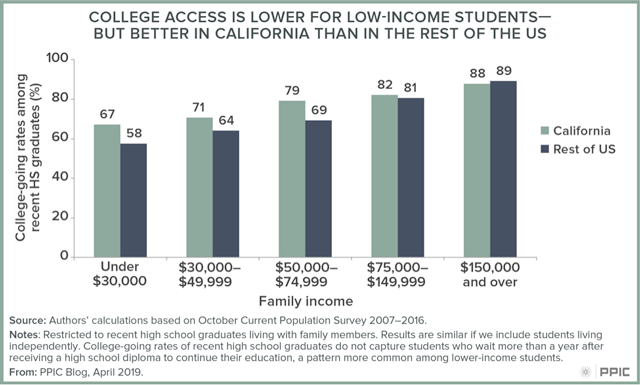
Our recent report on economic mobility and higher education highlights the challenges facing low-income students in California—but also offers some hope. Although recent high school graduates from low-income families are less likely to enroll in college than students from higher-income families, a greater percentage of low-income students go to college in California (67%) compared to other states (58%). Enrollment gaps between low- and high-income students in California (21 percentage points) are also substantially lower than in the rest of the country (31 percentage points).

Figure 1: College Access is Lower For Low-Income Students--But Better in California Than In the Rest of the US

California’s large public higher education system is key to ensuring broad access. The University of California (UC) enrolls more low-income students than any other public research university system in the country. Indeed, applicants from disadvantaged backgrounds are given extra consideration in UC’s “holistic review” process. Thirty-eight percent of UC undergraduates in 2016–17 received Pell grants (federal grants to low-income students), compared to 26% of undergraduates at public research universities in the rest of the country.

California State University (CSU), the largest public university system in the country, provides even more access than UC. Almost half (49% in 2016–17) of CSU students receive Pell grants. California’s private nonprofit colleges also play an important role, with 29% of their undergraduates receiving Pell grants.

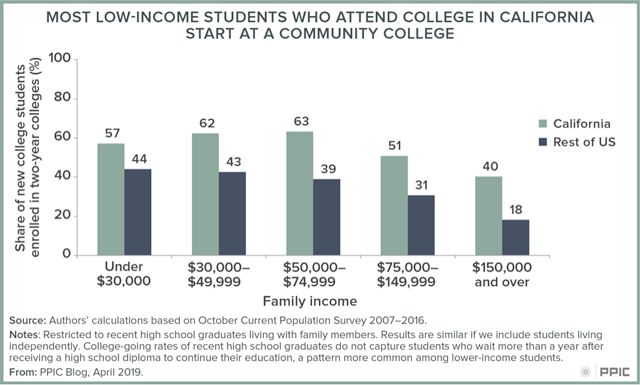
But perhaps most important are California’s community colleges. More than half of low-income students who attend college in California start at a community college.

Figure 2: Most Low-Income Students Who Attend College in California Start at a Community College

Although college access for low-income students in California is relatively good compared to the rest of the nation, more can be done. For example, improving financial aid would make college more accessible to more low-income students and would likely lead to higher graduation rates. And because so many low-income students start at community colleges, increasing transfer rates is critical to ensuring that higher education continues to serve as a ladder of economic mobility. New reforms at the community colleges—including changes in remediation and the Associate Degree for Transfer program—should lead to substantial increases in transfer and help more students achieve their academic and economic goals.

Serving California’s Diverse College Students

As part of his cradle-to-career initiative, Governor Newsom has emphasized higher education as a key means of expanding Californians’ social and economic opportunities. From proposing more higher education funding in this year’s budget to supporting two years of free tuition for first-time community college students, many of his initiatives are focused on making college accessible and affordable to more of the state’s residents. For these initiatives to succeed, it will be essential to enroll a broad array of students—in particular, those who have been historically underserved in higher education–and to ensure that more students successfully complete college.

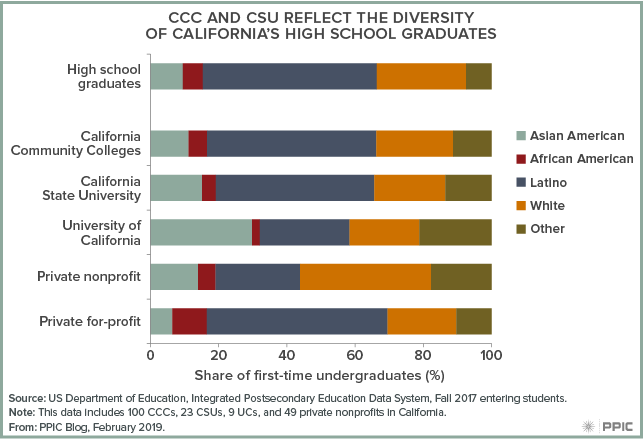
The good news is that the state is enrolling a diverse set of students, especially at the two largest systems, California State University (CSU) and the California community colleges (CCC). Overall, these two systems closely reflect the racial and ethnic make-up of California’s high school population—which is critical given that these two systems are key entry points for African American, Latino, low-income, and first generation college students. UC and private nonprofit colleges in California serve diverse populations, including more first generation and low-income students than their peer institutions in the rest of the country, but they do not reflect the full ethnic diversity of the state’s high school graduates.

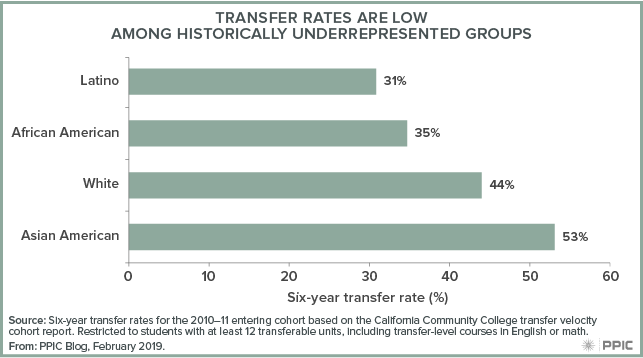
More challenging is helping students to successfully complete a four-year degree. Graduation rates are very high at UC and at most private nonprofit colleges. At CSU, graduation rates have improved dramatically, but even so about 40% of students do not earn a degree within six years. Most students who enter community colleges with the intent to transfer to a four-year college never do so. Transfer rates are especially low for African American and Latino students.

Both CSU and CCC have launched new policies and programs that hold the promise of improving transfer and reducing inequities. For example, community college reforms in developmental—also known as remedial—education will lead to substantial increases in the share of students taking college-level courses in English and math. The Associate Degree for Transfer (ADT) program is making the transition to California State Universities much more straightforward. And the new Guided Pathways initiative provides support services and clear course-taking patterns to community college students to promote success.

These are important steps in the right direction. Renewed interest in Sacramento regarding higher education will help. And Californians are well aware of the stakes. A majority of adults in California (56%) say a four-year college degree is very important for economic and financial success in today’s economy, and 75% believe California’s higher education system is very important to the quality of life and economic vitality of the state.