Testimony: California’s Future Need for Bachelor’s Degrees


Patrick Murphy, PPIC research director, testified before the Senate Budget Subcommittee Number 1 on Education at San Diego City College in San Diego today (November 1, 2016). Here are his prepared remarks.

The Public Policy Institute of California (PPIC) projects that between now and 2030 California will fall 1.1 million bachelor’s degrees short of workforce demand. Closing this gap will require substantial improvements in access to four-year colleges, transfer rates from community colleges, and completion rates among college students. This testimony describes specific targets for California’s public and private colleges and universities to help ensure that the state will have a sufficient number of highly educated workers in the future. It also briefly describes a recent pilot program in California that offers bachelor’s degrees at community colleges and similar efforts in other states in the context of closing the workforce skills gap.

PPIC senior fellow Hans Johnson, in testimony before the Assembly Budget Subcommittee Number 2, has offered a scenario for how the state might close the workforce skills gap relative to its current baseline. Assuming that college enrollment rates, completion rates, and transfer rates remain at current levels, the state will produce 3.1 million bachelor’s degrees over the next 15 years. Our closing-the-gap scenario charts a course to producing 4.2 million bachelor’s degrees by 2030—a 36% increase over the baseline for the entire projection period. It should be emphasized that this goal cannot be realized unless the state substantially improves the attainment of degrees by currently underrepresented groups, including first-generation college students, low-income students, Latinos, and African Americans.

There are two important issues to note regarding our closing-the-gap scenario. First, successfully reaching this goal requires contributions from all three of the state’s higher education systems as well as private colleges. Our scenario sets the following targets:

  • Access to four-year public institutions will increase, with eligibility increasing 5 percentage points over current levels at UC (the top 17.5% of high school graduates will be eligible for UC, up from the 12.5% set by California’s Master Plan for Higher Education) and 6.7 percentage points at CSU (the top 40% will be eligible for CSU, up from the top third). These new eligibility levels will be phased in over an eight-year period.
  • The number of transfer students from community colleges will grow incrementally to 35% above baseline levels over a five-year period.
  • Completion rates will increase 9 percentage points at UC and 17 percentage points at CSU. At UC, completion rates for students who enroll as freshmen will increase incrementally from 83% in 2016 to 92% by 2026. Completion rates for freshmen at CSU will increase incrementally from 57% in 2016 to 74% by 2030.
  • Private nonprofit colleges, which produce about one-third of all bachelor’s degrees annually, will keep pace with the relative rate of growth, increasing their production of degrees by 26% over baseline levels.

The second notable point is that there is no single solution to closing this gap. Our scenario represents only one path toward reaching the number of bachelor’s-degree holders the state needs. Based on the structure and performance of the current system, our scenario estimates the relative contribution that higher education segments could make in the future. Other combinations are conceivable. For example, a smaller expansion in eligibility and greater improvements in completion rates could also close the gap.

The assumptions underpinning our closing-the-gap scenario are clearly ambitious. Are the assumptions realistic? Is it possible to, for example, raise the completion rate at CSUs by 17 percentage points? Based on recent improvements, we think so. In another PPIC report, my colleagues Jacob Jackson and Kevin Cook observed that, from 2009 to 2015, the CSU system increased its six-year graduation rate 6 percentage points, from 51% to 57%. These increases came at a time when the system was focused on improving completion as part of its 2015 Graduation Initiative. This past September, Chancellor White announced that CSU seeks even greater improvements as part of its 2025 Graduation Initiative. The recently announced goals, including achieving a six-year graduation rate of 70% by 2025, are consistent with our closing-the-gap scenario.

We did not include in our scenario any assumptions regarding the potential for California’s community colleges to produce bachelor’s degrees. Beginning in 2015, the California Community Colleges Chancellor’s Office granted approval to 15 colleges to offer bachelor’s degrees in specific majors as a pilot program under Senate Bill 850. At this time, these programs are quite small and it is difficult to predict what impact they may have on the long-term production of bachelor’s degrees. A brief review of the experiences of two other states provides examples of different trajectories this pilot program could take.

Community colleges in Washington State began a pilot program offering applied bachelor’s degrees following legislation passed in 2005. The program, which focuses on fields currently not addressed by the state’s four-year public institutions, became part of the state’s regular programming in 2010. Community colleges currently offer bachelor’s degrees in 30 fields but produced only about 300 (less than 1%) of the more than 33,000 bachelor’s degrees conferred in the state in 2015.

In Florida, legislation authorizing community colleges to begin offering bachelor’s degrees passed in 2001. Florida has been quite aggressive in expanding the programs and schools offering bachelor’s degrees, with 24 of the state’s 28 colleges offering a total of 170 such programs. In 2015, these colleges produced 6,900 (about 7%) of the state’s 100,500 bachelor’s degrees.

As it is currently configured, California’s pilot program resembles the Washington approach. It has the potential to supply applied degrees in specific fields, making a contribution to the demand for skilled labor in some professions. But, due to its small scale, it is unlikely to have a significant impact on the overall workforce skills gap in the near term.

This is not to suggest that community colleges do not play a role in meeting the growing demand for bachelor’s degrees. In fact, about 103,000 community college students in California transfer to four-year institutions each year. Our closing-the-gap scenario assumes an increase in the number of transfers of 35% over five years—which would mean an additional 36,000 students moving on to four-year institutions. Should those students complete their bachelor’s degrees at rates similar to today’s transfer students, this would lead to tens of thousands of additional bachelor’s-degree holders by 2025.

Community colleges, UC, CSU, and private colleges must all play a role in the state’s efforts to meet the demands of a changing economy. Closing the workforce skills gap will lead to better economic outcomes for all Californians, increased state revenues, and reduced social service demands.
Testimony: Closing California’s Workforce Skills Gap

Hans Johnson, director of the PPIC Higher Education Center and PPIC senior fellow, testified before the Assembly Budget Subcommittee Number 2 on Education Finance in Sacramento yesterday (May 17, 2016). Here are his prepared remarks.


The Public Policy Institute of California (PPIC) projects that between now and 2030 California will fall 1.1 million bachelor’s degrees short of workforce demand.1 Closing this gap will require substantial improvements in access to four-year colleges, transfer rates from community colleges, and completion rates among students who enroll in college. In this testimony, PPIC identifies specific goals for access, transfer, and completion at California’s public colleges and universities, and increases in private colleges that together could close the workforce skills gap.

Our work on this issue emphasizes that closing the workforce skills gap will require strong improvements in college enrollment and completion among underrepresented groups, including low-income students, first-generation college students, Latinos, and African Americans. California cannot succeed economically unless gaps in educational attainment are eliminated or at least substantially reduced. A forthcoming report from PPIC will show how new goals for access, completion, and transfer will improve equity in California.

In our baseline scenario, which is based on current practices and procedures, California’s public and private higher education institutions will produce 3.1 million bachelor’s degrees between 2015–16 and 2029–30. This baseline scenario assumes that the state’s college enrollment rates, completion rates, and transfer rates will remain at current levels.

Our “closing-the-gap” scenario charts a course to producing 4.2 million bachelor’s degrees over the next 15 years. In this scenario, the total number of bachelor’s degrees awarded in 2029–30 would be 60 percent higher than in the baseline scenario—and it would be 72 percent higher than the number of degrees awarded in 2014–15. Such dramatic increases are not entirely without precedent. Between 2002–03 and 2014–15, the annual number of bachelor’s degrees awarded by California’s public and private universities increased almost 50 percent. Gains in earlier periods were even more impressive. For example, between 1964–65 and 1979–80 the number of bachelor’s degrees awarded at CSU increased 95 percent.

In the recent past, growth in the number of bachelor’s degrees awarded at UC and CSU was fueled primarily by increases in the number of students who enrolled in college and secondarily by increases in completion rates. Even though the share of high school graduates entering UC and CSU did not change appreciably, enrollment increased as the number of high school graduates grew.

The California Department of Finance projects that the number of high school graduates will not change substantially over the next fifteen years. This means that increasing the number of bachelor’s degrees awarded will require changes in three key thresholds in the education pipeline from high school to college to degree.

  • First, the share of recent high school graduates eligible for and enrolling in four-year colleges will need to increase.
  • Second, persistence and completion rates for students enrolled in college must increase.
  • Third, the number of students who transfer from community colleges to four-year colleges (or return to college) must increase.

The exact mix of improvements in these three areas is not set in stone. Our closing-the-gap scenario is based on empirical trends, and our current focus is on public institutions. We assume that private colleges will keep pace with those in the public sector, continuing to produce about a third of all bachelor’s degrees awarded each year. Also, we have not incorporated applied bachelor’s degrees awarded by the state’s community colleges, as those numbers are still very small. This means that UC and CSU together would need to produce an additional 730,000 bachelor’s degrees over this period and private colleges would need to produce an additional 340,000 bachelor’s degrees (a total of 1.1 million) to fully close the degree gap by 2030. Private nonprofit colleges would account for the vast majority of the additional degrees awarded by the private sector.

Our initial closing-the-gap scenario sets the following targets for the state’s public colleges and universities:

  • Eligibility will increase 5 percentage points over current levels at UC (the top 17.5 percent of high school graduates will be eligible for UC, up from the 12.5 percent share set by California’s Master Plan for Higher Education) and 6.7 percentage points at CSU (the top 40 percent will be eligible for CSU, up from the top third). These new eligibility levels will be phased in over an eight-year period.
  • The number of transfer students will increase 35 percent over baseline levels. These increases will be phased in over a five-year period.
  • Completion rates will increase 9 percentage points at UC and 17 percentage points at CSU. At UC, completion rates for students who enroll as freshmen will increase incrementally from 83 percent in 2016 to 92 percent by 2026. Completion rates for freshmen at CSU will increase incrementally from 57 percent in 2016 to 74 percent by 2030. There will be similar increases in completion rates for transfer students at both institutions.

CSU will account for most of the increase in degrees awarded over the entire projection period—it will award 481,000 additional degrees, compared to UC’s increase of 251,000. This is both because CSU is a larger institution, enrolling many more students than UC, and because CSU has much more room for improvement in graduation rates. Private nonprofit colleges would also play an important role, adding an additional 206,000 degrees. Other additional sources, such as private for-profit colleges, online degree programs, and bachelor’s degrees awarded by community colleges, will also need to play a role (see Table 1).

Most of the projected increase in degrees awarded at CSU comes from improvements in completion, while increased eligibility accounts for almost half of UC’s increase. Increased transfer rates will also be necessary to close the gap (see Table 2).

Of course, this is just one scenario for closing the workforce skills gap (our interactive model is available upon request). In the future, we expect to develop alternative closing-the-gap scenarios; we will also examine the potential impact of shortening the time it takes students to get their degrees. Additional work should assess the role that private institutions might play. Other scenarios might involve different assumptions and targets. But, however it is accomplished, closing the gap will lead to better economic outcomes for all Californians, increased state revenues, and reduced social service demands.

1. Hans Johnson, Marisol Cuellar Mejia, and Sarah Bohn, Will California Run Out of College Graduates? (PPIC, 2015).
Figure note (middle): “Other” includes online degrees, private for-profit degrees, and applied bachelor’s degrees awarded by the community colleges.
Photo credit: Public Affairs/Sacramento State

Testimony: Closing California’s Degree Gap

PPIC senior fellow Hans Johnson testified at a joint hearing of the Assembly Higher Education Committee and Assembly Budget Subcommittee on Education Finance yesterday (March 2, 2016). The topic was “Closing California’s Certificate and Degree Attainment Gap.” Here are his prepared remarks.


Thank you for organizing this joint hearing on such an important topic. My name is Hans Johnson. I am a senior fellow at the Public Policy Institute of California. PPIC is a nonpartisan, independent research institute and as such does not take positions on bills before the legislature. My testimony today is based on a recently released PPIC report, Will California Run Out of College Graduates?, which I authored with my colleagues Marisol Cuellar Mejia and Sarah Bohn.

Educational attainment is the single most important determinant of economic well-being for individuals, for states, and for countries. As the California economy continues to change, becoming more technical and requiring more skills of workers, a key question is whether the state’s workforce will be ready to meet these future challenges.

To answer this question, PPIC has developed projections of California’s workforce skills through 2030, focusing on the supply and demand for workers with a bachelor’s degree. We find that the state will fall about 1.1 million college graduates short of economic demand if current trends persist—a problem we call the workforce skills gap. We project that 38 percent of all jobs will depend on workers with at least a bachelor’s degree, but only about 33 percent of workers will have one in 2030. These projections are based on recent economic trends and on forecasts that show a continued increase in the demand for highly educated workers, a demand that is not going to be met by expected increases in the supply of college graduates. So the challenge is clear: either improve educational outcomes for Californians or face a future that has relatively dim economic prospects.

Already we see evidence of strong and increasing demand for highly educated workers. In today’s labor market, workers with a bachelor’s degree have better economic outcomes than those with less education, and that advantage is at or near all-time highs. Over time, college graduates have seen lower rates of unemployment and higher wages than other workers—even through the Great Recession and certainly in the recovery—illustrating that college degrees have become increasingly valuable in California’s labor market.

Future Jobs

To assess California’s future job market, we rely on long-term occupational projections from the state’s Employment Development Department (EDD). Here, we are concerned not just with changes in the state’s overall occupational mix but also with changes in skill requirements within occupational categories. Understanding these changes helps to provide a clearer picture of where the growth in demand for college degrees is likely to occur. To do so, we look at both broad occupational categories, such as business operations, and jobs within those categories, such as marketing specialists.

The projections suggest that the mix of occupational categories in California’s labor market is not going to change drastically over the next decade or so. The fastest-growing categories will include both high and low skills. Among the ten fastest-growing categories, five require high levels of educational attainment and five do not. This means that the bifurcation of California’s occupational mix, an important component of wage inequality, is expected to continue.

Because the demand for highly educated workers within occupational categories has been growing over the past decade, even though the mix of these categories is not shifting much, we expect the economy to require a higher share of educated workers by 2030. In most occupational categories, the share of workers holding at least a bachelor’s degree is projected to increase by 2030.

These increases are projected to occur in most occupational categories, from those regarded as high skill (such as management) to those regarded as low skill (food preparation). Some of this increase will be caused by a shift toward specific occupations within broader occupational categories. But the larger shift is likely to be an increase in educational attainment within specific occupations themselves.

Business operations is a case in point. In 2000, about half of the workers in the business operations occupational category held a bachelor’s degree; by 2013, this share had increased to 60 percent. If these trends continue, 74 percent will have a bachelor’s degree in 2030—a 14 percentage point increase over 17 years. But as an overall occupational category, business operations will make up a similar share of the economy as it does today—3.0 percent in 2030, compared with 2.7 percent in 2013.

The increase in educational attainment within this occupational category is occurring because its fastest-growing specific occupations include some with high levels of education—for example, market research analysts and marketing specialists, 75 percent of whom hold at least a bachelor’s degree. In addition, some specific occupations have seen a large increase in the share of workers with college degrees—for example, the share of fundraisers with a bachelor’s degree increased from 44 percent in 2000 to 84 percent in 2013.

Overall, there are no indications that the rocky economic landscape of the recent recession has shifted the trend in demand for highly educated workers. In the past, a strong demand for highly educated workers occurred as the economy shifted toward occupational categories and industries that demanded these workers. But in the 1990s and—based on our current analysis—through the 2000s, the strong demand for highly educated workers has reflected growth in education levels within industries and occupations.

Do these projections indicate a real demand, or are they simply evidence of a trend toward overeducating the workforce? One way to distinguish between these two possibilities is to examine the wage premium paid to college workers—that is, the extra wages employers are willing to pay college workers compared with less educated workers in the same occupational category. Positive and increasing wage premiums for college-educated workers reflect the economic demand for high skills. In general, the college wage premium is large and increasing economy-wide; moreover, we find that within occupational categories, the same is generally true. College-educated workers enjoy positive and significant wage premiums within almost every occupational category. These findings indicate that the strong demand for highly educated workers is likely to continue because employers and the economy require the skills associated with more highly educated workers.

Of course, the labor market does not value all college degrees equally. For degrees in highly lucrative fields, such as engineering and computer science, the lifetime wage premium—that is, the expected present value of the gain in wages by completing college, even after accounting for college costs—can total more than $1 million; but even for degrees with the lowest economic returns, the lifetime wage premium totals more than $200,000.

Future Educational Attainment

The share of adults in the workforce with a bachelor’s degree or more will increase only slightly—about 1 percent—by 2030. To a great extent, this slow growth stems from the retirement of the numerous and very highly educated members of the baby boom generation. Today, the best-educated age group in California consists of adults age 60 to 64. By 2030, these adults will be retired.

In the past, retirees tended to be less educated and relatively few in number—and they were replaced by younger, more-numerous, and more-educated adults. In the future, this will no longer be the case. Indeed, the retirement of the baby boomers represents the first time in California’s history that such a large and well-educated generation is exiting the labor force. This loss helps to explain the size of the skills gap we see in 2030.

California is unlikely to attract enough highly educated migrants from elsewhere to close the skills gap. For a long time, the state has relied on migrants to supply employers with the college graduates they need. Until recently, more of California’s college graduates, by percentage, were born elsewhere in the United States. And since 1980, the share of college graduates from other countries has increased quickly, a reflection of the globalization of the state’s economy—and we expect this to continue. Were it not for these increases, the size of the skills gap would be even larger.

California residents are making slight improvements in educational attainment. Indeed, in 2010, for the first time in the state’s history, more of California’s college graduates were born in the state (37%) than in other states (33%) or internationally (30%). Going forward, California’s best approach to closing its skills gap will be to concentrate on improving the educational attainment of its residents.

Policy Implications

We believe that the most promising approach to closing the workforce skills gap is to concentrate on improving the educational attainment of California residents. Here, I will outline four key strategies for the state and its colleges and universities to pursue. Implementing these strategies—which should be the core of a new state plan for higher education—would require increased coordination across institutions.

First, increase access. Research shows that students are much more likely to earn a bachelor’s degree if they first enroll in a four-year college, rather than in a community college—even when we account for differences in academic preparation. This means that increasing the share of high school graduates eligible for the University of California and California State University would be an important step toward increasing the number of college graduates. It would also improve access for students from low-income families and other underrepresented groups.

Second, improve completion rates and time to degree. Despite progress by both university systems to address these issues, only 19 percent of students at CSU and 60 percent of those at UC earn a bachelor’s degree in four years. Current strategies to graduate more students more quickly should be assessed to identify which are most effective. And new approaches—such as offering colleges fiscal incentives to increase the share of students taking a full, 15-unit course load—should be considered.

Third, expand transfers to four-year colleges. Improving transfer pathways from community colleges to four-year institutions is essential because California relies heavily on its two-year institutions. Currently, the vast majority of community college students do not earn degrees or certificates. Associate degree programs guaranteeing that qualified community college students can transfer to CSU should be expanded. These programs now depend on individual agreements between specific campuses and apply only to specific majors; expanding them to include more majors and transfers to UC is likely to increase the number of students who ultimately earn bachelor’s degrees.

Finally, be smart about aid. Grant and aid programs mean that most low-income and even some middle-income students do not have to pay tuition at the state’s public colleges and universities. But other educational costs are not well covered and student debt has been rising, raising questions about whether state Cal Grants should cover more than tuition. The state should also consider increasing the size of Cal Grants to students attending private colleges that have good graduation rates and low loan-default rates.

In summary, a state plan for higher education should ensure that enough high school graduates are ready for college, enough slots are available for new college students, more community college students are able to transfer to four-year institutions, and more students complete college in four years. Of critical importance, California and its higher education institutions must strengthen access to and success in college for low-income and underrepresented students, who make up an increasing share of the state’s population. Ultimately, closing the workforce skills gap will result in a more productive economy, higher incomes, greater tax revenues, less pressure on the social safety net—and a brighter future all Californians.

Video: Higher Education & Our Economic Future

“The world is radically changed,” Gavin Newsom, California’s lieutenant governor, told a Sacramento audience this week.

“We’re competing against billions and billions of people, not just competing against cheap labor now, but against cheap genius,” he continued.

Newsom—who is also a University of California regent and California State University trustee—spoke in a conversation with Mark Baldassare, PPIC president and CEO. PPIC’s new report Will California Run Out of College Graduates? provided the context for the discussion. The report concludes that California will fall 1.1 million college graduates short of economic demand by 2030, if current trends persist.

Newsom said that “there is not a major industrialized nation in the world that is not focusing with intention on radically transforming their education system. One of the remarkable things about California is that we do not have a plan.”

He summed up: “We need goals. And we need to be able to measure those goals. And those goals must emanate from the state itself.”

Newsom was not the only speaker at the PPIC event to use words like “radical” and “revolution” to describe changes needed in higher education.

At a subsequent panel discussion, state assemblymember Catharine Baker said she is concerned that the state is falling short of the workforce needed even now. She noted that there is bipartisan agreement in the legislature that higher education is important but not about the need for major change. “There is a lot more focus on issues around the margins, that is, on how many students are we admitting, what few changes we can make in the community college system.”

Eloy Ortiz Oakley, superintendent-president of the Long Beach Community College District, said, “We almost need a revolution in our system. We started to get there when we were in crisis mode.”

“During the recession, we saw more creativity than ever before in the community college system and we began to focus,” he said. “I fear that post-recession that focus will start to dissipate.”

Hans Johnson, coauthor of the PPIC report and PPIC senior fellow, said the big challenge for the state is replacing the retiring baby boom generation with young, well-educated workers.

“I think there is a very clear path to closing that skills gap,” he said. “We need to have more students going to colleges—especially four-year colleges. We need improve completion rates—that opens up room for more students. We need to improve transfer rates from community colleges to the four-year colleges. And if we do all of those things—and these are all decisions we can make, as policymakers and higher education officials—we can actually close that skills gap.”

Timothy White, California State University chancellor, said CSU can do its part to fill the workforce skills gap—with the help of its educational and funding partners. He called the PPIC report “a very sobering clarion call that is of crisis proportion— not for the CSU or for the University of California, or the community colleges, but rather for California. And I hope we take it with the seriousness that it deserves.”

Increasing Transfer Students at UC

The University of California has agreed to bring in more transfer students as part of its budget agreement with the governor. Specifically, UC has committed to enrolling one new transfer student for every two new freshman. This means that one third (33%) of entering students will be transfers system-wide and at each campus (except Merced) by 2017. It also means that unless there is funding to increase enrollment, there may be fewer places for entering freshman.

Three campuses—Davis, Los Angeles, and San Diego—met the transfer enrollment goal in the fall of 2014. The other five campuses have a long way to go: they would have needed to enroll between 500 and 950 more transfer students each to reach the 33% target last fall, given their freshmen enrollment levels.

In total, the five campuses would have had to enroll 3,776 more transfer students to meet the ratio last year. Are there enough qualified transfers to make up that ground? Some campuses have plenty of applicants. Berkeley, Irvine, and Santa Barbara admit fewer than half of their transfer applicants, and each campus denied more than 7,000 applicants in 2014. Riverside and Santa Cruz, however, could have more trouble finding students to fill the spots. Those campuses already admit almost 60% of their transfer applicants, and though they denied enrollment to about 3,600 students in 2014, many of these students could be ineligible for transfer to the university or specific major to which they are applying.

UC hopes to increase the size and strength of the pool of transfer applicants, as the UC President’s Transfer Action Team suggests in a recent report. The report recommends actions to increase outreach at the community colleges, streamline some of the transfer processes, and support transfer students once they arrive at a UC.

There is evidence that transfer students are successful at UC. Transfer students and students who enroll as freshmen have similar graduation rates. About 60% of freshmen graduate in four years and 83% graduate by their sixth year; 53% of transfer students graduate two years after transferring to a UC and 86% graduate by their fourth year after transferring.

UC’s recent budget agreement with the governor did not allocate any state funds for enrollment increases. That can change, depending on action taken by the legislature and governor.

Placing more community college transfers in UCs could help California close the gap between the number of college graduates the public higher education system is producing and the projected demand for college graduates by 2025. But at a time when UC is already turning away qualified high school graduates, the tradeoff between admitting transfer students and freshmen could be painful. Finding space for more eligible students in both categories would most benefit the state in the long run.

Chart source: Author calculations from University of California Office of the President Data.
Note: “Additional transfers needed” assumes a desired 2 to 1 freshmen to transfer ratio and that the enrollment of freshmen does not change. *Merced is not required to maintain a 2 to 1 ratio of freshmen to transfers.

Boosting Transfers From Community College to CSU

To increase the number of college graduates in California, state policymakers are working to make it easier for community college students to transfer to four-year institutions, particularly the California State University (CSU) system. Legislation in 2010 required state community colleges to create a special degree that would ease the transition to CSU campuses.

Researchers Colleen Moore and Nancy Shulock provided a progress report on the implementation of this new degree at a PPIC briefing on Friday. These two researchers are from the Institute for Higher Education Leadership and Policy at CSU Sacramento and are the authors of a new report for PPIC, From Community College to University: Expectations for California’s New Transfer Degrees.

They found that the new degrees have improved pathways for community college students. But many community colleges still offer transfer degrees in only a few majors, and some CSU campuses accommodate the degree in only some of their degree programs. In other words, the program still has a long way to go before it is fully implemented.

Evaluating Student Success at the City College of San Francisco

In July 2013, the Accreditation Commission for Community and Junior Colleges reaffirmed its earlier decision to pull accreditation from the City College of San Francisco (CCSF). Citing a “lack of financial accountability as well as institutional deficiencies in the area of leadership and governance” as the “main obstacles to the college’s turnaround,” the commission allowed CCSF 12 months to prepare to cease operation. San Francisco’s city attorney and City College faculty have filed lawsuits against the commission, and in January a court granted an injunction placing the loss of accreditation on hold. The California Community College Chancellor’s Office, which oversees the state’s 72 community college districts, is working closely with City College to address the commission’s concerns and avoid the loss of accreditation. And the state legislature is considering a bill that would stabilize CCSF funding for the next two years. Meanwhile, students are responding to the controversy: City College reports a 16 percent decline in spring enrollment in 2014 compared to 2013.

The fight over CCSF’s accreditation is focused on a number of issues and concerns. But it raises important questions about how colleges should be evaluated. Many states have begun funding higher education institutions based on performance, and California officials are discussing similar performance measures. Most would agree that student outcomes are an important measure of any college’s effectiveness. Of course, good student outcomes for a college might simply reflect the strength and preparation of incoming students.

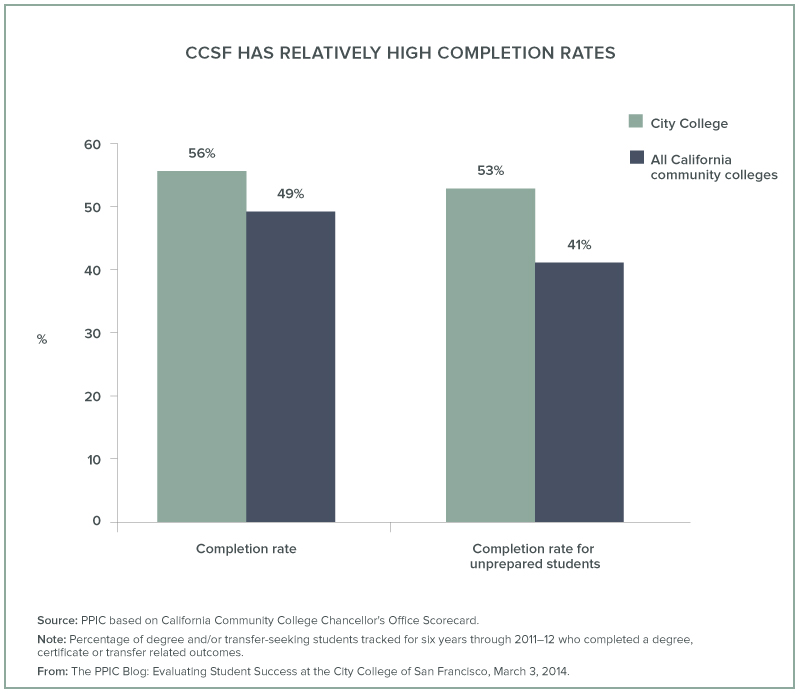
Because the California Community College Chancellor’s Office does an excellent job of providing information on student success, we have a wealth of data to examine student outcomes at CCSF. By most measures, City College fares well relative to other community colleges in the state. The share of students who complete college by earning a degree or certificate, or by transferring to a four-year college, is higher at CCSF than in the rest of the state. This advantage holds even when we limit our analysis to students who are initially unprepared for college-level work, which suggests that it is not simply the mix of students drawn to City College that drives its outcomes. (Although it is possible that CCSF’s unprepared students are closer to college level than unprepared students at other colleges.)

Of particular interest is how effectively a community college prepares students for transfer to four-year colleges or universities—this is arguably the most important mission of community colleges. Among students defined by the chancellor’s office as intending to transfer, City College has a higher success rate than most other college districts, ranking 6th out of the state’s 72 community college districts and 4th among the state’s larger districts—those with at least 2,000 students intending to transfer. The other top districts are a who’s who of the state’s most highly regarded: Foothill-De Anza, South Orange County, San Diego, Pasadena, and Santa Monica. By this important measure, City College is in very good company.

On some outcomes, City College performs below average. For example, its success rates in math remediation are significantly lower than the state average, and the share of career technical, or vocational, students who earn a certificate is slightly lower than the state average. However, City College fares well in most other measures. For example, the share of students who successfully complete remediation in English is higher than the statewide average, as is the share of students who successfully complete ESL courses.

Student outcomes are not the only way to assess a college. But they are an important measure of success. CCSF has provided thousands of students with a pathway toward meeting educational and occupational goals. That is no small feat.

Testimony: Community Colleges’ New Scorecard

The Select Committee on Community Colleges held an oversight hearing, “The State of California Community Colleges,” on February 18. The committee invited PPIC Bren Fellow Hans Johnson to testify on the Community College Chancellor’s Office efforts to provide new information on student outcomes through its Student Success Scorecard. Here are his prepared remarks.


Thank you Chairman Fox and committee members. My name is Hans Johnson. I am a Bren Fellow with the Public Policy Institute of California. PPIC has produced a number of studies on California’s higher education systems. Our focus in those studies is on student outcomes, and how we can improve those outcomes. I appreciate the opportunity to testify today about the Community College Chancellor’s Office efforts to provide more and better information on student outcomes through their “Student Success Scorecard.”

Community colleges play an especially important role in California. They enroll the large majority of undergraduates in our state, far more than UC, CSU, or private institutions. As a state, from a budget and enrollment perspective, we place more emphasis on community colleges than do most other states. Helping more community college students to achieve degrees, certificates, and transfer is key to our state’s wellbeing.

As an independent researcher, I have had the opportunity to work with the Chancellor’s Office, and I have been very impressed with their professionalism and their knowledge. The scorecard is a step in the right direction for several reasons. First, the scorecard offers the right kind of information on the right kinds of student outcomes. For numerous critical measures, such as completion rates, the scorecard provides information on outcomes for each of the state’s community colleges, with breakdowns for key demographic groups.

Second, the scorecard is transparent and accurate. It reflects the impressive data collection efforts and expertise of the Chancellor’s Office. Details about the scorecard measures and how they were created are readily accessible.

Third, the scorecard presents information in a user-friendly format. Graphs and tables are well-presented and easy to follow. This is critical for parents and prospective students as they consider their college choices.

Finally, the scorecard is a useful tool for policymakers, policy researchers, and the colleges themselves. The scorecard makes it easy for colleges to identify where they stand relative to other colleges and to measure their progress over time. For policy researchers, this information is useful in answering questions about student progress. For example, using the scorecard we find that there is a wide range in completion rates across colleges (with completion defined as earning an associate’s degree, a certificate, or transferring to a four year college). Some of this variation can be attributed to differences in the academic preparation of incoming students, as can be shown using scorecard data.

The scorecard is an important tool, but it could be enhanced by incorporating additional measures. This would be easy to do, because the Community College Chancellor’s Office already has very useful data available elsewhere. For example, through its Salary Surfer the Community College Chancellor’s Office provides data on salaries of community college students before and after earning a degree or certificate. Adding this information to the scorecard would provide valuable labor force information for prospective students. The Chancellor’s Office provides even more data on student outcomes through its online Data Mart query tool. Some of that data, such as transfer rates to four year colleges, should also be incorporated into the scorecard.

California’s community colleges are doing a very good job of collecting and sharing important data, and the scorecard is an important example of those efforts. However, the Community College Chancellor’s Office still faces a big challenge in getting the scorecard into the hands of prospective students and parents when they need it most.

Finally, it must be noted that the scorecard is only a tool. The information provided in the scorecard can prompt action, but the real key to increasing student success depends on improving student pathways to transfer, degree completion, and certificate completion.