Video: Reforming Remedial Math in Community College

Developmental—or remedial—education is one of the largest barriers to student success in California’s community colleges. The good news is that reforms are underway, and a new report by the Public Policy Institute of California (PPIC) looks at the effectiveness of some of these reforms in math. PPIC researcher Olga Rodriguez presented the report in Sacramento this week. One reform the researchers studied is an alternative to traditional algebra-based courses and is designed for students in majors—particularly those in the liberal arts and humanities—that require only statistics. The report finds that students in this statistics sequence substantially outperform their peers who take traditional developmental math.

In a discussion following the presentation, panelists addressed the issue of why this math alternative is not more widely available. Myra Snell, math professor at Los Medanos College and cofounder of the California Acceleration Project, said the reasons range from the logistical to the cultural. Most math professors are not trained in statistics. Further, there is a deeply held belief among faculty that intermediate algebra is essential. She said that this “gets in the way of them rethinking what might be best for students.”

Laura Metune, vice chancellor of external relations at the California Community Colleges Chancellor’s Office, noted the necessary shift in emphasis from encouraging campuses to try multiple interventions to investing in alternatives with the best chance of helping more students achieve their academic goals.

Nikki Edgecombe, senior research scientist at the Community College Research Center at Teachers College, Columbia University, noted: “If we know that students who are completing a statistics-level pathway are completing their transfer-level math at a significantly higher rate, but we hold on to the old system as well, it’s safe to say we’re doing a lot of students a disservice.”

She continued: “To be honest, there are a lot of bad ideas out there. We need to have the moral courage to identify what those are and fashion solutions for students.”

Learn more

Read the report Reforming Math Pathways at California Community Colleges
Visit the PPIC Higher Education Center

Partisan Gerrymandering and the Role of Social Science in the Courts

The US Supreme Court is considering a high-profile case that could change the way legislative maps are drawn and reshape elections. The court has invited social science to play an unusually significant role in its decision.

On October 3, the court heard oral arguments in Gill v Whitford, a Wisconsin case that could result in the first constitutional constraints on partisan gerrymandering. The case represents the culmination of decades of litigation on the subject. As someone who responded to the court’s call and provided a metric used in the case, I have an unusual perspective on the court’s relationship to social science and what it may say about the role of social science and the law more generally.

Partisan gerrymandering, broadly defined, is the practice of drawing the boundaries of representational districts to maximize the number of seats for one party. In 1986, the court declared this practice appropriate for judicial consideration. But the justices did not know how to define a partisan gerrymander so they could consistently identify one in a way that removed personal bias as much as possible. In the ensuing 30 years of litigation, the court has hardly strayed from this initial view—that the problem is real but difficult to define.

Partisan gerrymandering is a challenge to measure and describe because it represents the collision of two fundamental elements in American politics: geographic representation and party allegiance. Our district-based approach to elections presumes that geography trumps all other concerns. Each district is supposed to elect the best person to represent the needs of the people in that community, and each district’s needs are imagined to be distinct from the needs of other districts.

In reality, parties, not geography, drive our politics. Parties bring factions of voters in each district together into a broad, durable coalition that often has no relationship to geography at all. Voters will agree much more often with fellow partisans in other districts than they will with opposing partisans in their own district.

Parties therefore bind voters in different districts to each other. Voters who choose parties care about more than just the mechanical fact that someone has been elected to represent their district. They want their party to win, and they also want representatives from their party to be elected elsewhere.

But in our district-based system, a party that wins more votes does not necessarily win more seats. It has to win more votes in the right places: in districts where more votes will push the party over the threshold to victory.

Partisan gerrymandering exploits this fact by making sure that one party spends its votes in futile efforts: districts where it comes close to winning but will never quite get there, and districts that it will win by margins so large that victory is never in doubt. These outcomes “waste” votes because so much of the party’s support (the votes cast for losers and those cast in excess of the number required to win) do not contribute directly to victory. By playing with the number of votes each party wastes, a partisan gerrymander can manipulate the number of seats each party wins, even when the number of votes the parties receive does not change.

This leads to a real tension. One the one hand, our district-based political system suggests that parties are unnecessary and certainly not owed any particular level of representation.  On the other hand, if voters largely express their policy desires through parties, suppressing a party’s representation—as partisan gerrymandering does—seems like a serious violation of democratic norms. The court’s struggles in this area reflect this collision of ideas. The court believes the issue is real and potentially very serious, but it has trouble defining the harm within a system that does not take parties into account.

Rather than resolve this contradiction, the justices extended an open invitation to social scientists to solve it for them (or at least get them closer to a solution). This was a sensible step for the court to take. Social scientists add the most value when a clear, objective measurement is needed but the specifics of it are going to be nuanced and complex.

Moreover, social scientists have stepped up to the court’s challenge. In addition to the measure I have offered—the “efficiency gap”—social scientists have also presented several other approaches to the court. Each one measures a slightly different aspect of the concept of a partisan gerrymander, and each has its plusses and minuses. In the Whitford litigation, these quantitative options led to an unusually large amount of analysis. Graphs, tables, computer code, equations, and data all became important parts of the Whitford evidentiary record.

This is clearly a success for social science. But it also creates a problem for the court. Precisely because it takes social science to understand partisan gerrymandering, the solutions offered will be complex. The court balked at this complexity in the oral arguments, calling the social science “full of questions,” “gobbledygook,” and a “bunch of baloney.” Concerns were raised that reliance on social science would undermine the legitimacy of the court, since it might be difficult to explain the court’s decision in terms the average person could understand.

These concerns should be taken seriously, but they should not prevent the courts from addressing complex problems. As more data and computing power become available, social science will increasingly provide nuanced analyses that will be challenging to understand. These may not always be requested by the courts. In fact, it may be social science that invites the courts to get involved in issues that had once been considered untouchable—or that the courts were not even aware were problems.

The courts cannot just ignore this new evidence. Nor can they be expected to step in to defend something that they do not understand. Instead, we must find more effective ways to help the courts deal with the evidence that they see. There are a variety of options here, from staffing courts with social science experts to adding more social science analysis to law school curricula.  Perhaps we might even require judges, like doctors, to take short courses on the latest methods in order to be “re-certified” on a periodic basis.

Regardless of the solution, the struggles evident in the Whitford gerrymandering case are unlikely to get better without some change. Social science and the law are made for each other, but the marriage might need a little counseling to work itself out.

K–12 Test Scores Vary Widely across Student Groups

The 2017 test results for California’s public K–12 school students were essentially unchanged from 2016. But behind the overall results, there were significant differences among student groups. Economically disadvantaged students—mostly those who are eligible for free or reduced price school meals—continued to score far below students not in this category. Students with disabilities and English Learner (EL) students performed at levels significantly below those of low-income students. Gaps in achievement among these groups were essentially unchanged in 2017.

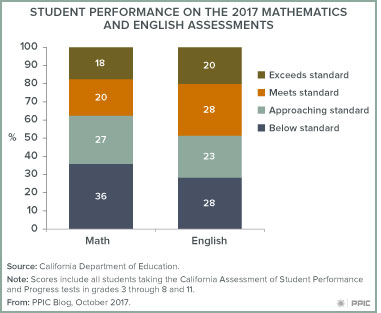
Known as the California Assessment of Student Performance and Progress (CAASPP), tests in English and mathematics are administered to virtually all K–12 students in grades 3 through 8 and in grade 11. Students take the computer-based assessments in late spring each year. The scores are reported across four performance levels. In English this year, 45% percent of students performed at the top two levels, which signal that they are working at or above the state’s standard for proficiency. About 28% of all tested students fell into the lowest performance level, “below standard.” In comparison, fewer students had mastered the mathematics skills needed to meet state standards, with 38% earning a proficient score. More than a third (36%) scored at the lowest performance level.

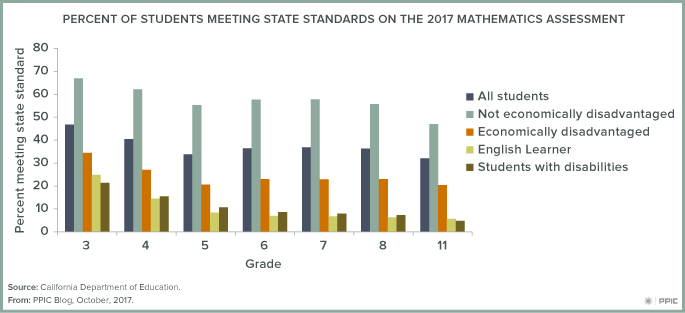
When we look at the proportion of students in each grade who scored at the two top performance levels on the mathematics test, we see that 47% of third graders meet the standard, while fewer students in subsequent grades meet state standards. By grade 11, only 34% are at the top two levels.


The state’s Local Control Funding Formula recognizes that family income is highly related to student success, and the test results reflect that relationship. Only 33% of economically disadvantaged students in third-grade and 20% in eleventh grade scored at proficient levels in mathematics. For students who are not economically disadvantaged, proficiency rates are more than twice as high—68% in third grade and 48% in eleventh grade. This divide is particularly important because 60% of students tested are economically disadvantaged.

Fewer than one-quarter of third grade students with disabilities or English Learners met the state’s mathematics standard. Performance is lower in the higher grades, and by grade 11 only about 5% of these groups are scoring at proficient levels. These data, however, understate the performance of these students. English Learner students who master English are reclassified as fluent, and are therefore no longer included in the EL group; the testing data show that reclassified students perform at higher levels than native English speakers. Also, newly arrived EL students in grades 3 through 11 tend to lower average EL test scores. These dynamics result in the data showing persistently low EL proficiency rates. A similar dynamic affects special education scores.

The new test scores reemphasize the need to boost outcomes for California’s low-income students. Students who are not considered low-income perform pretty well, yet even this group’s mathematics achievement lags in the higher grades. The data also underscore the need for better information on English Learners and students with disabilities. It is likely that the progress of these students is better than suggested by these scores. The state should consider using the individual student data to develop more accurate measures of progress for EL students and other groups.

New Laws Ease Funding and Improve Accounting for Water

This was a busy year for water policy in the California Legislature. Governor Jerry Brown signed more than a dozen bills affecting the way we manage water. The bills cover a wide range of issues, from funding water infrastructure to reporting on new groundwater wells in overdrafted basins.

Paying for water emerged as a major theme in this year’s crop of water bills. Here’s a summary of newly signed bills:

  • Stormwater: SB 231 gives the courts guidance on how to interpret Proposition 218, which requires that a majority of landowners or a two-thirds majority of all local voters approve new stormwater drainage fees—making it difficult for agencies to pay for needed improvements to their systems. SB 231 defines stormwater as part of the sewer system. This puts stormwater services on par with water, sewer, and trash collection, none of which are subject to direct voter approval of new fees. If the courts uphold SB 231’s interpretation, this will give stormwater agencies more flexibility to raise funds.
  • Safe drinking water: AB 560 and AB 339 expand funding options for projects that enhance drinking water quality in poor communities and meet emergency water supply needs. AB 560 will make it easier for some disadvantaged communities to access grants and get more affordable terms on loans for safe drinking water projects through the Drinking Water State Revolving Fund. And AB 339 makes permanent a temporary authorization to use the State Cleanup and Abatement Account for emergency drinking water supply problems such as shortages or impaired quality.
  • Water and parks bond: SB 5 (the California Drought, Water, Parks, Climate, Coastal Protection, and Outdoor Access for All Act of 2018) is a $4 billion general obligation bond for improving outdoor open spaces and parks, protecting rivers and coastlines, and supporting solutions to a range of other water management issues such as groundwater sustainability and flood protection. This will go before voters in June 2018.

Two bills improve water use accounting:

  • AB 589 creates standards for water use measurement techniques. This addresses the relatively recent requirement that surface water diverters measure and report water use to the state.
  • SB 252 specifies types of information that groundwater users must report to their local jurisdictions when they apply to dig new wells in critically overdrafted basins. Reporting includes characteristics such as well location and depth, distance from surface water areas, estimated volume to be pumped, and category of use. The bill, which sunsets on January 30, 2020, is aimed at filling a critical data gap until groundwater sustainability plans are adopted under the Sustainable Groundwater Management Act.

Other pending water policies that did not make it to the governor’s desk this year are likely to return in 2018. To pay for safe drinking water projects in disadvantaged communities, SB 623 would create a Safe and Affordable Drinking Water Fund, to be funded by fees on agricultural chemicals and urban water use. And AB 1668 (in conjunction with SB 606) would authorize state agencies to establish long-term urban water use efficiency standards. The bill also proposes additional components to agricultural water management planning and reporting. SB 606 proposes changes to urban water shortage planning policies.

The new laws are designed to improve access to funding and strengthen existing tools for improving the way California manages water. We will keep track of updates and new proposals in 2018.

Housing Costs and Higher Education

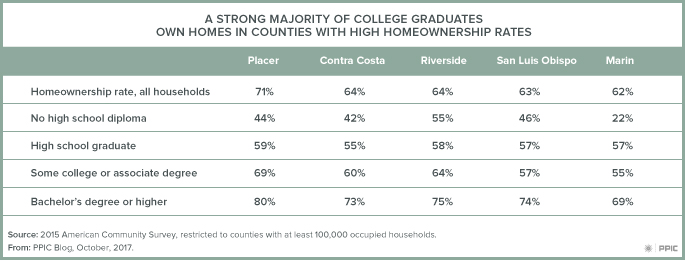
Homeownership FigureOwning a home has long been part of the American dream. But with the state’s high housing costs, homeownership is difficult for many Californians to achieve. In a recent PPIC Statewide Survey, more than half of renters say the cost of housing is making them seriously consider moving away from the part of California they live in now, with most of those indicating that they are thinking of leaving the state.

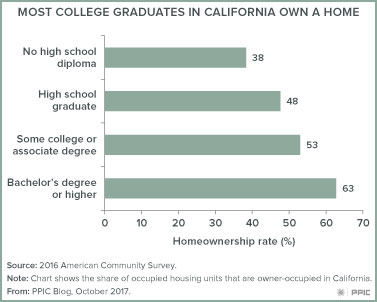
Homeownership rates are substantially lower in California than in the rest of the United States (54% vs. 63% in 2016, according to the American Community Survey). But one group in California fares relatively well with respect to homeownership: college graduates. Among heads of household with at least a bachelor’s degree, almost two-thirds own rather than rent, compared to less than half of high school graduates. The higher rates of homeownership among college graduates are a consequence of their economic success. As shown in other PPIC research, college graduates have much higher incomes and lower unemployment rates than other Californians, enabling many of them to purchase a home.  Owning a home, in turn, often leads to greater wealth. Indeed, the higher net worth of college graduates in California is strongly tied to homeownership.

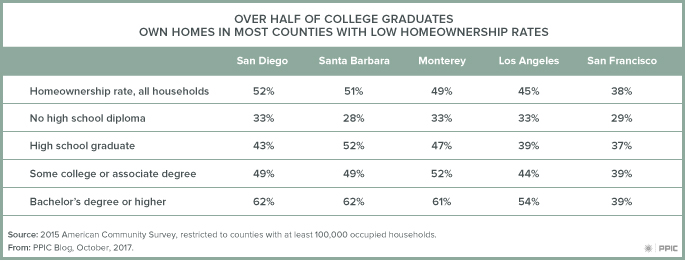
Of course, housing markets are regional, and the coastal areas of California are less affordable for everyone. The five counties with the lowest homeownership rates are all in coastal areas with high housing prices. But even in those counties—with the notable exception of San Francisco—over half of college graduates own a home. At the other extreme, counties with the highest homeownership rates are primarily suburban counties, including some with high housing costs. About 70% or more of college graduates in these areas own a home.


California policymakers have recently enacted a series of measures designed to increase the supply of housing, with a focus on affordable housing units. Certainly, the state’s housing crisis cannot be alleviated without building more housing. But while higher education is not often considered part of a housing agenda, it has played an important role in shielding many Californians from the state’s dramatic increases in housing costs. Because of the labor market advantages experienced by college graduates, many have been able to purchase a home, giving them more stability in their housing costs and allowing many of them to build wealth.

Commentary: California’s Forests are Dying—They Need Better Care

This commentary was published in the San Francisco Chronicle on October 14, 2017

California’s forests are on fire, with tragic consequences for communities around the state. While the firestorm in the Wine Country has made international headlines, many small mountain communities also were aflame or on high alert.

The focus now is on saving lives and protecting property, but when the fires are out, the state will have to face up to a major problem: Our forests are too dense and dry, and, in some areas, dying. We need a new way to manage this vital natural resource.

Read the full commentary on sfchronicle.com.

Testimony: Cybersecurity Needs and Higher Education

Hans Johnson, director of the PPIC Higher Education Center and PPIC senior fellow, testified at the Joint Legislative Oversight Hearing on Cybersecurity Education and the Needs of the Workforce before the Assembly Committee on Higher Education in Sacramento today (October 10, 2017). Assemblymember Jose Medina chairs the Higher Education Committee and Assemblymember Jacqui Irwin chairs the Select Committee on Cybersecurity. Here are Johnson’s prepared remarks.

Thank you Chair Medina, Chair Irwin, and committee members.  My name is Hans Johnson, and I am the director of the Higher Education Center at the Public Policy Institute of California. My role today is to provide a brief overview of cybersecurity labor market needs in the state. First, I’ll define cybersecurity occupations, next I’ll provide data on labor market trends, and finally I will discuss educational awards related to cybersecurity. Sources of information and data used in this testimony include the United States Department of Labor, the California Employment Development Department, the United States Census Bureau, and reporting by California colleges and universities to the United States Department of Education.

As an occupation, cybersecurity is identified by the US Department of Labor as “information security analyst” and resides within a broader set of computer and mathematical occupations. In this testimony, I will focus on the information security (IS) analyst occupation. However, it is important to note that other computer and information technology occupations include individuals who work at least partly on security issues. According to the US Department of Labor: “Information security analysts plan and carry out security measures to protect an organization’s computer networks and systems. Their responsibilities are continually expanding as the number of cyber attacks increases.”

The IS analyst occupation is a high wage, high demand occupation. It is growing but still relatively small. Increasingly, employers are hiring workers with at least a bachelor’s degree to fill IS analyst jobs, but a notable share of jobs are still filled by workers with less than a four-year degree.  California colleges and universities have substantially increased the capacity of their institutions to award degrees in computer science and related fields. Even so, unemployment rates remain very low—an indication that employers could be having a hard time finding workers.

In California, EDD estimates the state was home to about 8,000 IS analysts in 2014, with that number projected to increase to 10,100 by 2024, a growth rate (26%) slower than other computer occupations (29%) but much faster than the state’s overall employment growth rate (15%). Still, it is important to note that IS analysts make up less than 1% of employment in computer occupations in California and less than 2% in the nation (see chart below). IS analysts work in a broad range of industries, including technology, banks, higher education, insurance, and health.

EDD estimates that IS analysts in California had a median wage of $53 per hour in the first quarter of 2017, which amounts to $110,000 on a full-time annual basis. Nationwide, the unemployment rate for IS analysts has been around 2% for several years now (based on my analysis of American Community Survey data from 2012 through 2015), with similarly low unemployment rates in California. Unemployment rates that low are a sign of high labor market demand.


Of critical concern for workers, and for these committees, are the education and training requirements for IS analysts. According to the U.S. Department of Labor:

Information security analysts usually need at least a bachelor’s degree in computer science, programming, or a related field. As information security continues to develop as a career field, many schools are responding with information security programs for prospective job seekers. These programs may become a common path for entry into the occupation. Currently, a well-rounded computer education is preferred.

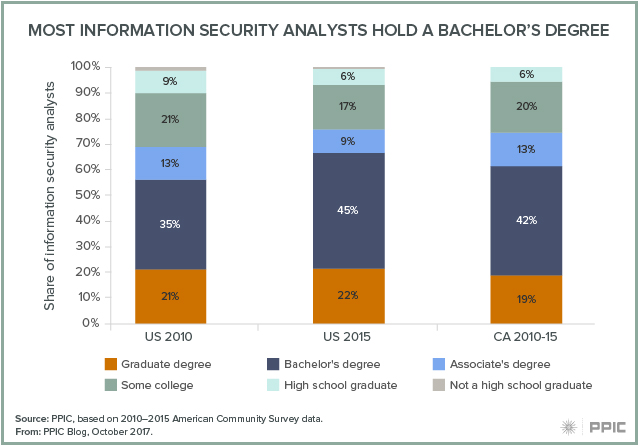
The number of IS analysts has increased nationwide in the last five years and so has their educational attainment. In the US, 67% of IS analysts had at least a bachelor’s degree in 2015 compared to 56% in 2010. In California, about two-thirds of analysts have at least a bachelor’s degree. The share of IS analysts in the US with an associate’s degree has declined from about 15% to less than 10%. The vast majority with a bachelor’s degree majored in one of three fields: computer science (including information systems), engineering (including electrical engineering and computer engineering), and business (including management information systems). In California, annual average earnings for IS analysts with a bachelor’s degree are about 70% higher than for those with some college or an associate’s degree, who in turn earn about 20% more than those with only a high school diploma. Unemployment rates are low for IS analysts, especially those who have some postsecondary education and those who have a bachelor’s or graduate degree.

California is home to dozens of colleges and universities that offer degrees in computer and information sciences. The state’s universities, especially the University of California, have quickly responded to the strong demand for these degrees (see chart below). The total number of bachelor’s degrees awarded increased from less than 3,000 in 2010 to 6,000 by 2016, with UC and CSU accounting for 65% of the total in 2016. The most common major is computer science, followed by computer and information science.


California’s community colleges also offer postsecondary training in computer and information sciences, ranging from short-term certificate programs to associate’s degrees. Importantly, they also provide lower division courses necessary for transfer to a four-year college or university. The total number of associate’s degrees in computer and information sciences and support services doubled between 2010 and 2016, from 719 to 1,490. The number of short-term certificates (completed in less than one academic year) increased from 1,605 in 2010 to 1,838 in 2016, and the number of longer-term certificates (completed in at least one but less than two academic years) increased from 225 to 321. In all, the number of postsecondary awards totaled more than 3,600 by 2016. PPIC is currently developing research that explores information technology awards at the community colleges and is working with the Employment Development Department and the Chancellor’s Office of the California Community Colleges to secure access to student and wage data.

In thinking through the roles of the different segments of higher education in California, it is important to keep in mind that the segments are designed to work as a system. The strong demand, both on the part of students and employers, in technology fields should be met by each institution and by the segments working together. For example, improving transfer from community colleges to UC and CSU in technology fields through better articulation—including Associate Degrees for Transfer—is necessary if students are going to fully realize the economic benefits of these fields. Moreover, cybersecurity occupations are but one part of a larger technology sector. Developing a larger industry-wide and cross-system approach to meeting demand is necessary. Innovations—such as locating some CSU bachelor’s degree programs at community college campuses—offer the promise of reaching more students, including those underrepresented at our four-year colleges. California can best serve the growing number of students who want to pursue technology jobs by taking advantage of the strengths of each segment of its public higher education system—and helping those segments work together to meet the economic need for these highly skilled workers.

Learn moreVisit the PPIC Higher Education Center

Reforming Remedial Education in Community College

Reforming developmental, or remedial, education is essential to improving student outcomes in community colleges. Why? Developmental education is supposed to help underprepared students, but currently it may be one of the largest impediments to success. As PPIC research has shown, 80 percent of incoming California community college students—and a disproportionate share of students of color—enroll in at least one developmental course, but relatively few successfully move on to complete a college-level course. The good news is that over the last few years, there has been a tremendous amount of support for reform.

Reforming Assessment and Placement
Assessment and placement reforms generally involve moving away from the traditional reliance on standardized tests and toward a more holistic measure of prior achievement such as high school course grades. Research finds that test-based assessment and placement policies assign many students into remediation unnecessarily. Indeed, students’ high school performance as measured by GPA and course grades—even when self-reported by students—is a much more accurate indication of student readiness. A recent report by the California Acceleration Project shows that the use of high school measures has dramatically broadened access to and completion of college-level math and English courses, significantly reduced equity gaps, and has had little impact on course success rates.

But implementation is key. Several decisions will determine the impact of new policies in increasing access to college-level courses and reducing unnecessary remediation: What GPA or course grades will qualify a student for access to college-level courses? If a college uses multiple measures, how will they be combined into a single placement decision? Will colleges accept students’ self-reports of their GPA and grades? Furthermore, as campuses expand access to college-level courses, it is critical that they provide supports to students who need to brush up on their math or English skills. Guidance provided by the Multiple Measures Assessment Project, the California Acceleration Project, and others will be central to helping colleges make these important decisions.

Reforming Developmental Courses
Changes to developmental coursework can also help more students progress to college-level courses.  Some colleges are transforming traditional developmental education into accelerated pathways that are relevant to students’ programs of study using the design principles of guided pathways introduced by Bailey, Jaggars, and Jenkins, which allow colleges to cluster hundreds of programs of study into a handful of broad areas (e.g., liberal arts, STEM, business, and health). For example, in math, there are statistics, quantitative reasoning, and STEM/precalculus pathways. In English, reforms often entail integrating reading and writing courses and contextualizing classes within broad fields of study. Additionally, colleges have shortened developmental pathways or offered concurrent support courses instead of requiring students to take prerequisites. This reduces the number of students who drop out because they fail to reenroll in long developmental course sequences, while providing just-in-time support to help students succeed in college-level work.

Across the state, PPIC has found that a growing number of developmental education reforms are underway—led by the California Acceleration Project and the Carnegie Foundation, among others. These initiatives are well positioned to implement reforms using the guided pathways framework. Emerging research suggests that providing accelerated math pathways that are more aligned with students’ programs of study helps improve early academic outcomes, including completion of college-level math. Less is known about the impact of developmental English reforms on student outcomes, but recent evidence on compressed and co-requisite English courses is encouraging.

Research and Policy Opportunities
Support for developmental education reform and guided pathways at community colleges has been spearheaded by the multimillion-dollar investments made through the Community College Chancellor’s Office, the governor’s annual budget, and legislative proposals, including AB 705 and SB 539. As colleges continue to adopt and scale placement and course reforms, it will be imperative to assess students’ perspectives and outcomes to determine if new policies improve student success and reduce equity gaps.

What Recent Hurricanes Mean for Flood Insurance in California

Three exceptional hurricanes—Harvey, Irma, and Maria— caused staggering damages from floods, winds, and storm surge in recent weeks. It’s likely they will make the record books as the most costly natural disasters in US history.

Although California doesn’t get hurricanes, it does get large storms (called “atmospheric rivers”) that can be just as damaging to people and property. Currently, one in five Californians and close to $600 billion worth of structures are vulnerable to flooding.

One way for residents and businesses to reduce the financial risks of flooding is to carry insurance. Millions of Californians depend on the National Flood Insurance Program (NFIP), managed by the Federal Emergency Management Agency (FEMA). But at almost 50 years old—and facing an uncertain reauthorization this December—it has many problems.

The most immediate concern is the imbalance between premiums and claims. Currently, the NFIP is more than $25 billion in debt―a figure that will certainly grow once all the recent hurricane claims are processed.

“The program never charged prices that would cover a year like Hurricane Katrina, where it paid out more than it had over the life of the program.  And the string of storms since then—Ike, Sandy, and now Harvey, Irma, and Maria—have only worsened its debt,” says Carolyn Kousky, director of policy research for the Wharton Risk Center and a member of the PPIC Water Policy Center research network.  “Realistically, the program will not be able to repay this debt, so the best thing may be for Congress to simply forgive it, while also putting in place a new approach to pay for catastrophic events.”

Another problem is that too many people at risk of flooding do not enroll in the program. In Houston, approximately 80% of Harvey-flooded homes were not insured.  And here in California, just 10% of flood-prone Sacramento county households and only half of those in high-risk areas have flood insurance.  Among the reasons so few people purchase insurance, Kousky says, are “unwillingness or inability to pay, a misunderstanding about the role of insurance, an unsubstantiated faith in disaster aid, and importantly, no information or even misinformation on flood risks.”

Inadequate perception of risk stems, in part, from the way FEMA maps flood hazards and mandates insurance. Currently, FEMA requires (but does not sufficiently enforce) flood insurance for homes with a 1-in-100 chance of flooding in any given year (the so-called 100-year flood). For homes in the floodplain but out of this high-risk zone, insurance is optional.

Nicholas Pinter—the associate director of the UC Davis Center for Watershed Sciences and a member of the PPIC Water Policy Center research network―notes that this gives a false impression that those outside this zone are safer than those within it. His laboratory found that roughly half the flooding from Harvey was outside of Houston’s 100-year floodplain zone.

“The picture in California is much better than in Texas,” Pinter says. “But updating flood maps here still takes many years, and California still largely works within FEMA’s framework of the ‘all or nothing’ 100-year floodplain.”

But the state may not be getting a good deal from the NFIP.  According to Pinter, California pays much more into the program than it is getting back.  He notes that California has gotten just 14 cents in return for every dollar of premiums paid.  The Central Valley—the most flood vulnerable area of the state—got just 9 cents per dollar.

“For a variety of reasons, California may be overpaying for its actual flood risk,” Pinter suggests. “The state needs to explore whether it is cheaper to develop its own flood insurance program and to invest the savings—estimated to be at least $150 million per year—in reducing flood risk across California.”

With this year’s unprecedented string of flood disasters and uncertainty for national insurance, it’s time for real policy reforms to ensure Californians are prepared to weather the growing risk of floods. Fixing our flood insurance problems is one way to start.

Learn more
Read Floods in California (PPIC fact sheet, September 2017)
Watch our 3-minute video “Floods”
Read Financing Flood Losses by Carolyn Kousky (February 2017), and her related blog post, “Flooding and the Economics of Risk Reduction” (August 30, 2017)

Video: How Californians View National Issues

With the nation focused on a range of contentious issues, the September PPIC Statewide Survey provides a California perspective. Dean Bonner, associate survey director, shared the key findings at a Sacramento briefing last week.

Among them:

  • A record-high share of Californians have a favorable opinion of the Affordable Care Act, and most want Republicans to work with Democrats to improve the law. While most Californians say it is the federal government’s responsibility to make sure that all Americans have health coverage, just a third favor a single-payer, government-run national health insurance system.
  • Three-fourths of Californians—also a PPIC record high—view immigrants as a benefit rather than a burden. There is broad and bipartisan support for protections provided by DACA, which shields from deportation some undocumented immigrants brought to the US as children and allows them to get a work permit if they pass a background check.
  • Half of Californians say they are very concerned about the possibility of North Korea having a nuclear missile that could reach the state.
  • Two-thirds of Californians view possible Russian interference in the 2016 as a serious issue.
  • Half of Californians say race relations have gotten worse in the United States over the last year. They are less pessimistic when it comes to race relations in the state.