Majorities Favor State Government Downsizing

The recent PPIC Statewide Survey offers an early snapshot of voters’ choices as we enter the November election cycle. The majority support for Governor Jerry Brown’s reelection and the Proposition 1 state water bond was widely cited in the media last week. But the poll also reveals surprising news about the voters’ overall mood this year: by a wide margin, likely voters would rather pay lower taxes and have a state government that provides fewer services (53%) than pay higher taxes and have a state government that provides more services (41%).

What is so special about this finding? We have been observing a slow but steady rise in the preference for lower taxes and fewer services since November 2012—when voters approved the Proposition 30 tax increase. In the 24 times since we first asked this question in our February 2003 poll, the preference for lower taxes and fewer services has usually been below 50 percent. Moreover, this preference has never exceeded 55 percent, placing the current reading close to the historic high.

This finding seems to run counter to the strong support we found for the Democratic governor and the multi-billion dollar state water bond on the November ballot. It is also seems at odds with another Golden State mega-trend: the steady decline in the number of Republican voters. The secretary of state recently reported that Republicans now account for just 28 percent of the electorate.

While a preference for smaller government has long been expressed by Republicans, the 53 percent of California likely voters who want lower taxes and fewer services are a politically mixed group. Forty- eight percent are registered Republicans and 55 percent are self-described conservatives—which means that many who hold this view are Democratic and independent voters, and see themselves as political moderates. They are predominantly homeowners (81%), and most are white (66%). But only a slight majority are age 55 and older (54%), and less than half are college graduates (41%) or have annual household incomes above $80,000 (44%). So, this likely voter group has a diverse demographic profile.

What do they have in common? Seven in 10 say the state is headed in the wrong direction. Three in four say that the state budget situation—that is, the balance between government spending and revenues—is a big problem for the people of California. Eight in 10 say that major changes are needed in the state budget process in terms of both revenues and spending. In sum, they are the core audience for fiscal restraint and reform.

Governor Brown’s emphasis on fiscal prudence, including the downsizing of the state water bond, seems to have struck a chord here. Among those who prefer a smaller role for state government, one in three are supporting Jerry Brown in the governor’s race. This trend helps to explain the Democratic candidate’s sizable 21-point lead over Republican challenger Neel Kashkari. This group is also leaning toward support for the Proposition 1 state water bond (46% yes, 37% no), helping this multi-billion dollar spending measure to now have a commanding two-to-one lead.

This likely voter group may be a major hurdle for a Democratic Party seeking to regain a supermajority in the state legislature. Seven in 10 of these likely voters say they disapprove of the way that the state legislature is handling its job. Six in 10 say it would be a “bad thing” for the Democrats to gain a two-thirds majority in the legislature in the November election. Only 18 percent say that this would be a “good thing.”

Our poll’s findings on the preferred role of state government suggest that the election is unlikely to result in a mandate for expanding services and raising taxes—they also point to an opening next year to discuss fiscal reforms that the state needs for the 21st century economy.

Is California the Poorest State?

In September and October of each year the Census releases estimates of poverty in the U.S. and in each state. Earlier this month “official” poverty estimates for 2013 showed 14.9% of all Californians in poverty and 20.3% of California children in poverty.

In October we expect to see the Census calculations for the “research supplemental poverty measure.” These estimates will represent three-year averages for states (2011-2013) and will likely show that more than 20% of all Californians are in poverty. In past years, this supplemental measure ranked California as the poorest state in the U.S. But according to the latest official estimates, 16 states had higher poverty rates than California. How do we make sense of this?

Some basic information on measuring poverty should help clarify the statistics:

    • The “official” poverty measure. This is based in a 1960s-era formula that is meant to provide a consistent measure across a long timeframe. Rates developed using this measure tell us what share of families lack enough cash to meet a simplistic budget. The rates compare pre-tax cash income (from work, investments, child support, social security, unemployment, and the like) to an estimate of resources needed built from a 1950s food budget and updated for inflation. This budget does not vary according to where a family lives.


    • Supplemental Poverty Measure. This is based on a more comprehensive set of resources and an up-to-date estimate of what it takes to make ends meet. Rates developed using this measure tell us what share of families lack enough total resources to meet basic needs. It adds together a family’s cash income (after taxes) and any in-kind benefits received (like food stamps and housing assistance), then subtracts key out-of-pocket expenses (like child care and medical costs). The resulting total is compared to an estimate of resources needed to meet basic living expenses for food, housing, clothing, and utilities. That estimate varies according to housing costs, so it is different within and across states.


In our view, the official measure is useful for tracking long-term trends in poverty. But the other measures better capture the full set of resources families have on hand and more accurately gauge current costs of living. Based on these measures, California is indeed one of the poorest states in the country.

This finding is largely driven by California’s high cost of living, rather than by sharply limited resources among its families. Using the California Poverty Measure we find that California’s housing costs loom large. Were these costs closer to the U.S. median, California’s poverty rate by either supplemental measure would be much closer to the official rate, and child poverty would be lower than the official rate.

Nonetheless, we also find that safety net resources substantially moderate poverty for many California families: according to the California Poverty Measure, the state’s poverty rate would be as much as 8 points higher were it not for these programs.

Poverty rates also vary widely across the state. PPIC just released a publication that examines this variation—as measured by the California Poverty Measure for 2011—with a focus on children and the role of the social safety net in mitigating poverty.

Briefing Focuses on Survey Election Findings

Less than two months before the election, PPIC’s latest survey looked at Californians’ views on the governor’s race and four statewide ballot measures. Dean Bonner, associate survey director, presented the findings at a briefing in Sacramento on Wednesday. As most of the media coverage noted, the survey found that Governor Brown is doing well in his reelection bid and that the water bond he approved is fairly popular.

The survey found that Proposition 2, labeled the Budget Stabilization Act in the ballot statement but known elsewhere as the rainy day fund, does not currently have majority support among likely voters. Proposition 45, which would regulate health insurance premiums, has a similar level of support, but Proposition 47, which would reduce sentences for some crimes, is favored by 62 percent of likely voters. The survey also found high levels of concern about the drought and mixed feelings about the Affordable Care Act and immigration policy priorities.

The High School Exit Exam: What’s Next?

The California High School Exit Examination (CAHSEE) is likely to be a topic of discussion in the next legislative session. Enacted in 1999, the CAHSEE involves tests in English and mathematics that high school students must pass in order to graduate. Testing started in 2001, but the graduation requirement was held up for several years by legal challenges that resulted in an exemption for special education students.

The immediate issue for the legislature has to do with the adoption of the Common Core State Standards, which take effect this school year. The state overhauled its testing program in 2013, eliminating most testing in high school except grade 11 English and math tests in that are aligned to the new standards. Because CAHSEE is based on the previous standards, the question is whether to update it so that it aligns better with Common Core, find an alternative measure, or eliminate the requirement altogether. For now, passing the CAHSEE continues to be a requirement for graduation.

The question of the CAHSEE’s impact on students and schools is also an important discussion item. The proportion of 10th graders who pass the test has increased significantly, suggesting that students are better prepared in math and English. The chart below shows that 10th grade pass rates on the math test by students in the four largest racial/ethnic groups has increased each year since 2004. Gains made by Latino and black students are especially significant—their passage rates have increased 18 percent and 20 percent, respectively.

Despite these gains, recent research suggests that exit examinations do little to boost student achievement but create costs in the form of lower graduation rates. In total, 95.5 percent of 12th graders in California passed both the English and math sections of the test, meaning that 4.5 percent of students did not graduate on time at least in part because they did not pass the test. This has a bigger impact on black and Latino students, whose 12th grade pass rates remain about 5 percent below those of white and Asian students. Moreover, because these rates do not include students who dropped out of school, they may understate the impact of the CAHSEE requirement on lower-performing students.

In a 2013 report, state education superintendent Tom Torlakson recommended a number of alternatives to the CAHSEE, including successful completion of specific high school courses, new tests that would be given at the conclusion of specific English and math courses, or the new Common Core tests given in 11th grade. Any discussion of updating the requirement would raise the question of the skills students should be expected to demonstrate. The current exam tests students at an 8th or 9th grade level; making the test more difficult would put more students at risk of finishing high school without a diploma. Thus, instead of focusing on aligning the exit exam to the new standards, the legislative discussion may revolve around the benefits and costs of minimum graduation standards to schools, students, and society.

Now Hiring: Skilled Health Workers

Changing medical technology, an aging population, and new health care policies have raised important questions about the workforce that will be needed to care for patients in the future. These issues were featured in a new report from PPIC—California’s Healthcare Workforce Needs: Training Allied Workers—and discussed at a luncheon in Sacramento on Friday that included a briefing by coauthor Shannon McConville, PPIC research associate.

The report notes that California will have to add 450,000 jobs to its health workforce over the next decade. With nearly 40 percent of these additional health jobs expected to require some college training below a bachelor’s degree, training programs at California’s community colleges and private two-year institutions will play an important role.

Participating in the panel discussion were Dr. Jocelyn Freeman Garrick, director of the Alameda County Health Pipeline Partnership; Catherine Martin, vice president of the California Hospital Association; and PPIC research fellow Sarah Bohn, a report coauthor. The panel, which was moderated by PPIC research director Patrick Murphy, explored the challenges faced by both public and private higher education institutions in keeping up with rapidly advancing skills requirements in the health care industry. Topics included differences between public and private schools and programs and partnerships that can train Californians for health workforce needs.

A Closer Look at Early Jail Releases

Almost three years after California’s public safety realignment took effect, county sheriffs have few options for handling jail populations that are approaching historical highs reached in 2007. To help address these capacity challenges and responsibilities, the legislature recently passed SB 863, which dedicated $500 million to county jail construction. This is in addition to the $1.7 billion provided through two previous measures: AB 900 in 2007 and SB 1022 in 2012. Overall, these three construction programs will add more than 13,000 jail beds across the state. However, given projected growth in the overall population—and if there are no new policies and practices that reduce incarceration—this investment in county jails will probably be insufficient to meet the state’s long term needs.

After realignment began in October 2011, the number of inmates in state prisons decreased quickly and substantially, as intended. But the prison population is still too large to meet the federal mandate and has recently started to increase somewhat. In that same period, the county jail population has increased by about 11,000 inmates. Because relying solely on expanding jail and prison capacity to handle future pressures would be very costly and would have a limited crime preventive effect, serious consideration should be given to sentencing reform. Conversations about sentencing changes are ongoing in Sacramento and an initiative reducing the penalty for certain property and drug offenses (Proposition 47) is on the November ballot.

As county sheriffs wait for long-term and sustainable solutions to the incarceration problem, they must handle the growing and fluctuating demand for jail beds. This is particularly true in the 19 counties facing court-ordered jail population caps. Releasing inmates early because of space constraints is nothing new for sheriffs. In fact, data from the Board of State and Community Corrections Jail Profile Survey show that the current level of about 13,000 of these releases statewide per month is well short of the highs of 16,000–17,000 reached in 2007.

Interestingly, these data also show that although the jail population continues to creep up, the number of monthly early releases increased but recently appears to have plateaued. After reaching a post-realignment high of 14,553 in August 2012, early releases declined to a monthly average of roughly 12,900. In other words, the data does not indicate a recent surge in the number of releases and they have certainly not approached the 17,000 level recently reported in the media.

However, these releases do raise public safety concerns. The leveling off of early releases despite the growing demand for jail beds suggests that sheriffs share these concerns. The extent to which early releases jeopardize public safety depends not only on the number of inmates released but on which ones are now spending time on the streets instead of in jail. There is no widely available information about how, and more importantly whether, sheriffs effectively identify and release the lowest risk inmates. Taking steps to assess these decisions would help ensure that future releases protect public safety.
Drought Watch: Crises as Catalyst for Policy Change

This is part of a continuing series on the impact of the drought.

Today Governor Brown signed three bills that require portions of the state to start managing groundwater sustainably. These bills are historic. Until today, California was the only western state that did not regulate groundwater, typically the source of more than one-third of the state’s supply, and much more during dry years.

Why, after a century of failing to address much-needed reform, has the state finally acted on this problem? It’s the drought.

The problem of groundwater overuse is nothing new in California. Calls for reform began as far back as the early 1900s, when severe excess pumping in many groundwater basins began to cause problems. Chronic overdraft—taking more out of the ground than nature puts back in—has left many basins severely depleted.

When the current drought arrived and communities and farms turned to groundwater to make up for shortages in surface water supply, a century of neglect—the hydrologic equivalent of deficit spending—caught up with California. The groundwater that, managed well, should have been cheap and plentiful, became expensive and scarce, leading to an economic and social crisis. The well-publicized effects of unsustainable pumping include sinking ground, dry wells, crumbling canals and roads, intense competition to drill deeper (and more costly) wells, the fallowing of more than 410,000 acres of farmland, and losses of more than $2 billion in farm revenues and more than 17,000 farm-related jobs. These factors combined to create pressure to tackle what had been, up to now, off limits to reform.

In our 2011 book, Managing California’s Water: From Conflict to Reconciliation, we note that significant advances in state water policy are often tied to droughts and floods, along with the inevitable lawsuits that follow. Extreme events like the current drought reveal fundamental weaknesses in California’s water management policies and practices. Perhaps more importantly, they create pressure on government to respond.

This is the silver lining of water crises in California: they are often the way we get things done. (The comprehensive reform of flood management enacted in 2007 was spurred on by the graphic images of Hurricane Katrina two years earlier, for example.) Indeed, one strategy for advancing water management reform is to plan and prepare for the inevitable, and then take advantage of a crisis to push ahead on needed reforms.

This year’s groundwater package is indeed historic, but California still has a long way to go in improving the way it manages water. With our changing climate, we should expect more frequent droughts and floods (and lawsuits)—so there will be no shortage of opportunities to tackle other problems in the future.

California’s Secretary of State Candidates in Conversation

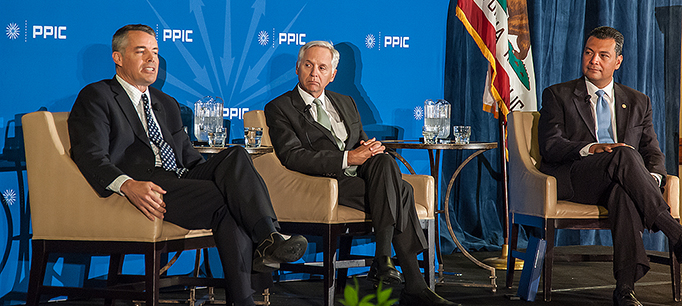
The two candidates running for California secretary of state bring different resumes to the campaign but found much to agree on in a conversation sponsored by PPIC Thursday. Alex Padilla, California state senator, and Pete Peterson, executive director of the Davenport Institute at Pepperdine University, talked about their priorities in a question-and-answer session moderated by Mark Baldassare, PPIC president and CEO.

Both candidates advocated improving the use of technology—to engage voters and improve the voting experience, speed up the disclosure of campaign contributions, and improve the business registration process. Both advocated better use of data and research from outside organizations—from civic engagement groups to the U.S. Census to think tanks and universities—to more proactively register and inform voters. Some of the research PPIC has done on voter participation figured into the discussion of voter engagement, including Voter Turnout in Primary Elections and Expanding California’s Electorate: Will Recent Reforms Increase Voter Turnout?

Each candidate listed a number of goals for their term in office, if elected. Asked to reduce their voter turnout goals to a number, Padilla said he was committed to the addition of 1 million more active voters to the rolls and Peterson said he expected to generate an increase in turnout of 5 or 10 percent.

The event was part of PPIC’s 2014 Speaker Series on California’s Future. PPIC does not support, endorse, or oppose any political parties or candidates for public office.

Louise Henry Bryson Joins PPIC Board of Directors

[vc_row][vc_column][vc_column_text]I am delighted to announce the election of Louise Henry Bryson—a leader in the arts, media, and entertainment industry—to PPIC’s board of directors.
Louise is the former president of distribution for Lifetime Television and executive vice president and general manager of Lifetime Movie Network. Previously, she was senior vice president for Fox Network, where she was responsible for distribution of Fox’s cable television channels and for station negotiations throughout the United States. She retired in 2008.

Louise’s professional experience, leadership talents, and commitment to public service make her an ideal addition to PPIC’s board. We look forward to her contributions as PPIC works to achieve its mission: informing and improving public policy through independent, nonpartisan research.

Louise began her career as a writer and producer in public television and radio. She is a trustee of WETA public broadcasting in Washington, D.C., and a lifetime trustee of Southern California Public Radio. She was board chair of KCET public television in Los Angeles and a member of the PBS National Board, which honored her with the 1998 Award for Excellence in Public Television Leadership. She was elected a fellow of the American Academy of Arts and Sciences in 2010.

Louise has a strong record of public service. She served on the board of trustees for the J. Paul Getty Trust for 12 years, including four as board chair. She was named chair emerita in 2010. Louise is currently a trustee of the American Funds. She is a member of the board of directors at a variety of nonprofit institutions, including Pomona College, the Pacific Council on International Policy, the Huntington Memorial Hospital, and the California Community Foundation.

She has master’s degrees in business and teaching from Stanford University.

As a new board member, Louise has been elected to an initial three-year term and is eligible for a maximum of three three-year terms. Donna Lucas, founder and chief executive officer of Lucas Public Affairs, is chair of the PPIC board. The other board members are myself; Ruben Barrales, president and CEO of GROW Elect; María Blanco, vice president of civic engagement at the California Community Foundation; attorney Brigitte Bren; Walter B. Hewlett, member of the board of directors at The William and Flora Hewlett Foundation; Phil Isenberg, vice chair of the Delta Stewardship Council; David Mas Masumoto, author and farmer; Steven Merksamer, senior partner at Neilsen, Merksamer, Parrinello, Gross & Leoni, LLP; Kim Polese, chairman of ClearStreet, Inc.; and Thomas Sutton, retired chairman and CEO of the Pacific Life Insurance Company. You can find more information about the PPIC board on PPIC.org.[/vc_column_text][/vc_column][/vc_row]

Improving the Vote-by-Mail System

For the first time in eight years, there is no incumbent running for California secretary of state. This offers a great opportunity to step back and consider where California’s elections are, and where they ought to go next. (You can hear what the candidates have to say about the future of elections at a PPIC event on Thursday, September 11.)

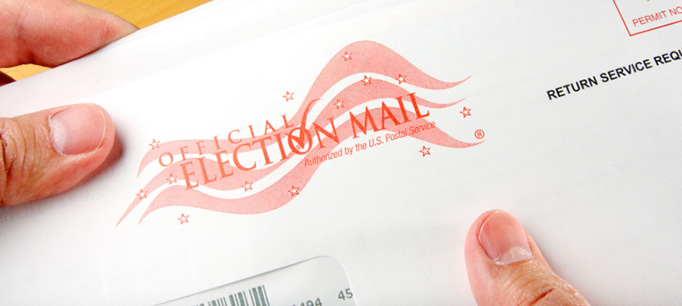
Any such assessment must take a hard look at voting by mail. We see more voters using this option in every passing election, with the growth actually accelerating in recent primaries. If the trend continues, about 57 percent of the ballots in this fall’s election will be cast this way.

The question is no longer whether vote-by-mail is a sensible way to run our elections; it is now how best to manage the vote-by-mail elections we already have. This has put a number of critical issues on the table:

  1. Signature verification. The signature on a vote-by-mail ballot must be compared to the one on file to ensure that the appropriate person cast the ballot. This slows down the process, leaving the outcomes of a few races in doubt for weeks after Election Day. Some counties have been moving to verification by computer to deal with the backlog, but the standards for this sort of verification are murky. The new secretary of state can help clarify which technology is permissible and how this technology should be used.
  2. Late ballots. In a recent PPIC report, we noted that, while the vast majority of vote-by-mail ballots arrive on time, thousands of ballots arrive late and are not counted at all. The legislature has passed a bill (SB 29) that would allow most of these late ballots to be counted. If Governor Brown signs this bill, the next secretary of state will need to monitor the new status quo as it unfolds. In particular, county registrars may face a surge in late ballots as more voters take advantage of the new relaxed standard.
  3. Shrinking postal service. As email and the Internet have grown in popularity, the U.S. Postal Service has been forced to lay off staff and consolidate processing centers. Our PPIC analysis suggests that these changes have not yet created problems for vote–by-mail, but it is a development that deserves constant monitoring.
  4. All vote-by-mail? When 70 percent of the ballots in an election are vote-by-mail, one wonders whether it’s time to abandon the old polling place approach and mandate the vote-by-mail system for everyone. Colorado, Oregon, and Washington use such a system, and it has generally worked well. There are a number of arguments for the change. The persistence of a dual system may add to the complexity of counting ballots, especially with yet another system—same-day registration—coming on-line in the next few years. Moreover, while the evidence for vote-by-mail’s effect on voter turnout is mixed, it generally suggests a small but positive effect. Finally, given the fact that county registrars continue to struggle with small budgets and increasing demands, an all vote-by-mail system would offer a much-needed cost savings.

We will probably never reach a point where every voter voluntarily votes by mail. There will always be some, both young and old, who prefer to show up at a polling place. But we must think carefully about accommodating the new reality of a mostly vote-by-mail system, and how best to make it work for everyone.