Public Higher Education in California Faces a Fiscal Crisis

[vc_row][vc_column][vc_column_text]As the coronavirus pandemic continues to disrupt California’s economy, the Newsom administration is projecting a $54 billion decline in state revenues for the 2021 fiscal year and revising the budget accordingly. California’s public universities—which do not have dedicated funding streams or constitutional protections—face disproportionately large funding cuts. So far, the federal government has provided some emergency relief to mitigate the pandemic’s unprecedented impact on higher education. Without additional support, however, the state’s public colleges might have to reduce student access and services.

During the Great Recession, a drop in state revenues of $40 billion in 2009 led to cuts equaling roughly one-third of state funding for the University of California (UC) and California State University (CSU) systems (on a per student basis). Consequently, tuition doubled at UC and CSU, faculty and staff were laid off or furloughed, and critical capital improvements and maintenance were deferred.

In turn, students faced reduced access to courses, higher student-faculty ratios, increased costs, and fewer support services. As the economy improved, the state was able to increase allocations to the state’s colleges. As a result, UC and CSU admitted thousands of additional students, graduation rates went up, and the number of degrees awarded increased substantially.
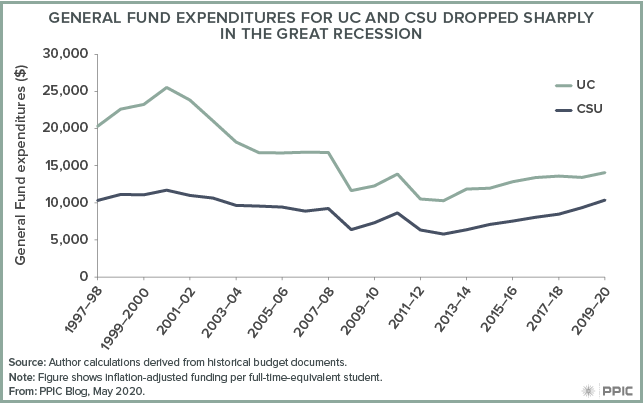
figure - General Fund Expenditures for UC and CSU Dropped Sharply in the Great Recession

Early evidence suggests that the global pandemic could have an even more dramatic fiscal impact on public higher education in California. In the short-term, public colleges face critical revenue shortages: now that students have been sent home and instruction has moved online, revenues from auxiliary enterprises (housing, food, parking, etc.) have evaporated. In addition, UC has suspended elective surgeries at its medical centers and is incurring costs associated with research and treatment of the coronavirus. CSU has projected revenue losses of $337 million for the spring semester, while UC projects a $500 million loss for the month of March alone.

In the longer-term, the systems may find it challenging to raise additional revenues. The percentage of out-of-state students—who pay higher tuition—is now capped at 18% for the five most popular UC campuses, and enrollment of international students is likely to decline due to visa and travel restrictions. Endowment funds are shrinking and tuition increases are controversial. Moreover, unprecedented levels of unemployment will increase demand for federal, state, and institutional financial aid programs.

Governor Newsom’s May budget revision includes a 10% cut for each public higher education system. The revised budget proposal also reduces state financial aid for students who attend nonprofit private colleges from $9,084 to $8,056 per year. The budget proposal does allow UC and CSU to redirect some restricted revenues and to refinance debt at historically low interest rates. However, without additional revenue–whether through federal or state support, or tuition increases—it will be difficult to improve access, quality, and student success in the coming years.[/vc_column_text][/vc_column][/vc_row]

Lessons from the Great Recession Can Protect College Students Today

[vc_row][vc_column][vc_column_text]Budget cuts for state services are likely on the horizon due to the economic disruption of COVID-19. This means state funding for public higher education may well be reduced—leading to restrictions in access and lowered enrollments. California went through this very scenario during the Great Recession, with thousands of students turning to for-profit colleges in lieu of public colleges.

figure - Enrollments Spiked for California For-Profit Colleges during the Recession

While some students at for-profit colleges earned a degree, many did not graduate and ended up with large amounts of debt. State and federal government subsequently put restrictions around for-profit colleges, but upcoming changes at the federal level could weaken the federal rules.

The recently announced federal Education Stabilization Fund will disproportionately provide emergency relief funds to private for-profit colleges. In California, only 5% of the state’s undergraduates attend for-profit colleges, but these schools will receive 10% of federal funds.

In contrast, 55% of undergraduates attend the state’s community colleges, which will receive only 34% of federal aid. (That’s because many low-income students who attend community college rely on state aid rather than federal financial aid: these students are not counted in the federal emergency funding formula.)

During the Great Recession in 2008, higher education faced deeper cuts than other state services. With escalating tuition, fewer instructional staff, and a narrow application window, students had less access to the state’s public colleges, especially community colleges.

At the same time, some for-profit colleges began to market heavily, and thousands of students enrolled in expensive programs. By several measures—graduation rates, student debt, loan default rates, and employment outcomes—private for-profit institutions often have poor outcomes. Of course, some colleges have a better track record than others.

People hurt most by the recession—and lack of access to college—were saddled with debt they couldn’t pay back. In response, California and the federal government both instituted new regulations requiring for-profit colleges to be more transparent and accountable.

California went a step further than the federal government. The state required colleges to meet minimum standards of graduation and loan default rates to be eligible for Cal Grants, the state’s financial aid program for low-income students. Enrollments in for-profit colleges in California declined, and some of the largest for-profit institutions, like Corinthian and ITT Technical Institute, declared bankruptcy as the economy improved and funding to public higher education was restored.

California policymakers should seek to avoid the mistakes of the last recession by ensuring that access to public higher education is not restricted during this recession. The key is to find ways to limit budget cuts so that public higher education remains accessible to all Californians looking to advance their knowledge and improve their economic well-being.[/vc_column_text][/vc_column][/vc_row]

Testimony: California Is on Track to Close the Degree Gap

[vc_row][vc_column][vc_column_text]Hans Johnson, director and senior fellow at the PPIC Higher Education Center, testified February 25, 2020, before the Assembly Budget Subcommittee (No. 2) on Education Finance, chaired by Assemblymember Kevin McCarty. Here are his prepared remarks.

At the PPIC Higher Education Policy Center, we have long been concerned about the future of California’s workforce. Would the state have enough college graduates to meet evolving economic demands? We have produced a series of reports addressing the dynamics of this issue.

Five years ago, we projected a shortage of highly educated workers in California. Specifically, our economic projections to 2030 showed that about two in five jobs would require at least a bachelor’s degree, while demographic projections suggested that only about one in three Californians would attain this level of education. This shortfall amounts to 1.1 million bachelor’s degrees.

PPIC noted that to fill this shortfall, the state and its higher education systems would need to act—increasing access, transfer, and completion especially among groups historically underrepresented in higher education, including low-income students, first-generation college students, Latinos, and African Americans.

We identified ambitious targets that—if met—would close the degree gap. Those targets included large increases in access to the University of California (UC) and California State University (CSU), both for first-time freshmen and for transfer students. They also included substantial increases in graduation rates. At the request of the legislature, UC and CSU both issued reports on how they might meet those targets.

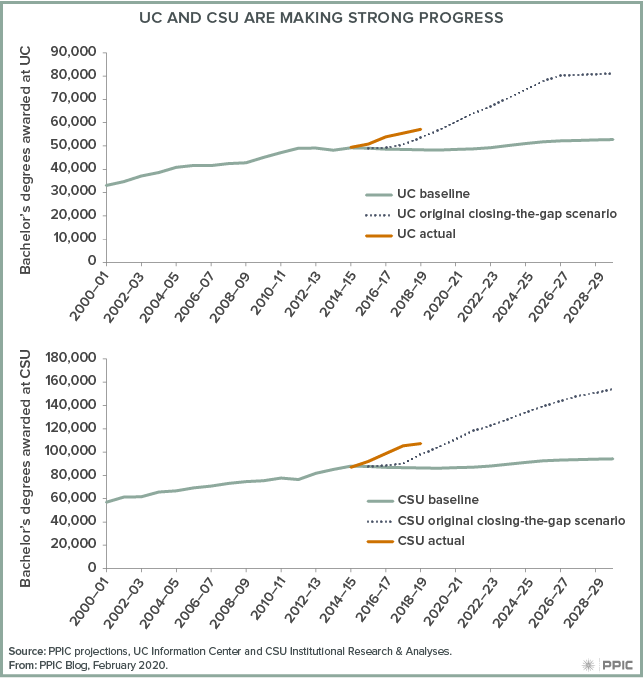
Today, I’m pleased to say that California is currently on track to close the gap. The concerted efforts of policymakers, higher education officials—including staff and faculty—and, of course, students have led to these early gains.

State General Fund allocations for each system have increased substantially since the Great Recession, allowing for increased enrollment and renewed efforts to improve student persistence and completion. Both UC and CSU have exceeded PPIC’s closing-the-gap targets. These early gains have reduced the degree gap by almost 80,000.

figure - UC and CSU Are Making Strong Progress

Two primary actions have led to these gains.

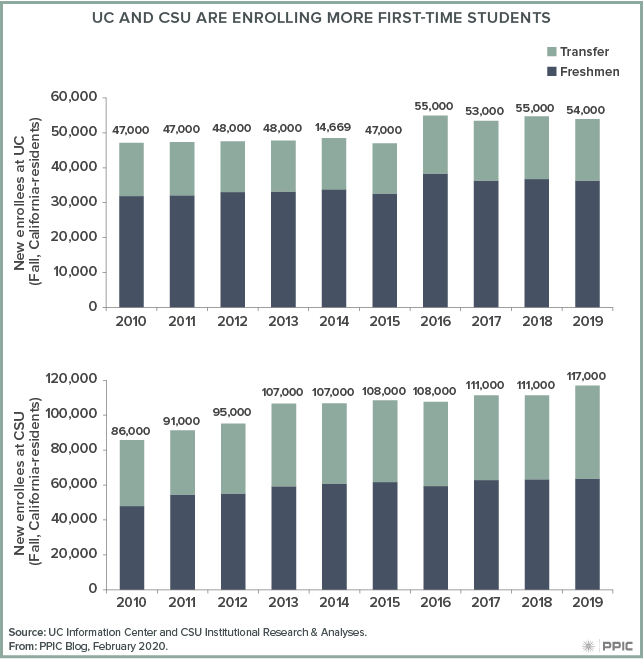
First, increases in state funding have allowed UC and CSU to enroll substantially more first-time students from California—both freshmen and transfer students. At UC, enrollment of transfer students went up 16% between fall 2010 and fall 2019. Enrollment of freshmen grew 14%. At CSU, enrollment increased 41% for transfer students and 33% among freshmen over the same time period. Notably, UC’s gains occurred primarily in one year, from 2015 to 2016, when the legislature and governor tied a $25 million allocation to increasing enrollment by 5,000 students. In that single year, total first-time enrollment of freshmen and transfer students went up 10%, with gains concentrated among African Americans (36%) and Latinos (25%).

figure - UC and CSU Are Enrolling More First-Time Students

Second, programs to improve student persistence and graduation rates have also paid off—and contributed to enrollment growth. These gains have been especially sharp at CSU, which has received substantial funding from the state to support its graduation initiative. At CSU, six-year graduation rates for California-residency students have increased from 57% for 2009 entering freshmen to 67% for the 2013 cohort. At UC, four-year graduation rates for California-residency students have increased from 62% for 2010 entering freshmen to 68% for the 2014 cohort. (Six-year graduation rates at UC remain very high, around 85%). Graduation rates for transfer students have also increased at both systems.

These early successes are very promising. Still, California needs to build on them if it is to close the degree gap fully. The demand for college remains high. PPIC’s statewide surveys show that the vast majority of parents (79%) want their child to earn at least a bachelor’s degree. College preparation among high school graduates has increased, with the share of students completing the college preparatory requirements of UC and CSU now at an all-time high. And while applications to UC and CSU have levelled off or even declined a bit recently, application levels are still near record highs. All but one UC campus and many CSU campuses already do not have room to admit all eligible applicants.

Looking ahead, strong demand for UC and CSU is likely to continue as college preparation improves and the transfer pathway becomes more efficient and effective. New initiatives, including reforms in remedial education at the community colleges and CSU, have the potential to substantially improve student success rates and boost transfer. New articulation agreements, such as the Associate Degree for Transfer, have streamlined the pathway from community colleges to four-year colleges, especially CSU. (PPIC will be issuing a report on transfer trends later this year.) And an increased focus on improving student outcomes has led to multiple substantive reforms designed to increase persistence and completion at UC and CSU.

Finding ways to accommodate all eligible students is a pressing challenge, but one that must be met in order to ensure a better future for all Californians. Through thoughtful planning—and yes, additional funding—closing the degree gap is possible. Improving access and completion is a necessary and critical component to ensuring that more low-income, first-generation, and underrepresented students enjoy the benefits of a college degree. The early progress I’ve highlighted here has led to greater access and success for underrepresented students, creating momentum to improve the wellbeing of all Californians.[/vc_column_text][/vc_column][/vc_row]
Do Californians Support the Proposed School Bond?

When Californians go to the polls in March, they will not only cast a vote in the presidential primary—they will also vote on an education bond to fund construction and modernization projects. Given differences in support for the bond across the state’s regions and demographic groups, turnout will play a pivotal role in whether this measure passes.

In the closing days of the legislative session, the legislature passed and the governor later signed a bill placing Proposition 13 (the Public Preschool, K–12, and College Health and Safety Bond Act of 2020) on the March ballot. If approved by voters, the measure would authorize $15 billion in general obligation bonds to pay for the construction and modernization of California’s public schools, community colleges, and four-year colleges.

The September PPIC Statewide Survey took an initial look at support for this proposition. While two-thirds of Californians (66%) are in favor, 54% of likely voters say they would vote yes—just slightly above the majority needed to pass.

Are some Californians more likely than others to support the bond measure? Unsurprisingly, there is a wide partisan divide, with three in four Democratic likely voters (76%) saying they would vote yes compared to just three in ten Republicans (29%). Overall, independent likely voters are divided (48% yes, 44% no). But among Democratic-leaning independents, nearly two in three (64%) are supportive.

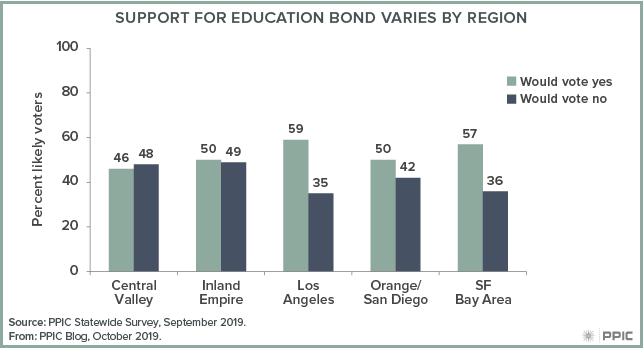
Support varies across regions, with Los Angeles (59%) and San Francisco Bay Area (57%) likely voters expressing the most support, compared to about half of likely voters elsewhere in the state.

figure - Support for Education Bond Varies by Region

While support is similar among likely voters with (55%) and without (53%) children in the house, there are differences across other demographic groups.

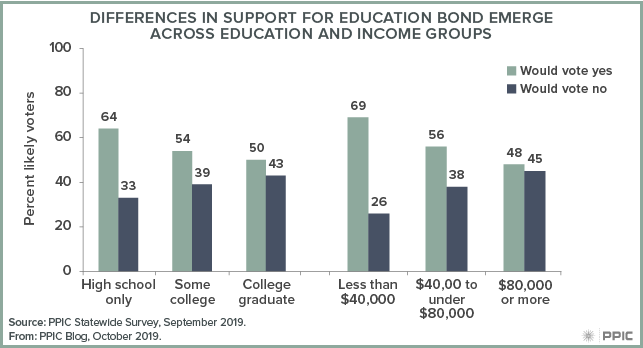
White likely voters (47%) are much less likely than Latinos (74%) and those of other racial/ethnic groups (62%) to say they would vote yes. And since school construction bonds are often paid off by property taxes, it’s notable that homeowners (44%) are far less likely than renters (71%) to say they would vote yes. Support is higher among younger likely voters (66% age 18 to 44, 48% age 45 and older). It declines as education and income levels increase.

figure - Difference in Support for Education Bond Emerge Across Education and Income Gaps

Overall, support for the education bond currently hovers at around half for likely voters, but there is much stronger support among many regional and demographic groups—suggesting that passage could depend on who shows up to vote. If Democrats and Democratic-leaning independents turn out in large numbers for the presidential primary, that could affect the fate of this bond. Stay tuned to the PPIC Statewide Survey as we continue to track this measure in advance of the March primary.

Video: Improving Educational Opportunity in California

What is the one thing that could be done to improve educational opportunity in California? Mark Baldassare, PPIC’s president and CEO, posed this question at the start of his conversation with Linda Darling-Hammond, president of the California State Board of Education, and Eloy Ortiz Oakley, chancellor of the California Community Colleges.

Darling-Hammond responded with a list of five major characteristics of school systems in other countries and states that have closed “opportunity gaps”: an equitable, adequate funding system; high-quality teachers and leaders; a thoughtful curriculum and assessment system; wrap-around support for students; and schools designed to allow for productive learning.

Then she circled back to California’s “number one thing”: “We’ve got to fix the teacher shortage—and we’ve got to do it quickly, purposefully, and soon.”

For Oakley, the “one thing” is to change “how we look at education, how we look at opportunity in California.” In short, we need to stop providing “the least amount of resources to the students, the communities that need them the most.”

A key part of this change involves “blurring the line” between the K–12 (or “TK–12”) and community college systems. Oakley noted: “There was a point in time when we felt that a high school diploma was the default to get into the workforce. Those days are gone. . . .We need to see the path to community college as the required path for everybody to get some sort of post-secondary credential.”

Darling-Hammond agreed that the two systems can and should work together. A good example of productive collaboration, she added, is concurrent enrollment, which allows high school students to take college courses (and earn college credit). These programs help students “find their passion” and move toward meaningful careers.

Funding is another key issue for both systems. Darling-Hammond pointed to the impact of significant post-recession increases in funding during the Brown and Newsom administrations and the potential impact of the governor’s commitment to early childhood education. But, she added, “just to get to the national average . . . we need about $12 billion more in the TK–12 system.”

Oakley agreed that “for those of us who managed our way through the recession, we’re certainly in a much better place.” The community college system could certainly benefit from more funding, he added, but state investments in early childhood education might be even more beneficial: “If we could prioritize the funding at the lowest level, for the youngest learners, that would make our job in the community colleges easier.”


2020 Primary: Funding Higher Education Facilities

The state legislature recently passed a $15 billion bond measure to fund upgrades to education buildings and facilities. Voters will decide whether to support this bond as part of the March 2020 primary ballot.

For higher education, the measure would provide $6 billion to the state’s three higher education systems, the University of California (UC), the California State University (CSU), and the California Community Colleges (CCC). These funds would be distributed equally ($2 billion each)—even though the systems enroll significantly different numbers of students.

The legislature will approve specific projects as part of the annual budget process. As a condition of making funds available, the bill requires UC and CSU to develop affordable housing plans for their students.

figure - Proposed Bond Funding Varies on a per Student Basis

The last time the state proposed and passed a ballot measure supporting higher education was more than a decade ago. Proposition 1D (2006) passed with almost 57% support. The total amount of funding for higher education in that initiative was about half of what is proposed in the current measure ($3.1 billion compared to $6 billion).

figure - 2020 Initiative Proposes Much More Funding for CSU and CCCs than the 2006 Measure

During the Great Recession funding for UC, CSU and the community colleges fell. One of the ways the systems responded was to defer maintenance on buildings, foregoing repairs and upgrades as a way to save money in the short run. Our estimate of the cost of addressing the resulting backlog of capital projects tops $30 billion for the UC and CSU systems. The proposed ballot initiative would provide bond authority to cover a little more than 10% of that.

The state’s community colleges are in a slightly different position. Local community college districts can issue their own bonds and make most of their own capital finance decisions. Since passage of Proposition 39 (2000), which made it easier for community colleges to pass bond measures, community college districts have been relatively successful in funding their capital needs. From 2001 to 2016, voters approved $35 billion in borrowing for local community college capital projects. In addition, Proposition 51 (2016) provided community colleges with $2 billion in state bond funding.

We know that bond measures for education generally have the support of voters, and recent PPIC polling suggests that a $15 billion education bond has a slim margin of support. Time will tell whether voters will be persuaded this time around.

CSU’s Prudent Saving Strategy

The California State University system is taking significant steps to improve its financial position and increase transparency with a new public, online Financial Transparency Portal. It shows that CSU is building both capital and operating reserves that could help soften the blow in the event of an economic downturn.

The new Transparency Portal shows that CSU’s reserves have grown in recent years, for both capital spending—which includes equipment acquisition, facilities maintenance and repairs, and capital improvement and construction—and operations. To put this growth into context, in CSU’s 2017–18 budget a little more than one third of total expenditures went toward salaries and wages (about $3.6 billion). The system’s operating reserve for that year was about $800 million, meaning that if that system spent its entire reserve it would still only be able to cover a very modest cut in state appropriations.

figure - CSU’s Capital Reserves have Grown Significantly in Recent Years

The portal also shows that some of the greatest growth has occurred in funds for capital improvement and construction. These funds are typically allocated to upgrade existing facilities and build new ones. This is very good news in terms of long-term planning, and provides a good example for the state’s other higher education institutions.

There also has been modest progress in accumulating savings to simply maintain facilities, an area that saw deep cuts during the Great Recession.

figure - A Majority of Capital Reserves are Aimed at Capital Improvements and Construction Projects

The growth in capital reserves is promising and helps to safeguard CSU’s ability to meet the needs of its future students. Similarly, building operating reserves is key to preserving access and maintaining strong student outcomes during the next recession.

Making financial information transparent, including campus-level information, is also a positive step. It clarifies the allocation of resources and reveals the details of CSU’s reserve strategy—making important information available to public officials and the attentive public.

LAUSD’s Measure EE and the Parcel Tax Vote Threshold

On June 4, voters in the Los Angeles Unified School District (LAUSD) will decide the fate of Measure EE, a historically large parcel tax that would generate about $500 million a year. Like all parcel taxes, Measure EE has a high bar to clear: two-thirds of voters must approve it. More than half of all proposed parcel taxes have cleared this bar since 2003.

The California Legislature is considering a constitutional amendment to lower the parcel tax vote threshold to 55%. If the legislature approves this proposal, California voters will weigh in. The amendment’s success at the ballot box is far from certain: the April 2019 PPIC Statewide Survey found that just 39% of likely voters would favor such a measure. But what might happen if the legislature and voters did ultimately approve the lower vote threshold? If the state’s recent experience with school bond measures is any indication, we would expect to see more parcel taxes placed on the ballot, with more of them passing.

The parcel tax is a California phenomenon. Proposition 13 (1978), which placed strict limits on commercial and residential property taxes, included a provision allowing cities, counties, and other districts to impose “special taxes” if two-thirds of voters approved. While the majority of parcel taxes levy a flat dollar amount per parcel—a lot or piece of property—Measure EE ties the dollar amount to the square footage of the building(s) on each parcel.

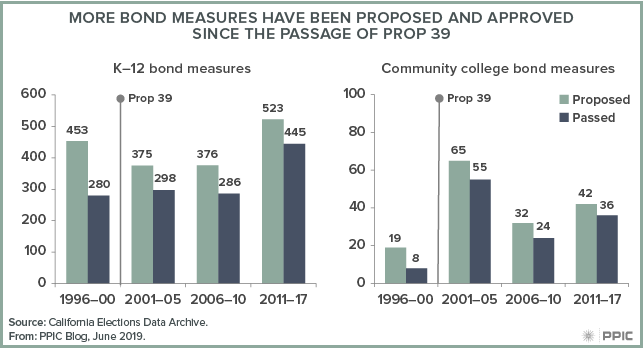
California voters lowered the approval threshold for school and community college bond measures to 55% when they approved Proposition 39 in 2000. The passage rate for K–12 bonds increased from 62% in the five-year period before Prop 39 to 79% in the five-year period after it was approved, and both the number of measures and rate of passage for K–12 bonds have been rising since 2011. This increase is especially striking given that the median bond amount has more than doubled (from $20 million to $45 million) since the threshold was lowered.

The trend has been similar for community college bond measures, though there are far fewer community college districts (73) than school districts (1,026) in the state. After Prop 39 passed, more colleges placed measures on the ballot—especially from 2001 to 2005—a higher share passed, and bond amounts increased. Passage rates increased from 42% before Prop 39 to 86% since 2011. The median amount has more than tripled since 1996 (increasing from $87 million to $350 million).

figure - More Bond Measures Have Been Proposed and Approved Since the Passage of Prop 39

The vote on Measure EE will be important for LAUSD—the resources that the parcel tax would generate are critical to the district’s future finances. The vote will also be worth watching with the pending constitutional amendment in mind. If the measure is approved, lawmakers may see less need for lowering the parcel tax threshold. If it is defeated, the amendment may gain momentum.

Expanding Enrollment at UC and CSU

California’s economy is increasingly demanding highly educated workers. To meet this demand, and to ensure that more Californians are successful in the 21st century economy, the state’s universities will need to admit and graduate greater numbers of students than they do today.

Governor Newsom’s budget proposal offers a step in the right direction, but it could go further.

The governor’s budget provides General Fund increases of 7% for the University of California (UC) and 8% for the California State University (CSU), including funding for enrollment increases of 1,000 and 7,000 students respectively.  The budget also provides $95 million ($50 million for UC and $45 million for CSU) in ongoing funding to improve student success efforts at both systems. This is good news and represents substantial reinvestment in the state’s public universities.

But the enrollment increases fall short of what CSU and UC had been hoping for, and more importantly, short of student demand. In its 2019-2020 budget plan, UC had sought enrollment increases for 2,500 California resident undergraduates in order “to maintain access for projected increases in UC-eligible high school graduates and transfer-ready California Community College students.” CSU had sought an even more ambitious increase of more than 18,000 in order to accommodate more freshmen and transfer students.

As the state moves into the eleventh straight year of economic growth, ensuring investments in higher education is critical—especially in the face of an eventual downturn. Higher education is often one of the first budget areas to be cut during a recession. Today, even after a decade of reinvestment and one of the largest economic expansions in state history, funding per student at UC and CSU still remains below pre-Great Recession levels. And it is far below the funding peaks of the late 1990s and early 2000s.

As the legislature and governor negotiate over the budget, it may be time to consider creating a long-term funding plan for public higher education. An effective multi-year plan would account for increased enrollment, incentivize student success, prioritize equity, and provide a sensible tuition growth plan.  This would allow students and their families, as well as universities, to better plan for the future—and would put the state on a path to meeting the economic demands of the future.

Videos: Higher Education Priorities

Last week in Sacramento, PPIC researcher Lunna Lopes outlined key findings from the latest PPIC Statewide Survey, which focuses on higher education. The following day in San Francisco, PPIC president Mark Baldassare and Monica Lozano, president of the College Futures Foundation, talked about the survey’s implications for governor-elect Gavin Newsom.

The survey finds that most Californians think public higher education should be a high priority for the next governor. For Monica Lozano, this is a key takeaway: “Overwhelmingly, Californians said that a four-year degree is essential to the economic vitality of the state. And, as much as we have considered Jerry Brown a real progressive on lots of issues, there is a sense that he did not do enough on higher education.”

Lozano also noted that Californians are focused on helping students succeed. Their concerns are less about access and enrollment capacity and more about student support: student debt, financial aid, and academic and other kinds of support. “The public is putting students at the center of this equation,” she said.

A majority of Californians see affordability as a big problem. In a state with one of the highest costs of living in the country, residents are divided on whether tuition and fees or housing and living expenses are the bigger burden: 45% say tuition and fees, 34% say housing and living expenses, and 17% volunteer that the two are equally burdensome. As Baldassare put it, “There’s more to affordability than tuition and fees.”

Noting that governor-elect Newsom has an ambitious agenda for “cradle to career” education, Baldassare asked how higher education advocates and experts could help the new administration move forward.

Lozano replied, “Our challenge is to actually help them think about the fundamental issues that surfaced in this survey.” For example, most Californians think state higher education funding is inadequate and many support a funding guarantee for UC and CSU. “If the system of financing higher education has to change so that it’s more predictable—so that there’s some sort of a dedicated revenue stream that’s tied to some accountability measures—how would you actually do that?”

More generally, Lozano and Baldassare agreed that the survey shows how highly Californians value higher education; as Lozano put it, “This survey gives the next governor permission to be bold.”