
[vc_row][vc_column][vc_column_text]Budget cuts for state services are likely on the horizon due to the economic disruption of COVID-19. This means state funding for public higher education may well be reduced—leading to restrictions in access and lowered enrollments. California went through this very scenario during the Great Recession, with thousands of students turning to for-profit colleges in lieu of public colleges.

While some students at for-profit colleges earned a degree, many did not graduate and ended up with large amounts of debt. State and federal government subsequently put restrictions around for-profit colleges, but upcoming changes at the federal level could weaken the federal rules.
The recently announced federal Education Stabilization Fund will disproportionately provide emergency relief funds to private for-profit colleges. In California, only 5% of the state’s undergraduates attend for-profit colleges, but these schools will receive 10% of federal funds.
In contrast, 55% of undergraduates attend the state’s community colleges, which will receive only 34% of federal aid. (That’s because many low-income students who attend community college rely on state aid rather than federal financial aid: these students are not counted in the federal emergency funding formula.)
During the Great Recession in 2008, higher education faced deeper cuts than other state services. With escalating tuition, fewer instructional staff, and a narrow application window, students had less access to the state’s public colleges, especially community colleges.
At the same time, some for-profit colleges began to market heavily, and thousands of students enrolled in expensive programs. By several measures—graduation rates, student debt, loan default rates, and employment outcomes—private for-profit institutions often have poor outcomes. Of course, some colleges have a better track record than others.
People hurt most by the recession—and lack of access to college—were saddled with debt they couldn’t pay back. In response, California and the federal government both instituted new regulations requiring for-profit colleges to be more transparent and accountable.
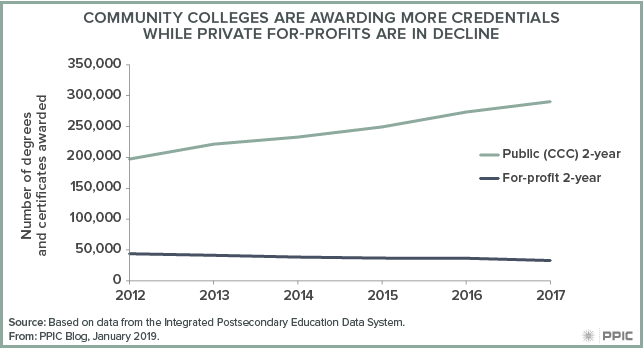
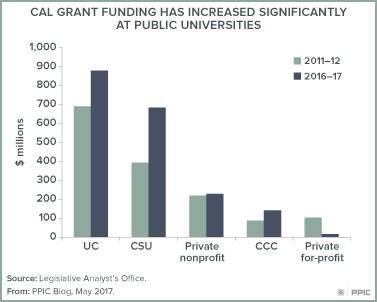
California went a step further than the federal government. The state required colleges to meet minimum standards of graduation and loan default rates to be eligible for Cal Grants, the state’s financial aid program for low-income students. Enrollments in for-profit colleges in California declined, and some of the largest for-profit institutions, like Corinthian and ITT Technical Institute, declared bankruptcy as the economy improved and funding to public higher education was restored.
California policymakers should seek to avoid the mistakes of the last recession by ensuring that access to public higher education is not restricted during this recession. The key is to find ways to limit budget cuts so that public higher education remains accessible to all Californians looking to advance their knowledge and improve their economic well-being.[/vc_column_text][/vc_column][/vc_row]






 As college costs have risen, the share of students taking out loans has grown substantially in both California and the nation. Just ten years ago, only about one-third of freshmen at four-year colleges and universities in California took out loans compared to 44% in 2014. Equally troubling is the growing size of those loans. Even after adjusting for inflation, average loan amounts for freshmen increased 14% in California between 2004 and 2014 (from just over $6,000 to almost $6,900). Among graduating seniors at California colleges in 2015, cumulative student debt totaled just over $24,000 for those who took out loans.
 The vast majority of students in California attend public colleges, and these students are much less likely to take out loans than students at private colleges. Very few California community college students take out loans, and less than 40% of freshmen at UC and CSU take out a loan, compared to more than 50% of freshmen at private nonprofit colleges and 70% at private for-profit colleges. Among those who take out loans, the amounts borrowed are also lower at California’s public colleges. Graduating seniors in 2015 at UC and CSU who took out loans had a median cumulative debt of $16,600, compared to $23,400 at private nonprofit colleges and $30,500 at private for-profit colleges. The lower rates of student debt at California’s public colleges and universities are related to institutional and state policies that provide scholarship and grant support to many low- and middle income students.

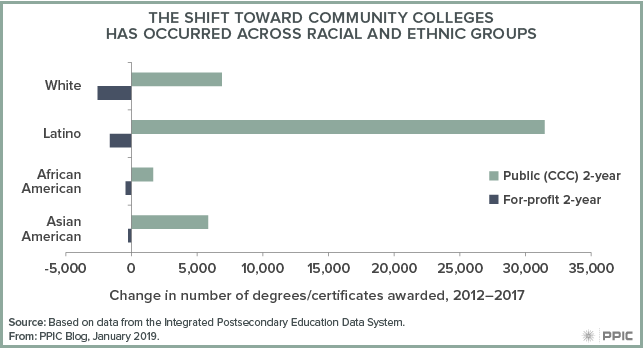
 During the period of rapid growth (between 2004 and 2011), enrollment in for-profits grew across every racial/ethnic group. While white and Latino students account for more than half of enrollment, African American enrollment saw the greatest growth―total for-profit enrollment doubled, but African American enrollment more than quadrupled.
 The fact that the overall African American postsecondary enrollment has dropped twice as much as this group’s high school graduation rate suggests that African American college enrollment may not be shifting from for-profits to other California institutions. If additional for-profits close, the college-going rate of African American students may continue to fall. Indeed, it may have fallen over the past year—we don’t yet have data on what has happened with enrollment since the shuttering of large for-profit institutions such as Heald, Wyotech, and ITT Tech.