Lessons from the Great Recession Can Protect College Students Today

[vc_row][vc_column][vc_column_text]Budget cuts for state services are likely on the horizon due to the economic disruption of COVID-19. This means state funding for public higher education may well be reduced—leading to restrictions in access and lowered enrollments. California went through this very scenario during the Great Recession, with thousands of students turning to for-profit colleges in lieu of public colleges.

figure - Enrollments Spiked for California For-Profit Colleges during the Recession

While some students at for-profit colleges earned a degree, many did not graduate and ended up with large amounts of debt. State and federal government subsequently put restrictions around for-profit colleges, but upcoming changes at the federal level could weaken the federal rules.

The recently announced federal Education Stabilization Fund will disproportionately provide emergency relief funds to private for-profit colleges. In California, only 5% of the state’s undergraduates attend for-profit colleges, but these schools will receive 10% of federal funds.

In contrast, 55% of undergraduates attend the state’s community colleges, which will receive only 34% of federal aid. (That’s because many low-income students who attend community college rely on state aid rather than federal financial aid: these students are not counted in the federal emergency funding formula.)

During the Great Recession in 2008, higher education faced deeper cuts than other state services. With escalating tuition, fewer instructional staff, and a narrow application window, students had less access to the state’s public colleges, especially community colleges.

At the same time, some for-profit colleges began to market heavily, and thousands of students enrolled in expensive programs. By several measures—graduation rates, student debt, loan default rates, and employment outcomes—private for-profit institutions often have poor outcomes. Of course, some colleges have a better track record than others.

People hurt most by the recession—and lack of access to college—were saddled with debt they couldn’t pay back. In response, California and the federal government both instituted new regulations requiring for-profit colleges to be more transparent and accountable.

California went a step further than the federal government. The state required colleges to meet minimum standards of graduation and loan default rates to be eligible for Cal Grants, the state’s financial aid program for low-income students. Enrollments in for-profit colleges in California declined, and some of the largest for-profit institutions, like Corinthian and ITT Technical Institute, declared bankruptcy as the economy improved and funding to public higher education was restored.

California policymakers should seek to avoid the mistakes of the last recession by ensuring that access to public higher education is not restricted during this recession. The key is to find ways to limit budget cuts so that public higher education remains accessible to all Californians looking to advance their knowledge and improve their economic well-being.[/vc_column_text][/vc_column][/vc_row]

Should Applying for College Financial Aid Be a High School Requirement?

A majority (58%) of Californians consider affordability at the state’s public colleges and universities a big problem, according to a 2018 PPIC Statewide Survey. Requiring all high school students to apply for financial aid could help more students pay for college.

Currently, around 60% of high school students in California complete the federal application for financial aid (FAFSA)—a student’s gateway to receiving federal grants and loans, as well as state aid. The remainder of students are unlikely to receive aid, even though there’s evidence that many of them would probably have qualified.

Requiring students to apply for aid may result in greater numbers of high school graduates enrolling in college, which could increase California’s college-going rate of 64% (2017–18). Earlier this year, a bill was introduced in the California Legislature that would require students to complete a financial aid application before graduating from high school.

Louisiana was the first state to have such a requirement, starting in 2017–18. The state saw FAFSA completion rates increase from 48% to 84% between 2015 and 2018, and college-going numbers increased by 12.6% (from 22,200 to 25,000) in the same time frame. Texas and Illinois are following suit, with the requirement taking effect in those states in fall 2019 and fall 2020, respectively.

California needs more college graduates to meet the increasing demand for highly skilled workers—and the proposed bill could make a difference if it increases access to college, especially for lower-income students. In addition, better financial support during college can reduce students’ debt load and might help more students complete their programs. Improved access to college and higher graduation rates would set more students up for success in the workforce and benefit the state’s economy.

New Federal Data Sheds Light on Student Debt in California

For the first time ever, the federal government has released data on loan debt for college graduates by type of degree and field of study. The data includes federal loans from three programs (Direct Loans, Federal Family Education Loans, and Graduate PLUS Loans) for students graduating in 2014–15 and 2015–16. This release is especially timely in light of national discussions about the cost of college–with some Democratic presidential candidates arguing for debt-free college and loan forgiveness. In just those two academic years, more than 300,000 Californians graduated from college (with degrees ranging from PhDs to vocational certificates) with debt. The total amount of federal debt among those graduates exceeded $10 billion.

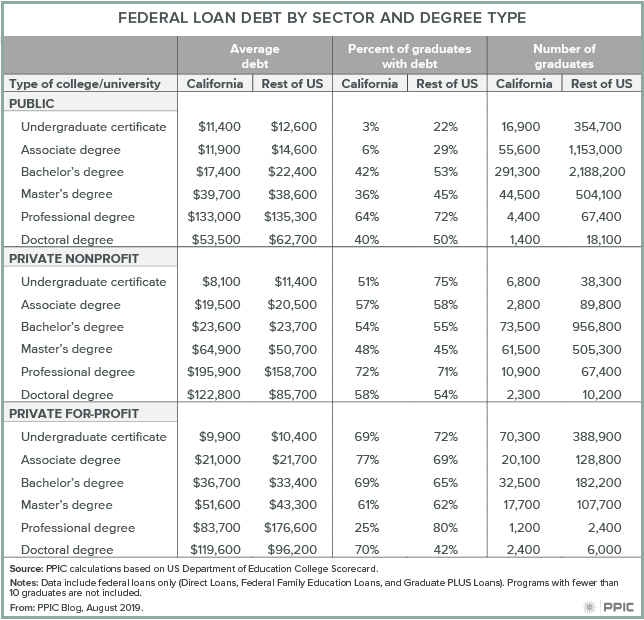
Some of the findings from the recently released data are not surprising. For example, undergraduates at public colleges and universities in California are less likely to take on debt than their peers in the rest of the country. And when students in California do take on debt, the amounts tend to be lower. Federal loan debt for Californians earning bachelor’s degrees at UC and CSU averages $5,000 less than at public universities in the rest of the country ($17,400 versus $22,400). And undergraduates in California are less likely to take out federal loans (42%) than their peers in the rest of the country (53%). Only 6% of associate degree holders from the state’s community colleges have federal loans, compared to 29% of public community college graduates in the rest of the country. Students at California’s public colleges and universities are also less likely than their counterparts at the state’s private institutions to take on debt, and those who do take out loans graduate with less debt.

Other findings are striking. In California and the rest of the nation, graduate students tend to have far higher loan amounts than undergraduates, with professional degree holders incurring the most debt—generally well over $100,000. The most common professional degrees are in law, medicine, and dentistry. Graduates of professional schools at private nonprofits in California incur the most federal loan debt—almost $200,000. In general, graduate students at California’s public universities are less likely to take on debt, and their loan amounts are lower than those for students at private colleges. Even so, graduate students at public institutions are incurring large amounts of debt.

table - Federal Loan Debt by Sector and Degree Type

Large debt levels among graduate students reflect higher tuition for many programs. For example, tuition and fees at UC Berkeley’s law school are almost $60,000 for 2019–20, compared to less than $20,000 for academic graduate programs such as English. High demand for many graduate professional programs coupled with expectations of earnings premiums account for both the higher tuition and students’ willingness to take on debt.

Policies to address student debt must be mindful of which students take on debt, the range of institutions and areas of study, and the ability of students to pay back their debt. These are critical concerns in putting college graduates on the path to economic mobility and long-term financial security.

State-level Strategies to Reduce Student Debt

As college costs have increased, the total amount of loan debt in California has risen. At four-year colleges and universities in California in 2016, 40% of first-time, full-time students took out loans to help pay for their education, according to federal data.

The average debt for California students who attend four-year public and private nonprofit schools is nearly $22,800. Repaying college debt can be a big challenge, in part because the federal landscape for repaying loans is extremely complicated. To reduce student debt, state policymakers are actively thinking about new ways to help students repay their college costs.

In 2018, nearly half (47%) of borrowers enrolled in the federal “standard repayment” plan. Under this plan, a graduate makes fixed monthly payments over the course of ten years, paying down the entire loan with interest. Regardless of income level, a graduate with a loan of $22,800—the average amount—would, at 5% interest, face payments of about $240/month. For those in less well-paying occupations or who face very high monthly payments, this kind of plan can be financially challenging.

Another option is income-based repayment, which is often more financially manageable—but a much smaller share (29%) of borrowers enrolled in an income-based program in 2018. Monthly payments might start at 10% of discretionary income, but payments increase if the graduate starts earning more. Under these plans, borrowers generally pay smaller monthly amounts over a longer period of time.

Possible reasons for lower participation in income-based repayment programs include complex eligibility requirements and missing the deadline for declaring income. Streamlining the federal loan process, including clarifying eligibility criteria, could help make the process less confusing and allow students to make the best financial choices.

At the state level, policymakers are exploring other options to ease the burden of college debt. For example, AB 140 (Cervantes) would authorize the California Student Aid Commission, which administers the state’s financial aid programs, to pay an eligible student’s monthly loan payments for two years. And AB 154 (Voepel) would pilot an “income share” program at one University of California campus and one California State University campus. This program would enable campuses to pay for some of an eligible student’s educational expenses. After graduating, students then repay a portion of their income to the campus.

It’s a positive sign that California policymakers are pursuing state-level strategies to address growing college debt. Establishing an easy-to-use application process and clear-cut eligibility criteria will be key to ensuring that students are able to benefit from these programs. Perhaps most important, more comprehensive financial aid counseling and outreach are necessary to help students make the best choice when repaying their loans.

California’s Partisan Divide on Higher Education

New national polling shows a big divide has opened up between Democrats and Republicans on higher education. A Pew Research Center poll taken in June shows that a majority of Republicans and those who lean Republican (58%) think colleges and universities have a negative effect on the way things are going in the country, while a vast majority of Democrats and those who lean Democrat (72%) think colleges and universities have a positive impact. This is a big change from two years ago, when majorities in both parties said higher education institutions had a positive impact on the direction of the nation.

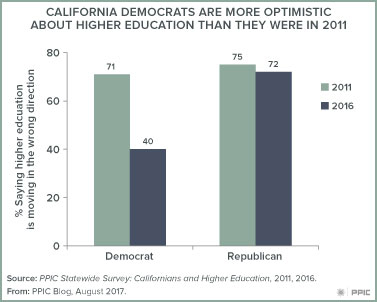
Is there a similar partisan divide over higher education in California? The PPIC Statewide Survey found a similar divergence over the past few years when we asked a different question: Is the state’s public higher education system generally going in the right or wrong direction? In 2016, California Republicans were far more likely than Democrats to say the system is headed in the wrong direction. This marked a change in the five years since we’d last asked this question. When we asked the question in 2011—toward the end of the recession and after large tuition increases—Californians in both parties overwhelmingly said higher education was moving in the wrong direction. Unlike national polling, which shows a shift in Republican opinion, PPIC surveys show a shift in the opinions of Democrats, who have become more positive, while Republicans have remained about the same.

Californians’ responses to other survey questions about higher education point to longer-term partisan divisions. Republicans have generally been more likely than Democrats to say that the overall quality of education in California’s public colleges and universities is a big problem or somewhat of a problem. Views about the direction and overall quality of public higher education are reflected in attitudes about California’s three public higher education systems. Currently about half of Republicans say that each of the systems—community colleges, California State University, and University of California—are doing an excellent or good job. More Democrats—about three-fourths—express this view.

Partisans have also historically differed on higher education funding. Compared to Republicans, Democrats are more likely to say that higher education does not receive enough funding, and Democrats are generally willing to pay higher taxes to support higher education.

Interestingly, there is some evidence that Californians’ views about the importance of college for individual success differ along party lines. A majority of Democrats (68%) say a college education is necessary for a person to be successful in today’s working world, while a majority of Republicans (72%) say there are other pathways to success. It is also true, however, that Californians in both parties have become more optimistic about the chances of success without a college degree since 2011—when the state was recovering from recession.

Finally, there are some areas of agreement. We find that members of both parties generally think that college affordability is a problem and students have to borrow too much money. Perhaps most significant is our finding that overwhelming majorities of both Republicans and Democrats say that the state’s system of higher education is important to California’s economic future and quality of life.

Learn more

Visit the PPIC Higher Education Center

The News on Student Debt Is Not All Bad

Californians are rightly concerned about the costs of attending college and the amount of money many students need to borrow in order to pay those costs. In a recent PPIC Statewide Survey, 57% of Californians identified lack of college affordability as a big problem. An even larger majority—78%—agreed with the statement that students have to borrow too much money to pay for a college education.

As college costs have risen, the share of students taking out loans has grown substantially in both California and the nation. Just ten years ago, only about one-third of freshmen at four-year colleges and universities in California took out loans compared to 44% in 2014. Equally troubling is the growing size of those loans. Even after adjusting for inflation, average loan amounts for freshmen increased 14% in California between 2004 and 2014 (from just over $6,000 to almost $6,900). Among graduating seniors at California colleges in 2015, cumulative student debt totaled just over $24,000 for those who took out loans.

But not all of the news is bad. There are some encouraging and newly emerging trends in student debt, especially in California.

  • Over the past few years the trend toward more loans and higher loan amounts has reversed, with declines in both the share of freshmen taking out loans and the amount borrowed. In California, the share of freshmen at four-year colleges taking out loans has declined from 48% to 44%, and average loan amounts (adjusted for inflation) have declined from over $7,700 in 2010 to under $6,900 in 2014.
  • Student debt remains lower in California than in the rest of the nation, with California freshmen less likely to take out a loan (44%) than their counterparts in the rest of the nation (54%). Among those who do borrow, loan amounts are lower in California ($6,851) than in the rest of the US ($7,014).
  • The vast majority of students in California attend public colleges, and these students are much less likely to take out loans than students at private colleges. Very few California community college students take out loans, and less than 40% of freshmen at UC and CSU take out a loan, compared to more than 50% of freshmen at private nonprofit colleges and 70% at private for-profit colleges. Among those who take out loans, the amounts borrowed are also lower at California’s public colleges. Graduating seniors in 2015 at UC and CSU who took out loans had a median cumulative debt of $16,600, compared to $23,400 at private nonprofit colleges and $30,500 at private for-profit colleges. The lower rates of student debt at California’s public colleges and universities are related to institutional and state policies that provide scholarship and grant support to many low- and middle income students.
  • Finally, and perhaps most importantly, strong job prospects for college graduates, especially in California, mean that the vast majority of students are able to pay back their loans. Loan default rates are very low for students graduating from the state’s public and nonprofit private universities. Students at private for-profit colleges fare much worse. They often accumulate large amounts of debt, and this—coupled with low graduation rates—often makes it a struggle to pay back their loans.

It is important to remember that loans are an important and useful source of financial aid for many students. Indeed, taking on debt can be a very smart economic choice if it allows a student to enroll in and complete college. Policymakers and educators should seek to provide more opportunities for students to strategically use loans to reach their educational goals. Student debt becomes a problem when graduates are not able to pay back their loans—especially if they received a low-quality education and/or took on an exorbitant amount of debt. These are outcomes we should work to prevent.

Learn more

Read Higher Education in California: Making College Affordable
Read the PPIC Statewide Survey: Californians and Higher Education
Visit the PPIC Higher Education Center