Why Students Found New Tests Tough

Recently the California Department of Education released the first results from the new Smarter Balanced Assessment test (SBAC), the standardized tests that were administered in spring 2015 to public school students in grades 3 through 8 and 11. As PPIC reported in a recent post, educators were not surprised to learn that proficiency rates in math and English language arts fell, relative to prior tests. However, when polled last April, a majority of public school parents (71%) had expected students to do at least as well on these new tests as they did on the state’s previous standardized tests.

There are a variety of explanations for why students did not do as well, but it is as yet impossible to untangle which, if any, is the primary driver.

  • The new Common Core State Standards (CCSS) have changed the testing landscape.The test is based on the new standards, which are intentionally more challenging. This would logically lead to lower rates of proficiency.
  • The CCSS have not been fully implemented yet. California is still fairly early in the implementation process, and administrators, teachers, parents, and students are all getting used to the new standards, curricula and materials, and teaching methods. Implementation of any new program takes time. Mike Kirst, president of the State Board of Education, has suggested that full implementation of the CCSS might be completed by 2019.
  • The SBAC test is harder. Both tests rely on multiple choice questions to gauge what students know. The new test also uses open-ended questions that require students to analyze, solve problems, and explain their answers.
  • The test is different than other tests students have taken. It is given online instead of with paper and pencil and it is adaptive rather than the same for all students. This means that if a student answers a question correctly, the next question will be a bit harder but if the student answers incorrectly, the next question will be easier. Students may not be used to using computers for testing and may be experiencing enhanced testing anxiety due to the changes in format and content. In addition, recent PPIC research indicates that not all schools and districts are at full capacity with regard to the computer technology needed to seamlessly test all students.
  • Teachers don’t know what is on the test. Scores on the state’s previous tests may have been inflated because of “teaching to the test,” which reportedly occurred frequently in the old testing regime. With its open-ended questions and adaptive approach, the SBAC test is designed to resist teaching to the test.

California is not the only state to see lower rates of proficiency on the SBAC. Other states, including Connecticut, Delaware, and Washington, have experienced the same phenomenon of lower rates of proficiency. In contrast, Kentucky has seen an increase in its proficiency rates. In some states, even if proficiency rates were low, state policymakers reported being pleased that the results were not as dire as had been expected based on field tests of the SBAC.

The CCSS and SBAC represent a way of guiding California’s K-12 system that addresses shortcomings in the previous standards and tests. Educators have learned that the standards need to encourage teachers to help students use what they learn to answer real-world questions. They also have tried to design the SBAC tests so they no longer drive instruction, but simply provide a snapshot of what students can do. The 2015 SBAC scores represent a starting place for this new regime, and the scores reflect that fact.

Videos: How Should We Price Water?

Most of us probably know the average price for a bottle of water, but do you know how much you’re charged for water coming out of your tap? The price of water—which can have ripple effects throughout our communities, the economy, and the environment—may not be typical water-cooler conversation, but understanding it is essential to addressing key water-management challenges.

We interviewed Ken Baerenklau, a UC Riverside economist and adjunct fellow with the PPIC Water Policy Center, on the role of pricing to mitigate scarcity during droughts, and the need for fair and economically sensible prices. As Baerenklau notes, it can be hard to get pricing right—but critically important that we do. These short videos produced with Marjorie Gelin Goodwin offer an introduction to some key issues that drive the price of water.

Balancing act: The price vs. value of water
Competing goals: The challenges of using pricing to reduce water use

Visit the PPIC Water Policy Center’s resource page on drought and water supply

Inspiring Civic Engagement

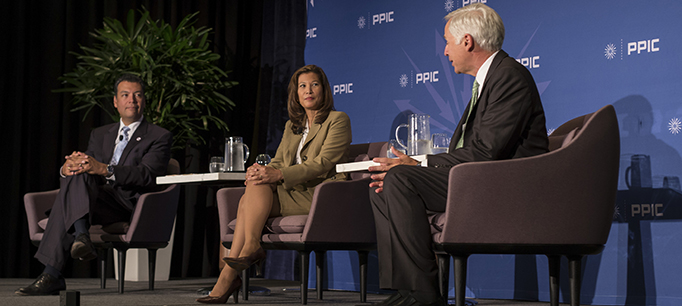
Many eligible Californians don’t register to vote, turnout in statewide elections has reached record lows, and PPIC surveys show many residents are disengaged from state government. What can be done to increase participation in elections and engage residents more broadly in all aspects of civic life? Tani G. Cantil-Sakauye, California’s chief justice, and Alex Padilla, California secretary of state, offered their responses last week in Los Angeles at an event co-sponsored by PPIC and the California Community Foundation.

In a conversation with Mark Baldassare, PPIC president and CEO, both emphasized the contribution schools can—and should—make to civic engagement.

Cantil-Sakauye noted that her teen-agers were taught civics in the second semester of his senior year in high school. “Now, think back where you were mentally in your second semester of senior year,” she told the audience. “Not the best place.”

She described Power of Democracy, a judicial branch initiative that includes Padilla and is an effort to elevate the status of civics education. Rather than focusing on teaching civics as a stand-alone subject, the group helps to integrate it into all school subjects, school projects, and community service. Partnering with Tom Torlakson, state superintendent of public instruction, as well as organizations and school districts, Power of Democracy provides schools the resources to do so, she said.

Padilla and Cantil-Sakauye each described personal experiences that sparked their interest in government and the people who had been influential along the way. Padilla said that after his freshman year at MIT, he returned to Los Angeles and visited his high school government teacher, who told his former student, “You’re 18 years old now. Have you registered to vote?” Then the teacher pulled out a voter registration form from his desk. “He wouldn’t let me leave until I filled it out,” said Padilla. That teacher, Alex Reza, was in the Los Angeles audience at last week’s event.

Cantil-Sakauye said she developed an interest in how decisions are made and who makes them after hearing adults in the Filipino community talk about their frustrations with government. When she was 9 years old, her family lost their home in an eminent domain proceeding. Cantil-Sakauye said her mother went to court and came back feeling “disrespected and humiliated.” Later on, her mother took her to see the pioneering Filipina lawyer, Gloria Megino Ochoa. “My mom threw me an elbow and said, you could do that!”

Managing Wildfires Requires New Strategies

Severe wildfires have been dominating the news this summer, with good reason. The persistent drought, coupled with the legacy of poor forest management practices, has produced historic fire conditions in California and much of the West.

In the month since the publication of our report on the California drought’s major repercussions—which projected a growth in extreme fires if the drought continues another few years—California has experienced several new fires that are among the largest or most damaging in recorded history.

Since this drought began in 2012, California has experienced two of the three largest fires on record, and four of the top 20, as measured by number of acres burned (see table). The newest “top 20” is the Fresno-area Rough Fire, which continues to spread and rise in fire rankings since its start in July. From September 11-17, the Rough Fire consumed around 20,000 additional acres and rose from eighteenth to fifteenth largest wildfire on record.

As of mid-September, this year’s Valley and Butte fires ranked third and seventh on the state’s list of most damaging fires, as measured by number of structures destroyed (see table). At this writing, neither fire was fully contained.

All three of these wildfires continue to burn despite a massive fire-suppression effort by the Department of Forestry and Fire Protection (CAL FIRE).

UC Berkeley wildfire expert Scott Stephens explains that the current statewide drought has affected the frequency and behavior of recent wildfires. Hotter temperatures and dry conditions have “reduced moisture in both live and dead trees, as well as shrub leaves and tree needles, which allows for more efficient fire initiation and high intensity burns,” says Stephens.

A century of wildfire suppression and inconsistent fuel reduction efforts—such as thinning out trees and introducing more frequent, low-intensity fires—has increased the risk of major wildfires in California’s forestlands. Unnaturally dense forests create ample fuel for wildfires once they ignite.

One new drought-induced characteristic is that wildfires are continuing to grow throughout the night, Stephens notes. Historically, lower temperature and higher relative humidity at night would slow wildfire growth and give firefighters a chance to suppress the burn. The Moonlight (2008), Rim (2013), King (2014), and Valley (2015) wildfires burned intensely throughout the night.

Stephens warns that that we need to rethink our approach to forest management. Intense fires have the potential to convert forests to shrublands, permanently altering their ecology. To avoid this, the state must increase fuel-reduction efforts to ten times the area that is currently treated. “The good news is this is possible,” Stephens says. “We have the techniques and research to show forest restoration treatments are in line with the ecology of these ecosystems.”

Short-term fire suppression is extremely important for protecting human life and property, but experts agree that California needs to take a longer range view of forest management to limit damage from wildfires as the climate warms, and reduce the ever-growing cost of fighting fires. Fuel reduction efforts require sustained application over large areas for decades. The fractured ownership of California’s forestland makes implementation difficult. Some efforts are underway on private lands in California, but this has proven more difficult on federal lands (roughly half of our forestlands) due to permitting constraints. Until private and public forestland owners coordinate long term fuel-reduction efforts, California can expect to experience larger, more frequent, and increasingly severe wildfires.

Table notes: *Number of acres burned or structures destroyed may increase until wildfire is fully contained. Wildfires in bold started since the drought began in 2012.

Table source: CAL FIRE, Top 20 Largest California Wildfires (updated by PPIC with current wildfire information as of September 23, 2015); CAL FIRE Top 20 Most Damaging California Wildfires (updated by PPIC with current wildfire information as of September 23, 2015).


College Readiness and the New State Exams

Last week, California released the results of the new statewide tests aligned with the Common Core State Standards for students in grades 3-8 and grade 11. The 11th-grade test—from the Smarter Balanced Assessment Consortium (SBAC)—is designed to measure whether students are on track to be ready for college and careers after graduation. In fact, the CSU and community colleges can use scores from the test to determine if students are ready for college level courses. The results show that about half of 11th-grade students are at least conditionally ready for college level courses in English and less than a third are ready for college level math courses.

The fact that most 11th-grade students are not yet ready for college is not necessarily news for California. Since 2004, California students have been able to participate in California’s Early Assessment Program (EAP), which used an optional statewide test to determine college readiness levels of 11th-grade students. The college readiness identification component of the new tests is based on the EAP and informs 11th grade students whether they are ready, conditionally ready, or not ready for college.

We cannot directly compare the test results to see if students have improved, as the EAP was optional for all students and the math section was only offered to students in advanced math courses, meaning a large portion of students were untested by the EAP. But the two tests are similar in that they show that a majority of high school juniors are likely not ready for college in both English and math. The new test data does show that a large majority of students are now tested in English and math, meaning more students now know whether they are ready for college level work.

But there is also some good news here for California. For students, new ratings regarding college readiness come early enough for the information to help before they enroll in their 12th-grade classes. Prior research on the EAP suggests that the optional testing helped lower the likelihood that a student would need remediation. Now, because the SBAC test is mandatory, almost all students in California will know whether they are ready for college or need to make improvements during their senior year.

This year, over 90,000 more students than last year were given a rating of “conditionally ready” in English. This will give them an opportunity to avoid remediation in college, by taking a prescribed 12th-grade English class and receiving at least a C grade.

And while it might seem that informing almost 200,000 more math students that they are not ready for college would be discouraging, prior research on the EAP suggests that a “not-ready” rating did not discourage students from enrolling at a CSU. Finally, the SBAC can serve as one of multiple ways for students to demonstrate college readiness. Research suggests that using multiple measures—rather than relying solely on a placement exam—can keep students from being misdirected into remediation.

For the state, the new test provides a benchmark by which to measure future progress and a way to compare across states. Of the eight states that have released test scores, California is 4th and 5th in the proportion of students who are at least conditionally ready for English and math, respectively. As more states release their scores, California will have a clearer picture of how well it is preparing high school students for college on a national scale.

Chart notes: Data from the EAP and CDE websites. The number of students in each category of the SBAC are estimated from the total numbers tested and the percentages given by CDE.

Poverty and Well-being in California

California is one of 12 states in which poverty declined last year, according to newly released US Census statistics. The state’s official poverty rate is down by 0.6 percentage points to 16.4%, from 17.0% in 2012. But poverty in the state remains high relative to the early 2000s. In 2007, the year the Great Recession began, California’s official poverty rate was 12.4%.

Official poverty statistics are intended to capture cash resources at hand. In other research we have analyzed the role of social safety net programs in augmenting cash resources and helping families to avoid dire economic need.

It’s important to note that jobs are still the biggest source of income for Californians overall, even among those living in poverty. And good news out last week shows the economy is continuing to improve—the unemployment rate in California is now 6.1%, less than half of what it was during the worst of the economic crisis.

At the same time we are all aware that well-being is complex, so it is instructive to look at multiple measures. Food insecurity—defined as ranging from worrying about being able to afford enough food to actually cutting back on meals—is also down from a recent high of 16.2% in California (across 2009–2011) and is estimated to be 13.5% for 2012–2014. In addition, the number of homeless in California—often not well-represented in indicators of need—is estimated to have declined by 13% between 2012 and 2014. The share of all California children with a validated report of maltreatment (most commonly for reasons of neglect) has also dropped, although this appears to be a longer term trend that predates the recession.

Broadly speaking, then, trends in well-being appear to be positive, even though we have a ways to go before poverty and other indicators decline to the levels experienced before the recession.

Big Declines in Number of Uninsured Californians

Nearly 2 million more Californians had health insurance coverage in 2014 than in 2013, according to newly released US Census data. Still, about 4.7 million Californians reported they were uninsured in 2014.

The percentage of Californians without health insurance coverage dropped nearly 5 points in the first year the Affordable Care Act (ACA) was implemented—from 17.2% to 12.4%. Declines were even more dramatic among adults age 18 to 64, who benefited the most from the ACA coverage expansions. Among this group, uninsurance rates declined nearly 7 percentage points—from about 24% in 2013 to about 17.3% in 2014.

Declines in uninsurance rates occurred across all racial/ethnic groups, with the largest drops among Latinos (6.5% overall and 9.2% adults age 18 to 64), followed by African Americans (5.7% overall and 8.1% adults age 18 to 64) and Asian Americans (4.9% overall and 6.7% adults age 18 to 64). Despite coverage gains, Latinos continue to have the highest proportion of residents without health insurance, with about 28% of adults age 18 to 64 reporting no coverage.

Changes in uninsurance rates also varied across California counties. The largest declines were in parts of the Central Valley and Monterey County, where the percentage of residents without insurance dropped by more than 6%. The counties that experienced the largest declines include Stanislaus (8.5%), Monterey (6.7%), and Merced (6.4%). Los Angeles County, home to the largest number of residents without health insurance in the state, had more than half a million fewer residents reporting they were uninsured in 2014 than in 2013. Generally, counties with higher shares of uninsured residents in 2013 experienced the largest declines.

California experienced one of the largest declines in the proportion of residents without health insurance coverage across the nation. But the percentage of Californians who remain uninsured is still above the national average – and continues to be higher than in several states that have not expanded their Medicaid programs.

Chart Source (TOP): American Community Survey, One Year Files for 2014 and 2015 accessed at American Factfinder.

Chart Notes (TOP): Individuals are considered to be uninsured if they do not have coverage at the time of the survey. The uninsurance rates presented do not account for the margin of error associated with the estimates. For the state estimates by race the margin of errors range from about 0.1% – 0.5%. The margins of error are larger for the county-level estimates and are larger for counties with smaller populations.

Three California Leaders Join PPIC Board

PPIC welcomes three distinguished Californians to our board of directors today. Each has made a unique contribution to public life. Together they bring a wealth of leadership experience, rich knowledge of the forces shaping our state, and a strong record of public service. They will be invaluable assets to PPIC as we work to shape a better future for California.

A. Marisa Chun, former prosecutor at the US Department of Justice, is a partner at McDermott Will & Emery LLP. Based in the firm’s San Francisco Bay Area office, she focuses on complex business litigation, intellectual property litigation, and white-collar criminal defense matters in the state and federal courts. She represents clients in commercial cases and investigations across a broad range of industries, including technology, energy, life sciences and pharmaceutical, health care, manufacturing, and construction and engineering.

Chun served as deputy associate attorney general at the Department of Justice from 2009 to 2013. She focused on antitrust, intellectual property, fraud, telecommunications, privacy, and environmental matters. From 2011 to 2013, she was a special assistant US attorney, prosecuting criminal cases and appeals. Previously, she was a litigation partner at the San Francisco firm of Coblentz, Patch, Duffy & Bass LLP and was outside counsel to PPIC. She has served as chair of the Bar Association of San Francisco’s litigation section and a mediator for the US District Court for the Northern District of California. She has a BA from Yale University and a law degree from Harvard Law School.

Gerald Parsky, who has an extensive record of public service in California and Washington, is chairman of Aurora Capital Group LP, a Los Angeles-based investment firm specializing in the acquisition of US companies. Previously, he was a senior partner at the law firm of Gibson, Dunn & Crutcher LLP.

Parsky was assistant secretary of the US Treasury from 1974 until 1977 and was responsible for capital markets policy and for all of the department’s international affairs. He received a number of presidential appointments, serving on President Reagan’s Council on Productivity, President George H. W. Bush’s Export Council, and President George W. Bush’s Commission to Strengthen Social Security. In California, Parsky was a member and chairman of the University of California Board of Regents, chairman of the Commission on the 21st Century Economy, and chairman of the Public Employee Post-Employment Benefits Commission. He currently serves on the boards of the RAND Corporation, the Center for the Study of the Presidency & Congress, and the Irvine Company. He is a trustee of The Ronald Reagan Presidential Foundation and a member of the Council on Foreign Relations. Parsky is a graduate of Princeton University and the University of Virginia Law School.

Gaddi Vasquez has served in leadership posts in local, state, and federal government in a long career of public service. Today, he is senior vice president of government affairs for Edison International and Southern California Edison, one of the nation’s largest investor-owned utilities. Before joining SCE in 2009, he served as US ambassador to the United Nations agencies based in Rome, including the World Food Program and the UN Food and Agriculture Organization. He was director of the United States Peace Corps from 2002 to 2006. Early in his career, Vasquez served as an Orange County supervisor, as chief deputy appointments secretary to California Governor George Deukmejian, and as a police officer for the City of Orange.

Vasquez has served on the President’s Commission on White House Fellowships, the California Criminal Justice Council, and the California Film Commission. He serves on the boards of the Segerstrom Center for the Performing Arts, the National Advisory Board of the Salvation Army, and the National Association of Latino Elected and Appointed Officials Educational Fund. He received a bachelor’s degree in public service management from the University of Redlands.

The chair of the PPIC board is Donna Lucas, founder and chief executive officer of Lucas Public Affairs. The other board members are myself; Ruben Barrales, president and CEO of GROW Elect; María Blanco, executive director of the Undocumented Student Legal Services Center in the University of California Office of the President; Louise Henry Bryson, chair emerita of the Board of Trustees of the J. Paul Getty Trust; Phil Isenberg, vice chair of the Delta Stewardship Council; Mas Masumoto, author and farmer; Steven A. Merksamer, senior partner of Nielsen, Merksamer, Parrinello, Gross & Leoni, LLP; and Kim Polese, chairman of ClearStreet, Inc.

You can find more information about the PPIC Board of Directors on PPIC.org.

Reducing the Costs of Drought: Lessons from Australia

What do droughts in California and Australia have in common, and what lessons from Down Under are best-suited to managing mega-droughts here? At a recent conference of agricultural economists, Americans and Australians shared their experiences and research on the topic.
The meeting covered what worked well—and what did not—in managing Australia’s Millennium Drought, which lasted from 1997-2009. The “worked well” list included: water conservation in urban areas, water pricing, and cooperative governance among water managers. The Australians also depended heavily on water markets to reduce the costs of their mega-drought. The flexibility and autonomy offered by water trading helped communities allocate water quickly and efficiently to competing uses, and also provided an effective way to recover it for the environment.
Several researchers noted that water trading is an important drought response that deserves much wider use in California. Speakers noted that although trading has helped some here, California’s water market still lacks transparency—with only limited information available about trading rules, volumes, and prices.
Australians also benefited from a strong water policy foundation going into their mega-drought, including a national water initiative. This national agreement (which state and territorial governments agreed to abide by) focused on ensuring reliable water use information that is publicly shared, and also mandated the separation of land ownership and water access. These two factors have helped facilitate water management, sharing, and marketing. While separating land and water ownership may not be in the cards for California, there are other ways to improve water marketing here by strengthening water-use information. As elaborated in a 2015 PPIC report on managing our drought, several other policy priorities that were at play in Australia are also within our reach: setting clearer priorities for public health and the environment, managing demand and supply more stringently, and implementing progressive environmental drought management practices.
Australians were able to create a more resilient water system, but some researchers at the conference noted that their drought management was not without fault. One cautionary tale was that much of the costly new infrastructure put into place in response to the drought—mainly desalination and inter-basin pipelines—brought increased water supply benefits only after the drought ended, due to the time it took to plan and build desalination plants, in particular. While desalination is currently providing drinking water in Western Australia, where dry conditions have continued, plants built to serve communities in other regions have not been used because cheaper alternatives are once again available.
A key recommendation made by a number of panelists was to ensure that all other options are exhausted before moving forward with costly infrastructure projects like desalination. In addition, it’s important to take other steps to develop sound policy in areas like water information before the next drought. Because droughts are unpredictable but cyclical, long-term vision and preparedness are critical.
The takeaway from the meeting was that while the challenges and debates in California are similar to those during Australia’s Millennium Drought, the comparison is not perfect. As we continue to adapt and develop our own drought policies, it will be important to take lessons from both the successes and ongoing challenges experienced during Australia’s “big dry.”
Adam Soliman is a graduate student in agricultural, food, and resource economics at Michigan State University. He served as an intern at the PPIC Water Policy Center this summer.

Extinction Risk for Native Fish if Drought Persists

If the California drought continues, many of California’s native freshwater fishes are at imminent risk of extinction. This is a key finding of our recent report What If California’s Drought Continues?, which projects the potential consequences of ongoing drought on key sectors, including the environment.

Managing scarce water resources to improve the drought resiliency of the state’s rivers, wetlands and forest ecosystems, and the native biodiversity they support, has proven to be the most vexing challenge of this extended drought.

Our research finds that 18 native fishes could go extinct if the drought continues for several more years; this map shows their distribution in the state’s watersheds. We estimated each species’ extinction risk by evaluating the response of these fishes to factors such as reduced flows, increased water temperatures, stress from habitat changes or competition caused by invasive species, and the impacts of hatchery-bred fishes on wild fish populations. (Learn more about our methods in the report’s technical appendix.)

The results are disconcerting. The state’s “anadromous” fishes—those that spawn in fresh water but rear in the ocean—are being hit particularly hard. Coming into this drought, historic water- and land-use practices had diminished their populations. Low flows and high temperatures have made matters worse. Most of the state’s salmon runs are at risk, along with many runs of steelhead trout. Other species—some well-known (delta smelt) and some obscure (unarmored threespine stickleback)—are also in trouble.

The state needs to prepare now for addressing this problem, because if there is another dry year or two, many fishes are likely to go extinct. Recommended actions include acquiring or allocating water (particularly cold water) to improve habitat in strategic locations, relocating some fish, restoring spawning habitat, and improving access of fish to spawning and rearing areas. As a matter of urgency, these species should be brought into conservation hatcheries so that they can be reintroduced to the wild when conditions improve.

Along with the conservation-oriented goal of protecting the state’s native biodiversity, there are also very practical reasons for taking urgent action to protect these fishes. Half of the 18 species at risk are not currently protected under the Endangered Species Act (ESA). Listing species for ESA protection brings legal obligations to stop population declines; experience shows this can be disruptive to water supply operations and incur considerable long-term costs. An ounce of prevention, in this case, would be worth many pounds of cure.