Health Care Access for California’s Immigrants

Governor Newsom is proposing to expand access to Medi-Cal—the state’s Medicaid program—for low-income young adults up to age 26, regardless of their immigration status. This could help a vulnerable segment of the immigrant population. Californians are signaling broad support.

Overall, immigrants make up about 27% of the state’s population and are less likely to have health insurance than US-born Californians. Immigrants are also less likely to have private insurance, partly due to differences in employment industries and income.

Figure - Health Care Coverage Rates are Lower For California Immigrants in All Age Groups

Documented immigrants—including those with green cards and visas—may qualify for Medi-Cal without being subject to the five-year waiting period required by federal law. They can also purchase private health plans through Covered California, the health insurance exchange that was created as part of the Affordable Care Act (ACA). However, most recently-arrived elderly immigrants are not eligible for Medicare because they have not paid Medicare taxes over a long enough period.

California offers a patchwork of health care options for undocumented immigrants, who are not covered by the ACA. For instance, low-income children and pregnant residents are eligible for Medi-Cal regardless of immigration status, and some counties include undocumented immigrants in programs for those who cannot afford medical care. Additional options for undocumented immigrants include community clinics, rural health clinics, emergency rooms, or a limited version of Medi-Cal for medical emergencies.

Californians support health care access for undocumented immigrants. In a 2015 PPIC Statewide Survey, a slim majority of Californians (54%) supported the idea of providing health care coverage to undocumented immigrants. In March 2019, about two-thirds (64%) expressed support for the governor’s proposed expansion of Medi-Cal coverage to low-income young adults, including those who are undocumented.
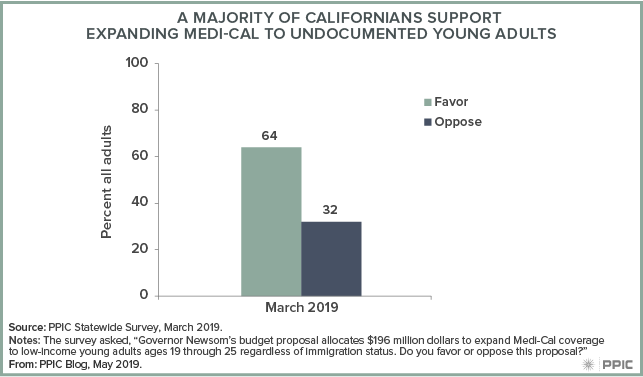
Figure - A Majority of Californians Support Expanding Medi-Cal to Undocumented Young Adults

The governor’s May budget revision delays implementation of the expansion, but it would still have an impact: by providing coverage to approximately 90,000 undocumented young adults in the first year, it could help make the health care landscape less complicated for an important share of California’s immigrant population.


Video: Emergency Department Use in California

Hospital emergency departments (EDs) are an important part of California’s health care system. They are sometimes called the safety net of the safety net because they provide care to all comers. Policymakers, health plans, and health providers have long focused on ED use, partly because it serves as a proxy for lack of access to other, less costly forms of health care. So how has the expansion of insurance coverage under the Affordable Care Act (ACA) affected ED use in California? At an event last week in Sacramento, PPIC researcher Shannon McConville outlined a new PPIC report that addresses this question, and a panel of experts offered their perspectives on recent ED trends.

While many predicted that coverage expansion would reduce ED use by providing access to other kinds of medical care, such as primary care physicians, some worried that because insurance coverage typically reduces patients’ out-of-pocket costs, the ACA would increase ED use. The good news is that the PPIC report estimates that ED use rates would be higher in the absence of the ACA. But ED use statewide has been increasing for the past decade. To get a sense of how recent trends in ED use are being experienced and addressed around the state, PPIC convened a panel of experts.

All of the panelists highlighted the importance of finding out why people are using EDs. Some frequent ED users may not know about other ways to get medical care, while others may have behavioral or mental health issues that could be addressed more effectively by other kinds of care—from housing assistance to substance abuse programs. As Sara Kate Levin, medical director for Contra Costa Health Services, put it, “What are the unmet social needs that are driving a lot of this high utilization?”

But filling information gaps and addressing behavioral and mental health issues does not solve all ED use problems. In many areas, there is a scarcity of primary care doctors and urgent care clinics, and many patients cannot take time off to go to medical appointments during the workday. Moreover, primary care doctors sometimes refer their privately insured patients to EDs, in part so they won’t have to wait for tests.

This range of issues points to what Renee Hsia, an ED physician at Zuckerberg San Francisco General Hospital and a professor of emergency medicine and health policy, called “the elephant in the room”: because the United States has “a very market-based approach to health care,” there are two very different stories about ED use. On the one hand, EDs in affluent areas broadcast their availability and convenience. On the other hand, there are long waits for treatment at EDs serving low-income areas. “In some areas, your ER is a revenue center . . . and in some places, where you don’t have paying patients, your ER is a cost center.”

Jennifer Rasmussen, vice president of health care services at Molina Healthcare of California, highlighted the geographical differences across the state that make it difficult to find “one size fits all” solutions. She pointed out that Molina serves Imperial and San Bernardino Counties, “a vast geography” with fewer social services than a dense urban area has to offer. In other words, “a solution for Imperial County is not going to be the same as a solution for San Francisco.”

Reviving the Health Care Mandate: Who Pays?

Governor Newsom has proposed creating a state individual mandate to help fund increased health insurance subsidies for low- and middle-income Californians. One of the major reforms ushered in by the Affordable Care Act, the federal individual mandate—which was rolled back in the federal tax bill passed in 2017—required most individuals to have comprehensive health insurance or pay a tax penalty. The governor’s administration projects approximately $500 million in revenue from the mandate, based on the total amount paid by Californians in 2016.

As the governor and legislature consider a state mandate, it’s worth examining which Californians paid the federal mandate penalty.

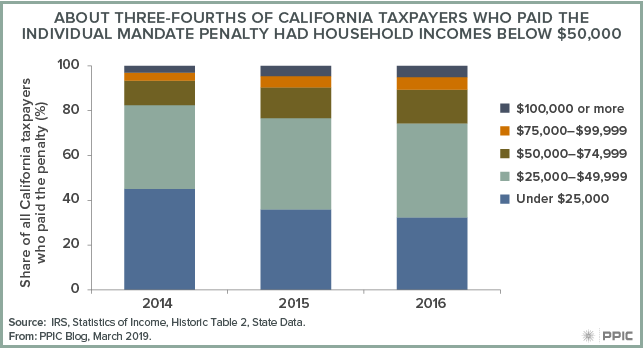
Between 2014 and 2016, taxpayers with incomes below $50,000 accounted for a vast majority of returns that included the individual mandate penalty. In 2014, the first year the individual mandate went into effect, the penalty was 1% of income or a maximum of $285 per family ($95 per adult and $47.50 per child). More than 1 million tax returns in California paid the penalty. Taxpayers with incomes below $25,000 accounted for about 45% of returns subject to the penalty, while those with incomes between $25,000 and $50,000 accounted for another 37%. Even more low-income individuals would have been subject to the penalty if not for certain exemptions—such as having an income below the tax filing threshold ($12,500 for a single adult) or facing hardships like bankruptcy and eviction.

In 2016, the minimum payment rose to 2.5% of income or a maximum of $2,085 per family ($695 per adult and $347.50 per child). The total number of taxpayers subject to the penalty dropped to about 600,000. Those with incomes below $50,000 still accounted for nearly three-fourths of all payments, though this was down from 83% in 2014.

About Three-fourths of California Taxpayers Who Paid the Individual Mandate Penalty Had Household Incomes Below $50,000

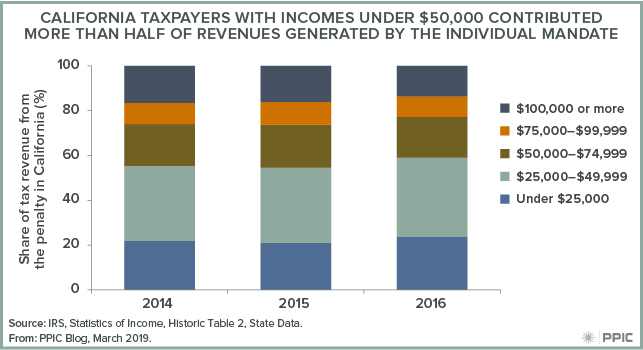
The revenues generated also disproportionately came from taxpayers in lower income brackets. In 2014, taxpayers with incomes below $50,000 accounted for more than 55% of the $222 million in total payments from California taxpayers. Those with incomes under $25,000 paid more than $48 million and those with incomes between $25,000 and $50,000 paid more than $74 million.

Although the number of taxpayers subject to the penalty dropped from 2014 to 2016, tax revenue doubled—in part because the penalty amount increased—and reached $446 million in 2016. Over this time, the share of the total amount paid by households with incomes of $100,000 or more decreased, from 17% to 14%. Meanwhile, the share of revenue paid by those with incomes below $50,000 rose, from 55% in 2014 to 59% in 2016.

California Taxpayers with Incomes Under $50,000 Contribute More Than Half of Revenues Generated by the Individual Mandate

If the state does implement the governor’s proposal, the revenue would increase subsidies currently available for individuals with incomes between 250% and 400% of the federal poverty level ($31,225–$49,960 for a single adult) and expand subsidies to individuals with incomes between 400% and 600% of the federal poverty level ($49,960–$74,940). Most Californians with lower incomes are eligible either for no-cost Medi-Cal or heavily subsidized coverage through Covered California—though not everyone who is eligible enrolls in these programs.

The repeal of the federal individual mandate is expected to lead to an increase in the number of uninsured individuals and higher insurance premiums. A state individual mandate might help counteract those effects by encouraging healthy individuals to enroll in coverage—but at a cost.

In an otherwise progressive state tax structure, the implementation of the federal mandate disproportionately affected low-income Californians. There’s also evidence that some Californians paid the penalty even though they should have been exempt. If the state revives the mandate, the governor and legislature should consider how to improve awareness about eligibility and exemptions so this problem can be avoided. At the same time, reducing the number of people paying the penalty also means that the governor’s revenue estimate may need to be lowered. As policymakers engage in discussions over a state individual mandate, assessing who bears the burden of the tax and who benefits will be an important consideration.

Emergency Departments and the Affordable Care Act

Coverage expansions under the Affordable Care Act (ACA) have resulted in a dramatic decline in the uninsured population in California. Much of the coverage gains have been driven by expanded eligibility for Medi-Cal, the state’s Medicaid program, which has seen a nearly 60% increase in enrollment since January 2014. With this large Medi-Cal expansion comes concerns about controlling costs, ensuring adequate access to care, and supporting the state’s health care safety net.

Monitoring how often people seek care in California’s emergency departments offers important insights—in part because frequent use can signal poor access to other medical care options. Hospitals in some parts of the state have reported growing demand for emergency care services in recent years. In a new study published this month in the journal Health Affairs, we examined emergency department use to understand how things have changed since the implementation of the ACA.

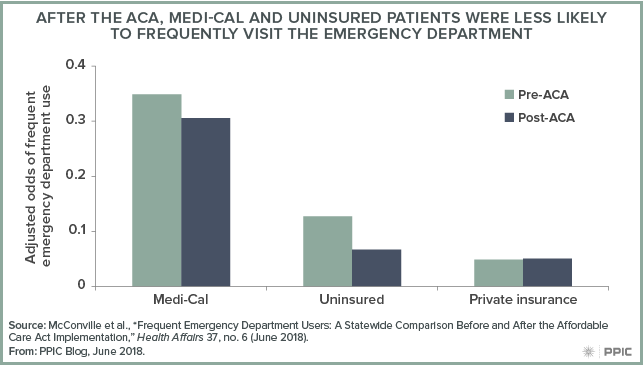
After controlling for factors such as patient age and health status, we found the odds of being a frequent emergency department user—with four or more annual emergency department visits—were significantly lower for Medi-Cal patients after the ACA. The odds of frequent use among the uninsured declined even more, while those with private insurance experienced little change. At the same time, however, there has been an overall increase in both the share and the absolute number of emergency department patients who are frequent users—despite the lower odds of frequent emergency department use after the ACA. We found that frequent users accounted for 7.9% of emergency department patients in the two years before the ACA, compared to 8.5% in the two years after.

Both before and after the ACA, the largest predictors of frequent emergency department use were having a diagnosed mental health condition or substance use disorder. This finding suggests state efforts to better integrate physical and behavioral health services for Medi-Cal enrollees could help lower frequent emergency department visits. Given that Medi-Cal is now the primary coverage source for more than two-thirds of frequent emergency department users, care plans managed by Medi-Cal will be a key player in efforts to manage emergency care moving forward.

In future work, we will be studying in more depth how changes in insurance coverage affected emergency department use across the state—with a particular focus on regions that saw the largest declines in their uninsured rates.

Video: Attorney General Becerra on the Issues

The Trump administration has clashed with California on a range of issues, and the state’s new attorney general, Xavier Becerra, is at the forefront of the legal battles with Washington. Before a large crowd in Sacramento, Becerra talked about his views and what he has done so far on a range of issues. He spoke with Mark Baldassare, PPIC president and CEO.

Some key highlights:

  • Environment: Becerra said he has been most active so far on this issue and vowed to continue to be aggressive, whether it is initiating lawsuits, joining other suits, or moving forward with the Paris climate agreement, to the extent the state can do so. “I’ve got the governor’s back on anything he wants to do on the environment,” he said.
  • Immigration: Becerra said he favors legislation to make California a sanctuary state as long as it does not undermine the ability of local law enforcement to protect public safety by, for example, combating drug and sex trafficking.
  • Health care: Becerra said that single-payer health care is ultimately the right approach to coverage. “I hope California gets further along in recognizing that affordability only comes when you have universality,” he said.

Video: Pessimism about Nation’s Direction

Californians have grown more pessimistic about the direction of the nation and the US economy since the beginning of the year, the May PPIC Statewide Survey shows. Underscoring that sentiment: just 27 percent of residents approve of the way President Trump is doing his job. Only 26 percent approve of Congress—a 10 point decline from March.

Researcher David Kordus presented these and other key findings at a survey briefing in Sacramento last week. On other federal issues, the survey found that most Californians disapprove of the House health care bill, and half expect negative effects from increased immigration enforcement.

Californians are feeling better about the state of their state by some measures: a solid majority favor Governor Brown’s budget plan, and fewer adults than in past years see the state budget situation as a big problem. But the state faces important challenges. Housing is one of them, with 59 percent of all adults saying affordability is a big problem in their part of the state. And solid majorities of Californians say the gap between rich and poor is getting larger. Majorities support state action to address these issues.

Learn more

Read the PPIC Statewide Survey: Californians and Their Government
Find out more about the PPIC Statewide Survey

Californians’ Views on ACA Repeal

With control of the presidency and both houses of Congress, Republicans now have the opportunity to act on their oft-stated promise to repeal and replace the Affordable Care Act (ACA), and legislation to replace the 2010 law is advancing in the House. In California, PPIC Statewide Surveys have found majorities of adults viewing the Affordable Care Act favorably since 2015. In our January survey, over half opposed repeal.

A slight majority (53%) of Californians said Congress should not vote to repeal the 2010 health care law, including majorities of those living in the San Francisco Bay Area (59%), Orange/San Diego Counties (59%), and Los Angeles County (56%). Statewide, 42% favored repeal, with just over half saying so in the Central Valley (51%) and Inland Empire (52%).

Not surprisingly, there were wide partisan differences on the question of repeal, with 78% of Democrats and 57% of independents opposing repeal and 80% of Republicans in favor. Whether living in coastal or inland counties, Democrats generally opposed repeal and Republicans generally favored it. But independents on the coast (61%) were more likely than independents in inland counties (46%) to oppose repeal.

In response to another question, 51% of Californians expressed a generally favorable opinion of the ACA. The Kaiser Family Foundation found in a survey conducted shortly after ours that adults nationwide held similar views (48% favorable in February). Majorities of adults in the San Francisco Bay Area (60%), Los Angeles County (56%), and Orange/San Diego Counties (53%) view the ACA favorably, compared with 44% and 41% in the Central Valley and Inland Empire, respectively. In California, there is little difference in opinion on the ACA by age or income, with about half across categories expressing a favorable view. White Californians (44%) are less likely to express a generally favorable opinion of the law, while majorities of other racial/ethnic groups hold a favorable view. Whites without a college degree (36%) are even less likely to view the ACA positively, and 60% favor repeal.

Though majorities of adults have viewed the ACA positively in our surveys over the past two years, opinions were more divided in prior surveys. We will continue to monitor Californians’ views as congressional proposals develop and as potential changes to health care in California become clear. Considering the support we found in our most recent survey for state action to address climate change and protect the rights of undocumented immigrants, it will be interesting to see what state action Californians may want to see if the federal government changes its approach to health care policy.

Learn more

Read the January PPIC Statewide Survey: Californians and their Government
Learn more about the PPIC Statewide Survey

Medi-Cal and the Fall Election

Lost in the sound and fury of the national election are the results of four statewide ballot initiatives that aimed to bolster financing of the Medi-Cal program. Medi-Cal is California’s version of Medicaid, which pays for the health care of low-income families, many elderly who live in nursing homes, and—with the passage of the Affordable Care Act—single low-income adults. The state spends nearly $19 billion annually from the General Fund (and $87 billion from all sources) to provide medical coverage for 13.5 million Californians through Medi-Cal.

Three of the four initiatives passed on November 8, providing up to $3 billion in additional funds for Medi-Cal each year. But it will take a while for Californians to see the concrete outcomes of their votes. And, as is often the case with initiatives, the impact of these measures will depend on questions that have yet to be answered. The three measures that passed include:

  • Proposition 52: This initiative permanently extends the fees hospitals pay to the state, which the state then uses to get federal matching funds to support Medi-Cal. This translates to about $1 billion in state General Fund savings annually – providing this system continues to be allowed under federal law. There wasn’t much doubt that the state would seek to extend these fees past the sunset date of January 1, 2018, since they reduce pressure on the General Fund. But the initiative makes it more difficult for the legislature to modify the hospital fee program.
  • Proposition 55: Extending the tax on high-income earners will generate between $4 billion and $9 billion each year to pay for K–12 education and community colleges, Medi-Cal, and other budget priorities. For Medi-Cal, this is expected to provide up to $2 billion annually starting in 2018. But the amount may vary significantly from year to year for several reasons. First, K–12 education gets first call on the new revenue. In addition, the amount of new revenue will be affected by the volatility in what high-income taxpayers earn. Thus, the governor and legislature will have to learn to cope with an undependable funding source for Medi-Cal.
  • Proposition 56: Higher tobacco taxes will generate up to $1 billion for Medi-Cal in 2017–18. Revenue from tobacco taxes has generally fallen each year as the number of smokers in California has declined, and the new tax may accelerate that trend. While building these funds into the Medi-Cal budget may strengthen the program now, the state’s General Fund could face increasing pressure in the future if this source of funding declines. The state legislature and governor will determine how to use these funds as part of budget discussions next spring.

The fourth initiative affecting the Medi-Cal program, Proposition 61, failed to garner a majority of votes. Perhaps not surprisingly, more questions were raised about the impact of this initiative than the other three. Proposition 61 prohibited the state from paying more for prescription drugs than the federal US Department of Veterans Affairs, which typically pays the lowest prices of any public or private entity. The measure’s intent was to reduce the cost of prescription drugs in California, but the fiscal analysis by the Legislative Analyst’s Office suggested that the savings were uncertain.

While the new funds for Medi-Cal will be welcome, it remains to be seen whether they will provide reliable support for the program. Plus, there are questions about how the new president and Congress will alter the Affordable Care Act and how that will affect the state’s program. For instance, the law allowed California to extend Medi-Cal coverage to single low-income adults. In the 2016–17 state budget, coverage for this group cost about $15 billion annually, with the federal government picking up 95% of the tab. If the federal government significantly reduces or eliminates this enhanced funding rate, the $3 billion in new revenues generated by the three initiatives will not be enough to operate California’s expanded Medi-Cal program without other fiscal support.

Video: County Jails and the ACA

A majority of inmates in California’s jail system are likely to be eligible for Medi-Cal, and providing health care coverage for them could have multiple benefits. These are the key findings of a new PPIC report, Expanding Health Coverage in California: County Jails as Enrollment Sites.

Coauthor Shannon McConville presented the report to a Sacramento audience last week. She noted that the 4 million state residents who are still uninsured will probably be the toughest to reach. The legislature has allocated money to target these Californians and increase enrollment in health coverage under the Affordable Care Act (ACA).

At the same time, counties—which have gained new responsibilities for low-level criminal offenders—have new incentives to help inmates successfully transition back into the community and avoid further contact with the criminal justice system.

“Health coverage, newly available under the ACA, could be part of a more comprehensive reentry strategy,” McConville said.

Managed care plans are also increasingly focused on better integrating physical health and behavioral health, providing more mental health and substance abuse treatment—services needed by the jail population.

These policy changes add up to an opportunity to leverage federal and state Medi-Cal resources to improve both public health and safety. Enrolling inmates could improve health care in the jail system, lower county corrections costs, and reduce recidivism.

McConville said the work to achieve these goals is just beginning. Counties are still adjusting to their new responsibilities. As a first step, they will need to identify effective enrollment strategies that improve reentry and reduce recidivism.

Closing California’s Health Insurance Gap

California has made great strides toward closing the health insurance coverage gap under the Affordable Care Act (ACA). In 2014, the state reduced the share of the population that was uninsured by 5 percentage points, or about 2 million people. Early evidence suggests the state made additional gains in 2015, but more than 3 million California residents continue to lack health insurance and many are eligible for free or subsidized coverage. Reaching them may have benefits beyond meeting the state’s health coverage goals, including the potential to improve public safety and public health.

The characteristics of the remaining uninsured are striking. Younger men (those under age 45) make up less than one-fifth of California’s adult population but represent more than one-third of the uninsured. When we examine other characteristics of Californians who continue to lack coverage, we find the highest uninsured rates among those facing high levels of disadvantage. Uninsured rates among adults with low levels of income, education, or employment are above 30 percent. And when we focus more closely on young men with high levels of disadvantage, uninsured rates are well above 50 percent.

Because highly disadvantaged young men are detached from educational and labor market institutions, they are likely to be among the hardest to reach through traditional sites of enrollment. They are also disproportionately represented among people who are arrested and incarcerated in county jails and state prisons.

In our study of a subset of California counties, we find that more than three-fourths of individuals booked into jail are men under age 45. Within the counties under study, nearly half a million individuals flowed through the jail system in 2014. Given the substantial overlap in the characteristics of the uninsured and the characteristics of individuals who have contact with the criminal justice system, county jails may provide an opportunity to target a share of the remaining uninsured.

Enrolling county correctional populations in health coverage may also support efforts to improve reentry outcomes under Public Safety Realignment by reducing the likelihood of recidivism. Specifically, chemical dependency treatment and outpatient mental health programs have been associated with reductions in repeat arrests and fewer total arrests.

Many county jail systems are engaged in some form of enrollment assistance. However, approaches and resources vary across the state. Counties may take a “front door” approach, offering enrollment screening to the large group of individuals being booked into jail. Or they may take a “back door” approach, offering enrollment assistance to a much smaller group of individuals nearing the end of their sentences, as part of reentry planning. When resources are limited—and they almost certainly are—counties face trade-offs between providing some form of assistance to a large population and providing in-depth assistance to a smaller group.

This variation across counties creates an opportunity to identify best practices in providing enrollment assistance. Further, we can help counties that successfully enroll a substantial share of their correctional populations to evaluate the effects of enrollment on recidivism. This kind of research can inform efforts to make the most cost-effective use of criminal justice resources.


Chart Source: American Community Survey, Public Use Microdata Sample, 2014.
Chart Note: Insurance coverage is measured at the time of the survey. Results shown are for all California adults ages 18–64. Income levels are presented as poverty rates based on federal poverty level (FPL) thresholds related to income eligibility cutoffs for health insurance coverage programs including Medi-Cal (under 138% FPL), premium and copayment subsidies available for coverage purchased through Covered California (138%–250% FPL), and premium subsidies only for coverage purchased through Covered California (250%–400% FPL).