Video: Californians and Their Government

In California’s March 3 primary, the state ballot will feature several initiatives—including a $15 billion bond for the construction and modernization of public education facilities. Slightly more than half of likely voters approve, while 42% are opposed and 8% are undecided. PPIC researcher Dean Bonner outlined this and other key findings from the latest PPIC Statewide Survey at a briefing in Sacramento last Friday.

In November, Californians may be asked to vote on a constitutional amendment that would require state and local governments to provide housing or shelter beds to all homeless residents. About six in ten adults and 55% of likely voters say they would vote yes on such an amendment. Majorities of adults and likely voters also support Governor Newsom’s proposal to allocate $1 billion to address homelessness.

Other survey highlights:

  • More than six in ten Californians say housing affordability is a big problem in their part of the state, and the cost of living is causing many to consider moving out of California.
  • A majority of Californians (53%) approve of the way Governor Newsom is handling his job; this is the governor’s highest approval rating to date.
  • Views on the governor’s plan to scale back the high-speed rail project are mixed, while most approve of his proposal to build only one tunnel under the Sacramento–San Joaquin Delta.
  • Bernie Sanders leads all other Democratic presidential candidates with 32% support among Democratic primary likely voters. Joe Biden has 14% support, 13% support Elizabeth Warren, and Pete Buttigieg and Michael Bloomberg were tied at 12%.

Video: Attorney General Becerra on the Issues

The Trump administration has clashed with California on a range of issues, and the state’s new attorney general, Xavier Becerra, is at the forefront of the legal battles with Washington. Before a large crowd in Sacramento, Becerra talked about his views and what he has done so far on a range of issues. He spoke with Mark Baldassare, PPIC president and CEO.

Some key highlights:

  • Environment: Becerra said he has been most active so far on this issue and vowed to continue to be aggressive, whether it is initiating lawsuits, joining other suits, or moving forward with the Paris climate agreement, to the extent the state can do so. “I’ve got the governor’s back on anything he wants to do on the environment,” he said.
  • Immigration: Becerra said he favors legislation to make California a sanctuary state as long as it does not undermine the ability of local law enforcement to protect public safety by, for example, combating drug and sex trafficking.
  • Health care: Becerra said that single-payer health care is ultimately the right approach to coverage. “I hope California gets further along in recognizing that affordability only comes when you have universality,” he said.

Video: Villaraigosa on His Priorities

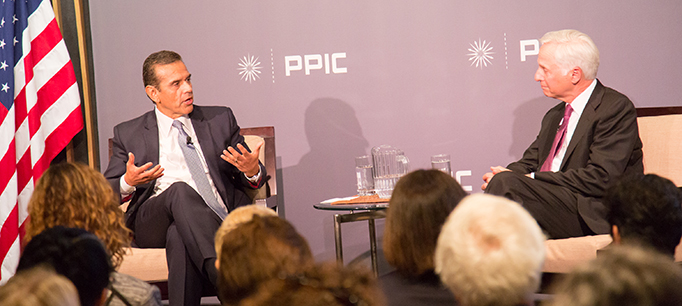
When Antonio Villaraigosa was asked to name the top issues most important to the state’s future, he started with the economy. His key concerns are poverty and the state’s business climate, its “byzantine and bureaucratic regulatory framework.”

Villaraigosa, candidate for governor and former mayor of Los Angeles, spoke at the Speaker Series on California’s Future sponsored by the Public Policy Institute of California (PPIC). As part of the series, PPIC is inviting all major candidates for governor to participate in a public event. Other highlights of his remarks:

  • Health care: He believes in universal health care but is skeptical about how to pay for the current plan before the legislature: “You’re selling snake oil when you say that single payer is something that’s going to happen any time soon.”
  • Infrastructure: He emphasized his long-term support for high-speed rail. He sees it as an economic development strategy to transform the Central Valley by connecting it to the two big centers of the economy, Los Angeles and the Bay Area.
  • Higher education: He said the state needs to look at how community colleges are funded and marshal its resources to make sure students get through the system and transfer to four-year colleges. But he’s not an advocate for making community college free to all: “It’s already free for poor people, and that’s who it should be free for.

Watch all candidate videos.

Video: Ending the Housing Crisis

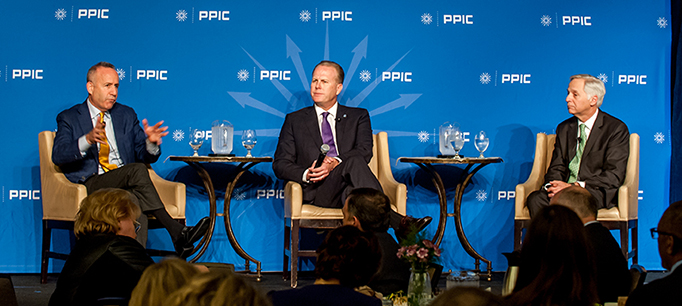
Sacramento’s mayor and San Diego’s mayor have different political perspectives, clearly evident in PPIC’s “Building California’s Future” event last week. Their views diverged on issues from high-speed rail to the voting requirements for passage of local transportation tax measures. But the mayors reached some consensus on one issue: the need for more housing and the difficulty of building the political will to end the state’s housing crisis.

“I don’t see the political coalition around housing that I see around transportation,” said Darrell Steinberg, Sacramento’s Democratic mayor.

“I could not agree more,” said Kevin Faulconer, San Diego’s Republican mayor. “It has not gotten the attention it should.”

Asked the single biggest action the state can take this year to help with our housing crisis, both mentioned regulatory reform. Steinberg said robust reform needs to be combined with a source of funding for affordable housing. He said he hoped the state can “combine these two prongs to make it easier to site housing and at the same time provide real funding to be able to subsidize and build affordable housing.”

Faulconer said reform of the 40-year-old California Environmental Quality Act (CEQA) is essential. Those who share his views contend that CEQA lawsuits have been used to slow or stop housing developments, even those deemed environmentally friendly. Faulconer said the business and housing climate are important in attracting businesses to California communities.

“We have to have really clear rules of the road, we have to follow those rules of the road,” he said. “We have to get people through the process in a defined amount of time because time is money.”

Housing was also an important part of the discussion in the panel that followed the mayors’ conversation at the PPIC event. Participants included two county supervisors, Kristin Olsen of Stanislaus County and Joe Simitian of Santa Clara County, as well as Lucy Dunn, president and CEO, Orange County Business Council. John Diaz, editorial page editor of the San Francisco Chronicle moderated.

Video: John Chiang Looks to the Future

What are the top three issues that will make a difference to California’s future? That is the first question John Chiang—state treasurer and candidate for governor—was asked by PPIC’s president and CEO, Mark Baldassare.

Chiang’s response: education, economic security and opportunity, and the environment. He elaborated on these themes in the conversation before a San Francisco audience last week.

As treasurer, Chiang is the state’s banker, whose responsibilities include selling California’s bonds, investing its money, and managing its cash. He served two terms as state controller and was also on the Board of Equalization.

Baldassare said that he would sum up Governor Brown’s philosophy about taxes and spending as “fiscal restraint” and asked Chiang to sum up his own fiscal philosophy.

“Smart financial investment,” Chiang said.

“If you have the money, you invest it in education, you invest it in safety, you invest in infrastructure, make sure that you do the core issues correctly,” he elaborated.

PPIC invited Chiang as part of PPIC’s Speaker Series on the Future, which brings thought leaders from across the political and geographic spectrum to California audiences for conversations about the state’s pressing challenges. PPIC does not endorse, support, or oppose candidates for public office.

Video: Californians Weigh in on Presidential Race

The strong partisan divisions prominent in the nation this election year are also evident in California, the latest PPIC Statewide Survey shows. As the primary nears, Democrats and Republicans are deeply divided in their views about the appropriate role and size of government. Dean Bonner, the PPIC survey’s associate director, presented these and other key survey findings in Sacramento last week.

Bonner noted that preferences among California’s likely voter in the upcoming presidential primary are similar to those seen in many states that have already voted. Among Democratic likely voters—including independents who say they will vote in the Democratic primary—48% support Hillary Clinton and 41% support Bernie Sanders. Most young voters support Sanders and most over age 45 support Clinton. Clinton leads among Latinos, women, and those who describe themselves as politically middle of the road, while Sanders leads among men and voters who describe themselves as very liberal.

Donald Trump leads the Republican field with 38%, followed by Ted Cruz with 27% and John Kasich with 14%. Bonner noted evidence in the survey of discontent with the status quo in the nation—signs that may have fueled the candidacies of “outsiders” in both major parties. A majority of likely voters—63%—say the nation is going in the wrong direction and 47% say the US will have bad times financially in the coming year. And Congress’ job performance gets a very low rating—across party lines. Notably, Republicans are more likely to approve of President Obama (20%) than they are to approve of the Republican-led Congress (11%).

Video: PPIC Statewide Survey Briefing

As discussions continue in Sacramento about drought relief, funding for higher education and transportation projects, and an extension of Proposition 30 tax increases, PPIC surveyed public opinion on these and many other topics. At a briefing last week in the capital, PPIC researcher Jui Shrestha provided the survey findings. Among the key points:

  • Two-thirds of Californians say the regional water supply is a big problem, and two-thirds say people in their part of the state are not doing enough to respond to the drought.
  • While most adults say that spending money on the maintenance of California roads, highways, and bridges is very important, there is little support for increasing the gasoline tax or vehicle registration fees to do so.
  • Half of Californians favor extending the Proposition 30 tax increases, and about a third favor making them permanent.

California–State of Change

As leaders from government, business, and philanthropy gathered last week to discuss California’s future, we were reminded once again that these are exciting times in our state. The discussions were part of PPIC’s full-day conference, California—State of Change, and they highlighted both the advantages our state enjoys and the major challenges ahead.

Speakers noted that the recovering state economy, newly elected state leaders, a richly diverse population, and a history of innovation provide much to build on—as well as a lot of building to do. For example, California has recently enacted sweeping changes in corrections and education finance. But, as the governor’s chief aide, Nancy McFadden, emphasized in her keynote address, most of the hard work of implementing these policies lies ahead.

Among other challenges noted in the subsequent panel discussions: a state tax structure that leads to extreme revenue volatility, a need for public employee pension reform, an uneven economic recovery that has left many Californians behind, government institutions that do not provide the tools for managing in the 21st century, and an electorate that is disengaged from the political process.

But, as other speakers reminded us, Californians are living in a time of reform. A change in term limits may lead to more stability in the legislature and result in more long-term policymaking. Recent initiatives to shift many school decisions from the state to the district level and to move state corrections responsibilities to the counties could make local governments labs for innovation—but only if we have the will and the data to evaluate the results.

Our final panel demonstrated that California still knows how to dream big. The discussion focused on three projects: a historic effort to combat climate change, the construction of high-speed rail, and the advancement of stem cell research. All have been controversial, but they show that California voters and elected officials embrace innovation, as they have throughout the state’s history. 

We invite you to watch the videos of each session. We hope you find the conversations as thought-provoking as we did.