Democrats View Environmental Policy as Critical in Upcoming Primary

Climate change is becoming a defining issue for voters in next year’s presidential election. According to PPIC’s latest statewide survey on the environment, record-high shares of Californians are concerned about the impacts of global warming, overwhelming majorities disapprove of the way President Trump is handling environmental issues, and most likely voters say presidential candidates’ positions on the environment are important in determining their vote next year.

With California’s presidential primary a little more than six months away, eight in ten likely voters say that the candidates’ positions on the environment are important (44% very, 36% somewhat) in determining their vote. Democratic likely voters (64%) are far more likely than independents (34%) and Republicans (20%) to say candidates’ positions on the environment are very important. In addition to partisan divisions, there are significant generational differences—even within parties, Democratic likely voters age 18 to 44 (76%) are much more likely than those age 45 and older (58%) to say candidates’ environmental positions are very important.

With the environment critical for many Democrats, especially younger voters, whom do they support in the 2020 presidential primary? Among likely voters who are registered Democrats or are Democratic-leaning independents, and who say candidates’ environmental positions are very important, support is greatest for Kamala Harris (19%), Elizabeth Warren (18%), Bernie Sanders (12%), and Joe Biden (11%). (Candidates mentioned are those who polled 10% or higher). Notably, nearly a quarter (24%) of those who say the environment is very important are currently undecided. Here, too, there are differences across age groups. Likely voters age 18 to 44 concerned about the environment name Warren (23%), Sanders (20%), and Harris (15%) as their top primary choices, while those age 45 and older name Harris (22%), Biden (16%), and Warren (15%).

When asked about the Green New Deal, a policy proposal in Congress that aims to address climate change and stimulate economic growth, three in four likely voters who are registered Democrats or are Democratic-leaning independents say that candidates’ positions on the proposal are important in determining their vote (35% very, 39% somewhat). Among those who say positions on the Green New Deal are very important, 20% name Harris and Warren, 14% name Sanders, and 10% name Biden as their preferred candidate. Again of note, 20% of voters who say this is very important are undecided. Likely voters age 18 to 44 interested in the Green New Deal support Warren (27%), Sanders (24%), and Harris (15%), while among those age 45 and older support is greatest for Harris (24%), Warren (16%), and Biden (15%).

figure - Candidates’ Environmental Policies Matter to Democratic Likely Voters

These findings suggest that Californians will place high importance on environmental issues when making choices at the ballot in the coming year. With the next Democratic presidential debate and climate crisis town hall less than a month away, PPIC will be closely tracking the role of climate policies and other salient issues.

 

Video: Californians and the Environment

In the wake of the devastating wildfires over the past few years, a record-high share of Californians are very concerned about wildfires becoming more severe as a result of global warming, and majorities support the newly established wildfire insurance fund. At a lunchtime briefing in Sacramento last Thursday, PPIC researcher Alyssa Dykman outlined these and other key findings from the latest statewide survey.

Eight in ten likely voters see environmental issues as very important in the 2020 presidential election. With the California presidential primary seven months away, Kamala Harris (19%), Elizabeth Warren (15%), Bernie Sanders (12%), and Joe Biden (11%) have the highest levels of support among Democratic and Democratic-leaning likely voters; a quarter of these voters are unsure about how they will vote.

More than half of Californians see the state’s leadership on climate change as very important, and majorities support state and federal efforts to address climate change—from renewable energy to land-use and transportation planning that reduces greenhouse gas emissions.

Other survey highlights:

  • Two in three Californians oppose allowing more oil drilling off the coast; seven in ten support offshore wind power and wave energy projects.
  • Majorities view pollution of drinking water as a more serious problem in low-income communities and support the state’s creation of a clean drinking water fund.
  • Many Californians value ocean and beach conditions and say plastics and marine debris are a big problem.
  • There are wide partisan differences on climate change and what the state should do about it.


Strong Support for California’s Climate Leadership

From September 12 to 14, Governor Jerry Brown will co-chair the Global Climate Action Summit in San Francisco. This gathering of world leaders will review achievements to date and discuss next steps in meeting the international goals established to reduce greenhouse gas emissions. How do Californians feel about their state playing such a prominent role in the global warming policy arena?

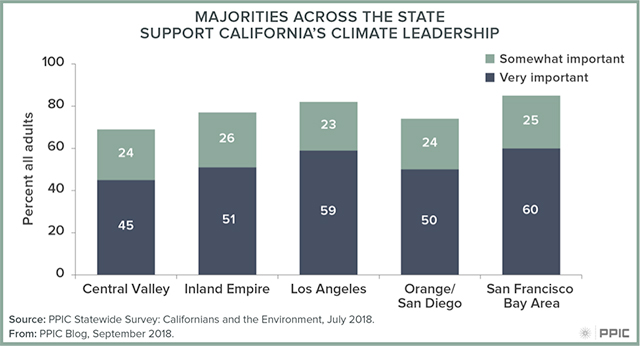
In the July PPIC Statewide Survey, a majority of California adults told us that California’s climate change leadership around the world is very (54%) or somewhat (24%) important to them; findings are similar among likely voters (51% very, 22% somewhat). Last July, after the Trump Administration’s decision to exit the Paris Agreement on climate change, a similar proportion of adults (58% very, 23% somewhat) and likely voters (52% very, 20% somewhat) said the state’s leadership was important. Today, overwhelming majorities of Democrats (95%) and independents (78%) and 41% of Republicans say it is important that California acts as a leader around the world. Majorities across age, education, gender, income, racial/ethnic groups, and regions of the state say this is important. Six in ten or more Latinos (68%) and African Americans (65%), Democrats (67%), San Francisco Bay Area residents (60%), and those with children under 18 (60%) say this is “very” important.

blog figure: Majorities across the state support California's climate leadership

These views are aligned with Californians’ willingness for the state to determine its own destiny in this policy arena. In the July survey, majorities of Californians (65% adults, 62% likely voters) favor having the state government make its own policies, separate from the federal government, to address the issue of global warming. Since we first asked this question in July 2005—throughout changes in presidents, governors, and party leadership in Washington, DC and Sacramento—more than half of Californians have favored state action on this issue.

blog figure: Majorities of Californians favor state action on global warming

Today, solid majorities of Democrats (82%) and independents (61%) and 29% of Republicans favor the state government making its own global warming policies. Majorities across age, education, gender, income, racial/ethnic groups, and regions of the state are in favor. Seven in ten or more are in favor among residents in Los Angeles (73%) and the San Francisco Bay Area (73%), Asian Americans (71%) and Latinos (70%), those under age 35 (75%), and college graduates (73%). Majority support has also been consistent for state policies (i.e., AB 32, SB 32) aimed at reducing greenhouse gas emissions.

What explains this California “exceptionalism” when it comes to climate change actions? In the July PPIC survey, two in three Californians (67% adults, 69% likely voters) say the effects of global warming have already begun. In thinking about the possible impacts of global warming in California, most residents express concerns about more severe wildfires (62% very, 23% somewhat), ocean warming (50% very, 28% somewhat), and rising sea levels (45% very, 29% somewhat). More than eight in ten Californians say that the issue of global warming is personally important to them (28% extremely, 34% very, 20% somewhat). These findings suggest that recent weather events—combined with a growing body of scientific evidence on climate change—have tapped into the long tradition of environmental stewardship in California.

This global meeting occurs at a critical moment for the state. PPIC is hosting related events and, along with many Californians, we look forward to learning more about what Governor Brown called “the existential threat of climate change” in convening this summit.

Environmental Priorities and the Midterm Election

Just three months ahead of a consequential midterm election, California and the federal government continue to move in very different directions on environmental policy. Last week, the Trump administration’s efforts to roll back strict automobile emission standards were strongly criticized by the Brown administration. State officials have also pushed back on federal efforts to increase offshore oil drilling and the president’s decision to exit the Paris Agreement on climate change. Meanwhile, personal experiences with a prolonged drought and recent severe wildfires are raising Californians’ awareness about the impacts of climate change. Where do California voters stand on environmental issues and what are the implications for November?

Californians’ support for environmental protection runs deep. Consider emissions standards. In the July PPIC survey, 60% of California registered voters say that they are in favor of setting higher emissions standards for automobiles. Majorities of voters across age, education, gender, income, and racial/ethnic groups support this environmental policy. Majorities of Democrats (74%) and independents (62%) and 34% of Republicans are in favor. Notably, 52% of registered voters living in the nine competitive House districts—as rated by the Cook Political Report—favor higher auto emission standards.

Or take another area of state-federal policy conflict over the environment, offshore oil drilling. Sixty-six percent of California registered voters are opposed to more drilling off the California coast. Opposition is high among Democrats (82%) and independents (66%), and reaches 40% among Republicans. Majorities oppose it in both the coastal and inland regions of the state and across age, education, gender, income, and racial/ethnic groups. As for the registered voters living in the nine competitive House districts, 56% are opposed to allowing more offshore drilling off the California coast.

These views on particular environmental policy issues are similar to larger concerns related to global warming. About two in three California registered voters believe that global warming has already begun (67%), say that they are very concerned about its possible impact on more severe wildfires (64%), and favor the state law that requires California to reduce its greenhouse gas emissions (67%). Majorities of Democrats and independents share these views, along with substantial proportions of Republicans and majorities of voters across regions and age, education, gender, income, and racial/ethnic groups. In the nine competitive House districts, majorities of registered voters believe that global warming has already begun (59%), say they are very concerned about the impact of global warming on more severe wildfires (56%), and favor the state law that requires greenhouse gas emission reductions (62%).

Personal views about global warming could shape the size and profile of the electorate this year. Majorities of California voters say that the issue of global warming is extremely or very important to them personally (62%). If this high level of personal concern motivates voter turnout, it will provide a partisan advantage (80% Democrats, 61% independents, 29% Republicans). It could also serve as a catalyst in several Democratic-leaning groups with a low propensity to vote (64% under age 35; 68% earning less than $40,000; 69% renters; 70% Latinos). Moreover, in the nine competitive House districts, majorities of registered voters (55%) say that global warming is extremely or very important to them personally.

In the midterm election context, Californians are indicating strong opinions on environmental matters. A record-high number of registered voters say that the gubernatorial candidates’ positions on the environment are very important in determining their vote (39% 2002, 46% 2006, 42% 2010, 40% 2014, 53% 2018).

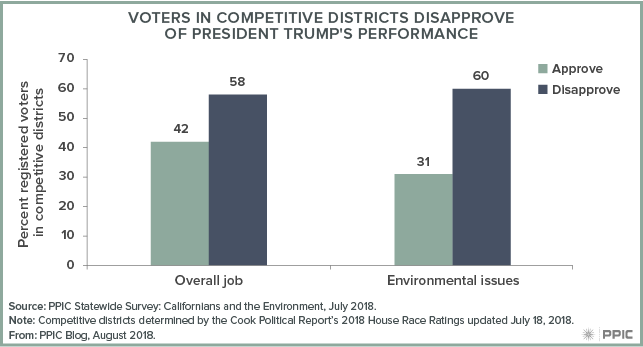
California voters say that they want statewide candidates to push back rather than work with the Trump administration on environmental issues (53% to 40%), and a majority disapprove of the way that President Trump is handling environmental issues (67%). Since the midterm elections are in part a referendum on the president, it is perhaps most significant that a majority of registered voters living in the nine competitive House districts disapprove of President Trump’s handling of environmental issues (60%)—similar to their disapproval of his overall job performance (58%).

Californians’ environmental priorities are high on our list of political wildcards in this important midterm election. Stay tuned as the PPIC Statewide Survey monitors this trend and other topics in our pre-election polling.

Video: Californians and the Environment

With the November election less than four months away, Democrat Gavin Newsom leads Republican John Cox by 24 points in the governor’s race—and nearly all likely voters see the candidates’ positions on environmental issues as important. In the US Senate race, Dianne Feinstein continues to lead fellow Democrat Kevin de León by double digits. These and other key findings in the July PPIC Statewide Survey were presented by researcher Alyssa Dykman at a Sacramento briefing last week.

Californians are much more likely than adults nationwide to say that global warming is extremely or very important to them personally. A majority of likely voters see global warming as a very serious threat to California’s economy and quality of life, and a solid majority say that the effects of global warming have already begun. This may help explain why most Californians are in favor of the state making its own policies to address climate change.

Other survey highlights:

  • Approval ratings for the president and Congress—both overall and on environmental issues—remain far lower than those for the governor and state legislature.
  • There are wide partisan differences in views on climate change and what the state should do about it.
  • Likely voters see drought and water supply as the top environmental issue facing the state; a majority support a water bond on the November ballot.
  • A majority of likely voters favor higher emissions standards for automobiles as well as state laws that aim to reduce greenhouse gas emissions in other areas.

California Millennials and Climate Change

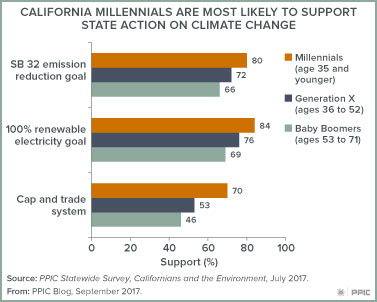
In our most recent PPIC Statewide Survey, we found a record-high share of adults (58%) saying that global warming is a very serious threat to the state’s economy and quality of life. This view is strongly related to Californians’ broad support for state climate change policies, and it is most commonly held among millennials—adults age 35 and younger. Millennials also stand out in their support for state actions to address climate change:

  • Seventy-five percent of millennials favor the state making its own policies, separate from the federal government, to address global warming.
  • Eighty percent support the new greenhouse gas emission reduction goal (SB 32) that updates California’s landmark climate change legislation, and 84% support a new target of 100% renewable electricity by 2045.
  • Seventy percent favor the state’s cap and trade system after hearing a brief description of it. In contrast, fewer than half of baby boomers (ages 53 to 71) favor the cap and trade system, in which the state enforces “caps” on greenhouse gas emissions by issuing permits that can be traded among companies.

Figure millennials and climate changeCalifornia millennials are about as likely as older adults to expect higher gas prices as a result of state climate change policies (52% millennials, 53% generation X, 55% baby boomers). But among those who expect higher gas prices, millennials are more likely than older adults to support the policies named above. Indeed, 73% of millennials expecting higher gas prices support SB 32, compared to 63% of gen Xers and 59% of baby boomers.

Also of note, majorities of younger adults support these policies, regardless of whether they call themselves liberals, moderates, or conservatives. For example, 61% of conservative millennials support cap and trade, compared to 25% of conservative baby boomers. Similarly, at least 7 in 10 millennials support SB 32, whether they are white or Latino, whether they have a college degree or not, and regardless of their income group.

Such broad support for the state’s climate change policies among younger Californians suggests that, if these opinions hold, Californians’ desire for state action on climate change is not likely to diminish in the years ahead.

Find out more about the PPIC Statewide Survey.

Video: Californians and Climate Change

When it comes to climate change policy, California and the federal government are on distinctly different paths. PPIC’s annual Californians and the Environment survey finds that there is a broad consensus in favor of the direction chosen by the state.

David Kordus of the PPIC survey team presented the survey to a Sacramento audience last week. Among the key findings he described:

  • Impact of global warming: A majority of Californians (66%) think global warming is already having an effect, and most think warming is a very serious threat to California’s future economy and quality of life.
  • Goals of state climate policies: A strong majority (72%) favor the law that requires the state to reduce greenhouse gas emissions to 40 percent below 1990 levels by the year 2030. A similar majority favor proposed legislation that would require 100% of electricity to come from renewable sources by 2045.
  • Economic effects: Just 22% of Californians think the state’s actions to address global warming will result in fewer jobs. But many do expect to pay a price: 54% expect to pay more for gas.
  • Leadership: Most state residents say it’s very important that California act as a world leader in the fight against climate change, and 71% oppose President Trump’s withdrawal from the Paris climate accord. Californians give the president and Congress low ratings for their handling of environmental issues—22% and 26%, respectively. Approval ratings are much higher for Governor Brown and the state legislature—51% for each. State leaders’ ratings on environmental issues have risen sharply since the governor took office in 2011.
Learn more

Read the full survey, PPIC Statewide Survey: Californians and the Environment
Find out more about the PPIC Statewide Survey

Californians Favor State Action on Climate, Immigration

The Trump administration has set a new course on two issues that have deep roots in California politics and policy: climate change and immigration. As state policymakers consider responses to the federal government on these issues, our most recent PPIC Statewide Survey finds that Californians are broadly supportive of the state taking its own action.

In PPIC surveys dating back to 2005, strong majorities of Californians have said that global warming is a threat to the state’s future economy and quality of life. Over the same period, majorities have said that they favor the state government making its own policies to address the issue of global warming: 63% said so in the January survey. When it comes to specific action the state has taken on climate change at least two-thirds have said since 2006 that they favor AB 32, the state’s landmark law limiting greenhouse gas emissions.

Many Californians also want to see state action on immigration. When asked the most important issue for the governor and legislature to work on this year, immigration was the most common response (tied with jobs and the economy). Furthermore, 65% of Californians favored state and local governments making their own policies and taking action to protect the legal rights of the undocumented. This is the first time we’ve asked about state and local action on immigration, so we don’t know how Californians might have answered under previous presidential administrations. We can, however, look to some longstanding attitudes toward immigrants in the state.

Consistent with what we saw in PPIC surveys over the previous year, an overwhelming majority (85%) said in January that there should be a way for undocumented immigrants to stay in the country legally if certain requirements are met. In surveys since 2013, we have also found at least 60% of Californians saying that immigrants are a benefit to California because of their hard work and job skills, rather than a burden because they use public services.

On climate change and immigration, we find wide differences between the parties, with Democrats and independents far more likely than Republicans to be in favor of independent state action. Among Trump voters, few want state action on either issue, but they are more likely to favor state policymakers acting on global warming (26%) than to protect the rights of the undocumented (16%). On both issues, majorities of Californians across regions of the state want independent action, though residents of the Central Valley are among the least likely to be in favor.

While President Trump has been in office for just over a month, he already has state and local policymakers in California considering responses to his early actions. We currently find widespread support for state action on climate change and immigration, and we will continue to monitor public opinion on these issues as federal policy changes and California responses unfold.

Learn more

Read the January PPIC Statewide Survey: Californians and Their Government
Find out more about PPIC Statewide Survey

Video: An Early Look at Views of President Trump

The January PPIC Statewide Survey asked Californians for to assess their new leaders in Washington and found that just a third of Californians, or 30%, approve of the way President Trump is doing his job. Californians gave Congress a similar rating.

Dean Bonner, associate survey director, presented these and other key findings at a briefing in Sacramento. The survey also examined contentious issues that are the focus of national debate.

  • Solid majorities of Californians favor state action—independent of the federal government—to protect the rights of undocumented immigrants and to address global warming.
  • About half of Californians have favorable opinions of the Affordable Care Act, and a slight majority oppose repealing it.
  • Most Californians—across political parties—say the government should not interfere with a woman’s access to abortion.

The survey also looked at views of Governor Brown’s job performance and his proposed budget. The governor job approval rating is at a record-high 66%. But his budget proposal and his plan to fund maintenance of the state’s roads, highways, and bridges fares less well. Just under half of residents support his budget plan and 41 percent support his transportation proposal.

Learn more

Read the January PPIC Statewide Survey
Learn more about the PPIC Statewide Survey

Video: Assessing California’s Global Warming Law

Ten years ago, California enacted a law to combat global warming that set an ambitious goal: reducing greenhouse gas emissions to 1990 levels by 2020. Today, the state is poised to reach this target, and policymakers are discussing aiming for a new one.

Each year since the law—AB 32—took effect, the PPIC Statewide Survey has examined Californians’ views on climate change and the state’s actions to address it. The survey has consistently found that most Californians believe that the effects of global warming have begun and that majorities support the state taking action to address it.

But a partisan split has emerged since the law took effect. AB 32’s goals no longer have the bipartisan support they did in 2006. Today, Democrats and independents are much more likely than Republicans to support the goals of AB 32. This divide is reflected in a number of findings in the 2016 Californians and the Environment Survey.

Research associate David Kordus presented the survey at a briefing in Sacramento last week.