Video: Californians and Their Government

Joe Biden, Elizabeth Warren, and Bernie Sanders continue to lead the field in California’s primary race. Most Californians say President Trump should be impeached and removed from office, though views are mixed on how Democrats in Congress are handling the impeachment inquiry. In Sacramento last Wednesday, PPIC researcher Alyssa Dykman outlined these are other key findings from PPIC’s latest statewide survey, which was conducted before the November 20 debate.

Among Democrats and Democratic-leaning likely voters, support for Joe Biden (24%), Elizabeth Warren (23%), and Bernie Sanders (17%) is much higher than for Kamala Harris (8%), Pete Buttigieg (7%), and Andrew Yang (5%). No other candidate is preferred by more than 1%, while 9% say they don’t know which candidate they would choose.

Views on impeachment are divided along party lines: 83% of Democrats, 51% of independents, and 11% of Republicans think the president should be impeached and removed from office. Democrats are also much more likely than independents or Republicans to approve of the way the inquiry is being handled in Congress.

In other news, most Californians are concerned about wildfires (34% very, 29% somewhat) and power shutoffs (32% very, 27% somewhat). Governor Newsom gets mixed reviews for his handling of these issues: 46% of adults and 42% of likely voters approve, while 39% of adults and 46% of likely voters disapprove. Only about a third of Californians have either a great deal or quite a lot of confidence in their utility providers.

Other survey highlights:

  • Six in ten Californians (61% adults, 63% likely voters) say things in the US are generally going in the wrong direction, but about half think the nation will have good times financially over the next 12 months.
  • Nearly two-thirds of adults (63%) say California is divided into the “haves” and the “have nots”; 41 percent say they are haves, while 44 percent see themselves as have nots.
  • Most Californians are very concerned about homelessness in their communities; majorities across regions say the number of homeless people in their local community has increased over the past 12 months.
  • A potential citizens’ initiative that would raise state income taxes on the wealthiest Californians to fund K–12 public schools has majority support. Fewer than half of likely voters favor two other measures—a school construction bond and a “split roll” property tax—that would benefit the K–12 system.


Interactive: Californians’ Views on Homelessness

[vc_row][vc_column][vc_column_text]Homelessness is a growing concern in California, where nearly a quarter of the nation’s homeless population lives. The crisis comes amid sky-high housing costs and widening income inequality. PPIC’s latest survey explores residents’ perceptions of homelessness in their part of the state.

Eighty-five percent of Californians say they are concerned about the presence of homeless people in their local community, including 58 percent who are very concerned. Majorities across regions and demographic groups say they are very concerned about this issue.

In addition, about six in ten Californians (58%) say the presence of homeless people has increased in their local community over the past year. Four in ten say it has stayed the same, while only 3% say it has decreased.

The chart below allows you to take a closer look at how different Californians view this issue. Across regions, Los Angeles (63%) residents are the most likely to say the presence of homeless people has increased. This is in line with recent data showing Los Angeles County saw a spike in homelessness in 2019. African Americans (73%) and residents with annual household incomes under $40,000 (61%) are also especially likely to report an increase in homelessness in their community. Very small shares of Californians report a decrease in the presence of homeless people.[/vc_column_text][/vc_column][/vc_row][vc_row max_width=”80″ visibility=”visible-desktop”][vc_column][vc_column_text][infogram id=”1p0621pw3w90yltegez9kvk6xdanq1qd6ey?live”][/vc_column_text][/vc_column][/vc_row][vc_row max_width=”80″ visibility=”visible-tablet-landscape”][vc_column][vc_column_text][infogram id=”1p0621pw3w90yltegez9kvk6xdanq1qd6ey?live”][/vc_column_text][/vc_column][/vc_row][vc_row visibility=”visible-tablet-portrait”][vc_column][vc_column_text][infogram id=”1p0621pw3w90yltegez9kvk6xdanq1qd6ey?live”][/vc_column_text][/vc_column][/vc_row][vc_row visibility=”visible-phone”][vc_column][vc_column_text][infogram id=”1p0621pw3w90yltegez9kvk6xdanq1qd6ey?live”][/vc_column_text][/vc_column][/vc_row][vc_row][vc_column][vc_column_text]Given the complexity of the homelessness crisis, the governor and state legislature must think of creative and sustainable solutions. One possible approach is a law that would require local governments to construct enough shelter beds so that any homeless person requesting to come indoors could do so. When asked about this proposal, an overwhelming majority of Californians (76% adults, 70% likely voters) are in favor. There is support for the policy across parties, regions, and demographic groups.[/vc_column_text][/vc_column][/vc_row][vc_row max_width=”80″ visibility=”visible-desktop”][vc_column][vc_column_text][infogram id=”1prd6drdjkx025ig27z3kwz276smgp3jj2r?live”][/vc_column_text][/vc_column][/vc_row][vc_row max_width=”80″ visibility=”visible-tablet-landscape”][vc_column][vc_column_text][infogram id=”1prd6drdjkx025ig27z3kwz276smgp3jj2r?live”][/vc_column_text][/vc_column][/vc_row][vc_row visibility=”visible-tablet-portrait”][vc_column][vc_column_text][infogram id=”1prd6drdjkx025ig27z3kwz276smgp3jj2r?live”][/vc_column_text][/vc_column][/vc_row][vc_row visibility=”visible-phone”][vc_column][vc_column_text][infogram id=”1prd6drdjkx025ig27z3kwz276smgp3jj2r?live”][/vc_column_text][/vc_column][/vc_row][vc_row][vc_column][vc_column_text]As state policymakers work on their policy agendas for the next year, we will continue to monitor Californians’ views on homelessness and related policies closely.[/vc_column_text][/vc_column][/vc_row]

Video: Counting the Central Valley

The 2020 Census is fast approaching, and the stakes are high for California—political representation and federal funding are on the line. The San Joaquin Valley, with a population of 4.3 million, may be one of the state’s hardest-to-count regions. In Sacramento last Friday, PPIC convened a discussion about how valley communities are preparing for the census.

California has long been home to high numbers of “hard to count” residents—including young children, renters, and immigrants. In 2020, the difficulty of counting all Californians will be greater than ever. PPIC researcher Joe Hayes outlined the challenges, which range from uneven internet access to a lack of trust: “Individuals are less likely to respond out of privacy concerns, on the one hand, but also out of distrust for the federal government.”

The good news is that state and local governments have invested heavily in outreach. Complete Count Committees have been established counties across the state, and community-based organizations are spearheading outreach efforts. To help guide these efforts, PPIC created interactive maps that show hard-to-count communities across the state. Maria Jeans, program coordinator for the Maddy Institute, moderated a panel discussion about the factors that make counting the Central Valley so challenging—and how challenges are being addressed.

Jesus Martinez, executive director of Central Valley Immigrant Integration Collaborative, highlighted the challenge of organizational capacity. As local preparations for the census got under way in 2018, he realized that “only a handful” of those who wanted to get involved “had any type of personal or institutional experience with the census.”

Don Saylor, a Yolo County supervisor, cited the difficulty of reaching remote rural settings across the Central Valley and the large numbers of farmworkers, language minorities, young children, and residences with multiple households. He included students enrolled at UC Davis and other colleges in the Central Valley—especially those “who are renters, living in different kinds of group settings”—as a hard-to-count population.

The panelists agreed that the fear generated by federal immigration rhetoric and policies are particularly challenging for the Central Valley. As a result, census outreach must focus on more than just making sure California gets its fair share of federal funding. As Martinez put it, “This is a human rights and civil rights issue for us now. It is the right of immigrants to be included in the 2020 Census.” Much of the outreach involves person-to-person conversations—canvassing and phone banking, “house meetings” among neighbors, and interactive media.

Cindy Quezada, senior program officer at Sierra Health Foundation, noted that encouraging people to participate is not the only challenge. “Sometimes people might want to participate but they don’t have a way to,” she said. “Either you’re living in a trailer in a backyard so you’re not going to get the invite and you’re not going to get an enumerator visit, or you may not speak a language that’s supported.” These structural barriers “are something we should really be paying attention to.”

Reducing Flood Risk in the Central Valley

The Central Valley has some of the highest risk of flooding in the state, and that risk is growing as the climate changes. We talked to Tim Ramirez, a member of the Central Valley Flood Protection Board, about how this risk is being managed for current and future conditions.

photo - Tim Ramirez

PPIC: Talk about managing flood risk in the valley.

TIM RAMIREZ: The valley has always flooded, especially in spring when snow melts in the high Sierra. Before it was developed, the landscape was often an inland sea in the spring. Now that many more people live there, it’s harder to minimize risk. The flood management system in the valley was envisioned 150 years ago, and in a lot of ways it continues to work. But the climate is changing with more rain and less snow, requiring an update.

That’s where the Central Valley Flood Protection Plan comes in. The plan is meant to not only protect people but also to help restore river ecosystems. We need to give rivers more room to flood, which better protects people and creates floodplains for native fishes, including Chinook salmon. For example, the Sacramento Valley Chinook salmon fall run is the single most important commercial fishery off northern California and southern Oregon, and there’s been a lot of work to ensure the health of those populations. There’s been a big push to restore salmon populations on the San Joaquin River, too. Reconnecting rivers to their floodplains is key to restoring salmon and illustrates the multiple benefits we can get from one project.

Rivers in the San Joaquin Valley in particular need more room. The San Joaquin River and its main tributaries—the Merced, Tuolumne, and Stanislaus—flow through Fresno, Merced, Modesto, Oakdale, and other communities. Each has less than 10,000 cubic feet per second (CFS) peak flow capacity in their floodways. By comparison, the American River has expanded its floodway and can now safely release more than 100,000 CFS. The San Joaquin system is plumbed to store and meter out snowmelt. But almost all climate forecasts show more rain and less snow. The reservoirs and levees on the San Joaquin aren’t designed or operated for large rainfall events or the “pineapple express” floods (like the January 1997 floods) that come from rainfall on large snowpack.

PPIC: Talk about the flood plan.

TR: What’s unique about the valley is that the state—through our board—is responsible for operating and maintaining levees. The plan outlines what needs to be done to minimize flood risk and restore river ecosystems. The first plan was completed in 2012. We’re scoping now for the third update, due for adoption in 2022. The most important thing about this update is the acknowledgment that we need to modify the system for changing climate conditions.

When the next big flood happens we’ll have a lot more people living in harm’s way. The most immediate thing we can do is make better use of new forecasting tools and prepare to execute evacuation plans, so we can get people to high ground.

One of highest long-term priorities is to make investments where the San Joaquin River flows into the Delta near Stockton. A lot of improvements are happening on the Sacramento side of the system—for example, setting back levees to make more room for floods—but not as many on the San Joaquin side. The state needs to support local efforts on the ground and also flesh out the plan so we can start building multi-benefit projects on the San Joaquin side.

PPIC: What is one thing you hope to see accomplished in five years?

TR: That’s easy—create expanded flood capacity, including new floodplain habitat, on the San Joaquin side of the system. I also want the state to set new standards for how much bigger our floodways need to be to protect Central Valley communities, taking into account our changing climate.

Near term, we also need to fund the necessary operations and maintenance for the system we have now. It’s a universal problem that affects flood management and management of other water systems, forests, and the electric grid.

Watch Tim Ramirez and other panelists discuss protecting Californians from fire, floods, and drought at our November 2019 water conference.

Strengthening Career Pathways in California’s Community Colleges

California lawmakers have made large state investments—totaling more than $1 billion over the past five years—to support and expand career education.  As the primary provider of career training in the state, California’s community college system was the recipient of much investment in this area, and their creation of the Strong Workforce program has established an ongoing source of funding to continue this work.

To assist policymakers, practitioners, and students to better understand how career education programs can meet regional workforce needs and connect students to well-paying, in-demand jobs, PPIC has engaged in a multi-year research agenda focused on community college career education pathways. We highlight our work in this area in a recent article, Strengthening Career Pathways in California’s Community Colleges, in Techniques magazine, a national publication that provides career education faculty and practitioners with timely analysis and insights to inform the delivery of high quality career education programs.

The article highlights recent research from PPIC’s Higher Education Center on the structure of career education pathways and their value to the students who complete them. Since many career education students are older than typical college-age students—and are likely to have work or family obligations (or both)—the article also highlights how various reforms being enacted by the community colleges could help students complete career training pathways, with a focus on the new online-only college, CalBright, that began enrolling students for the first time in October 2019.

How Did California’s Voter Registration Rate Get So High?

The most recent report on voter registration from the California Secretary of State offers startling news: the registration rate is now just above 80%, the highest it’s been before a primary election since World War II. With several months to go before the registration deadline, this rate is all the more remarkable considering the state’s population, which compared to other states is younger, more mobile, and less acculturated to voting—in part due to the high number of immigrants. As a result, eligible voters in California are especially challenging to mobilize.

What explains this incredible number? First, national politics has helped draw in new voters over the last decade. In the early 2000s, the state’s registration rate languished below 70%. Two presidential elections—the race between Barack Obama and John McCain in 2008, and the one between Hillary Clinton and Donald Trump in 2016—helped elevate that rate to about 76% heading into the 2018 election.

Second, the state implemented an important reform in April 2018. The California New Motor Voter (CNMV) program takes a fairly aggressive approach to registering eligible residents at the Department of Motor Vehicles. DMV customers getting a new driver’s license or state ID, renewing an existing one, or updating an address must now answer voter registration questions to complete their DMV transactions. If they don’t want to register they have to say so explicitly.

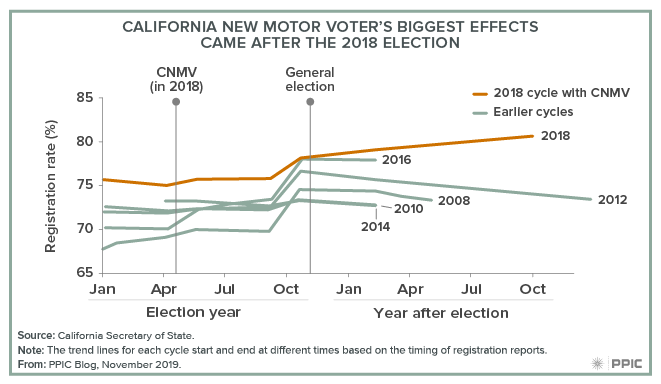
CNMV’s effect has been complicated. It has more than doubled the number of people registering at the DMV, from an average of about 140,000 per month to roughly 370,000. Yet most of these people were not new registrants. In fact, many aspects of registration in 2018 were unexceptional. The figure below compares the registration rate over time in every election cycle between 2008 and 2018. The rate already started higher in 2018—a consequence of the 2008 and 2016 elections. It then increased during the election season, but the increase was in line with previous years.

The real change has come since the 2018 election. In every past cycle, the registration rate has flattened or even fallen in the next calendar year. Excitement fades, and routine file maintenance removes more voters than the number who sign up. But an election doesn’t stop people from using the DMV, so under CNMV people have continued to register. The result is a steadily widening gap between registration now and registration at the same point in past cycles.

figure - California New Motor Voter’s Biggest Effects Came After the 2018 Election

It’s not clear from this gap whether more people will register by the 2020 election than would have without CNMV. Americans already seem unusually excited about voting, and enthusiasm often finds its way to the ballot box. Yet higher registration is not the reform’s only potential effect. In pushing so many to fill out a voter registration form, CNMV also helps keep the registration file up to date. This avoids glitches on Election Day that could prevent someone from voting.

Ultimately, whatever the cause, the registration rate is up. This hints at a new future for California. Unregistered Californians have traditionally been younger and more diverse than voters, with different views on policy issues. As the registration rate climbs, more of these residents become part of the voting public. Politics may be forced to change in response.

Addressing Inequality in Flood Risk

More than 7 million Californians live in places that are at risk of flooding. But not every community is well prepared to recover from floods. A new study, headed by experts at the University of California, Irvine (UCI), is looking at how flooding affects social inequality in flood-prone parts of the state. We talked to project leads Richard Matthew and Brett Sanders about the issue.

PPIC: How can flooding affect social inequality?

RICHARD MATTHEW: Inequity typically grows with disasters. There is a whole range of ways hazards increase social inequity, and these impacts are expected to increase as flooding becomes more frequent and intense because of climate change. Low-income communities and people of color tend to have considerably less access to resources, such as insurance, to help them recover from floods. They often don’t have good access to emergency response information. Floods can affect their health, and impose various costs they weren’t expecting. They may lose their jobs and their affordable housing. They may have poor access to relief funds. At the end of the day, higher-income people usually end up in about same place they were before a disaster, but lower income people largely end up worse off. And these effects can last for years, and sometimes even bring permanent losses.

PPIC: Talk about how we evaluate local and state flood risk currently.

BRETT SANDERS: We basically rely on Federal Emergency Management Agency (FEMA) maps to evaluate flood risk across the state. We make a lot of decisions on the risk to property and people based on whether they live inside or outside of the high flood risk zones those maps show. FEMA maps are fairly cryptic about flood hazard, and they’re not designed to help the average person understand their exposure to floods or what the impacts might be. This approach does a poor job of preparing communities to be more resilient to flooding. What we know from work we’ve done in Southern California is that creating visualizations of flooding in partnership with those affected leads to much more useful information. And fine-resolution data makes a difference. By visualizing flooding at the scale of buildings and streets, we not only increase awareness about flooding, but we can minimize differences in perceptions about flooding. This sets the stage for productive conversations—finding out the issues communities care about and what can be done to minimize future flood impacts. It also presents an opportunity to bring climate science into flood planning. This “collaborative flood modeling” approach is entirely complementary to the FEMA insurance program.

maps - A Sample Visualization of Flood Hazards - Credit: Brett Sanders/UCI
A sample visualization of flood hazards. Credit: Brett Sanders/UCI

PPIC: What are some policy changes that could help California better safeguard those most at risk?

RM: In the short term, we especially need to bring collaborative flood modeling into the state’s climate assessment. Flood maps must be developed with the people who will be affected, so we can understand how flooding will affect people and identify the ways in which they are vulnerable. Our study will be a step in that direction. Longer term, we need fair and affordable ways to reduce flood vulnerability in much of California. That might mean inclusion in risk reduction planning, improved emergency communications, community-based access to resources for people affected by floods—and also policies to protect lower-income communities from the losses they disproportionately incur.

BS: California should have intuitive and actionable flood data available statewide. More graded information is needed for the different kinds of flood risks across the state—levees breaking, sea level rising, intense precipitation, and mudflows coming out of the mountains.

College Applications Are Up and Admission Rates Are Down

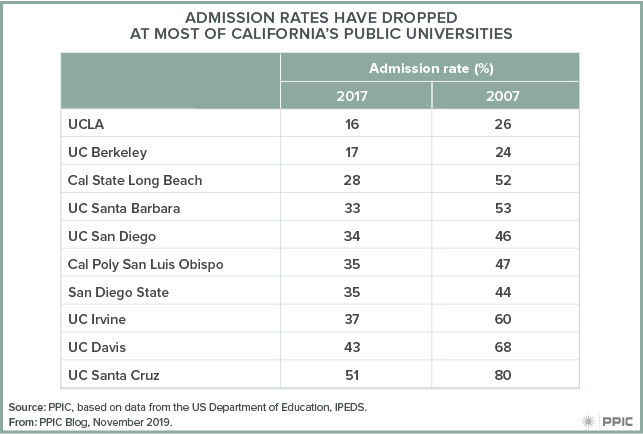
Across California, thousands of high school seniors are in the process of completing college applications. If recent trends continue, the number of applications this year should be staggering. Keeping up with demand has been a challenge; most colleges have reduced their admission rates in the face of large increases in student interest.

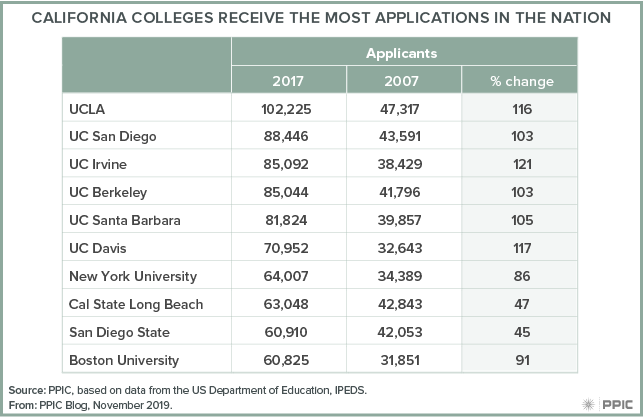
California colleges and universities garner the most applications in the nation. Of the top 10 most popular schools in the country, eight are in California (six UC campuses and two CSU campuses). UCLA has led the nation in applications every year for at least the past 17 years. In 2017, it became the first college in the country to receive more than 100,000 freshmen applications.

table - California Colleges Receive the Most Applications in the Nation

The popularity of UC campuses has surged over the past 10 years, with UC Irvine moving to 3rd in the nation in 2017, up from 7th in 2007. UC Davis moved to 6th from 11th, and UC Santa Cruz jumped to 15th from 32nd.

In the CSU system, Cal Poly San Luis Obispo has moved to 18th from 23rd. And even though other CSU campuses fell in the rankings, they still experienced large increases in applications.

Of course it makes sense that California colleges would lead the nation: the state has more high school graduates than any other and offers a robust system of public universities. And students are applying to more colleges than they did in the past, which contributes to the growth in applications.

But much of the increase is attributable to improvements in college preparation. Between 2007 and 2017, the number of California high school graduates completing the courses required for UC and CSU eligibility increased by almost 60%. In 2007, only about one third of high school graduates completed the required college preparatory courses, but by 2017 almost half had done so, a remarkable improvement in a relatively short time.

Unfortunately, California’s public universities have not been able to accommodate all qualified applicants. In fact, they lead the nation in turning applicants away.

table - Admission Rates Have Dropped at Most of California’s Public Universities

Each of the UC campuses except Merced are unable to admit all of the eligible students who apply. Seven CSU campuses (including Long Beach, San Diego, and San Luis Obispo) are impacted for all undergraduate programs, meaning they cannot admit all qualified applicants; all but one of the other campuses are impacted in certain majors. Both UC and CSU refer qualified applicants to campuses that have more room, but more needs to be done to expand capacity at campuses with high demand.

Video: Preparing California’s Water System for Climate Extremes

Climate change is stressing water management across California. This week the PPIC Water Policy Center hosted its annual half-day workshop in Sacramento to discuss how state and local leaders can help prepare California’s water system and ecosystems for greater climate volatility.

“California has the most variable year-to-year climate of any state in the lower 48,” said Ellen Hanak, director of the PPIC Water Policy Center. “This is expected to increase, with drier dries and wetter wets.” Water management of the future will “need to start managing our droughts for floods and our floods for droughts,” she added, because greater volatility will make it harder to manage multipurpose reservoirs for both floods and droughts at the same time. Flexible, multi-benefit approaches—and solutions that are aligned across agencies—are going to be increasingly important in tackling these complex challenges.

The first panel focused on managing fast- and slow-moving disasters—floods, fires, and droughts. Panelists discussed the impacts of the recent fires on communities and local water systems, and the types of tools and partnerships that can help minimize risks. Tim Ramirez of the Central Valley Flood Protection Board described the significant and increasing flood risk in the San Joaquin Valley and called for a flood bypass to protect the growing Stockton region. And Michael Thompson of Sonoma Water called for funding from the state to support the “collaborative infrastructure” that will enable agencies to work together more effectively.

A panel on safe drinking water summarized the current status of the problem and discussed how to best use the new Safe and Affordable Drinking Water Fund to ensure that the water delivery system works for everyone. “I think that in five years we want to see every child in California has safe drinking water in their home,” said Jonathan Nelson of the Community Water Center. “The way we do that will be through multiple strategies, but that’s the vision we want to work toward, and ideally, as quickly as we can.”

Darrin Polhemus of the State Water Board said small water systems pay more for their systems and supplies, have a lack of management and technical capacity, and are particularly hard hit by water contamination and shortages. He noted that “we have to change this whole paradigm” to help improve how small water systems operate.

The final panel brought key state officials to the stage to discuss the governor’s water resilience portfolio, now being developed to address the challenges of a more volatile climate. Wade Crowfoot, secretary of the California Natural Resources Agency, said a top priority is to make it easier to help the environment and get multiple benefits out of water projects. “Permitting wetlands restoration is the exact same process as permitting a strip mall,” he said. “So while we’re threatened by climate change and our ecosystem is under unprecedented threat, state government makes it really expensive and slow to get [such projects] done.” He said his agency is committed to cutting “green tape” that slows ecosystem restoration projects.

Sounding a particularly hopeful note, Karen Ross, secretary of the California Department of Food and Agriculture, said we have “an opportunity of a lifetime for farmers to step up and identify how they can be part of the solution to climate change.” She noted that farm practices can sequester carbon while also building resiliency to help farms weather droughts and floods.

We invite you to watch the videos from this event:

Proposition 187 and a Changing California

Twenty-five years ago, in the midst of the worst economic crisis since the Great Depression, 59% of Californians voted to pass Proposition 187. The landmark ballot measure sought to set up a state-run immigration system and deny most public benefits—including K–12 education—to undocumented immigrants. The measure was later found to be unconstitutional, but its impact was pivotal in transforming California into what it is today.

Most Californians now support policies to protect undocumented immigrants. A recent PPIC survey found 61% of Californians and 54% of likely voters are in favor of state and local governments making their own policies and taking actions, separate from the federal government, to protect the legal rights of undocumented immigrants. In addition, our April survey found 57% of Californians (54% likely voters) support public school districts designating themselves “sanctuary safe zones” to indicate they will protect undocumented students and their families from federal immigration enforcement efforts.

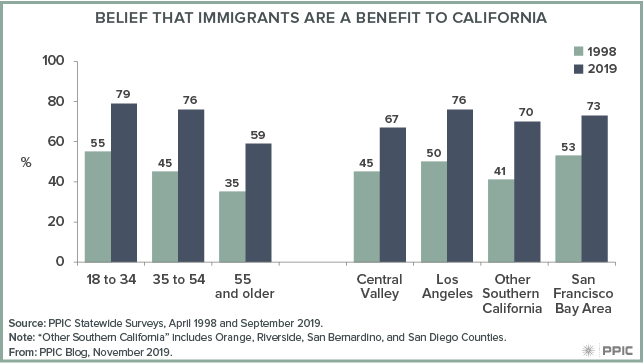
Californians’ overall views toward immigrants have also shifted. The PPIC Statewide Survey has monitored this issue since 1998. In April 1998, Californians were divided: 46% viewed immigrants as a benefit to California because of their hard work and job skills, while 42% viewed immigrants as a burden because they use public services. Since then, the share of Californians viewing immigrants positively has increased 25 points (71% benefit, 22% burden).

Across age groups and regions, the perception that immigrants are a benefit has risen by more than 20 points. Positive perceptions are also up across racial/ethnic groups, by 27 points among African Americans, 20 points among Latinos, 18 points among whites, and 12 points among Asian Americans. The share of Democrats viewing immigrants positively has increased 37 points, while the share of Republicans holding this view has decreased 2 points.

figure - Belief that Immigrants Are a Benefit to California

In recent years, Californians have supported policies to improve the lives of immigrants, such as providing health care for young undocumented Californians, taking state and local actions to protect immigrants, and supporting a pathway to citizenship. What role will immigration play in the upcoming election? Stay tuned to the PPIC Statewide Survey as we continue to examine Californians’ view of immigrants.