Will Groundwater Sustainability Plans End the Problem of Dry Drinking Water Wells?

In the midst of the COVID-19 crisis, work continues on managing groundwater for long-term sustainability, as required by California’s landmark Sustainable Groundwater Management Act (SGMA). In January, water users in 21 critically overdrafted basins delivered their groundwater sustainability plans to the state Department of Water Resources. In this series, we examine the 36 plans submitted for 11 critically overdrafted basins in the San Joaquin Valley—California’s largest farming region, where excess pumping is a major challenge.

Why are drinking water wells going dry in the valley?

In the San Joaquin Valley, groundwater is the primary source of drinking water. While groundwater levels in the valley have generally been declining for decades, the problem of overdraft—which can cause shallow wells to run dry—is particularly acute during droughts as surface water supplies for irrigating crops are limited. This especially affects domestic wells and small community wells, which tend to be shallower than those used for irrigation or large urban water systems. During the 2012–16 drought, 2,600 well-dependent households reported water shortages across the state; almost 80% of these were in the San Joaquin Valley. We estimate that the valley’s total number of dry domestic wells was likely higher (see map below, on left). Many small community wells also faced shortages.

Does SGMA protect wells from running dry in the future?

SGMA was enacted to address the negative consequences of groundwater overdraft. Declining water levels is one of the six undesirable results that plans must avoid. Local agencies are tasked with setting minimum water level thresholds to avoid effects that are “significant and unreasonable”—something that can vary with local conditions.

Allowing some flexibility is important, because very restrictive thresholds would require immediate and costly cuts in groundwater pumping. Yet in many places, additional water level declines can render shallow drinking water wells useless. If agencies choose to allow continued pumping to avoid major disruptions in the regional economy, they are required to mitigate any significant and unreasonable effects. Options include covering the costs of drilling deeper wells or providing an alternative water supply.

How do groundwater plans address risks to domestic wells?

The plans reflect a range of approaches—as shown in the map below, on the right. In several basins, plans set water level thresholds to protect domestic wells from going dry. Some other plans acknowledge that their thresholds might cause some wells to go dry, and these already have a mitigation program in place or propose considering mitigation in the future. Plans in the remaining basins either do not discuss the potential impacts their thresholds have on domestic wells or do not consider these impacts to merit action. This includes the Kings Basin—home to a dense network of well-dependent communities—where three plans acknowledge that roughly 600 domestic wells may go dry, but do not consider this a significant and unreasonable impact of continued overdraft.
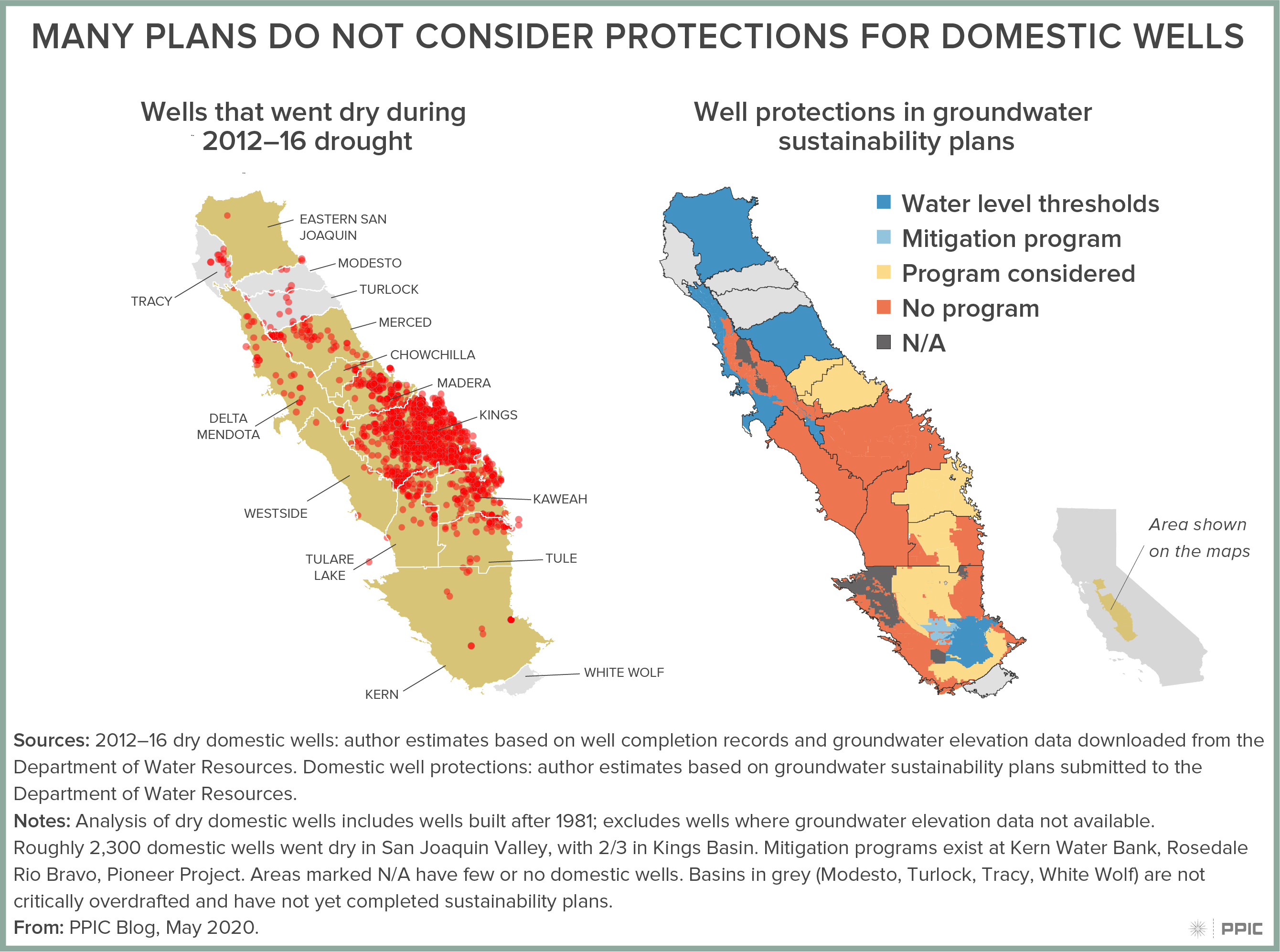
figure - Many Plans Do Not Consider Protections for Domestic Wells

Is mitigation a good alternative?

Chowchilla and Madera basins also have some domestic wells at risk and have conducted economic analyses to compare the costs of two alternatives: rapidly reducing agricultural pumping to maintain higher water levels, or replacing domestic wells that would be affected. At a cost of $25,000 per well, the full costs of replacing affected domestic wells in Chowchilla ($130,000) and Madera ($770,000) are orders of magnitude lower than the costs of reducing agricultural pumping sooner ($581 million in Chowchilla and $968 million in Madera). This shows that it can be more cost effective for a basin to provide assistance to domestic well owners than to set restrictive water level thresholds that would result in large and abrupt losses in the local economy.

What’s next?

Although SGMA doesn’t protect every well from going dry, it does require plans to consider this problem and mitigate significant and unreasonable effects. At a minimum, the state should require that each plan quantify the impacts of its water level thresholds on drinking water supplies.

Increasing community participation in groundwater planning efforts is another priority. And as groundwater sustainability agencies grapple with how to bring their basins into balance over the coming decades, better information will also be key to improving decision making and reducing conflicts. The Department of Water Resources began releasing well records several years ago. The next priority should be improving understanding of which wells are used for drinking water, which wells are abandoned, and other critical information.

Many shallow wells serve economically disadvantaged communities, making the stakes especially high. Because the San Joaquin Valley has a high share of water systems with water quality problems, it’s also important to consider solutions that address both water quality and water quantity whenever possible. In many cases, providing alternative sources of supply may be the best option for affected communities.

Sinking Lands, Damaged Infrastructure: Will Better Groundwater Management End Subsidence?

In the midst of the COVID-19 crisis, work continues on managing groundwater for long-term sustainability, as required by California’s landmark Sustainable Groundwater Management Act (SGMA). In January, water users in 21 critically overdrafted basins delivered their groundwater sustainability plans to the state Department of Water Resources. In this series, we examine the 36 plans submitted for 11 critically overdrafted basins in the San Joaquin Valley—California’s largest farming region, where excess pumping is a major challenge.

What is subsidence, and why does it matter?

Excess groundwater pumping can compact soils, causing land to sink. Because this subsidence can damage costly infrastructure, avoiding it is an important reason to manage groundwater.

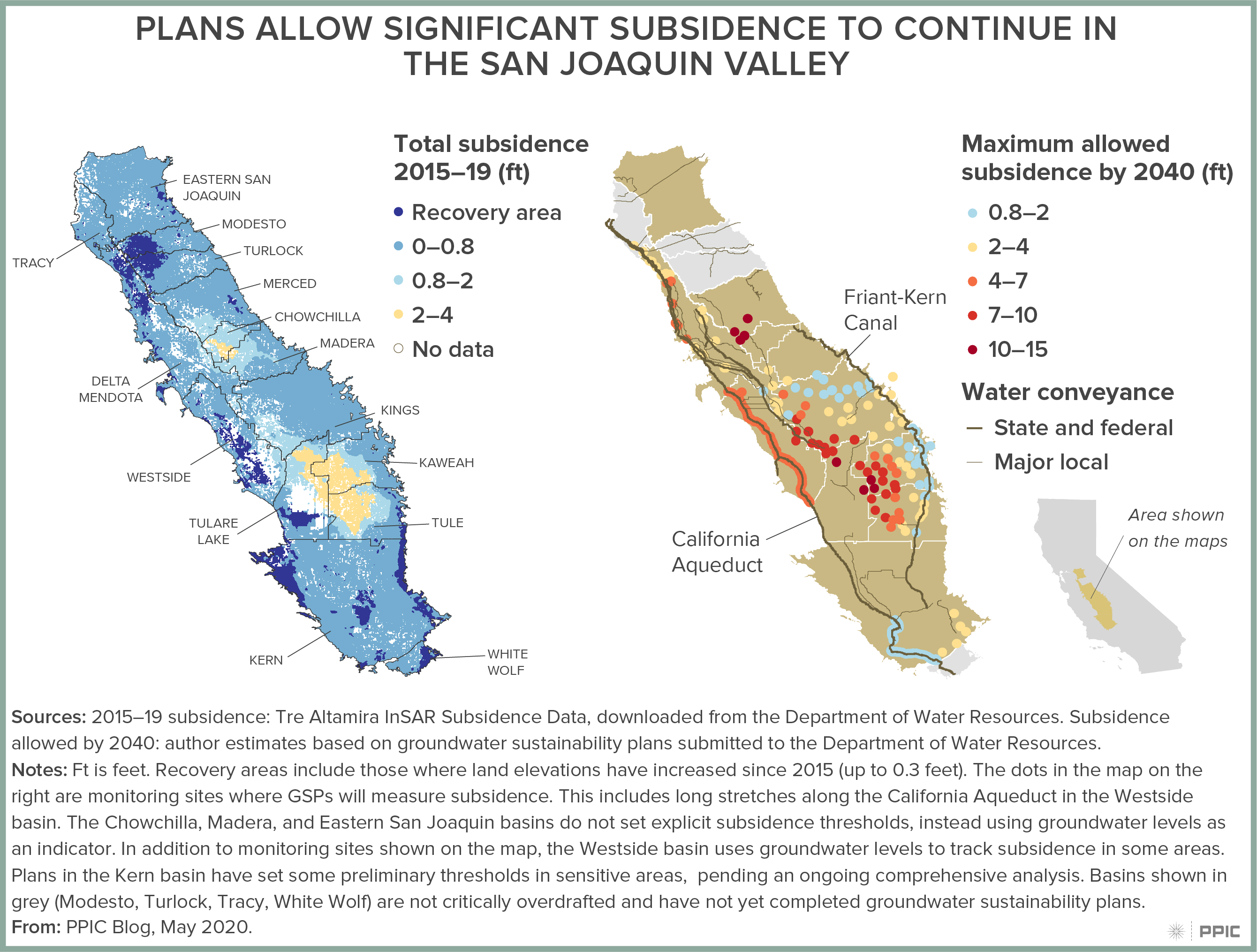
Subsidence due to groundwater pumping has been occurring in the San Joaquin Valley for almost a century, but it accelerated during the 2012–16 drought. Subsidence has damaged some critical water conveyance arteries, including the Friant-Kern Canal (40% of capacity lost in some stretches), and the California Aqueduct (more than 20% of capacity lost). Bridges over these and other canals are sinking, a local dam can’t hold water anymore, and stretches of the high-speed rail track have been designed to prevent damage from future subsidence.

Subsidence can also permanently reduce the capacity of aquifers to store water. Valley aquifers may have lost as much as 3.25% of their capacity from soil compaction during the 2012‒16 drought.

This infrastructure damage doesn’t just affect the individual farms or water agencies that are pumping groundwater—it affects other parties, both locally and many miles away. Mitigating damage will cost many millions, if not billions, of dollars.

How does SGMA require plans to address subsidence?

Under SGMA, land subsidence is one of the six undesirable results that every groundwater sustainability plan should seek to avoid. Plans must define indicators to track subsidence over time, and set thresholds to avoid “significant and unreasonable” impacts.

In principle, this framework allows plans to be more tolerant of continued subsidence in places that will not incur as much damage—for instance, in areas without major infrastructure. Local pumpers have an interest in this flexibility, because avoiding subsidence generally requires significantly curtailing groundwater use, and this curtailment is especially costly during droughts. But to be sure they are not causing harm, plans need to consider the consequences of subsidence for other parties—many of whom are not part of the local groundwater planning process.

Are the plans taking adequate steps?

In practice, the plans vary widely in their approaches to addressing subsidence. In several areas where infrastructure has already been damaged, agencies are setting thresholds to avoid additional subsidence. For instance, in the Chowchilla basin and parts of Delta Mendota, goals include avoiding further damage to local conveyance infrastructure and to levees that provide flood protection. But most plans set thresholds that are not tied to specific past or future impacts. And many of these thresholds are quite high—allowing the rates of land subsidence observed during the recent drought. This raises the risk of future harm, even in areas that have not yet experienced damage.

The figures below show subsidence rates over the past five years—which included both wet and dry years—alongside the cumulative amount of subsidence that the plans would allow over the next two decades. Recent subsidence rates are measured using satellite data, funded by the Department of Water Resources. Many plans are giving themselves a lot of leeway over the next 20 years, in some cases accepting 10–15 feet of additional subsidence. Even the lower thresholds in some sensitive areas might not end infrastructure problems and conflicts. For instance, the Friant Water Authority has warned that plans in the Tule basin will further reduce capacity in the Friant-Kern Canal, significantly affecting downstream water users. Similarly, the Department of Water Resources found that an additional 2.1 feet of subsidence in some sections of the California Aqueduct could further harm downstream water users. This is roughly one-third of the maximum amount allowed in the vicinity of the aqueduct by the Westside basin plan (6 feet).

figure - Plans Allow Significant Subsidence to Continue in the San Joaquin Valley

What’s next?

The valley’s groundwater plans are at an early stage in tackling land subsidence. One important next step will be strengthening the information base for effective management. The paucity of public monitoring data raises challenges for local efforts. Continued state support for annual valley-wide surveys using satellite data could reduce overall monitoring costs and facilitate early identification of subsidence hotspots. The state should also press water users to provide more robust assessments of the risks of future subsidence in their plans.

Water Availability for San Joaquin Valley Farms: A Balancing Act

In the midst of the COVID-19 crisis, work continues on managing groundwater for long-term sustainability, as required by California’s landmark Sustainable Groundwater Management Act (SGMA). In January, water users in 21 critically overdrafted basins delivered their groundwater sustainability plans to the state Department of Water Resources. In this series, we examine the 36 plans submitted for 11 critically overdrafted basins in the San Joaquin Valley—California’s largest farming region, where excess pumping is a major challenge.

Why does surface water access matter for groundwater sustainability?

Although the San Joaquin Valley has the largest groundwater deficit in the state, water resources vary considerably within the region. A few areas receive abundant surface water. Most others supplement with groundwater. Still others depend entirely on groundwater. In many areas, groundwater is being used at unsustainable rates and pumping will need to be cut to bring basins into balance.

Irrigated agriculture is a major industry in the valley, and the largest water user. Our in-depth study of water solutions for the region found that ending overdraft will entail fallowing at least 500,000 acres of farmland. Access to surface water will be a key factor in determining which croplands stay in production, and which lands are retired.

How does surface water availability vary across valley farmland?

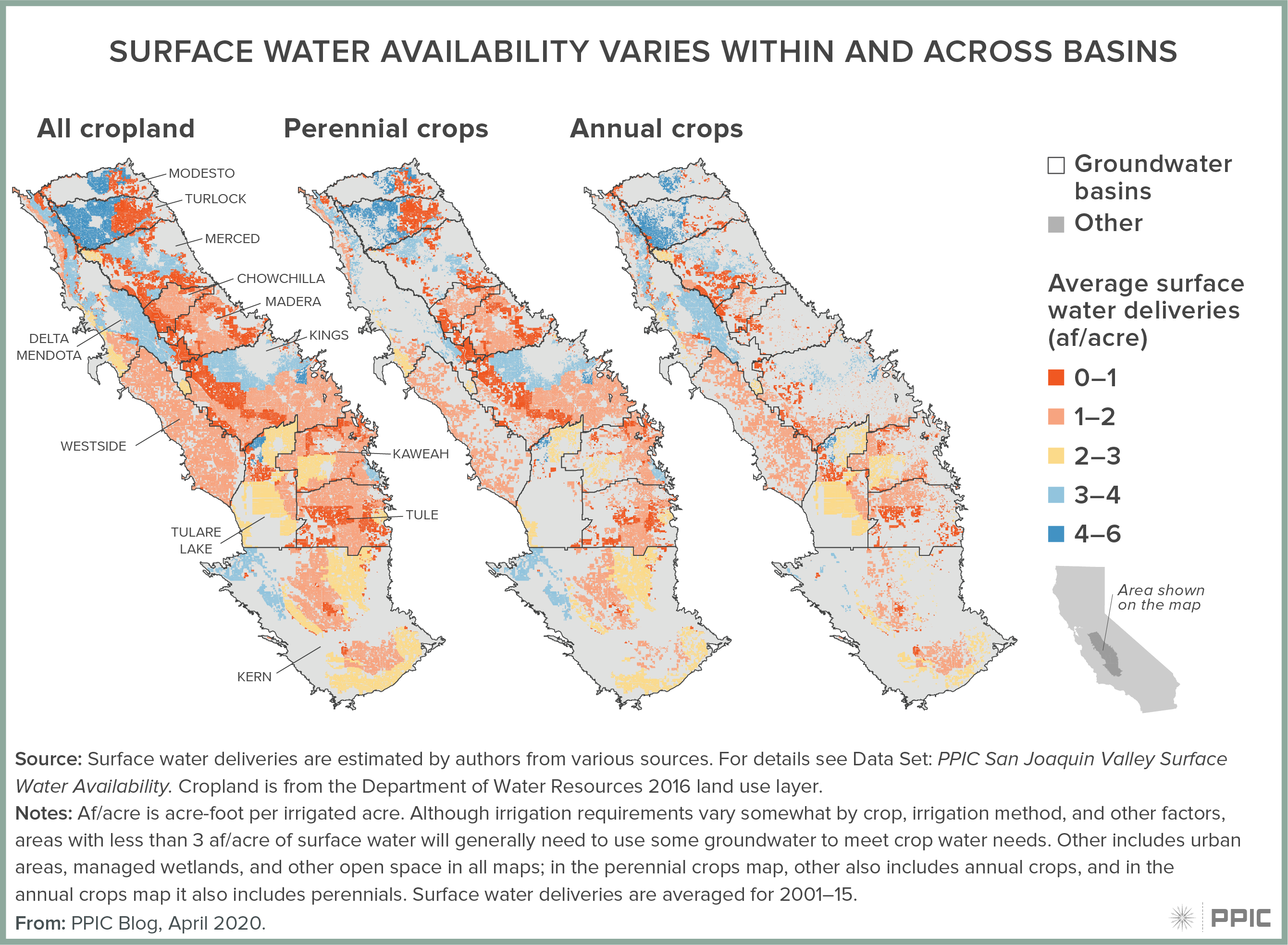
Last year we identified the location of groundwater-only croplands. Our newly compiled dataset allows a much richer view of surface water availability across the region. The maps below show surface water per acre of irrigated agriculture, using average water deliveries from 2001‒15 and cropland mapping from 2016. Surface water averages 1.8 acre-feet per acre valleywide, but availability varies widely both within and across basins. As a rough guide, lands with less than 3 acre-feet per acre of surface water generally need to supplement with groundwater. The less surface water there is, the more groundwater is needed.

figure - Surface Water Availability Varies Within and Across Basins

How does the growth in perennial crops affect approaches to sustainability?

Since the early 1980s, the valley has seen a sustained shift from annual crops to perennial fruit and (especially) nut orchards. Perennial crops now occupy nearly 60% of irrigated lands. More than 20% of perennial acreage is on groundwater-only lands.

The expansion of orchards has benefitted the regional economy, enabling valley agriculture to generate more GDP and jobs than would have occurred if farmers had not made this shift. But perennials are less flexible, because they need to be watered every year to maintain the investment. With groundwater cuts looming, areas with little or no surface water are on the front line of the effort to bring basins into balance. Inflexible approaches to managing this transition could result in unnecessarily large, undesirable reductions in high-value crop acreage, regional employment, and GDP.

What solutions are different areas pursuing?

Bringing basins into balance will require expanding water supplies or reducing water demands. The new groundwater sustainability plans generally emphasize new supplies—with groundwater recharge projects and a variety of efforts to expand or extend surface water deliveries. Fewer plans focus on demand, and those that do give few details on their approach. By our estimates, the plans are too optimistic about the availability of new supplies, and more demand management efforts will be needed.

Basins with less surface water for irrigation are more likely to include demand management as part of their portfolio. For instance, water-short Madera County outlines a range of efforts to augment recharge and to purchase surface water from more water-rich areas. But it also anticipates the need to gradually reduce groundwater pumping by nearly 120,000 acre-feet in the Madera and Chowchilla basins.

Only a few areas—mainly some districts in Kern—propose incentives for flexible demand management to reduce groundwater use. This includes pumping fees, voluntary land-purchase programs, and groundwater trading that enables farmers to reduce use on the least productive lands and keep the most valuable lands in production.

Incentives that encourage farmers to trade groundwater locally—and to trade surface water both within and across basins—can make a big difference to the valley economy. We estimate that trading can reduce the regional costs of ending overdraft by two-thirds.

What’s next?

The valley’s variable water conditions call for managing groundwater sustainability at a regional scale. This scale is appropriate for considering many recharge investments, such as expanding regional conveyance to help get unclaimed floodwaters to suitable recharge areas. It is also necessary to help assess the land use implications of valley-wide surface water trading, which has the potential to keep the most valuable croplands in production while putting fallowed lands into new productive uses. Scaling up this work will require collaboration across a broad sector of valley stakeholders—together with their state and federal partners—in much wider and more comprehensive ways than ever before.

Note: The underlying data and additional notes on surface water availability in the valley can be found in Data Set: PPIC San Joaquin Valley Surface Water Availability. The data on supply and demand options identified in the groundwater sustainability plans is located in Data Set: PPIC San Joaquin Valley GSP Supply and Demand Projects.

Allocating Floodwaters to Replenish Groundwater Basins

In the midst of the COVID-19 crisis, work on managing groundwater for long-term sustainability continues, as required by California’s landmark Sustainable Groundwater Management Act (SGMA). In January, water users in 21 critically overdrafted basins delivered their groundwater sustainability plans to the state Department of Water Resources. In this series, we examine the 36 plans submitted for 11 critically overdrafted basins in the San Joaquin Valley—California’s largest farming region, where excess pumping is a major challenge.

How can floodwaters reduce groundwater overdraft?

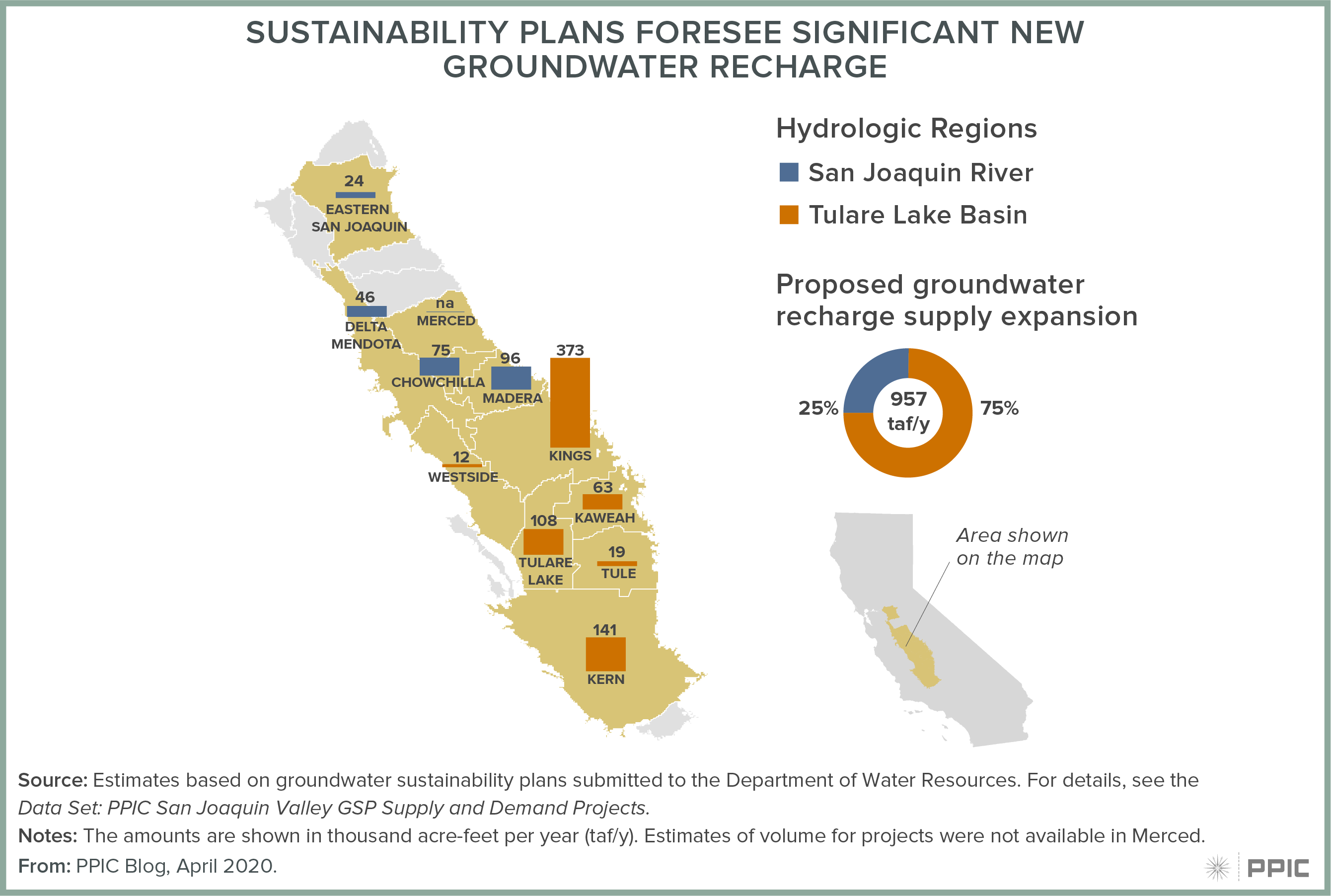
Water users have two options for bringing overdrafted groundwater basins into balance: reduce pumping or increase groundwater supplies. In many places, recharging basins with floodwaters from winter and spring storms is one of the most promising supply-side approaches. With SGMA, interest in capturing this water is at an all-time high. In the San Joaquin Valley, 28 of the 36 groundwater sustainability plans propose recharge projects. Total demand for floodwaters is so high that it outstrips what is likely to be available. Competition could be fierce.

Allocating this water is the state’s responsibility, and developing an effective allocation system is a top priority for successful SGMA implementation. Ideally, this system should allocate floodwaters to generate the most benefits and encourage cooperation among parties to realize these benefits in the most cost-effective ways.

figure - Sustainability Plans Foresee Significant New Groundwater Recharge

What is the state’s current approach for allocating floodwaters?

Previously, some water users have tapped unclaimed floodwaters for recharge, but there hasn’t been a formal permitting process until very recently. In 2019, the legislature enacted AB 658, authorizing the State Water Board to grant temporary permits to groundwater sustainability agencies and other public agencies to divert certain floodwaters. Based on this authority, the board also recently announced a permit system to establish permanent rights to divert and store floodwaters. This recharge water can be used to address various “undesirable results” of groundwater extraction as defined in SGMA, and diversions are limited to prevent harm to other legal users and aquatic species.

As with California’s system for permitting water rights, permanent rights to divert floodwaters will generally be allocated by seniority; those who first establish valid claims will have priority. Temporary permits will likely follow a similar priority system when water is available after satisfying the permanent rights.

Although these changes should make it easier to implement recharge projects, there are important shortcomings. Allocating water by the date of claim does not ensure it will be used to deliver the greatest benefits. It also encourages parties to fight to get to the head of the line, rather than to cooperate and plan to make the best use of this scarce resource.

Could an auction system improve the process?

In a recent article with colleagues from UC Berkeley and the Department of Water Resources, we proposed an auction approach as an alternative way for the state to allocate floodwaters for recharge. As in the current system, the state would set limits on how much water could be diverted within a watershed. But rather than simply apply for the right to divert and store high flow waters, parties would bid for this right.

Although parties would still be competing for the right to divert, this bidding process also encourages cooperation. To improve their chances of being selected, beneficiaries will have incentives to develop joint bids. Cooperative projects within and across groundwater basins will often have the best potential to mobilize funds for the investments needed to capture and use these waters.

By teaming up, parties can also develop projects that use the best locations for recharge—thereby lowering costs of this new supply. Bidding could also encourage cooperation with other beneficiaries—such as flood control districts that could benefit from reduced levee erosion or environmental groups who seek to increase wetland habitat on recharge lands.

Funding is another key difference between auctions and the current system. Right now, permittees pay a fee to cover administrative costs, but they do not pay for the water itself. In an auction system, the winning bidders would pay for the water. These funds could be used to support regional water management goals.

In short, the bidding process would spur creative, collaborative approaches to make the best use of recharge waters—with projects that bring the most benefits for the least cost. This would be a marked improvement over the currently planned “first-in-time, first-in-right” selection process, which does not explicitly consider the relative merits of competing proposals.

What’s next?

An auction approach can help coordinate stakeholders and improve the allocation of unclaimed floodwaters for recharge projects. Although legislation may be required to authorize it, existing California water law does not present an obvious impediment to adopting an auction system. Given its potential advantages over the current system, the state may wish to trial a round of auctions in river systems where recharge resources are likely to be scarce.

Note: The data on supply and demand options identified in the groundwater sustainability plans is located in Data Set: PPIC San Joaquin Valley GSP Supply and Demand Projects.

Groundwater Sustainability Planning Undeterred by COVID-19

COVID-19 has forced many of us to find creative ways of working together while sheltering in place. For California’s new groundwater sustainability agencies (GSAs), that means bringing together diverse groups of stakeholders in virtual forums to develop and implement state-mandated groundwater sustainability plans. We talked to Dave Ceppos—who, as managing senior mediator at Sacramento State’s Consensus and Collaboration Program, is working with many GSAs—about how the pandemic is affecting the complex public outreach process required by the Sustainable Groundwater Management Act (SGMA).

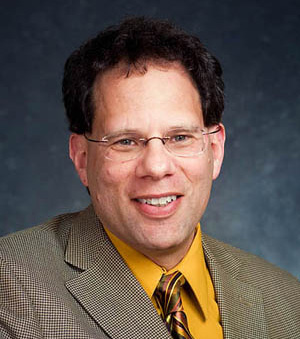
Photo - Dave CepposPPIC: Talk about how the pandemic lockdown is affecting the groundwater sustainability planning process.
DAVE CEPPOS: Unlike other public engagement laws and regulations, SGMA requires a dialogue between a GSA’s leadership and affected stakeholders. Planning and decision making need to take into account not only technical information about local groundwater basins, but also social information about water uses and needs. The GSAs have to show they’ve gotten input from water users, and that they’ve considered the impacts of their decisions on the local community. These conversations are hard and nuanced—basically, the GSAs are new regulatory agencies, the groundwater gods for their local area, and that’s a big change. Sheltering in place has made these complex conversations harder. I think GSAs are just getting their heads around the magnitude of the work they have to do under these new conditions, but they are rising rapidly to the challenge.

PPIC: How is the GSA community responding to limitations on public gatherings?

DC: In the past three weeks we’ve seen a pause in some places—the postponement of meetings that were coming up too fast to reconfigure to an online format, for example. But generally, work is continuing, and they’re taking it very seriously. My staff has already done probably six virtual SGMA public meetings. In the basins where plans are still under development, there is an outlying question about a possible need for an extension beyond the January 2022 deadline if the lockdown continues for a significant period of time, but for now it’s business as usual.

The governor’s recent executive orders relaxing some rules about how public meetings are held have been extraordinarily helpful—without them our work would be almost impossible. Meetings are continuing virtually. The agencies we’re working with are fully committed on publicizing meetings and putting out public messaging, but they’re not being hamstrung by Brown Act requirements about having to hold meetings in public places.

PPIC: SGMA involves many players from diverse groups, living in rural areas that may not have adequate online infrastructure for virtual participation. What’s being done to ensure that public participation is inclusive and fair?

DC: Every GSA that I know of is doing their best in terms of their obligation and their commitment to actively engage with the public. That said, not everyone has access to the internet. Not everyone can get information online, or can print agenda packets, which can be mammoth. We have farmers who attend midday meetings by calling in from their trucks—they can’t toggle through those packages or watch an online Powerpoint presentation from their phones. This is a daunting process involving a lot of complex information.

The reality is that even before this current crisis, our society had moved to a digital world that has left some people behind. In conversations we’re having with agencies, there’s typically an immediate rush to the online tools with the most bells and whistles. But for a facilitator, the first question we ask is, “what do we need to accomplish in a particular meeting?” Then we try to find the tools and methods to do that. To facilitate SGMA dialogues, we know that some people call in and can’t use online resources. We seek to create equity in virtual discussions by toggling back and forth between people in the virtual room and those sitting in trucks and kitchens who need to weigh in over the phone. When it comes to fostering inclusive dialogue, it’s not the bells and whistles that do it—it’s structuring meetings and using facilitation methods to make sure equity is maintained.

This is a challenging time, but we will get through it. Facilitators call it “change management,” which is all about helping people through a new condition by setting new expectations and behaviors. The good news is we humans are excellent at this, and we’re doing it already. Whether we need to manage this change for six weeks or six months, we’ll prevail and continue with this important work.

Note: On April 8, Dave Ceppos will lead a webinar by the Groundwater Resources Association of California, “How to Engage in a Socially Distanced World.”

What’s the Plan to End Groundwater Overdraft in the San Joaquin Valley?

In the midst of the COVID-19 crisis, work on managing groundwater for long-term sustainability continues, as required by California’s landmark Sustainable Groundwater Management Act (SGMA). In January, water users in 21 critically overdrafted basins delivered their groundwater sustainability plans to the state Department of Water Resources. In this series, we examine the 36 plans submitted for 11 critically overdrafted basins in the San Joaquin Valley—California’s largest farming region. PPIC has done extensive work on what SGMA means for this region, where excess pumping is a major challenge. This post examines how the plans propose to end overdraft.

What are the options for ending overdraft?
SGMA requires water users to bring their groundwater basins into long-term balance over the next two decades. Although there are no easy solutions, the math is simple: bringing these basins into balance will require expanding water supplies, reducing water demands, or a combination of these two approaches.

Our in-depth study of water solutions for the San Joaquin Valley found that about a quarter of the region’s 1.8 million acre-feet (maf) of annual overdraft could be filled with new supplies at a cost that local water users can afford. Among supply options, by far the most promising approach is expanding groundwater recharge: storing more of the runoff from large storms in underground aquifers. Filling the remaining three-quarters of the gap will likely require demand reductions. Since agriculture is the predominant water user, this will entail taking some farmland—at least 500,000 acres—out of production. Giving farmers the flexibility to trade water—so it can be used on the most productive lands—can reduce the costs of ending overdraft by two-thirds.

What do the new groundwater sustainability plans propose to do?
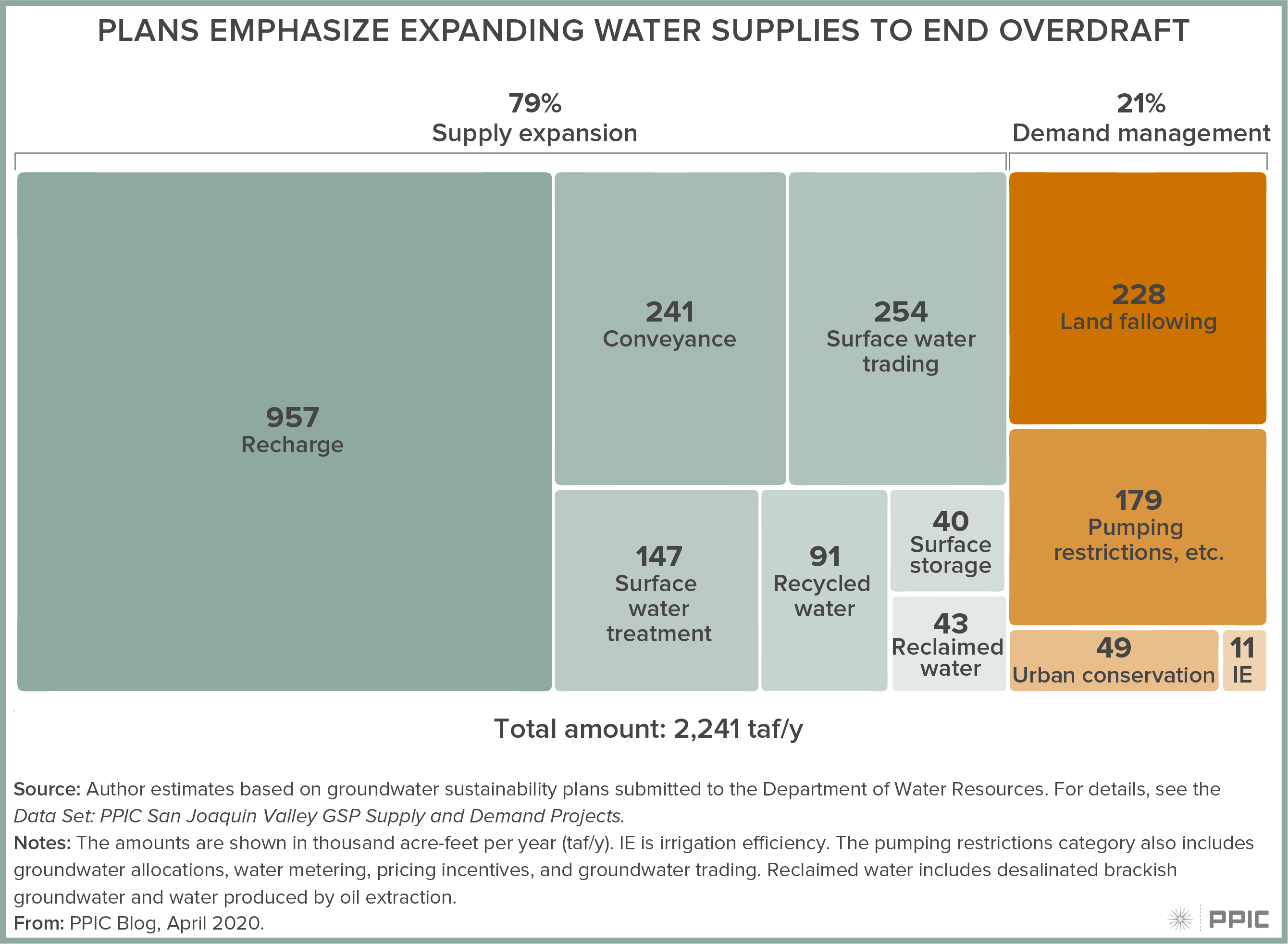
As the figure below shows, the plans consider a range of projects on both the supply and demand sides. Together, these projects would yield roughly 2.2 maf per year—in principle, enough to end regional overdraft. However, the plans invert our estimates: they assume that new supplies will account for more than three-quarters of the total, while demand management will save less than one-quarter. In line with our analysis, the single biggest new supply is recharging groundwater basins with more floodwater: the plans target roughly 1 million acre-feet annually, primarily through many small, local projects. Big infrastructure investments—such as new surface reservoirs and regional aqueducts and canals—are largely left out.

figure - Plans Emphasize Expanding Water Supplies to End Overdraft


Are the goals for expanding supplies realistic?
Probably not. When it comes to recharge, water users will be competing for floodwater that can be feasibly captured—likely a much smaller volume than the total envisaged by the plans. Although that total might be physically available for recharge, there are serious capacity constraints to getting it underground. A central challenge is moving very large volumes of water to storage sites quickly. Addressing this challenge is likely to require regional investments in conveyance, and greater efforts to coordinate the management of surface and groundwater storage infrastructure in order to expand their combined impact. Even then, it is probably not feasible to capture all available water in very wet years.

There are also limitations for the other supply options. Most surface storage and surface water treatment projects will be looking to capture the same high flow water as recharge projects—heightening the competition for these supplies. And most surface water trading and recycled water projects will shift available supplies from some water users to others within the region, rather than causing an overall increase in regional supplies.

What about the plans for reducing demand?
For the most part, the plans fall short on their analysis of demand management. Since reducing water use in this region largely means reducing the amount of irrigated cropland, there’s been reluctance to seriously consider the demand side at this early stage of SGMA implementation. But it’s encouraging that at least some plans are starting to look at such options. Several plans propose tools for managing demand flexibly—for example, groundwater trading, fees tied to volumes pumped, and monetary incentives for land fallowing.

What’s next?
These new plans are an early step on the path toward groundwater sustainability. As implementation gets under way, early actions—such as piloting new approaches to manage demand flexibly and coordinating on smart and affordable supply investments—can lay the foundation for long-term success.

Note: The underlying data and additional notes on supply and demand options identified in these plans can be found in Data Set: PPIC San Joaquin Valley GSP Supply and Demand Projects.

A Reality Check on Groundwater Overdraft in the San Joaquin Valley

This year marks a new phase in California’s landmark Sustainable Groundwater Management Act (SGMA). At the end of January, water users in 21 critically overdrafted basins delivered their first groundwater sustainability plans to the state Department of Water Resources. In this series, we examine the 36 plans submitted for 11 critically overdrafted basins in the San Joaquin Valley—California’s largest farming region. PPIC has done extensive work on what SGMA means for this region, where excess pumping is a major challenge. This post addresses key questions about groundwater budgets.

What are water budgets, and why do they matter?
Water budgets track the water coming into and going out of the groundwater basin. If more groundwater is pumped than the amount replenished over time, the basin is in overdraft. In our study of the valley’s 30-year water balance (1988‒2017), which used data on inflow and outflow to the San Joaquin Valley as a whole, we found a long-term overdraft of 1.8 million acre-feet per year—about 11% of net water use.

Under SGMA, water users need to bring their basins into long-term balance and avoid undesirable effects from excess groundwater pumping—such as lowering groundwater levels and causing lands to sink. Understanding the extent of the overdraft problem is key to taking appropriate action. As the saying goes, you can’t manage what you don’t measure.

What type of groundwater budgeting does SGMA require?
The regulations require groundwater sustainability plans (GSPs) to include three types of water budgets—historical, current, and projected—but allow a lot of flexibility on the specifics. Historical budgets only need to include 10 continuous years of data, including the most recent years available for that basin. Current budgets need to show present-day conditions, and projected budgets need to look ahead 50 years and consider anticipated changes in population, climate, and other factors that could affect water supplies and demands. The plans can then choose which budget to emphasize for addressing overdraft.

In many basins, water users have opted to develop separate GSPs for different areas. In those basins, the GSPs must use a common timeframe and a common overall budget. But there’s no requirement for consistency across neighboring basins. The regulations also leave it up to locals to choose their methods for elements that must be estimated, such as how quickly groundwater moves from one basin to another. Budgets can look better or worse depending on assumptions about such factors.

The span of years covered by budgets can also matter a lot, given California’s variable climate. Budgets with more wet years will look better than budgets with more dry years. The figure below shows the budget timeframes that the valley’s plans use for their preferred estimates of overdraft. These timeframes vary widely. Basins in the wetter northern part of the valley (the San Joaquin River hydrologic region) are more likely to include the recent drought than are the basins in the drier, more groundwater-dependent southern valley (the Tulare Lake Basin hydrologic region).

figure - Timeframes Used to Estimate Overdraft Vary across Basins


Do the plans acknowledge the valley’s overdraft problem?
In general, yes. As the figure below shows, the plans report a considerable amount of overdraft—around 1.4 million acre-feet (maf) per year. But since they cover different timeframes, it’s misleading to simply add up the totals reported. To compare apples to apples, we looked at the eight years that are included in all of the budgets: 2003‒10. This short period is instructive, because it includes both wet and dry years. The plans estimate around 1.7 maf of annual overdraft in these years—fairly close to our valley-wide estimate of 1.9 maf for the same period. So overall, the plans are telling a story that is broadly consistent with the overall regional water balance. This apples-to-apples comparison also reduces the wet-year bias in many of the Tulare Lake Basin budgets.

figure - Plans Acknowledge Significant Overdraft

Even so, some basins are probably underestimating overdraft. And if the future is drier than the past, the overall challenge for the valley could be greater. We found, for instance, that the region-wide overdraft for 2003‒17—a period that included a record-breaking five-year drought—was 2.4 maf/year—a good deal higher than the 30-year average of 1.8 maf.

What’s next?
Acknowledging overdraft is important, but it’s just the first step. The options to end overdraft include augmenting water supplies, reducing water demand, or some combination of the two. Next week’s post will examine what the plans propose to do.

Note: The underlying data and additional notes on the water budgets used in these plans can be found in Data Set: PPIC San Joaquin Valley GSP Water Budgets.

California Agriculture in 2050: Still Feeding People, Maybe Fewer Acres and Cows

Water supply concerns, regulations, labor issues, tariffs, climate change, and other challenges have prompted some rather dire predictions about the future of California agriculture. We talked to Dan Sumner—director of the UC Davis Agricultural Issues Center and a member of the PPIC Water Policy Center research network—about his research on California agriculture in 2050.

PPIC: How do you think California agriculture will change in the next few decades?

DAN SUMNER: The value of farm production in California has been growing for a very long time and is likely to continue to grow. Farmers have been shifting land and water to crops that generate more revenue per acre and per acre-foot of water. Tree and vine crops have replaced annual crops. For example, cotton acreage collapsed from more than 1.2 million Central Valley acres 30 years ago to just 260,000 now. And these days Central Valley farms are getting twice as much revenue from pistachios as from hay. The pace of the shift to crops that bring higher revenue per unit of land and water will likely slow in the coming decades simply because much of the transition has already occurred.

For many years now, California’s most valuable agricultural industry by gross revenue has been dairy. But the dairy industry has stopped growing—partly because it is expensive to haul hay in from places that have adequate water.

California dairy is also under pressure from economic implications of state regulations on climate and other environmental issues. Californians demand attention to environmental concerns, labor market conditions, energy costs, and other issues that generate regulation, and such regulations can be costly for farms. The result is some commodities that had been important in California will be grown elsewhere.

PPIC: How will climate change affect the state’s farms?

DS: It will drive many adaptations, including shifts in locations as farms plant crops better suited to new climate and market conditions. We also expect different pest problems. But given the close attention of researchers and growers to these issues, I don’t see unmanageable challenges in the next few decades.

It is important to recognize that global markets and climates interact, and so what economists call “comparative advantage” remains crucial to economic success. Let’s say climate change makes table grapes more expensive to grow here or moves the season earlier. But if climate change affects Mexican growing conditions even more, climate change could cause grapes to become more profitable and therefore expand in California. The crucial issue looking forward is what will grow well in California compared to other places and compared to other crops.

PPIC: What are important policy or regulatory drivers that could help the farm sector adapt to changing conditions?

DS: We’ll need all sorts of innovations in every sector, from banking, government institutions, and science to farm management. California agriculture is already innovative and flexible, but we’ll keep moving rapidly to adapt to the economic and environmental changes on the horizon. Regulations are a part of what is changing and a part of what agriculture is adapting to.

Farm labor cost and availability remain crucial drivers of the future of California agriculture. We need innovations to reduce labor per unit of output, but we also need policy and regulations that allow immigrants to continue to work in California.

The climate-water nexus is probably where we can gain the most from innovative regulations and adaptations. Climate change and water regulations, including groundwater regulations, will reduce California irrigation water availability. We’ll need to consolidate water use to fewer acres, possibly convert some land to dryland farming, and even idle some land. Fortunately, the Sustainable Groundwater Management Act (SGMA) is encouraging people to value water that once was taken for granted.

With far-sighted regulations, California can find more effective ways to store more water underground, and use it most effectively. For example, markets are crucial to provide incentives for groundwater recharge in the winter. If regulations continue to limit transfer of water among farms and from one year to the next, we will severely restrict incentives to adjust to climate change.  I am confident that California will find a regulatory path to allow continued farm adaptation and flourishing.

Video: Preparing California’s Water System for Climate Extremes

Climate change is stressing water management across California. This week the PPIC Water Policy Center hosted its annual half-day workshop in Sacramento to discuss how state and local leaders can help prepare California’s water system and ecosystems for greater climate volatility.

“California has the most variable year-to-year climate of any state in the lower 48,” said Ellen Hanak, director of the PPIC Water Policy Center. “This is expected to increase, with drier dries and wetter wets.” Water management of the future will “need to start managing our droughts for floods and our floods for droughts,” she added, because greater volatility will make it harder to manage multipurpose reservoirs for both floods and droughts at the same time. Flexible, multi-benefit approaches—and solutions that are aligned across agencies—are going to be increasingly important in tackling these complex challenges.

The first panel focused on managing fast- and slow-moving disasters—floods, fires, and droughts. Panelists discussed the impacts of the recent fires on communities and local water systems, and the types of tools and partnerships that can help minimize risks. Tim Ramirez of the Central Valley Flood Protection Board described the significant and increasing flood risk in the San Joaquin Valley and called for a flood bypass to protect the growing Stockton region. And Michael Thompson of Sonoma Water called for funding from the state to support the “collaborative infrastructure” that will enable agencies to work together more effectively.

A panel on safe drinking water summarized the current status of the problem and discussed how to best use the new Safe and Affordable Drinking Water Fund to ensure that the water delivery system works for everyone. “I think that in five years we want to see every child in California has safe drinking water in their home,” said Jonathan Nelson of the Community Water Center. “The way we do that will be through multiple strategies, but that’s the vision we want to work toward, and ideally, as quickly as we can.”

Darrin Polhemus of the State Water Board said small water systems pay more for their systems and supplies, have a lack of management and technical capacity, and are particularly hard hit by water contamination and shortages. He noted that “we have to change this whole paradigm” to help improve how small water systems operate.

The final panel brought key state officials to the stage to discuss the governor’s water resilience portfolio, now being developed to address the challenges of a more volatile climate. Wade Crowfoot, secretary of the California Natural Resources Agency, said a top priority is to make it easier to help the environment and get multiple benefits out of water projects. “Permitting wetlands restoration is the exact same process as permitting a strip mall,” he said. “So while we’re threatened by climate change and our ecosystem is under unprecedented threat, state government makes it really expensive and slow to get [such projects] done.” He said his agency is committed to cutting “green tape” that slows ecosystem restoration projects.

Sounding a particularly hopeful note, Karen Ross, secretary of the California Department of Food and Agriculture, said we have “an opportunity of a lifetime for farmers to step up and identify how they can be part of the solution to climate change.” She noted that farm practices can sequester carbon while also building resiliency to help farms weather droughts and floods.

We invite you to watch the videos from this event:

Learning the Language of Groundwater

groundwater (ground·wa·ter \-wȯ-tər, -ˌwä-\ Water beneath the land surface that fills pore spaces in underlying soil or rock.

Groundwater is a critical part of California’s water supply—on average, underground aquifers provide nearly 40% of the water used by the state’s farms and cities, and more in dry years. But after decades of unsustainable pumping in many basins, the state is undergoing major changes in how it manages this resource. The Sustainable Groundwater Management Act (SGMA) requires water users to develop plans to bring their basins into balance in coming years and encourages wide public participation in the planning process. Knowing some of the vocabulary is key to engaging in the conversation. This glossary will get you started.

Adjudication: A lack of clarity over how much groundwater individuals can pump has caused conflict in some places. In more than two dozen basins, mostly in Southern California, the courts have been asked to settle—adjudicate—disputes over groundwater pumping rights. Adjudicated basins must report how much water is being pumped, but most other basins are not yet required to do so.

Conjunctive use: The coordinated management of surface water and groundwater to make the best use of surface water during wet periods and groundwater during dry periods. Expanding this practice can require changing how surface reservoirs are operated, to allow the release of more water during the fall to replenish aquifers and increase reservoirs’ capacity to hold winter runoff.

Conveyance: The infrastructure needed to move surface water to where it can be used, including to areas suitable for recharging aquifers. In some parts of the state, this infrastructure is in poor condition or is missing links, creating barriers to getting more water into underground storage.

Glide path: A gradual approach to implementing SGMA, to give water users time to adjust and prevent major disruptions in the regional economy. Most groundwater sustainability agencies in the San Joaquin Valley—where overdraft is a major issue—are likely to adopt this approach. The result is that groundwater levels will continue to decline, but at a decreasing rate, until they reach long-term balance.

Groundwater sustainability agencies (GSAs): Local agencies formed to develop groundwater sustainability plans to manage their resources for the long run. More than 250 GSAs in 140 “priority basins” (which account for most of California’s groundwater use) have been formed.

Overdraft: When groundwater extraction exceeds what is being replenished (also called “groundwater mining”). Its repercussions can include drying wells, sinking lands, reduced streamflow, degraded water quality, and higher energy use from pumping water from deeper depths.

Recharge: Taking action to replenish underground aquifers with surface water (also known as “managed recharge” to distinguish it from natural recharge). This water can come from a variety of sources, including flood- and stormwater, treated wastewater, and spare surface water. Recharge usually involves spreading water on the land. Some water districts have dedicated recharge basins, but individual farms can also help by recharging on their lands. “In lieu” recharge is when farmers enable the aquifer to replenish naturally by pumping less and using surface water instead. One challenge is coming up with ways to compensate farmers who recharge shared basins under their land.

Safe or sustainable yield: The amount of water that can be withdrawn from a groundwater basin without causing problems—such as a significant drop in water levels, harm to groundwater-dependent ecosystems, land subsidence, and saltwater intrusion, to name a few.

Saltwater intrusion: Many coastal aquifers—for example, those on the Central Coast—are overdrafted, which reduces groundwater flow toward the sea and allows saltwater to move in.

Subsidence: Land surfaces can sink in overdrafted basins, which damages infrastructure such as bridges, reservoirs, and water canals. Parts of the San Joaquin Valley have been sinking by more than half a foot annually. Subsidence has reduced capacity in the Friant-Kern Canal, the Delta Mendota Canal, and the California Aqueduct.

Sustainable Groundwater Management Act: Requires water users in most groundwater basins to develop and implement groundwater sustainability plans to bring groundwater use and recharge into balance by the early 2040s. The challenges are particularly big in the San Joaquin Valley and the Central Coast.

White areas: Areas that rely entirely on groundwater for drinking water and irrigation supplies. Water users in these areas—which are shown in white on irrigation district maps—are particularly susceptible to groundwater quality problems and falling water tables, and are vulnerable to pumping restrictions with the implementation of SGMA.