Video: 3 Cities Address Economic Challenges

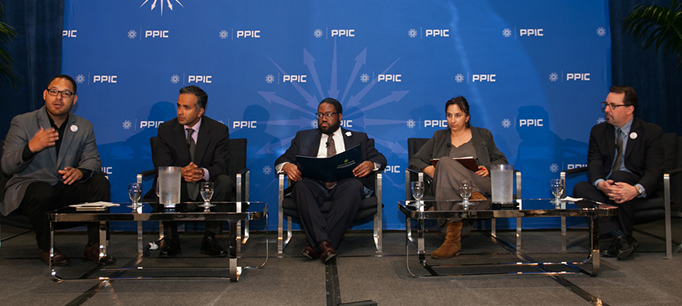
When Uber officials announced the company was moving to Oakland, there was a wave of fear and anger that well-paid tech workers would push longtime residents out of the city. Fresno, with its high concentration of poverty, struggles to attract the kind of private investment that caused angst in Oakland. In South Gate, housing is relatively affordable, which should be good news. But there are few homes for residents to buy because most are rentals owned by outside investors.

These stories, told by leaders of these communities at a recent PPIC event, were different. But common across the agendas of all three leaders was an emphasis on education as a key part of the solutions they are working on to address income inequality and poverty.

Jorge Morales, councilmember and former mayor of South Gate, said business owners told him that city residents didn’t have the education needed to get jobs beyond the entry level. Now, thanks to a partnership with the Los Angeles Community College District, a new campus will open in South Gate. The focus will be on jobs that become careers, Morales said.

“One of the mistakes we made as policy makers is that when manufacturing jobs started to leave, we all got excited about the revenue—about the sales taxes size—and we started building shopping centers everywhere.””What did that do? That provided the jobs that didn’t provide a living for folks.”

Ashley Swearingen, mayor of Fresno, said that missing the dot com boom of the late 1990s was a wake-up call for her city.

“We were not as a city and a region prepared to ride that wave of expansion,” she said. “That tidal wave of prosperity hit the state, but not a drop hit the ground in the places I was living and working.” The city partnered with Fresno State University to “undo and redo everything about our community” from its public systems to its civic environment, and entrepreneurship education is woven through school curriculums beginning in elementary school.

Libby Schaaf, mayor of Oakland, said she is most passionate about a program she is raising money to start, the Oakland Promise. She said that among this year’s ninth-graders, only 10% will have a college degree by the time they are 23 years old. The Oakland Promise is a “cradle-to-career strategy to triple that number in 10 years.” Each baby born into poverty will get a $500 college savings account, and parents will get another $500 in direct support for home visits and literacy training. Every kindergartener will receive a $100 college savings account. Students will be connected with internships, mentors, peer support groups, and help with financing college.

“You have got to intervene at every moment, from birth until college completion,” she said.

Schaaf says she has raised $23 million for the program and needs $15 million more.

Learn more

Read the PPIC report Income Inequality and the Safety Net in California

Public School Parents See Education Differently

In our annual PPIC Statewide Survey on Californians and education, 40% of adults say that the quality of K–12 public education in the state is a big problem. Notably, the parents of public school children are more likely than others to have favorable opinions about public education in California: just 27% say quality is a big problem. Adults without children, those with children in private schools, and those with children too young to attend school are the ones who tend to hold a more negative view of the state’s public education system. This pattern is consistent with our findings in previous surveys.

Parents who don’t have children in public schools are twice as likely as those who do to say the quality of K–12 public education is a big problem. They are also twice as likely to give their neighborhood public schools a grade of D or F. (Adults without children age 18 or younger fall in between the two parent groups on these questions.)

In addition, when asked how their elected officials are handling K–12 education, public school parents are much more likely than others to approve of Governor Brown and the California Legislature in this area.

Regardless of whether they have children in public schools, many parents agree that school funding is inadequate. Two-thirds of both parent groups say that the level of funding for their local public schools is inadequate, while 58% of other adults say the same.

Most adults support K–12 funding proposals, and support among public school parents is particularly strong. At least two-thirds of adults say they would vote for either a local or state bond measure to pay for school construction projects, with over 80% of public school parents supporting these measures. Asked how they would vote on a local parcel tax for schools, 70% of public school parents would vote yes—exceeding the two-thirds majority needed to pass such a tax. Among other adults, about 60% would vote yes.

Certainly, it’s not surprising that parents who decided to send their children to private schools might have different opinions about educational quality compared to those with children in public schools. The differences that we find, though, extend beyond a difference between public school parents and private school parents. On several measures, parents with children in public schools stand apart from all other California adults in their assessment of the state’s K-12 public education system.

Learn more

Read the PPIC Survey: Californians and Education
Visit the PPIC Statewide Survey pages

California’s Big-Ticket Water Challenges

California’s hundreds of local public water agencies are responsible for about 90 percent of the water delivered across the state. We asked Tim Quinn, executive director of the Association of California Water Agencies (ACWA) and vice-chair of the PPIC Water Policy Center’s advisory council, to weigh in on three big-ticket water management issues ACWA’s members are facing.

PPIC: Last week, the State Water Board voted to give control over water conservation standards to local agencies. Why is this change important?

Tim Quinn: Essentially, the board decentralized decisions about drought management so that local water agencies can tailor their plans to local conditions. ACWA strongly believes that this was a move in the right direction. The initial drought emergency conservation regulations did not account for local factors like climate and, more importantly, the extent to which local agencies have invested in drought-resilient local supplies. By allowing local public agencies to account for these factors, we will have more effective and lower-cost drought protection while maximizing incentives for further investments in drought resiliency. The new approach in no way means less conservation. In fact, ACWA strongly believes in raising the bar on water-use efficiency and conservation in our long-term water management plans. The board’s action appropriately recognizes that, at least for the time being, emergency conditions no longer exist. Now we need to pivot to the adoption of long-term conservation plans in which, as the California Water Action Plan puts it, “conservation is a way of life.”

PPIC: What do you think about the governor’s “twin tunnels” approach to addressing the issues facing the Delta?

TQ: I’ll be blunt: we have an outdated and ineffective system for conveying water through the Delta. The system’s intakes are in the wrong part of the Delta, which maximizes conflicts between species protection and water supply and does not work for either purpose. Unless we’re prepared to abandon this system, we need to fix it. I think abandoning it would not be good for California.

My organization believes that we need a comprehensive statewide program that includes a physical fix in the Delta to make our water supply less vulnerable. Fixing the system would help improve the Delta’s ability to cope with climate change and sea-level rise, minimize conflict between water supply and fisheries, improve water quality for 25 million Californians, and make the system better able to withstand earthquakes and floods.

I spent a couple of decades of my career up to my eyeballs in the Delta, trying to figure out how to get the water we need with the intakes in the wrong place. It seems California simply has a very difficult time having an adult conversation about the Delta. Despite the obvious difficulties, if the Brown administration can move forward with its Delta strategy, we should all be ready to provide support for it as part of a common-sense statewide water action plan.

PPIC: What are the most urgent water needs the state should invest in?

TQ: There are six critical areas we need to fund: water conservation and local resource development, storage—both above and below ground, Delta conveyance, implementation of the Sustainable Groundwater Management Act, provision of safe drinking water to disadvantaged communities, and investment in habitat and watersheds. These are the essential bricks in the wall of a sustainable water system for California, and they’re all important. They also lend themselves to different funding strategies; some are adequately funded and some not. The biggest shortfalls in funding probably arise for the last two categories. Some have suggested a public goods charge on water to fund these activities, which the water industry would oppose. Others point to the general fund as the logical source of funding for public benefits. It seems to me that the important thing is to come to some agreement on funding so that a comprehensive water plan can move forward.

Learn more

Read California’s Water briefing kit for more information on key water management challenges
(April 2015)
Read “Stressful Times for a Drought-Stricken Delta” (PPIC blog, October 5, 2016)
Visit the PPIC Water Policy Center’s water supply resource page

Video: Improving Graduation Rates at California State University

California State University (CSU), the nation’s largest university system, has steadily improved graduation rates, but there is more work to be done, PPIC researcher Jacob Jackson told a Sacramento audience last week.

The system still struggles with graduation gaps. Historically underrepresented students are much less likely than their peers to get degrees. Even though the system has higher six-year graduation rates than similar universities, it lags behind in the share of students who graduate in four years. This comes at a high cost to both the state and CSU students.

As CSU launches a new initiative to improve graduation rates, Jackson and fellow PPIC researcher Kevin Cook coauthored a report analyzing the system’s progress to date. The authors also describe promising strategies that could help CSU reach its goal of increasing graduation rates and cutting graduation gaps in half by 2025.

Learn more

Read the report, Improving College Graduation Rates: A Closer Look at California State University
Visit the PPIC Higher Education Center

Public Preschools Support Education, Work

As policymakers discuss California’s system of early childhood care and education, it is useful to look more closely at the families who use it—or might like to. Public preschools—enrolling four-year-olds and some three-year-olds—hold promise for improving school readiness and later life outcomes, particularly for low-income students who may not otherwise have access to high-quality preschool experiences. At the same time, publicly provided early education also serves a second goal: supporting work among low-income parents.

Full- or part-time work is typical among California’s low-income families with preschool-aged children. For a family of three, low-income means living on $37,167 a year – which is 185% of the federal poverty line, a threshold used to designate economic disadvantage in the K-12 education context. Among all such families, just 11% report no adults working in the past year. Lack of work is much more common in single-parent families (34%) than in families with two or more adults (6%). Research shows that access to subsidized child care raises employment among single mothers, suggesting that the larger percentage of single-adult families reporting no work reflects in part a lack of viable childcare options.

Most low-income preschool age children live in families with two adults (64%). Far fewer of these families than single-parent families report no work (7%); the share with both adults working full-time, year round is only 8%. The remaining 85% of low-income families with preschool-aged children and two adults rely on a combination of full-time and part-time work. In about a quarter of two-parent families, no adult has full-time work. This complexity reflects multiple factors—including opportunities for employment and family choices about care for young children.

In the context of a policy discussion about preschool, why are these patterns important? Working parents will be more likely to enroll their children in programs that align well with their work schedules. Non-working parents are more likely to seek work if they have reliable child care. Given that employment is a central piece of the financial picture for most California families, whether low-income or not, it is critical that policymakers keep the dual purposes of early care and education in mind as they consider ways to improve the system of public preschool in California.

Learn more
Just the Facts: Public Preschools in California
Just the Facts: Californians and Early Childhood Education
Just the Facts: Child Poverty in California

Testimony: Closing California’s Workforce Skills Gap

Hans Johnson, director of the PPIC Higher Education Center and PPIC senior fellow, testified before the Assembly Budget Subcommittee Number 2 on Education Finance in Sacramento yesterday (May 17, 2016). Here are his prepared remarks.


The Public Policy Institute of California (PPIC) projects that between now and 2030 California will fall 1.1 million bachelor’s degrees short of workforce demand.1 Closing this gap will require substantial improvements in access to four-year colleges, transfer rates from community colleges, and completion rates among students who enroll in college. In this testimony, PPIC identifies specific goals for access, transfer, and completion at California’s public colleges and universities, and increases in private colleges that together could close the workforce skills gap.

Our work on this issue emphasizes that closing the workforce skills gap will require strong improvements in college enrollment and completion among underrepresented groups, including low-income students, first-generation college students, Latinos, and African Americans. California cannot succeed economically unless gaps in educational attainment are eliminated or at least substantially reduced. A forthcoming report from PPIC will show how new goals for access, completion, and transfer will improve equity in California.

In our baseline scenario, which is based on current practices and procedures, California’s public and private higher education institutions will produce 3.1 million bachelor’s degrees between 2015–16 and 2029–30. This baseline scenario assumes that the state’s college enrollment rates, completion rates, and transfer rates will remain at current levels.

Our “closing-the-gap” scenario charts a course to producing 4.2 million bachelor’s degrees over the next 15 years. In this scenario, the total number of bachelor’s degrees awarded in 2029–30 would be 60 percent higher than in the baseline scenario—and it would be 72 percent higher than the number of degrees awarded in 2014–15. Such dramatic increases are not entirely without precedent. Between 2002–03 and 2014–15, the annual number of bachelor’s degrees awarded by California’s public and private universities increased almost 50 percent. Gains in earlier periods were even more impressive. For example, between 1964–65 and 1979–80 the number of bachelor’s degrees awarded at CSU increased 95 percent.

In the recent past, growth in the number of bachelor’s degrees awarded at UC and CSU was fueled primarily by increases in the number of students who enrolled in college and secondarily by increases in completion rates. Even though the share of high school graduates entering UC and CSU did not change appreciably, enrollment increased as the number of high school graduates grew.

The California Department of Finance projects that the number of high school graduates will not change substantially over the next fifteen years. This means that increasing the number of bachelor’s degrees awarded will require changes in three key thresholds in the education pipeline from high school to college to degree.

  • First, the share of recent high school graduates eligible for and enrolling in four-year colleges will need to increase.
  • Second, persistence and completion rates for students enrolled in college must increase.
  • Third, the number of students who transfer from community colleges to four-year colleges (or return to college) must increase.

The exact mix of improvements in these three areas is not set in stone. Our closing-the-gap scenario is based on empirical trends, and our current focus is on public institutions. We assume that private colleges will keep pace with those in the public sector, continuing to produce about a third of all bachelor’s degrees awarded each year. Also, we have not incorporated applied bachelor’s degrees awarded by the state’s community colleges, as those numbers are still very small. This means that UC and CSU together would need to produce an additional 730,000 bachelor’s degrees over this period and private colleges would need to produce an additional 340,000 bachelor’s degrees (a total of 1.1 million) to fully close the degree gap by 2030. Private nonprofit colleges would account for the vast majority of the additional degrees awarded by the private sector.

Our initial closing-the-gap scenario sets the following targets for the state’s public colleges and universities:

  • Eligibility will increase 5 percentage points over current levels at UC (the top 17.5 percent of high school graduates will be eligible for UC, up from the 12.5 percent share set by California’s Master Plan for Higher Education) and 6.7 percentage points at CSU (the top 40 percent will be eligible for CSU, up from the top third). These new eligibility levels will be phased in over an eight-year period.
  • The number of transfer students will increase 35 percent over baseline levels. These increases will be phased in over a five-year period.
  • Completion rates will increase 9 percentage points at UC and 17 percentage points at CSU. At UC, completion rates for students who enroll as freshmen will increase incrementally from 83 percent in 2016 to 92 percent by 2026. Completion rates for freshmen at CSU will increase incrementally from 57 percent in 2016 to 74 percent by 2030. There will be similar increases in completion rates for transfer students at both institutions.

CSU will account for most of the increase in degrees awarded over the entire projection period—it will award 481,000 additional degrees, compared to UC’s increase of 251,000. This is both because CSU is a larger institution, enrolling many more students than UC, and because CSU has much more room for improvement in graduation rates. Private nonprofit colleges would also play an important role, adding an additional 206,000 degrees. Other additional sources, such as private for-profit colleges, online degree programs, and bachelor’s degrees awarded by community colleges, will also need to play a role (see Table 1).

Most of the projected increase in degrees awarded at CSU comes from improvements in completion, while increased eligibility accounts for almost half of UC’s increase. Increased transfer rates will also be necessary to close the gap (see Table 2).

Of course, this is just one scenario for closing the workforce skills gap (our interactive model is available upon request). In the future, we expect to develop alternative closing-the-gap scenarios; we will also examine the potential impact of shortening the time it takes students to get their degrees. Additional work should assess the role that private institutions might play. Other scenarios might involve different assumptions and targets. But, however it is accomplished, closing the gap will lead to better economic outcomes for all Californians, increased state revenues, and reduced social service demands.

1. Hans Johnson, Marisol Cuellar Mejia, and Sarah Bohn, Will California Run Out of College Graduates? (PPIC, 2015).
Figure note (middle): “Other” includes online degrees, private for-profit degrees, and applied bachelor’s degrees awarded by the community colleges.
Photo credit: Public Affairs/Sacramento State

Troubled Waters for California Farmers

California farmers have been coping with major water challenges during the latest drought. We talked with Dave Puglia, executive vice president of Western Growers and a member of the PPIC Water Policy Center advisory council, about these challenges.

PPIC: What water uncertainties do California farmers face?

DAVE PUGLIA: It varies by region. In some areas, water reliability for the future is paramount. In other places, water quality requirements are more challenging. The San Joaquin Valley is facing long-term restrictions in surface water. Imperial County growers are wondering if their supply from the Colorado River will last.

In areas where water quality is key, the increasing capability to detect contaminants has led to increasing regulations to reduce pesticides, herbicides, and fertilizers. The state’s drive for perfection doesn’t recognize the realities of farming. California is treating nitrogen and nitrates as the equivalent of industrial solvents. Nitrogen is necessary to produce food, and we’re using fertilizers much more sparingly now. Many growers worry that there could one day be a virtual prohibition on the use of nitrogen, which has been used from dawn of agriculture.

Businesses hate uncertainty, and state policies on water quality and supply paint a very uncertain picture. These are multigenerational businesses with most of their assets tied up in land. They’re looking over a 20-year horizon and asking, should we continue to invest in this business in this state? They’ve experienced an immense growth in regulatory burdens in the past two decades—not just in water—and don’t see the trajectory changing. From a balance sheet perspective, it looks very dark.

I think we’ve lost regulatory balance in California. If we looked at how all these regulations work together, we could learn a lot about how these mandates add to the burden of this industry. That would force a conversation on whether we want to maintain the nation’s largest agricultural industry.

PPIC: What uncertainties does the state’s groundwater law pose for farmers?

DP: I think the biggest threat to its successful implementation rests in the fact that many growers fear they’ll lose access to adequate groundwater supplies, which won’t be replaced with surface water. In the past 20 years, the San Joaquin Valley has easily lost 2 million acre-feet a year in surface water. The biggest threat is the lack of surface water being delivered to the valley to recharge groundwater basins.

PPIC: What will it take to bridge the “fish vs. farms” divide?

DP: There is a major lack of confidence in the science used by fish agencies to make decisions on water deliveries from the Delta. The state and federal water projects are now functionally controlled by state and federal fish agencies based on the abundance of species, but their modelling seems arbitrary and questionable to many. The fish aren’t recovering, and there’s inadequate attention to other stressors that impact both salmon and smelt. Theoretically, the governor’s tunnels project has potential to break us out of this dynamic and provide adequate water reliability south of the Delta. But there’s uncertainty about it among agencies that would be required to pay for it and opposition from the environmental community. Without some big changes, I don’t see the divide getting better.

Learn more
Video: Farming’s Water Future (PPIC blog, March 2, 2016)
Visit the PPIC Water Policy Center’s water supply resource page

Video: County Jails and the ACA

A majority of inmates in California’s jail system are likely to be eligible for Medi-Cal, and providing health care coverage for them could have multiple benefits. These are the key findings of a new PPIC report, Expanding Health Coverage in California: County Jails as Enrollment Sites.

Coauthor Shannon McConville presented the report to a Sacramento audience last week. She noted that the 4 million state residents who are still uninsured will probably be the toughest to reach. The legislature has allocated money to target these Californians and increase enrollment in health coverage under the Affordable Care Act (ACA).

At the same time, counties—which have gained new responsibilities for low-level criminal offenders—have new incentives to help inmates successfully transition back into the community and avoid further contact with the criminal justice system.

“Health coverage, newly available under the ACA, could be part of a more comprehensive reentry strategy,” McConville said.

Managed care plans are also increasingly focused on better integrating physical health and behavioral health, providing more mental health and substance abuse treatment—services needed by the jail population.

These policy changes add up to an opportunity to leverage federal and state Medi-Cal resources to improve both public health and safety. Enrolling inmates could improve health care in the jail system, lower county corrections costs, and reduce recidivism.

McConville said the work to achieve these goals is just beginning. Counties are still adjusting to their new responsibilities. As a first step, they will need to identify effective enrollment strategies that improve reentry and reduce recidivism.

Testimony: California’s Exclusive Electorate & the 2016 Election

Mark Baldassare, PPIC president and CEO, testified before the Assembly Select Committee on Civic Engagement in Los Angeles today (May 13, 2016). Here are his prepared remarks.


“If the trends in voting continue, we face the prospect of an electorate making policy choices that neglect the realities and problems facing large segments of California society.” I wrote these words in a 2006 PPIC report, California’s Exclusive Electorate. The report analyzed trends in the state’s electorate from 1990 through May 2006 and polling results from the PPIC Statewide Surveys from 2005 to 2006. It revealed the gulf in political preferences between the state’s voters and the majority of its adult population, and suggested that if California’s nonvoting adult population made their voices heard at the ballot box, the political status quo could change—dramatically. In other words, the choices that voters make do not necessarily represent the preferences—or the needs—of California’s broader population. These disparities could be a problem for any state and are not unique to California.1 However, for California, a state that calls on its voters not only to elect representatives but also to make so much policy through ballot initiatives, these disparities raise real concerns.

In the years since that report, voter participation has continued to fall while the state’s population has become larger and more diverse. This troubling trend, especially notable in primaries and midterm elections, has motivated a statewide conversation about advancing civic engagement and increasing voter participation in California. Compounding this concern is our finding that California’s likely voters—who decide the fate of candidates and ballot initiatives—do not represent the demographics or the policy preferences of the state’s adult population.

At a time when new approaches to boosting voter turnout are being implemented and proposed, and as we approach the 2016 presidential election, it seemed important to update our work on the electorate. Using PPIC Statewide Survey data from 2015—drawn from about 12,000 interviews during seven monthly surveys that included voting and nonvoting adult Californians—our 2016 PPIC report paints a comprehensive picture of likely voters and their nonvoting counterparts. Once again, we find that the people who go to the polls in California are very different from those who don’t; they have different demographic characteristics—such as age, education, homeownership, immigration, income, and race/ethnicity. They also have different political attitudes and policy preferences. As California’s population continues to expand and change, the voting rolls are not keeping pace, and the state’s voters remain unrepresentative of its population.

In our 2016 report, we found a strong connection between economic inequality and political inequality. Likely voters in California tend to be older, white, college educated, affluent, U.S. born, and homeowners. They tend to identify themselves as “haves”—rather than “have nots”—when asked to choose between these two economic categories. Nonvoters tend to be younger, Latino, renters, less affluent, less likely to be college educated, and not U.S. born—and they generally identify themselves as “have nots.” Voters and nonvoters differ noticeably in their views on the role of government, taxes and spending, ballot choices, and elected officials—all of which come into play during an election year and influence governing choices in the long term.

California’s recent steps to encourage voter participation are a step in the right direction, but the divide between voters and nonvoters is deep and persistent. Why has the exclusive electorate phenomenon that we identified 10 years ago been so difficult to change? State laws that make it easier to register to vote and cast ballots are helping to expand the electorate, but only to a limited degree. When eligible adults are asked why they are not registered to vote, most cite a lack of confidence or a lack of interest in elections, a lack of trust in government, and a lack of time to vote. When registered voters are asked why they do not always vote, their top reasons are a lack of interest and time and low levels of confidence and trust.2

More fundamentally, the broad demographic and economic shifts underway in the state are shaping the divide between California’s voters and nonvoters today. Immigration is one important factor. Millions of California adults are documented and undocumented noncitizens. The share of the adult population that is undocumented is on the decline, but it is still a large segment of California society. Public and private efforts are needed to encourage more noncitizens to become citizens and join the voter rolls. Comprehensive federal immigration reform that provides a path to citizenship is another key ingredient in creating a larger and more diverse electorate. Other powerful socioeconomic factors help determine political participation. A significant share of California’s population is living in poverty, housing costs in coastal regions are high, and the state economy is likely to face a shortage of college-educated workers in the near future. Efforts to increase economic opportunity through policies that produce high-paying jobs, provide affordable housing, and increase college graduation rates would also grow and diversify the electorate.3

How will these ongoing trends in political and economic inequality affect the 2016 election cycle? As is always the case, voter turnout will increase and demographic profiles will broaden for the November presidential election. Still, we expect to see a large divide between voters and nonvoters this year. Once again, California faces the prospect of an electorate making policy decisions that neglect the realities and problems facing large and growing segments of society.

What are the larger consequences of uneven participation rates and low voter turnout? First, the fact that a relatively small group of voters is making decisions about elected representatives and public policy raises serious questions about the legitimacy of the democratic system. Next, because the haves in society are the frequent voters, and so many of the have nots are not voting or are not registered to vote, our electoral process does not reflect the broad economic and political interests of all adults. Last, likely voters and nonvoters have different perspectives on the role of government, government spending, ballot choices, and the state’s elected officials.

What might happen if voters were more representative of California’s adult population? There could be more voter support for policies that increase spending for health care and education, and for an expansion of the government’s role in improving the lives of immigrants and the less economically advantaged. If large numbers of new voters continue to register with “no party preference” and the proportion of major party voters continues to shrink, the power of independent voters in determining election outcomes could be bolstered. Finally, growth and change in the electorate could initially produce more political instability, as elected officials, candidates, political parties, and initiative campaigns reach out to a larger and more diverse electorate.4

In the long run, having a larger and more engaged electorate that is more representative of the people of California would be a source of political stability for a state that increasingly relies on the ballot box to make its major policy decisions.

1. Raymond E. Wolfinger and Steven J. Rosenstone, Who Votes? (Yale University Press, 1980); Eric Plutzer, “Becoming a Habitual Voter: Inertia, Resources, and Growth in Young Adulthood,” American Political Science Review 96 (1): 41-56, 2002; Karthick Ramakrishnan, Democracy in Immigrant America, (Stanford University Press, 2005); Mark Baldassare, At Issue: Improving California’s Democracy (Public Policy Institute of California, October 2012); Jan E. Leighley and Jonathan Nagler. Who Votes Now? (Princeton University Press, 2014).
2. Mark Baldassare, Dean Bonner, David Kordus, and Lunna Lopes, “Voter Participation in California,” Just the Facts (Public Policy Institute of California, September 2015).
3. Laura Hill and Joseph Hayes, “Undocumented Immigrants,” Just the Facts (Public Policy Institute of California, June 2015); Sarah Bohn, Caroline Danielson, and Monica Bandy, “Poverty in California,” Just the Facts (Public Policy Institute of California, December 2015); Hans Johnson, Marisol Cuellar Mejia, and Sarah Bohn, Will California Run Out of College Graduates?, (Public Policy Institute of California, October 2015); Hans Johnson and Marisol Cuellar Mejia, California’s Future: Housing, (Public Policy Institute of California, February 2015).
4. Jack Citrin, Eric Schickler, and John Sides, “What If Everyone Voted?” American Journal of Political Science 47 (1) 75-90, 2003; Mark Baldassare, At Issue: Improving California’s Democracy, (Public Policy Institute of California, October 2012); Jan E. Leighley and Jonathan Nagler, Who Votes Now? (Princeton University Press, 2014).