Lessons from the Great Recession Can Protect College Students Today

[vc_row][vc_column][vc_column_text]Budget cuts for state services are likely on the horizon due to the economic disruption of COVID-19. This means state funding for public higher education may well be reduced—leading to restrictions in access and lowered enrollments. California went through this very scenario during the Great Recession, with thousands of students turning to for-profit colleges in lieu of public colleges.

figure - Enrollments Spiked for California For-Profit Colleges during the Recession

While some students at for-profit colleges earned a degree, many did not graduate and ended up with large amounts of debt. State and federal government subsequently put restrictions around for-profit colleges, but upcoming changes at the federal level could weaken the federal rules.

The recently announced federal Education Stabilization Fund will disproportionately provide emergency relief funds to private for-profit colleges. In California, only 5% of the state’s undergraduates attend for-profit colleges, but these schools will receive 10% of federal funds.

In contrast, 55% of undergraduates attend the state’s community colleges, which will receive only 34% of federal aid. (That’s because many low-income students who attend community college rely on state aid rather than federal financial aid: these students are not counted in the federal emergency funding formula.)

During the Great Recession in 2008, higher education faced deeper cuts than other state services. With escalating tuition, fewer instructional staff, and a narrow application window, students had less access to the state’s public colleges, especially community colleges.

At the same time, some for-profit colleges began to market heavily, and thousands of students enrolled in expensive programs. By several measures—graduation rates, student debt, loan default rates, and employment outcomes—private for-profit institutions often have poor outcomes. Of course, some colleges have a better track record than others.

People hurt most by the recession—and lack of access to college—were saddled with debt they couldn’t pay back. In response, California and the federal government both instituted new regulations requiring for-profit colleges to be more transparent and accountable.

California went a step further than the federal government. The state required colleges to meet minimum standards of graduation and loan default rates to be eligible for Cal Grants, the state’s financial aid program for low-income students. Enrollments in for-profit colleges in California declined, and some of the largest for-profit institutions, like Corinthian and ITT Technical Institute, declared bankruptcy as the economy improved and funding to public higher education was restored.

California policymakers should seek to avoid the mistakes of the last recession by ensuring that access to public higher education is not restricted during this recession. The key is to find ways to limit budget cuts so that public higher education remains accessible to all Californians looking to advance their knowledge and improve their economic well-being.[/vc_column_text][/vc_column][/vc_row]

COVID-19 Shutdown Forces Colleges to Ramp up Online Learning

[vc_row][vc_column][vc_column_text]California colleges are moving classes online in response to the COVID-19 pandemic, which means most students at most colleges will take classes remotely. For example, the entire University of California and California State University systems have moved almost all undergraduate education to online settings. Such a dramatic change is necessary for public health, but may interfere with student access and success.

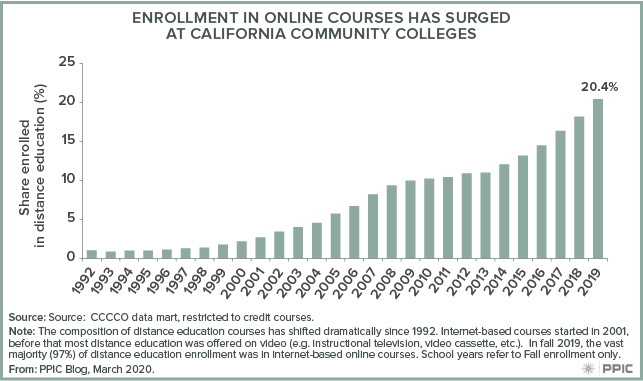
California’s community colleges can offer others a lesson in effective practices for distance education. These schools have been at the forefront of remote learning for more than four decades, from correspondence courses in the early days to instructional television and video cassettes in the 1980s. In the early 2000s, community colleges began to offer internet-based online courses.

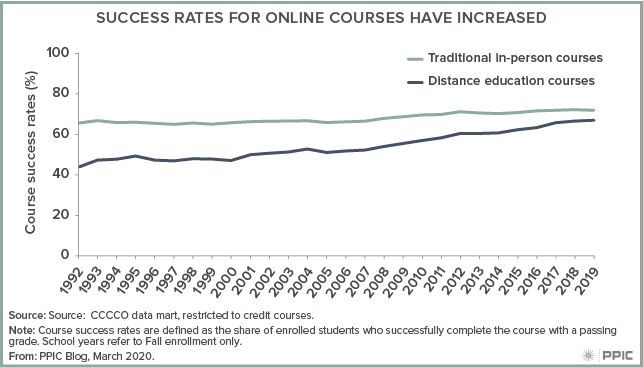
The availability and popularity of distance courses have exploded with the internet, as have course success rates. The share of enrolled students completing and passing a course has skyrocketed, narrowing the gap in success between online and in-person courses substantially.

figure - Enrollment in Online Course Has Surged at California Community Colleges

figure - Success Rates for Online Courses Have Increased

Policies around closing the success gap were intentional, with the Community College Chancellor’s Office leading efforts to improve online courses through the Online Education Initiative and the California Virtual Campus. Resources available to administrators and faculty include modules on effective course design, remote tutoring, student services, and even proctoring of exams.

Effective practices involve more than moving a face-to-face course online. Success means providing faculty support and training, setting appropriate student expectations, and promoting interaction among faculty, students, and course materials.

Better software has also cleared paths to and shifted the debate around online pedagogy. Instead of discussing how to replicate face-to-face learning, educators are examining the advantages of online learning over the traditional model. By identifying student needs, personalizing learning, and giving instant feedback, teachers may have more avenues to eliminate the online performance gap.

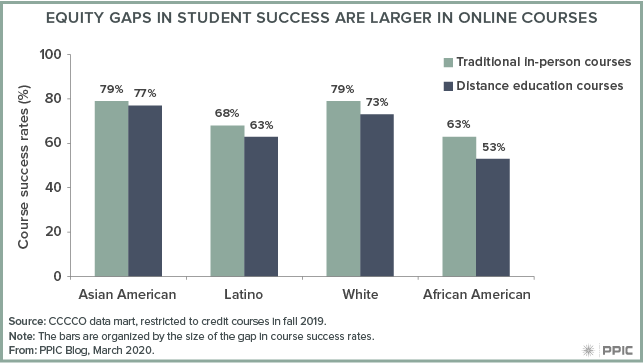
Still, problems remain. Students with limited technology, such as those without access to broadband, may not be able to access online courses. In community colleges, Latinos are less likely to enroll in online courses than other groups, which may reflect the digital divide. And while course success rates have improved across the board, equity gaps remain large.

figure - Equity Gaps in Student Success Are Larger in Online Courses

The COVID-19 crisis is unprecedented, and California’s colleges deserve credit for quickly moving courses and student supports to online platforms. Clear and effective communication with students remains key. More than ever colleges must also identify and reach out to vulnerable students—low income, food insecure, and homeless—who face challenges transitioning online and need extra support.[/vc_column_text][/vc_column][/vc_row]
Testimony: California Is on Track to Close the Degree Gap

[vc_row][vc_column][vc_column_text]Hans Johnson, director and senior fellow at the PPIC Higher Education Center, testified February 25, 2020, before the Assembly Budget Subcommittee (No. 2) on Education Finance, chaired by Assemblymember Kevin McCarty. Here are his prepared remarks.

At the PPIC Higher Education Policy Center, we have long been concerned about the future of California’s workforce. Would the state have enough college graduates to meet evolving economic demands? We have produced a series of reports addressing the dynamics of this issue.

Five years ago, we projected a shortage of highly educated workers in California. Specifically, our economic projections to 2030 showed that about two in five jobs would require at least a bachelor’s degree, while demographic projections suggested that only about one in three Californians would attain this level of education. This shortfall amounts to 1.1 million bachelor’s degrees.

PPIC noted that to fill this shortfall, the state and its higher education systems would need to act—increasing access, transfer, and completion especially among groups historically underrepresented in higher education, including low-income students, first-generation college students, Latinos, and African Americans.

We identified ambitious targets that—if met—would close the degree gap. Those targets included large increases in access to the University of California (UC) and California State University (CSU), both for first-time freshmen and for transfer students. They also included substantial increases in graduation rates. At the request of the legislature, UC and CSU both issued reports on how they might meet those targets.

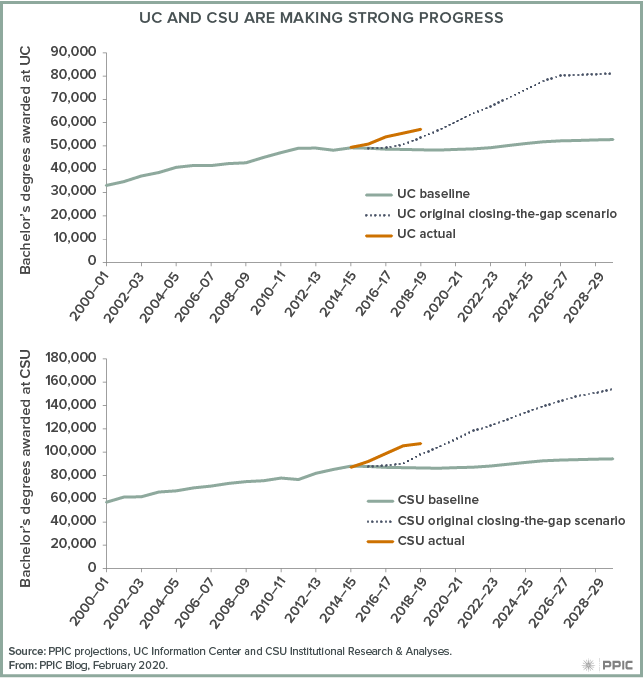
Today, I’m pleased to say that California is currently on track to close the gap. The concerted efforts of policymakers, higher education officials—including staff and faculty—and, of course, students have led to these early gains.

State General Fund allocations for each system have increased substantially since the Great Recession, allowing for increased enrollment and renewed efforts to improve student persistence and completion. Both UC and CSU have exceeded PPIC’s closing-the-gap targets. These early gains have reduced the degree gap by almost 80,000.

figure - UC and CSU Are Making Strong Progress

Two primary actions have led to these gains.

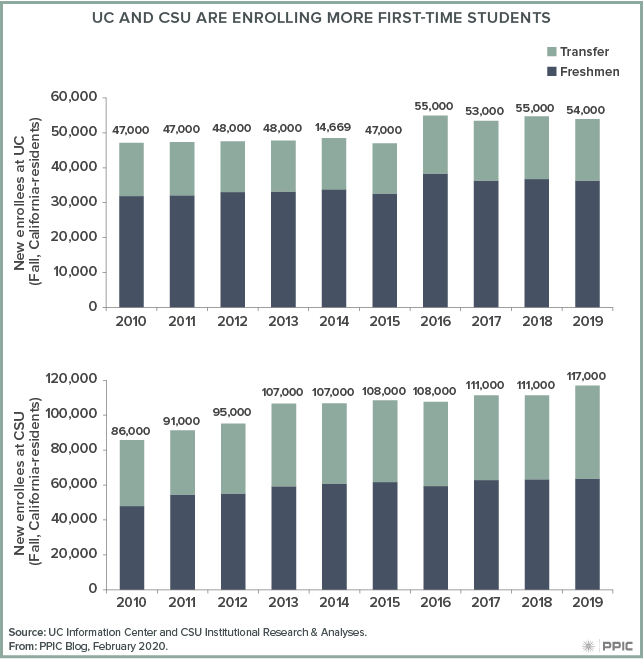
First, increases in state funding have allowed UC and CSU to enroll substantially more first-time students from California—both freshmen and transfer students. At UC, enrollment of transfer students went up 16% between fall 2010 and fall 2019. Enrollment of freshmen grew 14%. At CSU, enrollment increased 41% for transfer students and 33% among freshmen over the same time period. Notably, UC’s gains occurred primarily in one year, from 2015 to 2016, when the legislature and governor tied a $25 million allocation to increasing enrollment by 5,000 students. In that single year, total first-time enrollment of freshmen and transfer students went up 10%, with gains concentrated among African Americans (36%) and Latinos (25%).

figure - UC and CSU Are Enrolling More First-Time Students

Second, programs to improve student persistence and graduation rates have also paid off—and contributed to enrollment growth. These gains have been especially sharp at CSU, which has received substantial funding from the state to support its graduation initiative. At CSU, six-year graduation rates for California-residency students have increased from 57% for 2009 entering freshmen to 67% for the 2013 cohort. At UC, four-year graduation rates for California-residency students have increased from 62% for 2010 entering freshmen to 68% for the 2014 cohort. (Six-year graduation rates at UC remain very high, around 85%). Graduation rates for transfer students have also increased at both systems.

These early successes are very promising. Still, California needs to build on them if it is to close the degree gap fully. The demand for college remains high. PPIC’s statewide surveys show that the vast majority of parents (79%) want their child to earn at least a bachelor’s degree. College preparation among high school graduates has increased, with the share of students completing the college preparatory requirements of UC and CSU now at an all-time high. And while applications to UC and CSU have levelled off or even declined a bit recently, application levels are still near record highs. All but one UC campus and many CSU campuses already do not have room to admit all eligible applicants.

Looking ahead, strong demand for UC and CSU is likely to continue as college preparation improves and the transfer pathway becomes more efficient and effective. New initiatives, including reforms in remedial education at the community colleges and CSU, have the potential to substantially improve student success rates and boost transfer. New articulation agreements, such as the Associate Degree for Transfer, have streamlined the pathway from community colleges to four-year colleges, especially CSU. (PPIC will be issuing a report on transfer trends later this year.) And an increased focus on improving student outcomes has led to multiple substantive reforms designed to increase persistence and completion at UC and CSU.

Finding ways to accommodate all eligible students is a pressing challenge, but one that must be met in order to ensure a better future for all Californians. Through thoughtful planning—and yes, additional funding—closing the degree gap is possible. Improving access and completion is a necessary and critical component to ensuring that more low-income, first-generation, and underrepresented students enjoy the benefits of a college degree. The early progress I’ve highlighted here has led to greater access and success for underrepresented students, creating momentum to improve the wellbeing of all Californians.[/vc_column_text][/vc_column][/vc_row]
Governor Newsom Proposes New Investments in Math and Science Teachers

The governor unveiled his proposed 2020-21 budget last week, which includes record-high levels of K-12 and community college funding—a $3.8 billion dollar increase over last year. This includes $900 million for K–12 educator recruitment and development, building on a nearly $150 million investment from last year’s budget.

These new investments are an attempt to address the statewide teacher shortage, which is most acute in the high-need subjects of math and science (special education is also a high-need area). The hope is that these investments will pay dividends in improving the size and the quality of the teaching force in these subjects, which are important for college success and for jobs in the 21st century economy.

Most notably, the proposed funding includes one-time increases to address teacher shortages in key ways:

  • $350 million in competitive grants for teacher professional development
  • $193 million to address teacher shortages in high-need subjects
  • $175 million for residency programs to prepare and retain teachers in high-need subjects
  • $100 million to fund $20,000 stipends for teachers in high-need subjects at a high-need school for at least four years

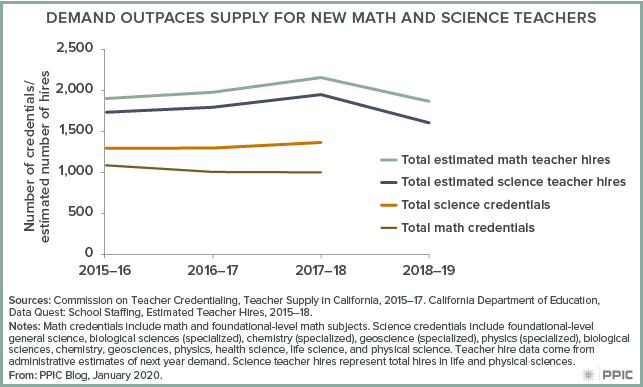
Schools across the state face critical teaching shortages in math and science, leading many schools to increase their reliance on less-credentialed and less-experienced educators. Difficulty in staffing these subjects also means that some schools must reduce course offerings, impeding student access to math and science coursework. Indeed, the number of new math and science teaching credentials has not matched demand for such teachers in recent years. In fact, the number of new math credentials has actually fallen over the past two years, constraining schools in both hiring and course offerings.

figure - Demand Outpaces Supply for New Math and Science Teachers

These continued shortages have important implications for student opportunities in STEM fields. For example, nearly one-third of high school graduates do not meet current UC and CSU requirements for science coursework, and many schools do not have the number of teachers required to offer three or four years of math and science to all interested students. Proposed increases to science eligibility requirements for UC admission—and for math requirements at CSU—mean that increasing the supply of qualified new math and science teachers is more essential than ever. Continued shortages will make it difficult to both accommodate this increased demand and to address equity gaps in the availability of high-quality math and science coursework.

In this light, the governor’s proposal provides reason for optimism. Increased funding for teacher recruitment and retention should help to encourage young adults to enter teaching and retain those who do. And more money for training and development should help to ensure that schools are able to choose among qualified teachers. Whether this will be enough to truly make a dent in the state’s teacher shortage remains to be seen; it depends crucially on whether these investments will be continued in future years or end up as one-time relics from a strong budget year.

Covering the Real Costs of College

Faced with the state’s high cost of living, California college students struggle to secure adequate food and housing. Even amid one of the largest and longest economic expansions in state history, 33% of students are housing insecure and 35% have low or very low food security, according to a California Student Aid Commission survey of 150,000 college students. As the state seeks to meet economic demand by producing more students with degrees and certificates, the full cost of college remains a barrier to progress.

Governor Newsom and the legislature have recognized the need to reform state financial aid programs to address the full cost of college. The 2019–20 state budget provided $41 million in ongoing funding to help colleges address food and housing insecurity, $19 million to support rapid rehousing programs, and increased the number of competitive state grants for non-traditional students from 25,750 to 41,000.  Additionally, the legislature increased the maximum award amount that students with children pay for non-tuition college costs from $1,672 to about $6,000.

However, broader reform of the state grant aid program remains elusive. Two recent bills sought to expand eligibility for Cal Grants by eliminating current age, time out of high school, and high school GPA requirements. The bills also sought to provide additional non-tuition aid to community college students and students in career education programs.  The bills did not make it to a vote; however, they will be re-examined in the next legislative session. Estimated at $2 billion per year, proposed reforms would nearly double the annual cost of the program.

Consequently, the California Student Aid Commission, the agency that distributes financial aid, intends to streamline these proposals to constrain costs while increasing access. Higher education is a vital tool that increases economic and social mobility; ensuring all students have equal access to an affordable education is paramount to modernizing California’s economy. An equitable and financially viable approach to financial aid will be critical if the state’s booming economy slows in coming years.

Strengthening Career Pathways in California’s Community Colleges

California lawmakers have made large state investments—totaling more than $1 billion over the past five years—to support and expand career education.  As the primary provider of career training in the state, California’s community college system was the recipient of much investment in this area, and their creation of the Strong Workforce program has established an ongoing source of funding to continue this work.

To assist policymakers, practitioners, and students to better understand how career education programs can meet regional workforce needs and connect students to well-paying, in-demand jobs, PPIC has engaged in a multi-year research agenda focused on community college career education pathways. We highlight our work in this area in a recent article, Strengthening Career Pathways in California’s Community Colleges, in Techniques magazine, a national publication that provides career education faculty and practitioners with timely analysis and insights to inform the delivery of high quality career education programs.

The article highlights recent research from PPIC’s Higher Education Center on the structure of career education pathways and their value to the students who complete them. Since many career education students are older than typical college-age students—and are likely to have work or family obligations (or both)—the article also highlights how various reforms being enacted by the community colleges could help students complete career training pathways, with a focus on the new online-only college, CalBright, that began enrolling students for the first time in October 2019.

Do Californians Support the Proposed School Bond?

When Californians go to the polls in March, they will not only cast a vote in the presidential primary—they will also vote on an education bond to fund construction and modernization projects. Given differences in support for the bond across the state’s regions and demographic groups, turnout will play a pivotal role in whether this measure passes.

In the closing days of the legislative session, the legislature passed and the governor later signed a bill placing Proposition 13 (the Public Preschool, K–12, and College Health and Safety Bond Act of 2020) on the March ballot. If approved by voters, the measure would authorize $15 billion in general obligation bonds to pay for the construction and modernization of California’s public schools, community colleges, and four-year colleges.

The September PPIC Statewide Survey took an initial look at support for this proposition. While two-thirds of Californians (66%) are in favor, 54% of likely voters say they would vote yes—just slightly above the majority needed to pass.

Are some Californians more likely than others to support the bond measure? Unsurprisingly, there is a wide partisan divide, with three in four Democratic likely voters (76%) saying they would vote yes compared to just three in ten Republicans (29%). Overall, independent likely voters are divided (48% yes, 44% no). But among Democratic-leaning independents, nearly two in three (64%) are supportive.

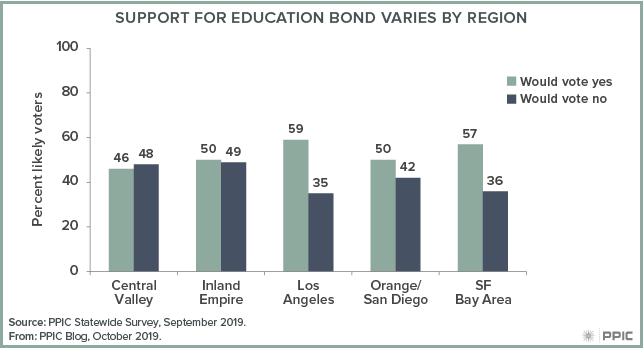
Support varies across regions, with Los Angeles (59%) and San Francisco Bay Area (57%) likely voters expressing the most support, compared to about half of likely voters elsewhere in the state.

figure - Support for Education Bond Varies by Region

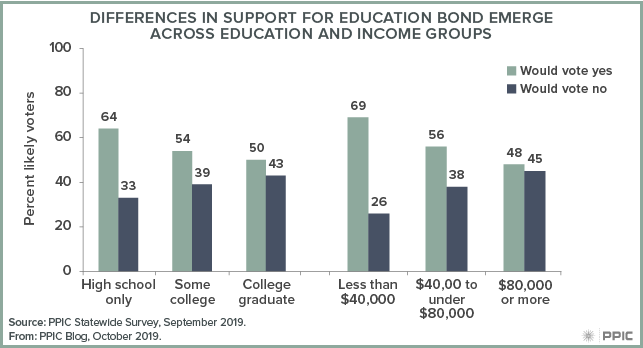
While support is similar among likely voters with (55%) and without (53%) children in the house, there are differences across other demographic groups.

White likely voters (47%) are much less likely than Latinos (74%) and those of other racial/ethnic groups (62%) to say they would vote yes. And since school construction bonds are often paid off by property taxes, it’s notable that homeowners (44%) are far less likely than renters (71%) to say they would vote yes. Support is higher among younger likely voters (66% age 18 to 44, 48% age 45 and older). It declines as education and income levels increase.

figure - Difference in Support for Education Bond Emerge Across Education and Income Gaps

Overall, support for the education bond currently hovers at around half for likely voters, but there is much stronger support among many regional and demographic groups—suggesting that passage could depend on who shows up to vote. If Democrats and Democratic-leaning independents turn out in large numbers for the presidential primary, that could affect the fate of this bond. Stay tuned to the PPIC Statewide Survey as we continue to track this measure in advance of the March primary.

Video: Improving Educational Opportunity in California

What is the one thing that could be done to improve educational opportunity in California? Mark Baldassare, PPIC’s president and CEO, posed this question at the start of his conversation with Linda Darling-Hammond, president of the California State Board of Education, and Eloy Ortiz Oakley, chancellor of the California Community Colleges.

Darling-Hammond responded with a list of five major characteristics of school systems in other countries and states that have closed “opportunity gaps”: an equitable, adequate funding system; high-quality teachers and leaders; a thoughtful curriculum and assessment system; wrap-around support for students; and schools designed to allow for productive learning.

Then she circled back to California’s “number one thing”: “We’ve got to fix the teacher shortage—and we’ve got to do it quickly, purposefully, and soon.”

For Oakley, the “one thing” is to change “how we look at education, how we look at opportunity in California.” In short, we need to stop providing “the least amount of resources to the students, the communities that need them the most.”

A key part of this change involves “blurring the line” between the K–12 (or “TK–12”) and community college systems. Oakley noted: “There was a point in time when we felt that a high school diploma was the default to get into the workforce. Those days are gone. . . .We need to see the path to community college as the required path for everybody to get some sort of post-secondary credential.”

Darling-Hammond agreed that the two systems can and should work together. A good example of productive collaboration, she added, is concurrent enrollment, which allows high school students to take college courses (and earn college credit). These programs help students “find their passion” and move toward meaningful careers.

Funding is another key issue for both systems. Darling-Hammond pointed to the impact of significant post-recession increases in funding during the Brown and Newsom administrations and the potential impact of the governor’s commitment to early childhood education. But, she added, “just to get to the national average . . . we need about $12 billion more in the TK–12 system.”

Oakley agreed that “for those of us who managed our way through the recession, we’re certainly in a much better place.” The community college system could certainly benefit from more funding, he added, but state investments in early childhood education might be even more beneficial: “If we could prioritize the funding at the lowest level, for the youngest learners, that would make our job in the community colleges easier.”


2020 Primary: Funding Higher Education Facilities

The state legislature recently passed a $15 billion bond measure to fund upgrades to education buildings and facilities. Voters will decide whether to support this bond as part of the March 2020 primary ballot.

For higher education, the measure would provide $6 billion to the state’s three higher education systems, the University of California (UC), the California State University (CSU), and the California Community Colleges (CCC). These funds would be distributed equally ($2 billion each)—even though the systems enroll significantly different numbers of students.

The legislature will approve specific projects as part of the annual budget process. As a condition of making funds available, the bill requires UC and CSU to develop affordable housing plans for their students.

figure - Proposed Bond Funding Varies on a per Student Basis

The last time the state proposed and passed a ballot measure supporting higher education was more than a decade ago. Proposition 1D (2006) passed with almost 57% support. The total amount of funding for higher education in that initiative was about half of what is proposed in the current measure ($3.1 billion compared to $6 billion).

figure - 2020 Initiative Proposes Much More Funding for CSU and CCCs than the 2006 Measure

During the Great Recession funding for UC, CSU and the community colleges fell. One of the ways the systems responded was to defer maintenance on buildings, foregoing repairs and upgrades as a way to save money in the short run. Our estimate of the cost of addressing the resulting backlog of capital projects tops $30 billion for the UC and CSU systems. The proposed ballot initiative would provide bond authority to cover a little more than 10% of that.

The state’s community colleges are in a slightly different position. Local community college districts can issue their own bonds and make most of their own capital finance decisions. Since passage of Proposition 39 (2000), which made it easier for community colleges to pass bond measures, community college districts have been relatively successful in funding their capital needs. From 2001 to 2016, voters approved $35 billion in borrowing for local community college capital projects. In addition, Proposition 51 (2016) provided community colleges with $2 billion in state bond funding.

We know that bond measures for education generally have the support of voters, and recent PPIC polling suggests that a $15 billion education bond has a slim margin of support. Time will tell whether voters will be persuaded this time around.

Video: Broadening Access to Transfer-Level Courses at California’s Community Colleges

The majority of California community college students never complete their education. For many students, the biggest barrier to success has been the traditional approach to remedial education. Until recently, the vast majority of entering students were placed in remedial—or developmental—courses, and relatively few of them went on to receive a degree or transfer to a four-year institution. In recent years, several colleges have responded to this longstanding challenge by experimenting with placement and curricular reforms, and state legislation enacted in 2017 aimed to accelerate the pace of change.

A new PPIC report examines what happened at colleges that were early in implementing large-scale reforms, focusing on student access to and completion of transfer-level courses in English and math. Marisol Cuellar Mejia, PPIC senior research associate and report coauthor, reported on the findings at a briefing in Sacramento last week, followed by a panel discussion of higher education experts moderated by coauthor Hans Johnson, PPIC senior fellow and director of the PPIC Higher Education Center.

Panelists included Julianna Barnes, president, Cuyamaca College; Laura Metune, vice chancellor for external relations, California Community Colleges Chancellor’s Office; and John Stanskas, president, Academic Senate for California Community Colleges.

The three panelists emphasized the equity implications of placing students in transfer-level classes, as opposed to remedial courses.

Barnes said that “we cannot deny the data” showing that placement and curricular reforms are particularly helpful to students who are historically underrepresented in college. Making these changes became “an equity imperative” at Cuyamaca College.

Thoughtful leadership and a commitment to addressing equity gaps are particularly important in managing change, according to Metune. She noted that “we need to just be careful that it’s not our own implicit bias that’s resulting in differences in student outcomes.”

All community colleges now have a plan for implementing reform, Stanskas said. He pointed to the importance of tailoring programs to specific student populations. Colleges should be ready to “get down to being more nuanced about who [their] students are and what they need from us to be successful.”