Strengthening Career Pathways in California’s Community Colleges

California lawmakers have made large state investments—totaling more than $1 billion over the past five years—to support and expand career education.  As the primary provider of career training in the state, California’s community college system was the recipient of much investment in this area, and their creation of the Strong Workforce program has established an ongoing source of funding to continue this work.

To assist policymakers, practitioners, and students to better understand how career education programs can meet regional workforce needs and connect students to well-paying, in-demand jobs, PPIC has engaged in a multi-year research agenda focused on community college career education pathways. We highlight our work in this area in a recent article, Strengthening Career Pathways in California’s Community Colleges, in Techniques magazine, a national publication that provides career education faculty and practitioners with timely analysis and insights to inform the delivery of high quality career education programs.

The article highlights recent research from PPIC’s Higher Education Center on the structure of career education pathways and their value to the students who complete them. Since many career education students are older than typical college-age students—and are likely to have work or family obligations (or both)—the article also highlights how various reforms being enacted by the community colleges could help students complete career training pathways, with a focus on the new online-only college, CalBright, that began enrolling students for the first time in October 2019.


Video: Career Education and Economic Mobility in California

[vc_row][vc_column][vc_column_text]

Career education, also known as vocational education or career technical education (CTE), prepares a wide range of Californians for employment and economic advancement. Community colleges are a major provider of career education in California, offering short- and long-term certificates along with associate degrees across a variety of fields of study.

In this video, senior research associate Shannon McConville discusses the importance of career education for California and what new PPIC research says about its economic benefits. Career education credentials can provide substantial earnings gains and also helps create a strong California workforce over the long term.

[/vc_column_text][/vc_column][/vc_row][vc_row visibility=”hidden-phone”][vc_column][vc_video link=”https://youtu.be/5qmlPVWwiEw” el_width=”70″ align=”center”][/vc_column][/vc_row][vc_row visibility=”visible-phone”][vc_column][vc_video link=”https://youtu.be/5qmlPVWwiEw”][/vc_column][/vc_row][vc_row][vc_column][/vc_column][/vc_row]

Training California’s Students for Well-Paying Jobs

California’s community college system is the largest provider of career education—also known as career technical education or vocational education—in the state. Career education programs play a critical role in training students, especially underserved and nontraditional students, for jobs that provide solid wages but don’t require a four-year college degree.

How can colleges identify these jobs? In a recent PPIC report, we compare occupational earnings to regional poverty thresholds to assess how future workforce needs connect to well-paying jobs that don’t require a four-year degree. Other work by the Brookings Institute focuses on “opportunity industries,” in which good jobs—those that provide stable employment, middle-class wages, and benefits—represent an above-average share of the industry’s total jobs and are filled by workers with only some college training.

Opportunity industries are largely concentrated in fields that align with many of the community colleges’ career education disciplines, including business, engineering, health, information technology (IT), and public and protective services. A critical question is whether students are successfully completing programs that will prepare them for careers in these fields.

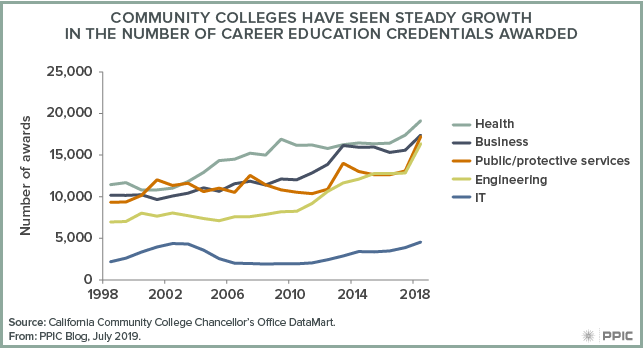
The good news is that over the past 20 years, there has been a consistent upward trend in the completion of career education credentials in California’s community colleges, with major gains observed in the last decade. This increase spans industries. Notably, more degrees and certificates are being earned in health than in any other discipline—this is important since health credentials are especially valuable in increasing students’ subsequent earnings.

Figure - Community Colleges Have Seen Steady Growth in the Number of Career Education Credentials Awarded

But not all credentials are associated with large economic gains. For example, in our analysis of wage returns, we find that career education credentials in business and IT do not provide much of a wage boost.

Furthermore, there seems to be a mismatch between the awards with the most value and the awards students are earning. While awards from longer programs generally tend to confer more value than those from shorter ones, completion of short-term awards has increased in several career education disciplines.

Community colleges and industry partners need to work together to ensure students have a path to well-paying jobs and the tools needed to succeed. As shown in our research, some of that work begins with colleges structuring effective pathways to these industries and clearly communicating the economic returns and opportunities available to students.

Moreover, strong partnerships between community colleges and nearby industries will be essential in creating a bridge between students and their industry of choice. Ultimately, these efforts can help improve the economic well-being of individual students and the state as a whole.

Video: Career Pathways and Economic Mobility at California’s Community Colleges

About a third of future jobs in California will require more than a high school diploma but less than a bachelor’s degree. By training workers for these jobs, career education—also known as career technical education or vocational training—plays an integral role in meeting California’s workforce needs and improving students’ economic well-being.

At an event in Sacramento last week, PPIC researcher Shannon McConville outlined the findings of a new report on career education and economic mobility, and a panel of experts discussed the implications for students, colleges, and the state as a whole.

McConville noted that completing a career education credential at a California community college confers a 20% wage gain, on average. But economic benefits vary greatly across program areas. For instance, returns to health credentials tend to be substantial, while business and IT credentials yield lower returns.

The panelists began by highlighting current efforts to improve students’ labor market outcomes. Marty Alvarado, executive vice chancellor for educational services at California’s community colleges, explained the system’s “two-pronged approach” to making sure programs connect to in-demand, high-return careers. One area of focus is regional infrastructure, which includes regional labor market centers that provide colleges with data on local industries. The second area includes tools to help students better navigate their program choices, “while also trying to make transparent the earnings projections for students as they move into these career options.”

Supporting students—especially low-income students from underrepresented demographic groups—in completing high-return credentials was another topic of conversation. Alvarado discussed efforts at the community colleges to streamline processes that may be creating “unnecessary barriers for students,” while Assemblymember Autumn Burke emphasized the importance of access to social safety net services so students can focus on their career.

Alma Salazar, senior vice president of the Center for Education Excellence and Talent Development at the Los Angeles Area Chamber of Commerce, noted that all stakeholders need to be involved. “How do we get the system as a whole to take ownership in helping us collectively solve for these problems? . . . It has to go beyond Sacramento. It has to go beyond the system’s leadership. It has to get to the institutional level and the people who work [there], who have to be equally committed.”

While many see the evolving nature of work and increasing automation as challenges, Assemblymember Burke was optimistic about providing a “just transition” for workers who may lose jobs in fast-changing industries. “We can train people for this new economy [and] prepare them now. . . . It’s a shortcoming to worry about losing minimum-wage jobs, because there’s so much opportunity on the other side.”

Is College Worth it? What Graduates Say

As college registration deadlines approach, thousands of Californians are making important decisions to invest in their education and long-term career prospects. The vast majority of parents (85%) hope their child earns at least a bachelor’s degree, according to the PPIC Statewide Survey. But how do graduates see it? And how well-informed are their decisions?

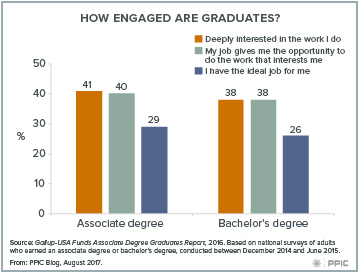
The good news is that most people who earn degrees believe their investment was worth it. According to national survey data, 71% of those who earned an associate degree and 73% of those with a bachelor’s degree agree their education was worth the cost. Going beyond the economic value, a large share also find engagement in the work they do. In fact, a sizeable share of associate- and bachelor’s-degree holders report deep interest in their work (41% and 38%, respectively) or say that they have the ideal job (29% and 26%, respectively).

Although having an “ideal job” may be a very high bar to achieve, these results suggest that a majority of degree earners are not terribly satisfied or engaged with their work. Indeed, in a wider-ranging national survey conducted recently, a majority of college graduates indicate that they would change their degree, their college, or their major if they could do it again. Among associate-degree holders, 23% would seek a different degree—more than double the share of bachelor’s-degree holders who say the same. But graduates with bachelor’s degrees are not entirely satisfied with their choices either: 40% would study a different major (compared to 36% among associate-degree holders). And the survey finds curiously similar responses regardless of a person’s income level. Though higher-income Americans are slightly less likely to regret their college choices, a large fraction of them (35–45% for those with income over $100,000) would still make a different choice.

These results confirm that while college pays off, there is room to improve how well-informed prospective students are about their colleges, majors, and degrees. On this blog, we’ve written about the economic value of college credentials and how it varies across fields of study. We’ve also highlighted the need for data to inform student choices, given the sizeable financial commitment entailed.

Among the state’s public colleges and universities, California’s community colleges are ahead of the curve in providing information online about institutional performance, future salary, and more. Other institutions should follow suit. However, the survey results above suggest it is perhaps equally important to design courses and programs that ensure students can efficiently and effectively identify the degrees and majors best suited to them. Indeed, this is one of the tenets of the guided pathways movement taking place at community colleges across the country and in California. To inform and improve the college decisions of Californians, it is critical that these practices expand beyond community colleges, so that K–12 schools and four-year universities are also working to ensure students have comprehensive information when choosing their pathway into a career.

Learn more

Visit the PPIC Higher Education Center

Students Choose College with Future Jobs in Mind

Throughout California and the nation, hundreds of thousands of high school seniors are currently making decisions about where to attend college. An increasingly important part of that decision is based on career opportunities. PPIC’s statewide survey on higher education finds that the vast majority of Californians (77%) believe the state’s higher education system is very important to the economic vitality of the state.

Students’ career goals play an important role in the decision to go to college at all. According to an annual nationwide survey of freshmen conducted by UCLA’s Higher Education Research Institute, the vast majority of students agree that a very important reason to go to college is “to be able to get a better job” (85%) and “to get training for a specific career” (76%). A record-high 60% of students say that a very important consideration in choosing a college is the ability of its graduates to obtain good jobs.

Students are right in thinking that college can give them economic advantages. Using data from the 2014 and 2015 American Community Survey, we examine some basic labor market outcomes for recent college graduates (ages 22 to 29) in California. The advantages in terms of employment and wages are clear. Young adults with a college degree are much less likely to be unemployed and, on average, earn far higher wages.

Of course, not all majors are equal when it comes to career opportunities. Among young adults with a bachelor’s degree, wages vary widely by major. Among the ten most popular majors for young adults in California, the most remunerative major is computer and information sciences; young workers with those degrees earn more than twice as much as young workers who majored in psychology. But even among those paid least, wages are still substantially higher than those of less educated workers.

Students attend college for many important reasons beyond economics. But because career opportunities are an important consideration for most, state policymakers and higher education institutions should seek ways to provide students with accurate and meaningful information about labor market outcomes by college and by major. The American Community Survey does not provide information for specific colleges nor for community college certificates, but public colleges in California can link student records with wage records from the Employment Development Department. For example, California’s community colleges have created a “Salary Surfer,” which offers useful information on wages for students contemplating different career paths and provides a good model for other colleges to follow.