What COVID-19 Budget Cuts Mean for Public Safety Spending

State funding aimed at programs and supervision for some jail inmates in jails and others on probation will drop sharply as a result of the COVID-19 crisis. While spending on the state correctional system will decrease less than 1% under recently announced cuts to the California state budget, funding for counties may drop 24%.

Probable cuts now loom over local budgets as well, and spending on local public safety may fall significantly.  Although lower jail populations during the pandemic could create budget savings, there may also be a higher need for re-entry and community-based services as released individuals return to communities.

In 2011, California enacted sweeping changes to its correctional system to address federal court orders to alleviate severe overcrowding in the prison system. This public safety realignment shifted correctional responsibilities for tens of thousands of offenders, from state prison and parole systems over to county sheriff and probation departments.

To fund the shift, the state created the local community corrections account, with money drawn from a dedicated portion of state sales tax revenue. Voters issued a constitutional guarantee for that portion of tax revenue when they passed Proposition 30 in November 2012. But while the percentage of revenue was guaranteed, the actual amount of sales tax collected can vary. The amount is now changing because of the COVID-19 crisis.

Counties were meant to use these funds to provide supervision and programming to individuals who were realigned from the state to the counties. More specifically, the state expected counties to fund cost-effective, evidence-based programming that improved offender rehabilitation and public safety in local communities. Such programming might include day reporting centers, expanded jail training programs, or specialized courts that handle individuals with drug dependency or mental health disorders.

Each county had the freedom to implement programs that best suited their situation. Community Corrections Partnerships (CCPs)—headed by the chief probation officer, with representatives from law enforcement, health and human services, and community organizations—provide realignment plans and recommend where to allocate funding.

Realignment funding grew 47% from $930 million in 2012–13 to $1.37 billion in 2018–19. In state budget estimates from before COVID-19, sales tax revenue rose steadily, with the local community corrections fund expected to increase to $1.54 billion for fiscal year 2020–21.
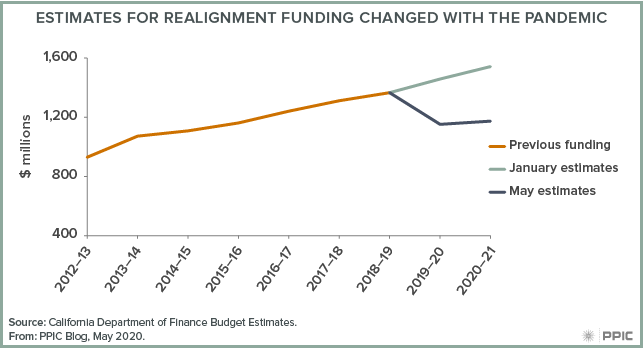
Figure - Estimates for Realignment Funding Change with the Pandemic

However, the pandemic weakened the economy—in updated state budget estimates, the governor predicted a drop in sales tax revenue of more than 27% for 2020–21. The local community corrections account is now estimated to receive only $1.17 billion—a 24% decrease from the earlier estimate and 14% below the 2018–19 fiscal year.

Because revenues are paid to counties monthly, local agencies will feel the effect of sinking revenues almost immediately. The fiscal situation undoubtedly poses challenges for successful community re-entry programs; it is more important than ever to evaluate policies and programs that to lead to cost-effective solutions.
Public Higher Education in California Faces a Fiscal Crisis

[vc_row][vc_column][vc_column_text]As the coronavirus pandemic continues to disrupt California’s economy, the Newsom administration is projecting a $54 billion decline in state revenues for the 2021 fiscal year and revising the budget accordingly. California’s public universities—which do not have dedicated funding streams or constitutional protections—face disproportionately large funding cuts. So far, the federal government has provided some emergency relief to mitigate the pandemic’s unprecedented impact on higher education. Without additional support, however, the state’s public colleges might have to reduce student access and services.

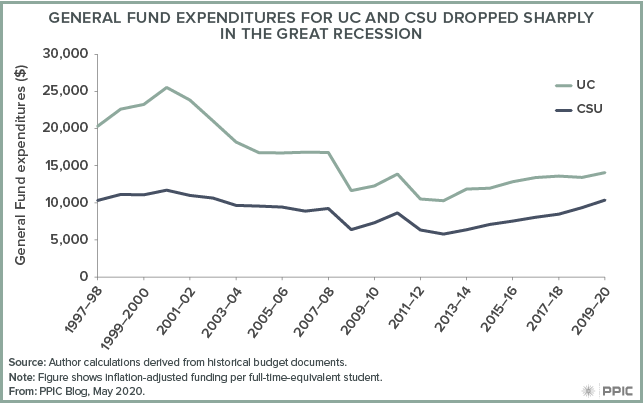
During the Great Recession, a drop in state revenues of $40 billion in 2009 led to cuts equaling roughly one-third of state funding for the University of California (UC) and California State University (CSU) systems (on a per student basis). Consequently, tuition doubled at UC and CSU, faculty and staff were laid off or furloughed, and critical capital improvements and maintenance were deferred.

In turn, students faced reduced access to courses, higher student-faculty ratios, increased costs, and fewer support services. As the economy improved, the state was able to increase allocations to the state’s colleges. As a result, UC and CSU admitted thousands of additional students, graduation rates went up, and the number of degrees awarded increased substantially.

figure - General Fund Expenditures for UC and CSU Dropped Sharply in the Great Recession

Early evidence suggests that the global pandemic could have an even more dramatic fiscal impact on public higher education in California. In the short-term, public colleges face critical revenue shortages: now that students have been sent home and instruction has moved online, revenues from auxiliary enterprises (housing, food, parking, etc.) have evaporated. In addition, UC has suspended elective surgeries at its medical centers and is incurring costs associated with research and treatment of the coronavirus. CSU has projected revenue losses of $337 million for the spring semester, while UC projects a $500 million loss for the month of March alone.

In the longer-term, the systems may find it challenging to raise additional revenues. The percentage of out-of-state students—who pay higher tuition—is now capped at 18% for the five most popular UC campuses, and enrollment of international students is likely to decline due to visa and travel restrictions. Endowment funds are shrinking and tuition increases are controversial. Moreover, unprecedented levels of unemployment will increase demand for federal, state, and institutional financial aid programs.

Governor Newsom’s May budget revision includes a 10% cut for each public higher education system. The revised budget proposal also reduces state financial aid for students who attend nonprofit private colleges from $9,084 to $8,056 per year. The budget proposal does allow UC and CSU to redirect some restricted revenues and to refinance debt at historically low interest rates. However, without additional revenue–whether through federal or state support, or tuition increases—it will be difficult to improve access, quality, and student success in the coming years.[/vc_column_text][/vc_column][/vc_row]

COVID-19 Highlights the Need for Statewide Student Data

The pandemic makes it clearer than ever that California would benefit from a data system that links information across educational institutions. Without it, California policymakers will continue to lack important information—including insights into the impact of the coronavirus pandemic on our students and educational institutions.

Better data would help determine who is most affected by the pandemic, where to direct support, and how to prepare for future crises. For example, is the pandemic affecting key educational transitions of some students more than others? Some regions more than others? Where should the state best direct its resources to ensure students keep moving through the educational pipeline? Right now, these questions cannot be fully answered.

The governor’s office remains supportive of building a statewide data system, and the state’s Cradle to Career Workgroup is still aiming to deliver a proposal to the legislature by the end of 2020.  At its most recent meeting, the workgroup endorsed creating a multifaceted system, including data tools for the general public and researchers, as well as ways for practitioners, students, and families to link data regarding transitions to and between colleges.

The workgroup also endorsed including early childhood data, to focus on early determinants of educational success and align with the governor’s focus on early childhood care. Over the summer and fall, the workgroup will decide on proposals that define the scope of the system, ensure privacy and security, and govern access.

Balancing the state’s need for connected data with the current economic downturn may be difficult. However, forgoing all of the recent progress could indefinitely stall this important effort, not only hampering the flow of critical information but also leaving the state flying blind during the next crisis.

PPIC will continue to participate in an advisory capacity for the Cradle to Career Workgroup and will also convene the California Education Data Collaborative to aid and inform the state in creating a useful data system that helps students and provides valuable direction for the state—during good times and bad.

Lessons from the Great Recession Can Protect College Students Today

[vc_row][vc_column][vc_column_text]Budget cuts for state services are likely on the horizon due to the economic disruption of COVID-19. This means state funding for public higher education may well be reduced—leading to restrictions in access and lowered enrollments. California went through this very scenario during the Great Recession, with thousands of students turning to for-profit colleges in lieu of public colleges.

figure - Enrollments Spiked for California For-Profit Colleges during the Recession

While some students at for-profit colleges earned a degree, many did not graduate and ended up with large amounts of debt. State and federal government subsequently put restrictions around for-profit colleges, but upcoming changes at the federal level could weaken the federal rules.

The recently announced federal Education Stabilization Fund will disproportionately provide emergency relief funds to private for-profit colleges. In California, only 5% of the state’s undergraduates attend for-profit colleges, but these schools will receive 10% of federal funds.

In contrast, 55% of undergraduates attend the state’s community colleges, which will receive only 34% of federal aid. (That’s because many low-income students who attend community college rely on state aid rather than federal financial aid: these students are not counted in the federal emergency funding formula.)

During the Great Recession in 2008, higher education faced deeper cuts than other state services. With escalating tuition, fewer instructional staff, and a narrow application window, students had less access to the state’s public colleges, especially community colleges.

At the same time, some for-profit colleges began to market heavily, and thousands of students enrolled in expensive programs. By several measures—graduation rates, student debt, loan default rates, and employment outcomes—private for-profit institutions often have poor outcomes. Of course, some colleges have a better track record than others.

People hurt most by the recession—and lack of access to college—were saddled with debt they couldn’t pay back. In response, California and the federal government both instituted new regulations requiring for-profit colleges to be more transparent and accountable.

California went a step further than the federal government. The state required colleges to meet minimum standards of graduation and loan default rates to be eligible for Cal Grants, the state’s financial aid program for low-income students. Enrollments in for-profit colleges in California declined, and some of the largest for-profit institutions, like Corinthian and ITT Technical Institute, declared bankruptcy as the economy improved and funding to public higher education was restored.

California policymakers should seek to avoid the mistakes of the last recession by ensuring that access to public higher education is not restricted during this recession. The key is to find ways to limit budget cuts so that public higher education remains accessible to all Californians looking to advance their knowledge and improve their economic well-being.[/vc_column_text][/vc_column][/vc_row]

Video: Californians and Education

In the era of COVID-19, about eight in ten adults fear getting sick, and 80% expect bad economic times ahead. At a virtual briefing on Thursday, PPIC researcher Alyssa Dykman said the drop in consumer confidence “is unprecedented in the history of the PPIC survey.”

The event featured Dykman, who presented attitudes on K–12 education, funding, and policy preferences along with concerns over the coronavirus pandemic in the latest PPIC statewide survey. PPIC President and CEO Mark Baldassare supplied deeper context for key findings and responded to online questions.

Approval ratings have hit rare numbers: at 78%, approval has surged for Governor Newsom’s handling of K-12 education, and at 92%, public school parents express overwhelming support for school district handling of school closures. COVID-19, however, has shaken support for school bonds, with about half or fewer adults and likely voters saying it’s a good idea now for state government to fund school construction projects.

Baldassare underscored Californians’ concerns around health and finances, stating that two-thirds of adults are worried about both. Many say their lives are disrupted and about half say the stress is affecting mental health.

What do these concerns mean for California schools? “People are giving state leadership and local leadership a lot of leeway in how they respond to the public health and economic crisis,” Baldassare said. But the state will see its first test of this extraordinary support in May, when the governor submits a revised budget that will reflect revenue loss from a sharp economic downturn.

That may also lead to roadblocks for state and local school funding in November. In the March primary, “the defeat of most of the local school bond measures really caught a lot of people by surprise,” Baldassare said. “It was difficult to pass school funding measures.” At the moment Californians are hesitant to commit more funding to schools, which may impact voting on the split-roll property bond measure and others in the November election.

The survey offers several takeaways around planning for California public education. “We’ve never had anything like the school closures that are taking place,” Baldassare said. He reflected that Californians may reconsider the value of teachers going forward, including whether “teachers have the resources they need in order to do the job,” and noted that the public may have “a new understanding of the important and difficult role teachers play every day in the lives of public school children.”

Californians also may now recognize the struggles of vulnerable students, especially in terms of online access.

“It is going to be a test of Californians’ political will,” Baldassare said, “the degree to which we are committed to improving student outcomes, particularly among the large numbers of English language learners and low income students across the state.”

School Funding, COVID-19, and the 2020 Election Year

This post is excerpted from Mark Baldassare’s prepared remarks for the PPIC Statewide Survey virtual briefing on April 23, 2020.

State funding for K–12 public schools will take center stage when Governor Newsom unveils revisions to the state budget in a few weeks. The growing fiscal toll of the COVID-19 crisis is likely to affect school funding plans as a deep economic recession looms. K–12 schools have the largest share of the state General Fund, and many Californians say it is their top priority for state spending. Still, California voters seem to be pulling back their support for school funding on ballot measures.

One of the biggest surprises in the March 3 primary was the defeat of the Proposition 13 state school bond (53% voted no). The last time a state school bond failed to pass was back in 1994. Proponents have tried to explain away this loss as confusion caused by the number 13—the same as the notorious anti-tax initiative that passed in 1978.

However, outcomes of local school bond measures point to a different story. Bucking recent trends, 63% of local school bonds on the March primary ballot failed to reach the 55% threshold needed to pass. It may be that early anxieties about COVID-19 resulted in voter caution about extending debt. In the absence of exit polls to validate this theory, the April PPIC Statewide Survey sheds light on what may have happened. It also offers sobering news for efforts to convince voters to support school funding measures in the November election.

First, though, let’s dispense with the notion that views about school funding have fundamentally shifted. Today, 55% of California likely voters say that state funding for their local public schools is not enough. And 53% would vote yes on a state school bond while 50% would vote yes on a local school bond. Moreover, 53% percent would vote yes on a split roll property tax to fund local public schools—a measure that appears headed for the November ballot. All of these results today are similar to those last April, suggesting that basic attitudes about school funding are fairly stable.

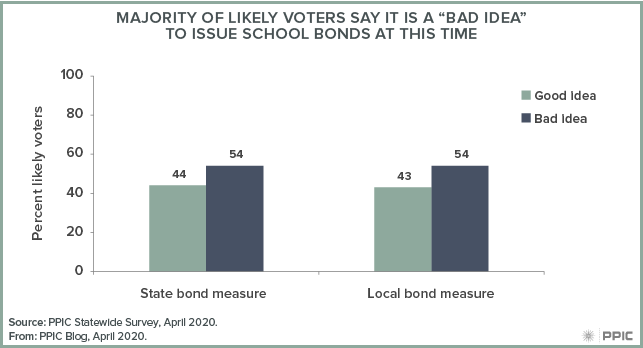
But current conditions appear to be having a strong effect on the timeframe for public support. Our survey was conducted from April 1 to 9—roughly a month from the primary and a few weeks into stay-at-home orders. We find that most likely voters say it is a “bad idea” to issue state (54%) or local (54%) school bonds at this time. Majorities of Californians without children in public school agree (bad idea: state 56%, local 57%). Fewer than half across the state’s regions say it is a good idea to issue these bonds now. Only those with children in public school think that it is a good time to issue state (57%) or local school bonds (58%).

figure - Majority of Likely Voters Say it is a “Bad Idea” To Issue School Bonds at this Time

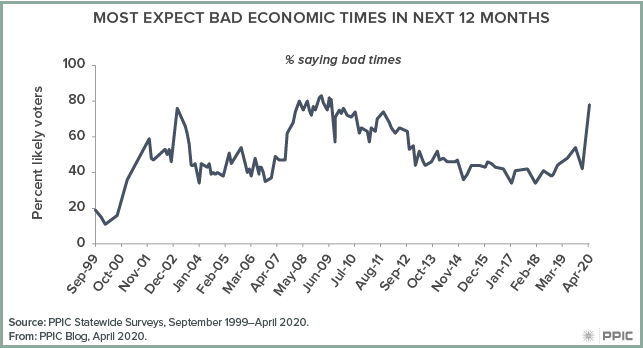
Why? Californians have had their world shaken by the COVID-19 crisis. Since January there has been a 36-point increase in expectations for bad economic times in California over the next 12 months (42% to 78%)—sending us to depths of consumer pessimism not seen since the Great Recession. And right now, 74% percent are worried about negative impacts of the coronavirus on their personal finances.

figure - Most Expect Bad Economic Times in Next 12 Months

This pessimism is likely to have profound implications for school funding measures on the November ballot. The state’s fiscal and economic problems will weigh heavily on voters’ minds when they are asked to make decisions on spending, taxes, and bonds. Many may be reluctant to ask taxpayers (like themselves) to foot the bill, or to increase commercial property taxes, to make up for shortfalls in school funding.

We can also expect a rocky road ahead for the governor and state legislature. Although our April survey found a steep rise in the governor’s and legislature’s approval ratings around handling K–12 public education, state leaders now face the prospect of having to cut back on popular plans to increase school funding. During the Great Recession, we saw the governor’s and legislature’s approval ratings tumble with state budget cuts to local schools.

Our surveys will be closely monitoring all of these dynamics as California heads toward a much-anticipated November presidential election.

Will Mail-in Ballots Benefit One Party?

If coronavirus is still active during this November’s presidential election, the risk remains of spreading the virus among voters and poll workers. The best solution is to limit in-person options and rapidly expand the number of voters who submit ballots through the mail.

This is the right choice for public health. But a debate around the degree of change needed is reasonable: how many mail-in ballots and how many polling places are needed to both keep people safe and allow fair access? And lurking in the background are darker questions: does one party stand to benefit as vote by mail expands? Is this a partisan game masquerading as a question of public health?

The short answer to both questions is no. On the surface, there might seem to be a partisan angle. Many Democrats have pushed for expanding vote by mail, while President Trump has firmly stated it would hurt Republican candidates. States friendly to voting by mail tend to vote more Democratic, while some Republican-leaning states like Texas have resisted more voting by mail even in the pandemic. And Californians who vote by mail are older and more likely to be white, demographics that also vote more Republican on average.

But these scenarios describe the status quo; they don’t tell us how election results might change if vote by mail became more widely available. When election jurisdictions—including some California counties—have rapidly expanded vote by mail, neither major party has clearly benefited. Likewise, early evidence from experiments with heavy vote by mail in California suggests an increase in turnout among Latinos, Asian Americans, and young people of up to seven percent, though often with a fair amount of statistical uncertainty.

The same analysis suggests overall turnout increased about two to three percent, making it difficult to say that the composition of the electorate changed much in the end. Thus, while the greater convenience of vote by mail does seem to draw in a few more voters, these voters aren’t that different on average from the ones who show up already.

The demographic differences between in-person and by-mail voters are real, but should not be overstated. People from all backgrounds and political persuasions vote in person. All of them will be at risk in an election where coronavirus is still active. Expanding vote by mail is now a pure question of public health and administrative capacity. Neither party should worry that it will put them at a disadvantage.

The Coronavirus Pandemic Will Test the State’s Budget Reserves

As it grapples with the COVID-19 pandemic, California faces an uncertain fiscal future. This global crisis has caused a sharp decline in economic activity, exposing crucial sectors to heightened risk. As discussions continue about when and how to re-open the economy, it is clear that the state will have to respond to significant fiscal challenges.

The good news is that California has made important changes to its reserve policies since the Great Recession. The passage of Proposition 2 (2014) created the Budget Stabilization Account—the state’s rainy day fund—as well as the Public School System Stabilization Account, a separate reserve for K–12 districts and community colleges. In addition, Governor Brown and the legislature created the Safety Net Reserve Fund to shore up Medi-Cal and CalWORKs funding during downturns.

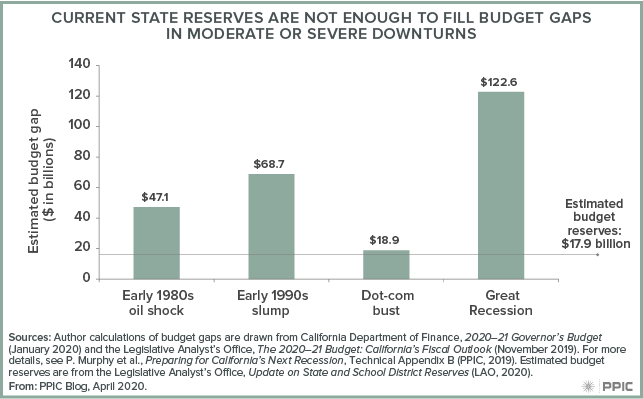
The bad news is that a severe recession is likely to pose significant budgetary challenges. Drawing from the state’s experience during several recent recessions, PPIC estimated the budget ramifications of mild, moderate, and severe recessions and the capacity of state reserves to fill gaps. We found that the state’s reserve balance—estimated to be $17.9 billion—is large enough to withstand a mild recession such as the dot-com bust in the early 2000s.

However, a long and/or severe recession like the early 1980s oil shock (which lasted four years), or the early 1990s slump and the Great Recession—both of which were much more severe and lasted five years—would create large budget gaps and require policymakers to make difficult decisions. (It is important to note that the estimated reserve balance relies on the 2019–20 enacted budget and that it will change when revenue estimates are updated in May.)

figure - Current State Reserves Are Not Enough To Fill Budget Gaps in Moderate or Severe Downturns

In the meantime, the federal government has stepped in. The Families First Coronavirus Response Act includes an increase in the federal share of Medicaid payments and reimbursements to states that are expanding public assistance programs. The Coronavirus Aid, Relief, and Economic Security (CARES) Act provides about $2.2 trillion; some aid goes directly to families, some goes to schools, and some to state and local governments. Additionally, two federal disaster declarations make many of California’s COVID-19 expenditures eligible for at least partial reimbursement.

Governor Newsom has requested additional federal assistance, including flexible aid to state and local governments, a further extension of unemployment insurance benefits, and expanded support for safety net programs, small businesses, K–12 and higher education systems, childcare, and broadband.

The state is also making significant changes to the 2020 budget process. The Department of Finance is drafting a “workload” budget for the May Revision that will set the baseline for the final budget to be enacted in June. This will limit spending increases while allowing for growth in programs—particularly safety net programs—that expect increased demand. The legislature will revisit the budget for an “August Revision” that reflects changes in the state’s financial condition. As these processes move forward, PPIC will continue to monitor California’s evolving fiscal challenges and steps being taken to address them.

Emergency Child Care for Essential Workers

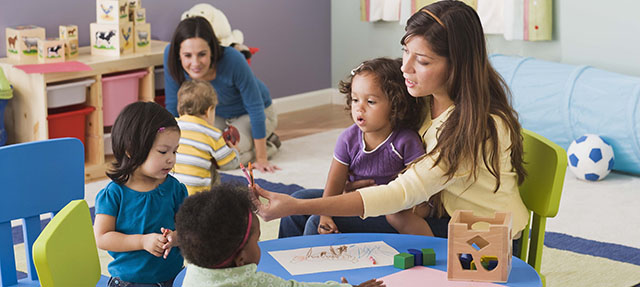
Of the state’s estimated 5.1 million essential workers, about 1.9 million have children younger than 13. These parents may be having difficulty finding care for their children amid the COVID-19 crisis, with most schools closed and many child care providers shuttered.

To address this need, the California Department of Education issued guidelines last Thursday for temporarily restructuring state-provided child care services. Parents who are essential workers can apply for services during the pandemic even as the state continues to prioritize certain at-risk children regardless of parents’ occupations.

Child care programs that receive state funds are now encouraged to remain open—or to reopen—if they can safely do so in order to care for the children of essential workers. To be eligible, all parents in the household must be essential workers and require child care so they can continue working (for example, they do not have the option to work remotely).

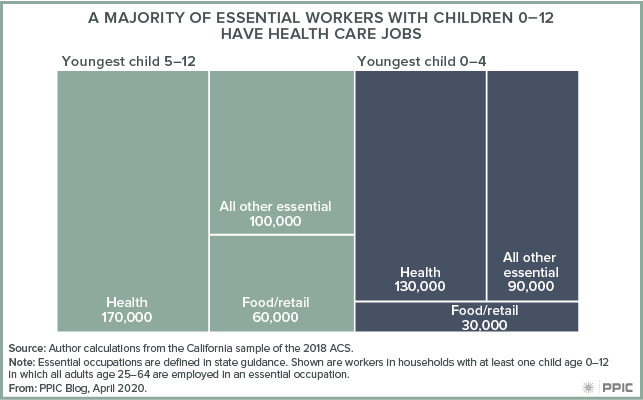
More than half a million essential workers with about 640,000 children younger than 13 could qualify. About 43% of these essential workers have a youngest child between 0 and 4 years old at home, while the rest have older children. Most of these parents work in health-related occupations, which are prioritized in the guidelines to receive child care services.

figure - A Majority of Essential Workers with Children 0-12 Have Health Care Jobs

On Monday, Governor Newsom announced that $100 million of the funds allocated in SB 89, emergency legislation to fight the coronavirus pandemic, will go toward funding up to 20,000 more short-term child care slots—and making child care programs safe for those children and their teachers. The CARES act provides federal funds to states for these purposes, so California will recoup these expenditures.

While we don’t know how many state-subsidized programs have remained open, even in the best of times the number of spaces is limited so most children—including those in low-income families—cannot access such care. However, demand for child care is indicated by the number of children in low-income, essential worker families. During this emergency, essential worker families do not need to show they are low income when they seek child care. However, programs are instructed to prioritize families.

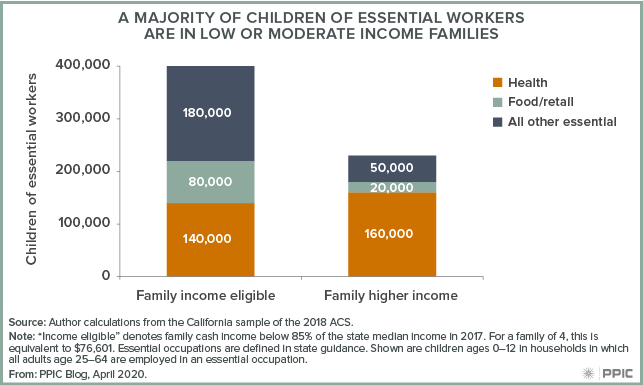
About 400,000 children in essential worker families live on incomes below 85% of the state median—the income cut-off for state preschool in normal times. While a majority of parents in essential jobs work in health occupations, most low-income children have parents working in other essential occupations. In other words, tension may arise between serving children of low-income essential workers and serving children of health workers.

figure - A Majority of Children of Essential Workers Are in Low or Moderate Income Families

In this time of uncertainty, the state has existing capacity to support child care, and it has shifted the goals of state-supported programs to help essential workers meet—and afford—their child care needs. By tracking the response, the state could gain insight into whether it is meeting the needs of essential workers in this difficult time, how to meet these needs in the longer term, and to what extent needs vary across the state.

Unemployment Benefits in the COVID-19 Pandemic

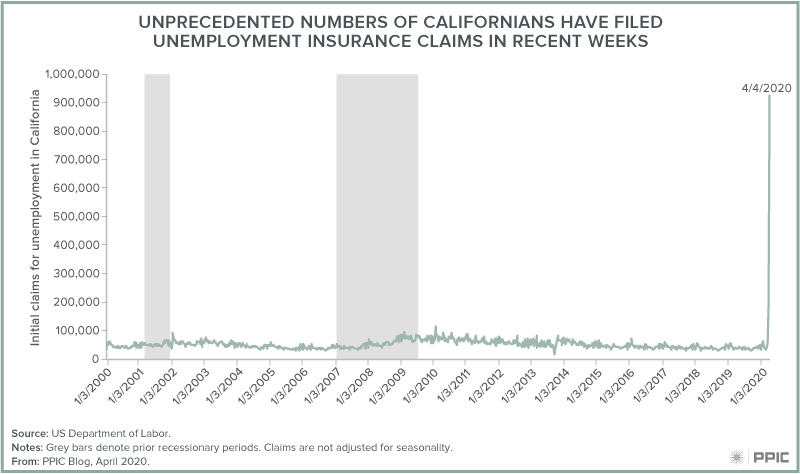
Today, the US Department of Labor revealed that 925,450 Californians filed initial unemployment insurance claims during the week ending April 4. This makes for a record-breaking three-week period during which nearly two million claims were filed in California, representing roughly 10% of the labor force. What kind of benefits can these millions of newly unemployed workers receive?

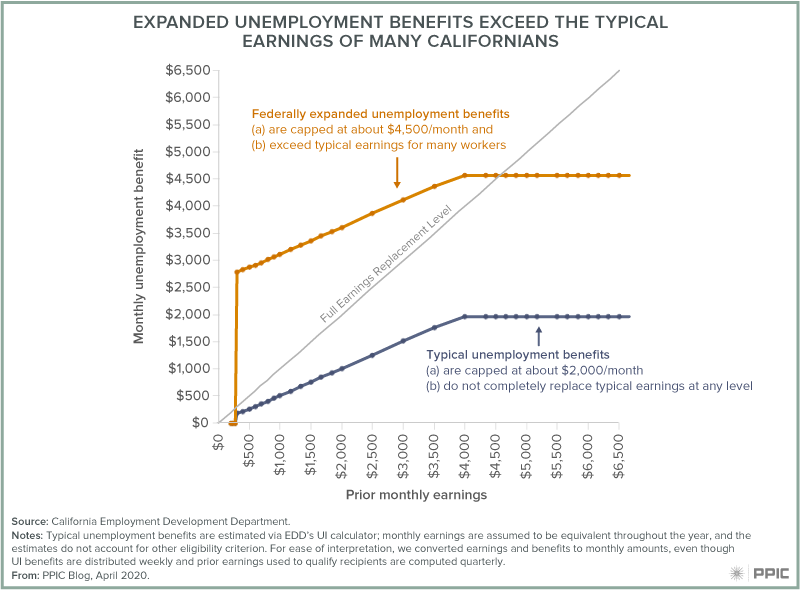
Typically, Californians who qualify for unemployment receive a maximum of $450 per week as long as they are actively looking for work, and that assistance can last for up to 26 weeks. (Notably, benefits in California are less generous than those in most other states: in 2019, its average weekly benefit of $345 ranked 29th.) However, federal policymakers are responding to unprecedented circumstances; so far, they have expanded both eligibility and benefits.

Federal legislation temporarily expands eligibility. The Coronavirus Aid, Relief, and Economic Security (CARES) Act makes self-employed Californians—including gig workers and other independent contractors—who are unable to work or have had hours reduced by COVID-19 eligible to receive benefits. Also, laid-off workers who expect to return to their current jobs are not required to be searching for work.

The new law also supplements and extends benefits. The CARES Act provides $600 per week on top of typical benefits for up to four months. This represents a dramatic boost for most unemployed Californians. The legislation also covers the cost of a 13-week extension of benefits, so that laid-off workers can now receive unemployment for up to 39 weeks.

Unemployed Californians who earn less than $4,000/month would normally qualify for a benefit that replaces roughly half of their earnings, and the benefit covers a smaller and smaller share of earnings above $3,894/month. The $600 federal supplement is higher than California’s maximum benefit and more than covers prior earnings for many unemployed Californians.

It is likely that workers in the state’s hardest-hit sectors make up a large share of early applicants for unemployment benefits. In the accommodation and food service industry—one of the hardest-hit sectors—the average monthly wage is roughly $2,000; an unemployed worker could receive up to $3,700 per month. The average worker in transportation and warehousing, another impacted industry, earns more than twice as much ($5,000/month), but unemployment benefits for this worker would be only slightly higher: up to $4,550 per month.

These expanded benefits will help millions of newly unemployed Californians, but the state and its workers face important limitations and challenges. Given the massive surge in applications, workers may have to wait several weeks—or months—to receive benefits. Moreover, laid-off immigrants who are unauthorized to work in the US will have to rely on other support.

More generally, California’s unemployment insurance fund reserves are inadequate to weather even a mild recession, although the federal government steps in to loan the funds when needed. In the longer term, policymakers should seriously consider reforms to the unemployment system, so that it can respond quickly and comprehensively in the next economic crisis.