COVID-19 Will Make California Elections Challenging but Doable

California’s November 3 general election could come in the midst of a new viral surge. This poses tremendous risks to voters and poll workers at in-person voting sites. Even if we wanted to have the same number of polling places, it might be difficult to find volunteers willing to staff them.

The good news is that the transition to a safer approach, while challenging, is more manageable in California than in most states.

One option is off the table: postponing the fall election. Many states have postponed their primaries, but postponing a general election would require congressional approval and would run up against deadlines hardwired into the U.S. Constitution.

Instead, we must get as many voters to cast ballots by mail as possible. In most states, such a switch would be complicated, but California has long been friendly to vote by mail (VBM). California’s VBM rate is very high and growing. Almost two-thirds of ballots in the 2018 general election were either mailed in or dropped off at a polling place.

Fourteen counties have rapidly increased their VBM capacity already by sending every registered voter a VBM ballot by default. They have also replaced polling places with a smaller number of “vote centers” that are open to any voter in the county and for early voting before Election Day. Almost a quarter of registered voters are now covered by this system, up from 7% in the fall of 2018.

Five of these 14 counties switched to this new model in 2018 and saw the share of ballots cast by mail increase an average of 20% from the 2016 general election. Preliminary evidence also suggests the reform slightly increased turnout without negatively impacting underrepresented groups like Latinos, Asian Americans, and young people.

COVID-19 will move elections across the state closer to this model. Governor Newsom has mandated something like this for the special elections coming in April and May. Though this is a realistic path forward, it is not without obstacles. Preparation time is short. And the risk of infection will alter the siting and staffing of in-person options, even in experienced counties.

Furthermore, initial positive experiences in vote center counties may not translate to the rest of the state. A chaotic transition could create unforeseen problems that prompt some to throw up their hands and not vote at all. Young people and voters of color are more likely to use in-person voting, so great care must be taken to ensure they receive news of the change, trust that the change is being done fairly, and have options besides VBM if they want them.

Fortunately, California is well positioned here, too. Organizations like the Future of California Elections have helped make the state a national model for robust communication between election administrators and stakeholders.

The task is daunting, but we have little choice. Our best hope for a safe and fair election is to expand vote from home options as much as possible. The question is not whether to do it, but to recognize the challenges and work to mitigate them as much as possible.

Counting Californians and Holding Elections in a Pandemic

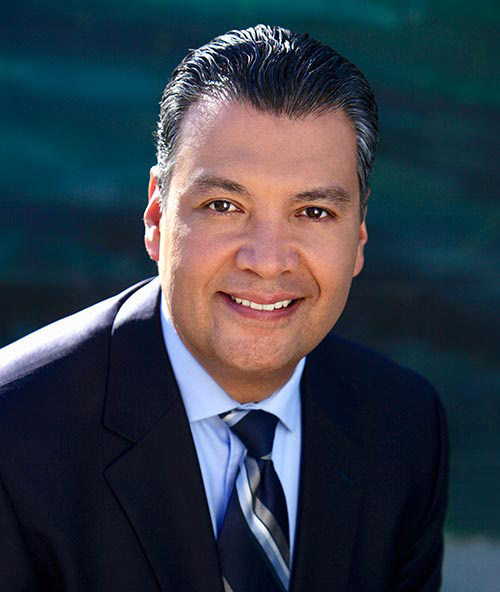
Today is Census Day, the day to count everyone living in the country in 2020. It’s not the deadline for responses—you have until August 14 to complete your census form—just the “anchor day” for counting those living in your household. We talked to California Secretary of State Alex Padilla about the challenges the COVID-19 pandemic brings to counting Californians—and for holding elections in November.

Photo - Alex PadillaPPIC: What challenges does the pandemic bring to conducting the census?

ALEX PADILLA: Ensuring a fair and accurate count is tough under normal circumstances, and it’s made more challenging by this global health pandemic. A lot of the state and local strategies for engaging the public on the census have had to be modified or replaced with ones that are more effective when people are staying at home. The good news is, this is the first time it’s been possible to do the census online, as well as by phone or paper. We’re seeing people get more creative at staying in touch while keeping their distance, whether through video chats with their coworkers or using teleconferencing to stay in touch with family and friends. We can also use these methods to remind everyone to do the census.

It’s really important to remember that participation in the census is how we ensure our communities receive their fair share of federal dollars for critical needs such as public health, education, public safety, housing, and infrastructure. This message is really striking a chord right now.

PPIC: As they shelter in place, what can Californians do to help ensure an accurate census count?

AP: Every Californian should participate in the census, but also remind people they’re in touch with to do so. Assuring a complete and fair count depends on everyone doing the census. It’s not just a count of adults or voters or citizens; it’s for everybody living here.

California has an especially high number of hard-to-count populations—for example, communities of color, young people, and immigrant families and communities. More than 70% of Californians fit into a hard-to-count category. It already takes extra effort to ensure participation by these groups. The pandemic is not making the job any easier—at a time when the job is more important than ever for ensuring the state gets its share of federal funding for critical needs over the next decade.

Based on the prior census 10 years ago, California’s most undercounted population were kids under five years old. My youngest just turned five, and especially now with all the kids at home, it’s hard to imagine forgetting to include him as he’s the loudest member of our household! Today, kids who weren’t counted in 2010 are now teens who’ve been in school for years, but their schools haven’t been getting their full share of federal education dollars. It’s a very tangible way to think about it, and it shows the importance of the census for our quality of life.

There are many options for participating in the census. Go online or call in today. Once you’ve submitted your information, help us by spreading the word with neighbors you’re checking in on and friends and family.

PPIC: Talk about the administration of the upcoming election.

AP: To put it in context, we should recognize that throughout the nation’s history, Americans have gone to the polls—in times of war, during the Great Depression, and even during the deadly 1918 flu pandemic. So it’s not a matter of if or when we’ll hold the election. We have a date: it’s Tuesday, November 3. It’s a matter of how we hold the election in a way that is accessible, secure, and healthy for everyone—voters, elections personnel, poll workers. Many things California has championed to get more people voting really make a lot of sense in an era of public distancing. You can register to vote online. Voting by mail and in-person early voting are good ways to avoid crowds. We’re diligently working on expanding those opportunities.

COVID-19 and California’s Census Count

The COVID-19 crisis has upended the carefully laid plans for the 2020 Census in ways that might have disproportionate effects on California’s count. The Census Bureau is making important adjustments, but California needs to be particularly vigilant about the potential consequences.

The Bureau began its self-response period on March 12, when it started mailing out invitations to participate in the census to virtually every household in the country. Self-response remains the safest and simplest way to gather census data because, unlike in-person interviews, it does not raise the risk of coronavirus exposure.

The virus has altered almost every other effort the Bureau had planned. The Bureau always does extensive follow-up with households that fail to self-respond. More people are likely to need follow-up in California than in the average state, so problems with that process will be felt more acutely here. Follow-up is generally in person, which raises risks that didn’t exist just a few weeks ago; at least one census worker has even tested positive for the virus. To accommodate some of these challenges, the Bureau has delayed hiring and pushed back both the start of the follow-up (from May 13 to May 28) and the cutoff date for completed self-response forms (from July 31 to August 14).

The Bureau’s plans for counting those in less conventional living arrangements have been upended as well. The original plan for group quarters such as college dorms and senior living facilities was to send out a census worker to collect information for the entire facility from a contact person. College students are supposed to be counted as if at school, but many have been sent away from their campuses. And senior facilities are protecting their highly vulnerable residents by strictly limiting access. The Bureau is exploring alternative approaches.

People who are homeless, particularly those living on the street or in cars, are especially difficult to count. Estimates suggest that homelessness is a bigger and faster-growing problem in California than in almost any other state. The Bureau had planned to count homeless people wherever they happened to be from March 30 to April 1. But the homeless population is especially vulnerable to the virus, and sending census workers out to count in person would put the workers and their communities at risk. The Bureau has delayed this effort by a month to lower the risk of contagion.

Finally, the Bureau does a wide range of communications work just to get the message out that the census is happening and is important. The Bureau’s carefully developed media campaign is likely to be overwhelmed by news about the pandemic. Moreover, a significant amount of outreach was to be conducted in physical spaces by trusted messengers in each community. All of that will need to be rethought. Not only are large gatherings generally banned, but most community spaces are closed.

Though there is some scheduling flexibility, a hard deadline looms. By law, the Bureau must submit total state populations to the president by December 31 so that congressional representation can be adjusted to reflect changes in population over the previous 10 years. This is the most basic constitutional function of the census. Changing that deadline would require congressional approval and could complicate the process of redrawing the lines of representational districts.

These challenges are significant, but a strong performance during the self-response period will mitigate them. PPIC will be monitoring and providing key analysis of the self-response process to help ensure that the state is in the best possible position before the follow-up period begins.

Video: Fiscal Challenges of Declining Enrollment in California Schools

Enrollment declines in California’s public K–12 school system are expected to intensify in the coming decade. Districts with falling enrollment face financial pressures, as state funding falls along with the number of students they serve. Lower enrollment also has important implications for the state budget. At a lunchtime event in Sacramento last week, PPIC researcher Paul Warren outlined a new report on declining enrollment and a panel of experts offered state and local perspectives.

Warren explained that enrollment is falling in about half of California’s school districts. In the coming decade, declines will be significant in coastal areas—and in many of the state’s largest school districts. The state budget cushions the fiscal impact of declines in enrollment by delaying attendance-based funding cuts for one year. But enrollment declines are almost always long term, and district costs do not fall at the same rate as district revenues.

Renee Arkus, executive director of fiscal services for the Long Beach Unified School District, said that adjusting to lower enrollment hinges on knowing the speed and the spread of declines. Long Beach, the state’s third-largest district, has been experiencing declines for 15 years. “We’ve lost 25% of our population,” she said, adding that the district has been losing 1,500 to 2,000 student each year, and those losses have been spread across a number of schools.

Sara Bachez, assistant executive director of governmental relations for the California Association of School Business Officials, noted that declining enrollment is one of many fiscal pressures districts are facing. She cited a growing demand for special education, pension and health care costs, aging infrastructure, and the challenge of offering proper compensation for district staff.

Claudia Davis, associate superintendent of the Calaveras County Office of Education, highlighted the challenges that small districts face. Like Long Beach, Calaveras County has been experiencing declines for the last 15 years. But because Calaveras is a small county, it is challenging to find ways to reduce spending. “We have district offices with three people in them,” she said, so cutting staff would have a big impact: “The work has to get done regardless of the size of your district.”

Mike Fine, chief executive officer of the Fiscal Crisis and Management Assistance Team, pointed out that the fiscal challenges that Calaveras County faces are typical, as more than half of the state’s districts serve fewer than 2,500 students. In his view, the best guide to addressing these challenges is the Local Control and Accountability Plan (LCAP) that each district is required to develop. “We have to clearly define what are our core services that we can’t do without, and then everything else is up for discussion,” he said.

Most districts could benefit from state assistance in forecasting and responding to declining enrollment. As Arkus put it, long-term planning is “the only way that some districts can survive this.” And Davis noted that small districts don’t have the human capacity for exhaustive planning. “Long-term planning is difficult when you’re . . . just trying to keep the doors open.”

Medi-Cal Expansion for Undocumented Seniors

Under the proposed expansion of Medi-Cal to undocumented seniors, vulnerable Californians would gain comprehensive health insurance. The policy improves access to care for individual seniors and could alleviate the financial burden on counties that serve undocumented immigrants in indigent care programs, increasing resources for other low-income groups.

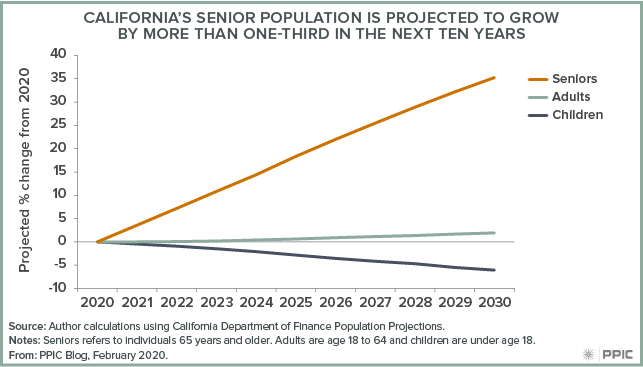
The senior population in California is projected to increase by over 2 million in the next decade, dramatically outpacing growth of younger groups in a demographic shift known as the Silver Tsunami. This increase, in particular among those in older age groups (75 to 84), will test California’s health care delivery and financing systems, because seniors are more likely to be disabled and to have complex or multiple health conditions than younger groups.

Figure - California’s Senior Population Is Projected to Grow by More than One-Third in the Next Ten Years

While most California seniors have health insurance—with Medicare being the most common—not all seniors have coverage. Many uninsured seniors are likely to be undocumented, making them ineligible for Medicare or to purchase coverage through Covered California, the state’s health insurance marketplace. These same seniors may have limited finances and therefore also are likely to struggle to access and afford health care.

Currently, most uninsured, undocumented seniors rely on safety net providers and a limited form of Medi-Cal that covers only emergencies, along with indigent care programs in certain counties that choose to cover undocumented immigrants. Under the expansion, these seniors would gain access to full-scope Medi-Cal, connecting them to preventive care and to programs to improve their disease management. Some expansion funds would also apply to the In-Home Supportive Services (IHSS) program, which pays for a caregiver—often a relative—to provide support for a senior to continue living at home rather than entering a costly long-term care facility.

The budget estimates state costs of $320 million for the expansion, which would benefit 27,000 individuals. If enacted, the policy could have implications for local finances. Counties in California provide health care and mental health services to the medically indigent, with some areas—most notably Los Angeles—serving undocumented immigrants. These county programs, together with community clinics and emergency rooms, are essential access points to health care for undocumented, uninsured seniors. If undocumented seniors become eligible for full-scope Medi-Cal, the state would finance their care instead of the county, where applicable. This shift could free up funding that could then be invested in other health-related county responsibilities, such as disaster preparedness, prevention activities, and substance use disorder treatment.

A complicated fiscal relationship between the state and counties, however, makes it difficult to estimate how much funding could be redirected if this group of seniors gain access to Medi-Cal. As state lawmakers consider the policy change, it will be important to consider how it may affect local and state finances.

Video: Countdown to Census 2020

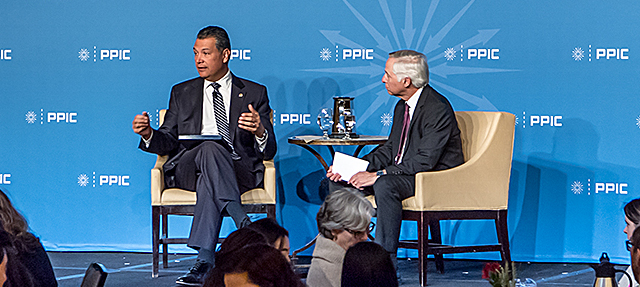
Census Day 2020 is fast approaching, and results from the population count will determine political representation and federal funding for California for the next 10 years. Speaking at a PPIC event in Sacramento last week, Alex Padilla, California secretary of state, joined Mark Baldassare, president and CEO of PPIC, to reflect on the importance of counting the country’s most populous state.

Padilla stressed that along with billions in funding for education, health care, and other critical areas, the count affects the state’s representation in Congress as well as lines drawn at all district levels. “It affects you regardless of the issues you care about, regardless of where you live,” Padilla said. He further emphasized that the census is a population count, not a citizen or adult count. In 2010, California undercounted children under five, which led to underfunded schools over the next 10 years. “Here is a way to make sure schools get the funding they deserve without raising taxes.”

Following the conversation with the secretary of state, Sarah Bohn, PPIC vice president of research and senior fellow, convened an expert panel that expanded on strategies at the frontlines for reaching hard-to-count communities.

Assemblymember Marc Berman discussed the investment by California— which has directed $187 million toward census infrastructure at state, regional, and local levels—that sets the groundwork for outreach and coordination. Partner organizations are now pushing a public awareness and information campaign. “Nobody has ever tried anything like this in a state of 40 million people at the level of specificity and detail that we really need to be successful,” Berman said.

Success depends on participation, however, and trust in government can influence participation in the census—especially among hard-to-count groups who may feel suspicion of the federal government. Apathy is another obstacle. Carolyn Coleman, executive director for the League of California Cities, described how the census returns funds to communities: “We send a lot of dollars to Washington, DC, every year via the tax code, and this is one of the most important ways we get those dollars reinvested back into our communities.”

It takes coordination by trusted messengers to reach hard-to-count groups and communicate this idea. Ditas Katague, director of California Complete Count, said, “We have amazing partners on all levels—whether we’ve contracted them, whether they are foundations, whether they’re state agencies.” Katague outlined efforts by a Sacramento organization mapping territory from the Oregon border to Yolo County, and San Diego ambassadors doing outreach in Arabic, Kurdish, Farsi, Vietnamese, and Somali. Regions are playing to their strengths: Silicon Valley is emphasizing tech; the San Joaquin Valley is partnering with faith-based organizations.

Californians can participate in the census starting in March, and assistance centers around the state will offer help through April. Katague emphasized the importance of motivating others to complete it, saying, “There are 9 questions on the census. It takes 10 minutes to secure the future for the next 10 years.”

Video: A Conversation with Governor Gavin Newsom

Governor Gavin Newsom’s conversation with PPIC president Mark Baldassare last week focused on energy policy and climate change. After noting that it had been one year since PG&E declared bankruptcy, Baldassare asked the governor about his vision for the future of California utilities. Newsom responded by broadening the question. “We have to start thinking about our energy future and our transportation future and our low-carbon, green growth future in a collaborative mindset.”

In this context, he continued, “PG&E’s bankruptcy has turned out to be an extraordinary opportunity for this state. . . . It’s allowed us to ask questions . . . that otherwise weren’t front and center.” PG&E, he said, has to come out of bankruptcy with a vision for the future that prioritizes long-term thinking and public safety rather than shareholder return. The bottom line? California needs a “transformatively different” utility. And, he added, “if PG&E can’t do it, we’ll do it for them.”

Key to planning for the state’s energy future is making sure it works for all Californians. Going green, Newsom said, “can’t mean more income inequality.” It has to benefit both the “haves” and the “have nots”—creating jobs and ensuring affordable energy, and mitigating the dislocation that comes with change.

Another key area is wildfire mitigation and prevention. Newsom noted that the 2019 fire season was less damaging than other recent seasons, in part because “we’ve never been more prepared.” The state has been investing in new technology that monitors and predicts wildfires, as well as equipment for suppressing fires and responding to crises.

Wildfire prevention is complex, in part because, as Newsom pointed out, the federal government owns the majority of forest land in California. “We are doing the job the federal government is no longer doing,” Newsom said, adding that “the Trump administration’s budgets have been proposing cuts to forest management.” Land-use patterns are another complicating factor. New building codes have helped recently built housing survive fires, but there are a large number of older buildings in fire-prone areas.

As Newsom sees it, the challenge of implementing the state’s ambitious climate mandates is to bring politics and policy into alignment. “Politically, I recognize that what’s necessary may be impossible. But also I recognize from a policy perspective that what is impossible has to become necessary.” The ultimate goal, of course, is to move California forward: “The world is changing. We have to change with it.”

Video: A Conversation with Leon Panetta

Leon Panetta, former secretary of defense and CIA director, joined PPIC president Mark Baldassare in Sacramento last week for a wide-ranging conversation about leadership. Baldassare began by asking Panetta to “put on your CIA hat” and compare the targeting of Osama bin Laden during the Obama administration with the recent killing of Iranian general Qasem Soleimani. The main difference, Panetta said, is that bin Laden had directly attacked the United States, and that he and other Al-Qaeda leaders were almost certainly planning more attacks.

Panetta explained that the Obama administration “never seriously considered an attack on Soleimani,” because “the result would be that we would increase the chances of war with Iran.” The issue was not whether Soleimani was a “bad actor,” but whether the US wanted to escalate the conflict: “When you make those kinds of decisions, you ought to damn well consider the risks of war.”

For Panetta, the tense situation with Iran underlines the importance of leadership. “In a democracy we govern either by leadership or by crisis.” Leadership, he continued, involves actively addressing major challenges—and this, in turn, entails uncertainty and risk. “If you’re not willing to take the risks associated with leadership . . . , crisis will drive policy in this country.”

Panetta sees impeachment as “a reflection of our times”—we have “a president who doesn’t abide by moral boundaries” and a Congress that “can’t work together.” But he is hopeful that the Senate will deal with the trial “in a fair and impartial way.” Otherwise, he continued, “there is a danger that impeachment is going to become just another political tool.”

Asked to assess how things are going in California, Panetta identified three interrelated leadership challenges: political imbalance, economic inequality, and education. To have a chance of restoring political balance in Sacramento, he said, Republicans are “going to have to look at immigration . . . inequality . . . climate change.” At the same time, the state’s Democratic leadership will have to collaborate with a broad range of stakeholders to tackle economic inequality—and its efforts will need to include a focus on education, which “is absolutely critical to the future of California.”

While Panetta is clearly worried about the level of dysfunction in Washington, he is not entirely pessimistic. “I’ve seen Washington at its best and Washington at its worst. The good news is that I’ve seen Washington work!” More seriously, he stressed the need for people to engage in the political process: “They’ve gotta be willing to fight for what they believe is right.” He conceded that politics “has gotten tougher.” But, he added, the great satisfaction of being involved in our democracy is that “you can do things to make people’s lives better.”


Governor’s Budget Seeks to Build Water Resilience

Earlier this month the Newsom administration laid out its vision for addressing the linked issues of water and climate in two key policy documents: the much-anticipated draft of its Water Resilience Portfolio (WRP) and the governor’s budget proposal. The WRP, which resulted from an April 2019 executive order, was developed with extensive input from state agencies and stakeholders from around California. It outlines more than 100 actions designed to ensure that communities, the economy, and ecosystems across California’s diverse regions are able to weather our increasingly volatile climate. The January budget provides a roadmap of the administration’s initial spending priorities in this area.

The big ticket item is the $4.75 billion Climate Resilience Bond, which could appear on the November 2020 ballot. More than 60% of the bond amount would directly support actions in the WRP—including integrated regional water projects, safe drinking water, flood protection, and environmental stewardship. The remainder would address other climate resilience issues for California communities—including reducing risks from wildfire, sea level rise, and extreme heat—and closing the funding gap for restoration efforts in the troubled Salton Sea.

General obligation bonds—which are repaid through the state General Fund—have been a key tool for funding water and environment initiatives over the past two decades. Although they usually pass (eight of nine have been approved since 2000, totaling $39 billion in today’s dollars), voters rejected the most recent water bond—an $8.9 billion bond on the November 2018 ballot.

The administration also proposes a modest allocation of General Fund dollars to near-term actions on the portfolio’s long to-do list. Key areas of investment include:

  • Groundwater sustainability: Groundwater is an essential drought reserve. This year, local agencies and water users in the state’s most stressed basins will begin implementing the landmark Sustainable Groundwater Management Act to bring their basins into balance. The budget proposes to spend $60 million on the hard work of reducing water demand in ways that support local communities and economies, such as water trading and making the best use of fallowed cropland.
  • Better data for decision making: The WRP emphasizes the importance of modernizing data use to make the most of our water resources, and acknowledges the key role of the state as a data collector and developer. Of note is the proposed allocation of $80 million toward development of statewide LiDAR maps—landscape contour images that can help guide investments in habitat improvements and efforts to reduce risks from flooding and sea level rise.
  • Cutting “green tape”: The WRP also stresses the importance of improving the approval process for projects designed to enhance the natural environment, which is especially vulnerable to climate change. The current process, which involves many agencies, causes lengthy and costly delays. The budget proposes to reduce “green tape” by allocating $4 million for new staff positions to help make the approval process more efficient. Even modest additional resources, coupled with strong direction from state leadership to agency staff, could help California move toward truly coordinated, expedient, and effective stewardship of our natural environment.

The administration’s proposals provide much food for thought about state priorities in the California water arena. The WRP in particular emphasizes the state’s role in facilitating and supporting efforts at local and regional levels, where most water investments take place. In the coming months, there will no doubt be a lively debate about the specifics of the Climate Resilience Bond—which must be finalized by early summer to qualify for the ballot—as well as the other ways the Newsom administration and the legislature can help the state’s communities, economies, and environment build water resilience.

Governor Newsom Proposes New Investments in Math and Science Teachers

The governor unveiled his proposed 2020-21 budget last week, which includes record-high levels of K-12 and community college funding—a $3.8 billion dollar increase over last year. This includes $900 million for K–12 educator recruitment and development, building on a nearly $150 million investment from last year’s budget.

These new investments are an attempt to address the statewide teacher shortage, which is most acute in the high-need subjects of math and science (special education is also a high-need area). The hope is that these investments will pay dividends in improving the size and the quality of the teaching force in these subjects, which are important for college success and for jobs in the 21st century economy.

Most notably, the proposed funding includes one-time increases to address teacher shortages in key ways:

  • $350 million in competitive grants for teacher professional development
  • $193 million to address teacher shortages in high-need subjects
  • $175 million for residency programs to prepare and retain teachers in high-need subjects
  • $100 million to fund $20,000 stipends for teachers in high-need subjects at a high-need school for at least four years

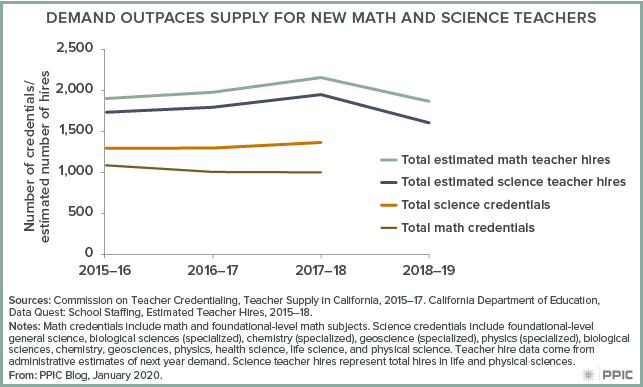
Schools across the state face critical teaching shortages in math and science, leading many schools to increase their reliance on less-credentialed and less-experienced educators. Difficulty in staffing these subjects also means that some schools must reduce course offerings, impeding student access to math and science coursework. Indeed, the number of new math and science teaching credentials has not matched demand for such teachers in recent years. In fact, the number of new math credentials has actually fallen over the past two years, constraining schools in both hiring and course offerings.

figure - Demand Outpaces Supply for New Math and Science Teachers

These continued shortages have important implications for student opportunities in STEM fields. For example, nearly one-third of high school graduates do not meet current UC and CSU requirements for science coursework, and many schools do not have the number of teachers required to offer three or four years of math and science to all interested students. Proposed increases to science eligibility requirements for UC admission—and for math requirements at CSU—mean that increasing the supply of qualified new math and science teachers is more essential than ever. Continued shortages will make it difficult to both accommodate this increased demand and to address equity gaps in the availability of high-quality math and science coursework.

In this light, the governor’s proposal provides reason for optimism. Increased funding for teacher recruitment and retention should help to encourage young adults to enter teaching and retain those who do. And more money for training and development should help to ensure that schools are able to choose among qualified teachers. Whether this will be enough to truly make a dent in the state’s teacher shortage remains to be seen; it depends crucially on whether these investments will be continued in future years or end up as one-time relics from a strong budget year.