Video: A Conversation with Chief Justice of California Tani G. Cantil-Sakauye

Last Thursday, at a lunchtime event in Sacramento, PPIC president Mark Baldassare talked with Tani Cantil-Sakauye, California’s chief justice and the leader of the state’s judicial branch. Their conversation covered a wide range of challenges and opportunities facing the courts today. In particular, Cantil-Sakauye spoke about civic education, the collaborative courts, and the critical importance of self-evaluation in the judicial branch.

Cantil-Sakauye is known for her efforts to make the courts accessible and understandable to all Californians. She became convinced of the need to educate the public about the judicial branch after the state judiciary was hit hard by budget cuts during the Great Recession. Cantil-Sakauye recalled that state legislators responded to her pleas for adequate funding with “quizzical looks” and questions: “‘What agency are you from? . . .Which chief are you?’ . . . And I thought a civics education initiative might be in order!“

She launched an initiative called the Power of Democracy in 2012: “Judges and lawyers, the president of the California Chamber of Commerce, labor unions, and scholars come together to teach civics to K–12 and also adult students.” In her view, helping Californians understand that “the courts exist for you to press your rights” empowers them to advocate for themselves and their communities.

Asked to name her greatest accomplishments, Cantil-Sakauye pointed to collaboration, civility, and problem solving. “The California judiciary is a collaborative, problem-solving entity,” she said. Indeed, California has led the nation in collaborative courts—community-based courts that specialize in issues such as homelessness, landlord-tenant disputes, domestic violence, veterans, or behavioral health. These courts address underlying problems by connecting people to services and programs that can help get their lives on track. As Cantil-Sakauye put it, “The whole point of a collaborative court is to end recidivism.”

The chief justice is especially proud of the judiciary’s willingness to evaluate itself: “We ask ourselves how we’re doing and we’re honest when we’re not doing well.” A case in point is bail reform. Questions about the efficacy and fairness of bail prompted the chief justice to form a committee to study the issue. After looking at the evidence and hearing from a wide range of stakeholders, the committee unanimously recommended the elimination of cash bail “because it does not serve the purpose of protecting the community or ensuring a person’s return to court.”

The bail reform law signed by Jerry Brown last year is being contested—voters will decide its fate in November. But efforts to improve bail and other aspects of the judicial system will continue. As Cantil-Sakauye put it, “More and more, California courts are becoming social justice centers.”

For Many Californians, Poverty Is One Minor Expense Away

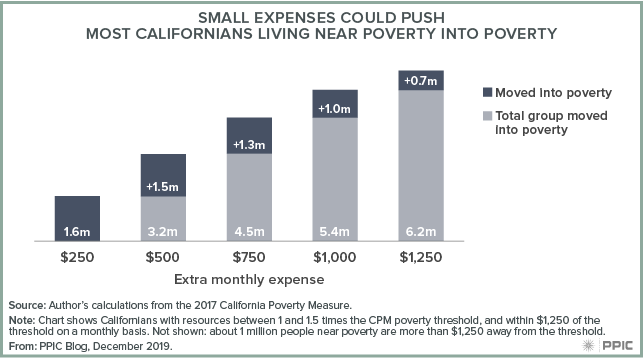
Add one extra expense and families living just above the poverty line could fall into poverty. Data from the California Poverty Measure (CPM) show that 7.2 million Californians live near poverty, that is, with just enough resources to meet their basic needs. All told, in 2017 as many Californians lived just above the poverty line as below it, or about 18% in each case. Even a small change, a monthly expense of $250 or less, could push 1.6 million people under the line.

We define “near poverty” to mean having resources worth 1 to 1.5 times the poverty threshold after taxes and necessary expenses. Since the CPM accounts for California’s varied living costs, the range for near poverty differs across regions. In Fresno County, a family of four who rents their home and has $25,900 to $38,900 in resources is near poverty, while in Santa Clara County, the same is true of a family of four with $40,000 to $60,000.

Because the poverty line is a blunt standard, “near poverty” includes families earning just a few dollars above the poverty threshold—even though a few dollars are unlikely to make it easier to make ends meet. This makes it especially important to understand how many Californians are near poverty, and how close those near poverty are to falling into it.

Californians can be pushed into poverty by the smallest expenses. Overall, people near poverty are more likely to be pushed into poverty by a small expense than a large expense. As expenses grow, the total number of people threatened climbs. Three out of four people near poverty, or 5.4 million, are pushed into poverty by an extra $1,000.

figure - Small Expenses Could Push Most Californians Living Near Poverty into Poverty

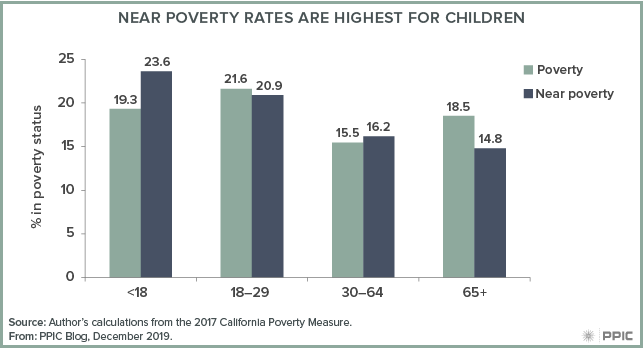
Near poverty affects young people more than it does older Californians, and children under 18 are more likely to be near poverty (23.6%) than in poverty (19.3%). Young adults and seniors, however, are more likely to be in poverty. Regional differences in living costs, opportunity levels, and the impact of existing policies and programs are key factors driving this variation.

figure - Near Poverty Rates Are Highest for Children

Without safety net programs, more people, and in particular, more families with children, would face poverty instead of near poverty: resources from programs including CalFresh and the federal and state Earned Income Tax Credits (EITCs) keep 7.1% of Californians out of poverty. Yet almost all people (93%) who move out of poverty via the safety net move into near poverty. This fact has implications for policymakers’ ongoing efforts to help ensure all Californians can meet their basic needs. As the state works to reduce poverty, strategies that promote economic mobility complement investments in programs like the CalEITC and the new Young Child Tax Credit.

Covering the Real Costs of College

Faced with the state’s high cost of living, California college students struggle to secure adequate food and housing. Even amid one of the largest and longest economic expansions in state history, 33% of students are housing insecure and 35% have low or very low food security, according to a California Student Aid Commission survey of 150,000 college students. As the state seeks to meet economic demand by producing more students with degrees and certificates, the full cost of college remains a barrier to progress.

Governor Newsom and the legislature have recognized the need to reform state financial aid programs to address the full cost of college. The 2019–20 state budget provided $41 million in ongoing funding to help colleges address food and housing insecurity, $19 million to support rapid rehousing programs, and increased the number of competitive state grants for non-traditional students from 25,750 to 41,000.  Additionally, the legislature increased the maximum award amount that students with children pay for non-tuition college costs from $1,672 to about $6,000.

However, broader reform of the state grant aid program remains elusive. Two recent bills sought to expand eligibility for Cal Grants by eliminating current age, time out of high school, and high school GPA requirements. The bills also sought to provide additional non-tuition aid to community college students and students in career education programs.  The bills did not make it to a vote; however, they will be re-examined in the next legislative session. Estimated at $2 billion per year, proposed reforms would nearly double the annual cost of the program.

Consequently, the California Student Aid Commission, the agency that distributes financial aid, intends to streamline these proposals to constrain costs while increasing access. Higher education is a vital tool that increases economic and social mobility; ensuring all students have equal access to an affordable education is paramount to modernizing California’s economy. An equitable and financially viable approach to financial aid will be critical if the state’s booming economy slows in coming years.

Video: A Path Forward for California’s Freshwater Ecosystems

“The current approach for ecosystem management is not working. We’re proposing an alternative path,” said Jeff Mount, senior fellow at the PPIC Water Policy Center, at a public briefing in Sacramento last week. He described two ways the current path is failing: in preserving the broad economic and social benefits associated with healthy ecosystems and in reversing the long-term downward trend in native biodiversity and ecosystem conditions. “The Endangered Species Act misses all that. It’s emergency room treatment” of a chronic problem, he added.

The event launched a new report that proposes managing more broadly for ecosystem health while still protecting species at risk of extinction. “We need diverse, complex, and varied ecosystems to recover species,” he noted.

A panel of experts brought real-world experience to the discussion. Panelists have worked on a plan to protect habitats for multiple species in the Upper Santa Ana watershed, a program to restore the San Joaquin River, and the effort to remove dams on the Klamath River, among others.

Heather Dyer, an endangered species biologist with the San Bernardino water district, said that in the Upper Santa Ana watershed, a large group of stakeholders is seeking to “reestablish a community of species” rather than solely focusing on one or two endangered species. She noted that improving the health of ecosystems requires planning at larger scales—and with the full landscape of regulators and stakeholders coming together to work things out.

Ali Forsythe of the Sites Reservoir Project noted that the hardest lift for large-scale projects is building trust among diverse stakeholders—especially when the project has had a long history of litigation behind it, as the San Joaquin River restoration did.

Lester Snow, now with the Klamath River Renewal Corporation, raised the issue of urgency for improving the health of the state’s freshwater ecosystems. Noting that the Klamath dam removal is already at the 13-year point with the four dams still standing, he said, “It’s these lead times that I think are killing us. Climate change and the change of our natural resource system are moving faster than we’re responding,” with grave implications for water supply reliability and ecosystem health. “We cannot have two decades of litigation and negotiation to address a problem that is critical today.”

We invite you to watch the event video.

Commentary: California Must Stop Relying on the Endangered Species Act to Manage the Environment

This commentary was published on CalMatters on November 5, 2019.

In California, state and federal Endangered Species Acts play an important and often outsized role in regulating water and land management. These powerful laws are also often at the center of conflicts between environmental and economic uses of water.

The state and federal acts have helped prevent the extinction of species and encourage better stewardship of water and the environment. But endangered species protection is often used as a proxy for protecting the environment, something the act are not intended to do. Here’s why we need a better tool.

Under the endangered species acts, state and federal agencies narrowly target regulations to protect listed species from direct harm and loss of critical habitat.

To illustrate, the recent dust-up between the Newsom and Trump administrations over proposed increases in water diversions from the Sacramento-San Joaquin Delta is mostly about actions affecting two endangered fish: Delta smelt and winter-run Chinook salmon.

This narrow focus ignores the fact that it is the ecosystems of the Delta watershed, and the diverse array of social, economic, and environmental benefits, that provide value to all Californians.

But given the narrow mandates of the acts, the arguments and lawsuits tend to focus on just one aspect of these ecosystems: the trade-offs between endangered species and water extraction.

To be clear, society places great value on native biodiversity and rightfully seeks to prevent extinctions. For many, protection of threatened or endangered species is a way to leverage improvements in the overall health of ecosystems.

Unfortunately, that is beyond the scope of the state and federal acts.

To promote healthy ecosystems and protect native biodiversity, California needs a different approach.

A new report by the Public Policy Institute of California’s Water Policy Center recommends that California adopt ecosystem-based management. This doesn’t require major reforms to state or federal endangered species acts. Rather, we recommend a shift in the way these acts are implemented.

Widely used in other countries and in marine fisheries and forest management in the United States, ecosystem-based management emphasizes improving ecosystem condition. The goal is to simultaneously protect native biodiversity while improving other uses of freshwater ecosystems.

It integrates human needs such as water supply and quality, flood risk reduction, hydropower, recreation, and spiritual uses into management objectives and promotes actions that create multiple benefits.

Importantly, this approach is consistent with the acts and other state and federal laws that govern water management. A growing body of research suggests that managing at the ecosystem level, rather than emphasizing the protection of a narrow range of habitat deemed critical, improves the likelihood of recovery of listed species. It also helps head off future endangered species act listings by improving conditions for all native species.

Shifting away from single-species to ecosystem-based management will not be easy. It requires three things:

  • The state needs to rethink planning and governance processes to include all beneficiaries of freshwater ecosystems, not just advocates for water supply and endangered fish. This includes finding new ways to align agency priorities and permitting rules—now a major obstacle to ecosystem improvement projects.
  • The state needs to use new tools that go beyond traditional regulatory approaches for environmental water, such as setting minimum flow and water quality standards. One promising approach is to create ecosystem water budgets, which can be stored and traded like a priority water right. This water can be flexibly allocated to improve ecosystem condition, and managed along with habitat changes to maximize benefits.
  • The state needs to incentivize and institutionalize ecosystem-based management. Given its broad water quality and water right authorities, and its mandate to balance all uses of water, the State Water Board should take the lead.

The board would set the criteria for ecosystem-based management plans and incorporate them into water quality control plans. Where possible, these plans would be supported by negotiated agreements between regulatory agencies, water users, and stakeholder communities.

We don’t need to start from scratch. Elements of ecosystem-based management are being employed throughout the state. For example, the Delta Stewardship Council and the Central Valley Flood Protection Board have plans to simultaneously improve ecosystem condition and human well-being.

A novel ecosystem-based approach to water and species management is being implemented in the Upper Santa Ana Watershed in Southern California. And the Newsom administration’s efforts to develop voluntary agreements for environmental water allocation in the Central Valley take a broad approach to improve ecosystem health.

These nascent efforts are not enough. Changing course will require commitment to new ways of planning and managing. Most importantly, it will require risk-taking and leadership from the water users, state and federal officials and legislators.

This won’t be easy. But the alternative is to keep doing what we’ve been doing, which isn’t working for anyone.

Video: Californians and Their Government

Joe Biden, Elizabeth Warren, and Bernie Sanders continue to lead the field in California’s primary race. Most Californians say President Trump should be impeached and removed from office, though views are mixed on how Democrats in Congress are handling the impeachment inquiry. In Sacramento last Wednesday, PPIC researcher Alyssa Dykman outlined these are other key findings from PPIC’s latest statewide survey, which was conducted before the November 20 debate.

Among Democrats and Democratic-leaning likely voters, support for Joe Biden (24%), Elizabeth Warren (23%), and Bernie Sanders (17%) is much higher than for Kamala Harris (8%), Pete Buttigieg (7%), and Andrew Yang (5%). No other candidate is preferred by more than 1%, while 9% say they don’t know which candidate they would choose.

Views on impeachment are divided along party lines: 83% of Democrats, 51% of independents, and 11% of Republicans think the president should be impeached and removed from office. Democrats are also much more likely than independents or Republicans to approve of the way the inquiry is being handled in Congress.

In other news, most Californians are concerned about wildfires (34% very, 29% somewhat) and power shutoffs (32% very, 27% somewhat). Governor Newsom gets mixed reviews for his handling of these issues: 46% of adults and 42% of likely voters approve, while 39% of adults and 46% of likely voters disapprove. Only about a third of Californians have either a great deal or quite a lot of confidence in their utility providers.

Other survey highlights:

  • Six in ten Californians (61% adults, 63% likely voters) say things in the US are generally going in the wrong direction, but about half think the nation will have good times financially over the next 12 months.
  • Nearly two-thirds of adults (63%) say California is divided into the “haves” and the “have nots”; 41 percent say they are haves, while 44 percent see themselves as have nots.
  • Most Californians are very concerned about homelessness in their communities; majorities across regions say the number of homeless people in their local community has increased over the past 12 months.
  • A potential citizens’ initiative that would raise state income taxes on the wealthiest Californians to fund K–12 public schools has majority support. Fewer than half of likely voters favor two other measures—a school construction bond and a “split roll” property tax—that would benefit the K–12 system.

Video: Counting the Central Valley

The 2020 Census is fast approaching, and the stakes are high for California—political representation and federal funding are on the line. The San Joaquin Valley, with a population of 4.3 million, may be one of the state’s hardest-to-count regions. In Sacramento last Friday, PPIC convened a discussion about how valley communities are preparing for the census.

California has long been home to high numbers of “hard to count” residents—including young children, renters, and immigrants. In 2020, the difficulty of counting all Californians will be greater than ever. PPIC researcher Joe Hayes outlined the challenges, which range from uneven internet access to a lack of trust: “Individuals are less likely to respond out of privacy concerns, on the one hand, but also out of distrust for the federal government.”

The good news is that state and local governments have invested heavily in outreach. Complete Count Committees have been established counties across the state, and community-based organizations are spearheading outreach efforts. To help guide these efforts, PPIC created interactive maps that show hard-to-count communities across the state. Maria Jeans, program coordinator for the Maddy Institute, moderated a panel discussion about the factors that make counting the Central Valley so challenging—and how challenges are being addressed.

Jesus Martinez, executive director of Central Valley Immigrant Integration Collaborative, highlighted the challenge of organizational capacity. As local preparations for the census got under way in 2018, he realized that “only a handful” of those who wanted to get involved “had any type of personal or institutional experience with the census.”

Don Saylor, a Yolo County supervisor, cited the difficulty of reaching remote rural settings across the Central Valley and the large numbers of farmworkers, language minorities, young children, and residences with multiple households. He included students enrolled at UC Davis and other colleges in the Central Valley—especially those “who are renters, living in different kinds of group settings”—as a hard-to-count population.

The panelists agreed that the fear generated by federal immigration rhetoric and policies are particularly challenging for the Central Valley. As a result, census outreach must focus on more than just making sure California gets its fair share of federal funding. As Martinez put it, “This is a human rights and civil rights issue for us now. It is the right of immigrants to be included in the 2020 Census.” Much of the outreach involves person-to-person conversations—canvassing and phone banking, “house meetings” among neighbors, and interactive media.

Cindy Quezada, senior program officer at Sierra Health Foundation, noted that encouraging people to participate is not the only challenge. “Sometimes people might want to participate but they don’t have a way to,” she said. “Either you’re living in a trailer in a backyard so you’re not going to get the invite and you’re not going to get an enumerator visit, or you may not speak a language that’s supported.” These structural barriers “are something we should really be paying attention to.”

How Did California’s Voter Registration Rate Get So High?

The most recent report on voter registration from the California Secretary of State offers startling news: the registration rate is now just above 80%, the highest it’s been before a primary election since World War II. With several months to go before the registration deadline, this rate is all the more remarkable considering the state’s population, which compared to other states is younger, more mobile, and less acculturated to voting—in part due to the high number of immigrants. As a result, eligible voters in California are especially challenging to mobilize.

What explains this incredible number? First, national politics has helped draw in new voters over the last decade. In the early 2000s, the state’s registration rate languished below 70%. Two presidential elections—the race between Barack Obama and John McCain in 2008, and the one between Hillary Clinton and Donald Trump in 2016—helped elevate that rate to about 76% heading into the 2018 election.

Second, the state implemented an important reform in April 2018. The California New Motor Voter (CNMV) program takes a fairly aggressive approach to registering eligible residents at the Department of Motor Vehicles. DMV customers getting a new driver’s license or state ID, renewing an existing one, or updating an address must now answer voter registration questions to complete their DMV transactions. If they don’t want to register they have to say so explicitly.

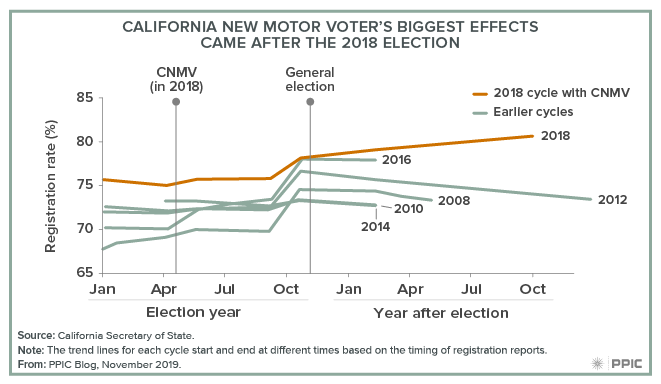
CNMV’s effect has been complicated. It has more than doubled the number of people registering at the DMV, from an average of about 140,000 per month to roughly 370,000. Yet most of these people were not new registrants. In fact, many aspects of registration in 2018 were unexceptional. The figure below compares the registration rate over time in every election cycle between 2008 and 2018. The rate already started higher in 2018—a consequence of the 2008 and 2016 elections. It then increased during the election season, but the increase was in line with previous years.

The real change has come since the 2018 election. In every past cycle, the registration rate has flattened or even fallen in the next calendar year. Excitement fades, and routine file maintenance removes more voters than the number who sign up. But an election doesn’t stop people from using the DMV, so under CNMV people have continued to register. The result is a steadily widening gap between registration now and registration at the same point in past cycles.

figure - California New Motor Voter’s Biggest Effects Came After the 2018 Election

It’s not clear from this gap whether more people will register by the 2020 election than would have without CNMV. Americans already seem unusually excited about voting, and enthusiasm often finds its way to the ballot box. Yet higher registration is not the reform’s only potential effect. In pushing so many to fill out a voter registration form, CNMV also helps keep the registration file up to date. This avoids glitches on Election Day that could prevent someone from voting.

Ultimately, whatever the cause, the registration rate is up. This hints at a new future for California. Unregistered Californians have traditionally been younger and more diverse than voters, with different views on policy issues. As the registration rate climbs, more of these residents become part of the voting public. Politics may be forced to change in response.

Video: Preparing California’s Water System for Climate Extremes

Climate change is stressing water management across California. This week the PPIC Water Policy Center hosted its annual half-day workshop in Sacramento to discuss how state and local leaders can help prepare California’s water system and ecosystems for greater climate volatility.

“California has the most variable year-to-year climate of any state in the lower 48,” said Ellen Hanak, director of the PPIC Water Policy Center. “This is expected to increase, with drier dries and wetter wets.” Water management of the future will “need to start managing our droughts for floods and our floods for droughts,” she added, because greater volatility will make it harder to manage multipurpose reservoirs for both floods and droughts at the same time. Flexible, multi-benefit approaches—and solutions that are aligned across agencies—are going to be increasingly important in tackling these complex challenges.

The first panel focused on managing fast- and slow-moving disasters—floods, fires, and droughts. Panelists discussed the impacts of the recent fires on communities and local water systems, and the types of tools and partnerships that can help minimize risks. Tim Ramirez of the Central Valley Flood Protection Board described the significant and increasing flood risk in the San Joaquin Valley and called for a flood bypass to protect the growing Stockton region. And Michael Thompson of Sonoma Water called for funding from the state to support the “collaborative infrastructure” that will enable agencies to work together more effectively.

A panel on safe drinking water summarized the current status of the problem and discussed how to best use the new Safe and Affordable Drinking Water Fund to ensure that the water delivery system works for everyone. “I think that in five years we want to see every child in California has safe drinking water in their home,” said Jonathan Nelson of the Community Water Center. “The way we do that will be through multiple strategies, but that’s the vision we want to work toward, and ideally, as quickly as we can.”

Darrin Polhemus of the State Water Board said small water systems pay more for their systems and supplies, have a lack of management and technical capacity, and are particularly hard hit by water contamination and shortages. He noted that “we have to change this whole paradigm” to help improve how small water systems operate.

The final panel brought key state officials to the stage to discuss the governor’s water resilience portfolio, now being developed to address the challenges of a more volatile climate. Wade Crowfoot, secretary of the California Natural Resources Agency, said a top priority is to make it easier to help the environment and get multiple benefits out of water projects. “Permitting wetlands restoration is the exact same process as permitting a strip mall,” he said. “So while we’re threatened by climate change and our ecosystem is under unprecedented threat, state government makes it really expensive and slow to get [such projects] done.” He said his agency is committed to cutting “green tape” that slows ecosystem restoration projects.

Sounding a particularly hopeful note, Karen Ross, secretary of the California Department of Food and Agriculture, said we have “an opportunity of a lifetime for farmers to step up and identify how they can be part of the solution to climate change.” She noted that farm practices can sequester carbon while also building resiliency to help farms weather droughts and floods.

We invite you to watch the videos from this event:

Do Californians Support the Proposed School Bond?

When Californians go to the polls in March, they will not only cast a vote in the presidential primary—they will also vote on an education bond to fund construction and modernization projects. Given differences in support for the bond across the state’s regions and demographic groups, turnout will play a pivotal role in whether this measure passes.

In the closing days of the legislative session, the legislature passed and the governor later signed a bill placing Proposition 13 (the Public Preschool, K–12, and College Health and Safety Bond Act of 2020) on the March ballot. If approved by voters, the measure would authorize $15 billion in general obligation bonds to pay for the construction and modernization of California’s public schools, community colleges, and four-year colleges.

The September PPIC Statewide Survey took an initial look at support for this proposition. While two-thirds of Californians (66%) are in favor, 54% of likely voters say they would vote yes—just slightly above the majority needed to pass.

Are some Californians more likely than others to support the bond measure? Unsurprisingly, there is a wide partisan divide, with three in four Democratic likely voters (76%) saying they would vote yes compared to just three in ten Republicans (29%). Overall, independent likely voters are divided (48% yes, 44% no). But among Democratic-leaning independents, nearly two in three (64%) are supportive.

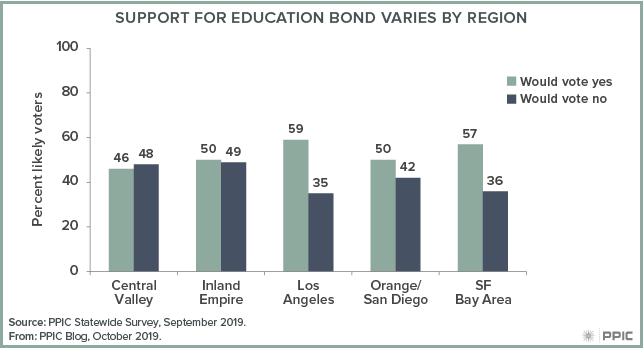
Support varies across regions, with Los Angeles (59%) and San Francisco Bay Area (57%) likely voters expressing the most support, compared to about half of likely voters elsewhere in the state.

figure - Support for Education Bond Varies by Region

While support is similar among likely voters with (55%) and without (53%) children in the house, there are differences across other demographic groups.

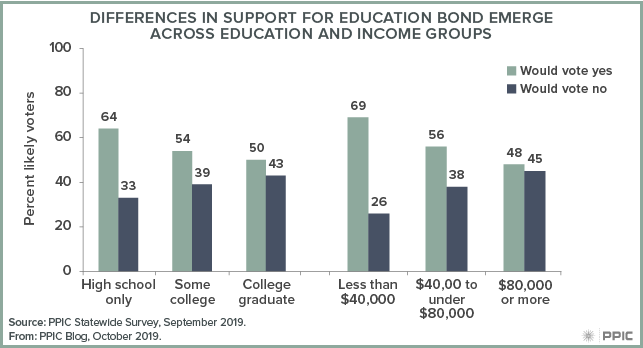
White likely voters (47%) are much less likely than Latinos (74%) and those of other racial/ethnic groups (62%) to say they would vote yes. And since school construction bonds are often paid off by property taxes, it’s notable that homeowners (44%) are far less likely than renters (71%) to say they would vote yes. Support is higher among younger likely voters (66% age 18 to 44, 48% age 45 and older). It declines as education and income levels increase.

figure - Difference in Support for Education Bond Emerge Across Education and Income Gaps

Overall, support for the education bond currently hovers at around half for likely voters, but there is much stronger support among many regional and demographic groups—suggesting that passage could depend on who shows up to vote. If Democrats and Democratic-leaning independents turn out in large numbers for the presidential primary, that could affect the fate of this bond. Stay tuned to the PPIC Statewide Survey as we continue to track this measure in advance of the March primary.