Low Crime Numbers Leveling off Under Shelter-in-Place

After large decreases in March, the latest numbers on crime in the wake of COVID-19 mostly point towards a leveling off, with continuing lower rates for four California cities—Los Angeles, Oakland, San Diego, and San Francisco. There are a few exceptions, such as commercial burglaries, which rose by about 37%.

Swings in crime numbers stem from many factors under any conditions, and certainly during a pandemic.  With improved weather and possible shelter-in-place fatigue, more people—potential victims and perpetrators—are out. The dire economic situation may be a factor, while state and local directives, such as zero bail, an issue of heightened concern within law enforcement, may be another.

Data on crime in these four large cities cover rates through April 2020. They represent preliminary numbers that are subject to revision before they are submitted to the California Department of Justice as part of the state’s official crime statistics. Furthermore, the numbers do not represent all of California.

A closer look shows that violent and property crimes broadly leveled off in April, after falling from February through March. In particular, violent crimes fell from 1,881 in February to 1,603 in March, and then came down slightly to 1,580 in April—a decrease of 16% since February. For property crimes, the number dropped from 4,294 in February to 3,399 in March, then fell somewhat further in April to 3,302, for a total February-to-April drop of 23.1%.
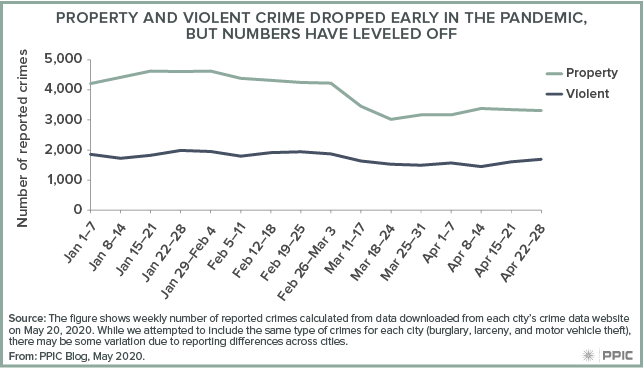
Figure - Property and Violent Crime Dropped Early in the Pandemic, but Numbers Have Leveled Off

Within these broader categories, some crime was on the uptick in April. While burglaries fell by 1.3% from February to March, the weekly number rose by 9.3% in April compared to February. This increase is primarily driven by commercial burglaries, up by 21.2% in March relative to February and up by 37.5% in April, again relative to February. Car theft is also up: after declining by 4.2% between February and March, it rose in April and is now 8.5% higher than in February.
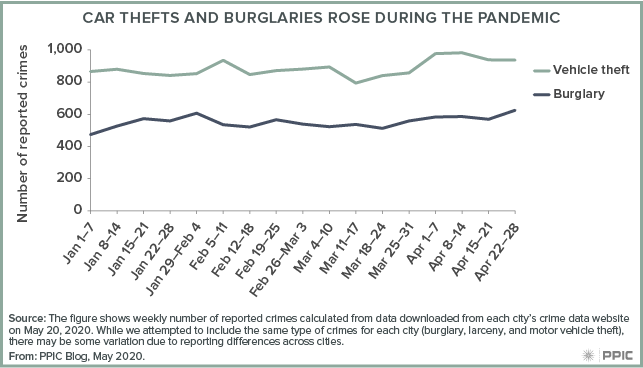
Figure - Car Thefts and Burglaries Rose during the Pandemic

The changes in crime numbers vary across these cities. For example, while commercial burglary is up in all four cities, the rise in vehicle theft is driven by Los Angeles, where the number of stolen vehicles increased from 352 to 363 and then 468 in February, March, and April; or up 32.9% compared to February. In Oakland, reported assaults rose in April; after dipping to 96 per week in March—from 116 in February—the average weekly number of assaults climbed to 129 in April. And while still below pre-pandemic numbers, assaults in Los Angeles in late April were higher than in March, up from 766 to 805 on average per week.

As crime in these four cities seems to be hovering at low rates, at or below the pre-pandemic numbers, there is no evidence yet that efforts like zero bail, which went into effect April 13, led to broad increases in crime. However, as some crimes are on the uptick, they deserve attention to determine whether they are part of common swings in crime numbers or early signs of reversing trends. If reversals are indicated, now is the time to identify contributing factors and investigate effective solutions.

California’s Jail Population Has Plummeted during COVID-19

When the COVID-19 crisis began, state and county governments recognized that overcrowded jail conditions could pose unacceptable health risks for inmates and staff. As the crisis has unfolded, all counties have taken steps to decrease their jail populations. Some have made steeper reductions than others, and some of the measures that have facilitated these reductions—reducing pretrial detention and setting bail at zero for many crimes—may have longer-term significance as California considers whether to eliminate money bail.

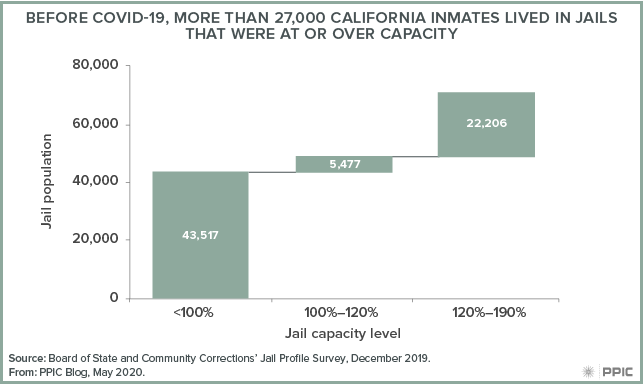
In December 2019, the average statewide daily population was 71,200—89% of capacity. However, about one in six county jails were at or over capacity, and twelve were between 120% and 190%. Looking only at numbers of jails understates the scale of the problem, because overcrowding was most prevalent in the biggest ones in a few large counties—Fresno, Los Angeles, Orange, Riverside, and San Diego. About four in ten (39%) California inmates—more than 27,000 people—lived in jails that were filled to or beyond capacity just prior to the pandemic.

Figure - Before COVID-19, More than 27,000 California Inmates Lived in Jails that Were at or Over Capacity

To reduce their jail populations, many counties began admitting fewer people to jail and releasing some inmates early. From February 29—when the Board of State and Community Corrections began reporting additional data—to April 11, the statewide jail population had fallen by 19%, to about 58,000 inmates. However, two county jail systems (Kings and Los Angeles Counties) remained over capacity and six county systems were at least 85% of capacity, accounting for over 20,000 inmates in total. Social distancing is challenging for inmates and staff at these capacity levels.

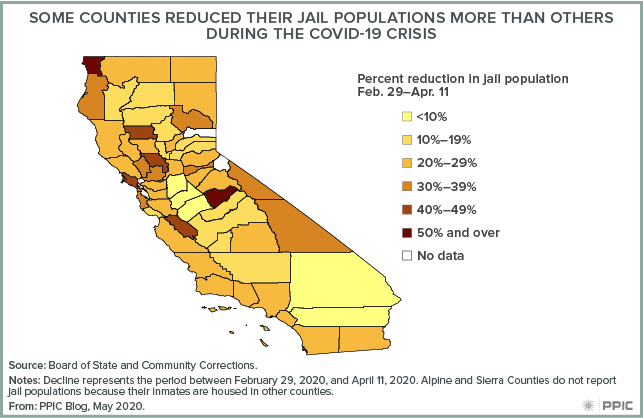
Between February 29 and April 11, all of California’s counties reduced their jail populations by releasing more people than they admitted. However, the reductions varied across counties: some lowered their jail populations by less than 10%, whereas others made reductions in excess of 50%.

Figure - Some Counties Reduced Their Jail Populations More than Others during the COVID-19 Crisis

To encourage further reductions in the jail population, the Judicial Council issued a statewide rule setting bail at $0 for misdemeanors and low-level felonies that went into effect on April 13. The “zero-bail” rule targets pretrial detainees, who historically have been about two-thirds of California’s jail population; many of these detainees are incarcerated mainly because they cannot pay bail. From April 11 to April 25, county jail releases continued to outpace admissions, with 14,154 people admitted and 19,924 released statewide.

Temporary state and county efforts to reduce jail populations come as California considers a permanent shift from cash bail to a risk-based system of determining pretrial release. Given the public safety concerns raised as the zero-bail rule was implemented, and the fact that voters will decide whether to make a permanent shift away from cash bail in November, it is important to assess the impact of zero bail and other emergency measures.

Jail Bookings Down Significantly during COVID-19

In the midst of the coronavirus pandemic, California has sought to reduce county jail populations through a range of actions, including a “zero bail” emergency measure. This means that most misdemeanor and lower-level felonies currently have no bail amount associated with them, and that suspects are more likely to be cited and released instead of booked into jail. This new practice, along with decreases in crime and local directives to reduce arrests and bookings, appear to have drastically reduced the number of people sent to jail at this time.

A number of offenses—including felony burglary, driving under the influence, and the most serious sexual and violent crimes—can still receive a bail amount above zero.  And law enforcement can still book someone into jail even for a so-called zero bail offense—but the arresting law enforcement agency (or the district attorney) has to request to a judge to set a bail amount. If the court denies the request then the suspect has to be released.

To get a sense of the magnitude of zero bail’s effect on releases and bookings, we looked at data from the Monthly Arrest and Citations Register (from 2016, the most recent available). These data do not perfectly identify zero bail offenses or the offenses excluded from the zero bail list. But they do allow us to identify an upper bound of the impact on jail bookings.

Of the roughly 1,140,000 arrests that we analyzed, about 791,000 were booked into jail (about 69% of arrests). About 317,000 of these bookings (or 40%) were for offenses in which bail is still is an option today. The remaining 474,000 bookings (or 60%) were for zero bail offenses.

This suggests that today, if the arrest offense distribution is currently the same as it was in 2016 and there are practically no requests to set bail for zero bail offenses, then only about 28% of arrests in California would lead to a booking into jail.

In 2016, misdemeanors made up the majority of arrests booked into jail (about 77%) for what are now zero bail crimes. Of these, the most common offenses were drugs (almost 28%), failure to appear in court on a misdemeanor offense (about 21%), drunk and disorderly conduct (12%), and traffic and petty theft (each about 5%). The most common felony offense bookings now set at zero bail were drug offenses (almost 30%), theft (22%), and vehicle theft (roughly 14%).

While crime appears to be down since the COVID-19 outbreak, and the type of crimes committed during the pandemic almost surely have changed, our examination of 2016 arrest data suggests that the implementation of zero bail—in addition to the effects of local directives and fewer crimes—means that far fewer people are being booked into jail at this time.

Recent statewide data from the Board of State and Community Corrections supports this conclusion, as it reveals that weekly jail bookings have dropped from 17,140 the week of February 23 to 6,880 the week of April 12 (a decrease of about 60%, consistent with our data analysis).

These findings suggest that the zero bail measure is playing a significant role in reducing crowding in California’s county jails and helping to make social distancing more achievable. Going forward, it will be important to monitor other possible impacts this reduction in jail bookings might have, including on homelessness, public safety, and access to health care.

Video: A Conversation with Chief Justice of California Tani G. Cantil-Sakauye

Last Thursday, at a lunchtime event in Sacramento, PPIC president Mark Baldassare talked with Tani Cantil-Sakauye, California’s chief justice and the leader of the state’s judicial branch. Their conversation covered a wide range of challenges and opportunities facing the courts today. In particular, Cantil-Sakauye spoke about civic education, the collaborative courts, and the critical importance of self-evaluation in the judicial branch.

Cantil-Sakauye is known for her efforts to make the courts accessible and understandable to all Californians. She became convinced of the need to educate the public about the judicial branch after the state judiciary was hit hard by budget cuts during the Great Recession. Cantil-Sakauye recalled that state legislators responded to her pleas for adequate funding with “quizzical looks” and questions: “‘What agency are you from? . . .Which chief are you?’ . . . And I thought a civics education initiative might be in order!“

She launched an initiative called the Power of Democracy in 2012: “Judges and lawyers, the president of the California Chamber of Commerce, labor unions, and scholars come together to teach civics to K–12 and also adult students.” In her view, helping Californians understand that “the courts exist for you to press your rights” empowers them to advocate for themselves and their communities.

Asked to name her greatest accomplishments, Cantil-Sakauye pointed to collaboration, civility, and problem solving. “The California judiciary is a collaborative, problem-solving entity,” she said. Indeed, California has led the nation in collaborative courts—community-based courts that specialize in issues such as homelessness, landlord-tenant disputes, domestic violence, veterans, or behavioral health. These courts address underlying problems by connecting people to services and programs that can help get their lives on track. As Cantil-Sakauye put it, “The whole point of a collaborative court is to end recidivism.”

The chief justice is especially proud of the judiciary’s willingness to evaluate itself: “We ask ourselves how we’re doing and we’re honest when we’re not doing well.” A case in point is bail reform. Questions about the efficacy and fairness of bail prompted the chief justice to form a committee to study the issue. After looking at the evidence and hearing from a wide range of stakeholders, the committee unanimously recommended the elimination of cash bail “because it does not serve the purpose of protecting the community or ensuring a person’s return to court.”

The bail reform law signed by Jerry Brown last year is being contested—voters will decide its fate in November. But efforts to improve bail and other aspects of the judicial system will continue. As Cantil-Sakauye put it, “More and more, California courts are becoming social justice centers.”

Can Pretrial Decisions Be Improved?

Controversy over the cash bail system in California has led to a number of recent legal and legislative actions that may spell the end of cash bail in the state. If that happens, risk assessment systems would take on heightened importance in decisions about pretrial detention. At stake are concerns about equity, consistency, and transparency in the pretrial process.

Californians who have been arrested but not yet convicted are 84% more likely to be detained than defendants in other states. California’s high bail amounts contribute to this high rate. Of the defendants who are released on bail, nearly all secure their release via bail bondsmen, who require a nonrefundable deposit equal to 10% of the bail amount. The average bail amount in California in 2015 was $50,000—five times higher than the national average. Many poor and middle class individuals lack the means to secure pretrial release through bail—one study found that 40% of Americans do not even have $400 on hand to cope with an emergency.

State and federal courts have begun to address this inequity. Last year, a state appellate court ruled that defendants should not be held before trial solely because they cannot afford bail. More recently, a federal judge ruled against San Francisco’s use of bail schedules, which set bail amounts. The judge found that although bail schedules seem scientific and transparent, bail amounts are set inconsistently, their origins are unclear, and they do little to ensure public safety.

Additionally, judges can override recommended bail amounts based on their assessment of a defendant’s likelihood of misconduct—arrest or failure to appear in court—if he or she is released during the pretrial period. And they can do so without reporting why. The result has been inconsistency in pretrial detention decisions for defendants who committed similar crimes.

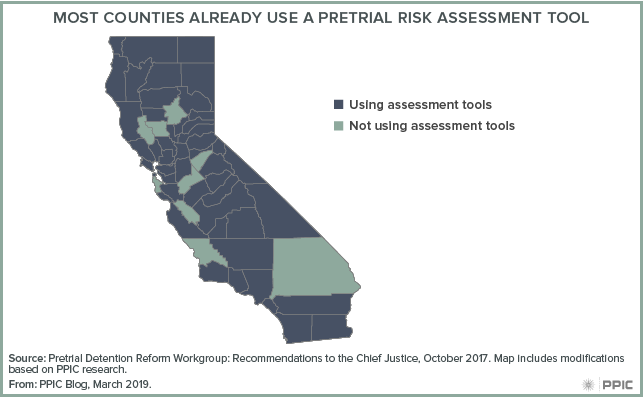
Concerns about inconsistency and lack of transparency motivated the recent passage of Senate Bill 10, which eliminates cash bail and mandates the use of risk assessment tools. These tools use mathematical models to predict pretrial misconduct. Pretrial detention recommendations based on these predictions are supposed to guide judges’ pretrial detention decisions. SB 10 will be subject to a November 2020 referendum—but it’s worth noting that 49 of California’s 58 counties already use some type of risk assessment tool.

figure - Most Counties Already Use a Pretrial Risk Assessment Tool

Risk assessment tools are not without controversy. They have been challenged as unfair and can only surmount this challenge if they are used within transparent and consistent risk assessment systems. Importantly, judges will still be able to override recommendations from those systems.

To ensure more transparency, it will be critical to collect information about why judges override such recommendations. Only with court data that comprehensively records information used to make pretrial detention decisions can the essential work of ongoing evaluation take place. These evaluations are key to determining how well risk assessment systems protect individuals’ liberty while also ensuring public safety—and how potential sources of unfairness in them can be identified and addressed.

Pretrial Risk and Cash Bail

Most of California’s jail inmates are unsentenced defendants awaiting arraignment, trial, or sentencing—and this heavy reliance on pretrial detention has come under scrutiny in recent years. The goals of pretrial detention are to make sure that defendants appear at court hearings and to ensure public safety. But California’s high pretrial detention rates have not been associated with more defendants appearing in court or lower levels of rearrest. Reforming the current system by allowing more defendants to be released pending trial could allow the state to free up scarce jail beds and realize substantial cost savings—while maintaining public safety.

Last year, state lawmakers examined the issue of cash bail, the predominate means by which defendants can be released pretrial. Legislation to change the system is pending. Under cash bail, judges can order defendants to pay a certain amount—which varies based on the alleged offense—in order to secure release. In most cases, defendants contract with bail bond companies to deposit the full amount of the bond with the court in exchange for a service fee (usually 10% of the bond). If the defendant complies with all court orders during the release period, the bond company gets the deposit back and keeps the defendant’s premium as payment. The idea is that the threat of financial penalty helps prevent pretrial misconduct—for example, making offenders less likely to flee the jurisdiction and more likely to appear in court.

However, there are several flaws in the bail system. Bail is calculated by offense, making it more challenging for defendants cited for more serious offenses to obtain release. This may make intuitive sense, but it turns out offense category is not typically a strong predictor of future misconduct. For instance, PPIC research found that misdemeanor probationers were in fact more likely to be booked into jail at least two times after release (19.6%) than felony probationers (17.6%). Moreover, cash bail makes it more difficult for low-income defendants to obtain release, regardless of their risk to public safety, raising concerns about whether the system is treating wealthy and poor individuals equitably.

The primary alternative is a risk-based framework in which law enforcement employs tools called risk assessments to determine which offenders can safely be released pretrial. Risk assessments use demographic data and information pertaining to a defendant’s criminal history to predict a defendant’s probability of disobeying the terms of his or her release. Some of these models show great promise. For example, researchers found judges in New York could reduce the jail population by 42% without affecting crime rates by following their model’s release recommendations.

But these tools have limitations. California already uses a range of risk assessment tools at the state and county levels, but they vary in predictive power based on whether they have been validated. Validating a risk tool means testing it using local data from the community of offenders it will be assessing. Counties using unvalidated, out-of-the-box risk assessments could improve their tools’ predictive powers by following the example of counties like Riverside, where county agencies collaborated with academics to tailor a tool that had been originally developed in Virginia to Riverside’s unique characteristics—boosting the model’s accuracy.

Local validation studies consume a lot of time and resources. Riverside’s took two years and required data from over 500 offenders. However, if the state continues to emphasize risk-based reform and evidence-based practices to improve its corrections system, making these models work for California and its counties should be a priority.


New Laws Expand Criminal Justice Reforms

Governor Jerry Brown recently signed a number of bills that extend the state’s efforts to reform California’s adult and juvenile criminal justice system. This legislative package supplements previous reforms; several of the new laws could further reduce the state’s prison population, which remains subject to a court-ordered population target. The bills cover issues at all levels, including arrest, conviction, incarceration, and parole.

Arrest and conviction

  • SB 395 strengthens protections for arrested minors under the age of 16 by requiring that they confer with an attorney prior to waiving their Miranda rights and being interrogated by police. AB 529 allows juveniles to have their records sealed if they are not convicted. SB 312 allows juvenile offenders convicted of serious or violent offenses committed after the age of 14 to have their records sealed.
  • SB 393 allows adults to request that the court seal their records if they are arrested but not convicted.

Sentence enhancements

  • Sentence enhancements allow prosecutors to seek additional prison time in certain circumstances—such as the use of a firearm or gang involvement. The number of enhancements has increased dramatically over the past 30 years. SB 180 eliminates the three-year sentence enhancement for certain circumstances related to selling drugs, though it leaves in place the enhancement for using minors in the sale of illegal drugs. SB 620 allows judges the discretion to dismiss or strike sentence enhancements for offenders who are in possession of a firearm while committing a crime.

Parole

  • AB 1308 and SB 394 raise the age limit for youth parole from 23 to 25, and grant the possibility of parole for juvenile offenders serving life sentences after they serve at least 25 years.
  • AB 1448 allows certain offenders older than 60 who have been incarcerated for more than 25 years to be released to parole. It is worth noting that AB 1448 codifies a practice that has been helping the state reduce overcrowding: a total of 557 offenders were released under this program between February 2014 and August 2017.

Impact of supervision on juveniles and families

  • SB 625 reinstates honorable discharges for juvenile offenders who have “proven their ability to desist from criminal behavior.” An honorable discharge removes long-term penalties, such as the ban on juvenile offenders working as police officers.
  • SB 190 limits the financial liability of families for the housing, transport, or supervision of juvenile offenders.

The goal of these laws is to improve offender outcomes by emphasizing rehabilitation and reentry to the community—and possibly reducing pressure on the state budget. State lawmakers believe these bills are grounded in evidence-based practices. For example, the reduction of long-term penalties for juveniles and young adults is grounded in neuroscientific evidence that decision-making ability does not mature fully until the mid-20s.

Two bills that aim to reform the state’s bail system, AB 42 and SB 10, did not reach the governor’s desk this legislative year. However, the debate over bail reform will most likely continue in 2018. Advocates for reform believe that evidence-based practices that base pre-trial release decisions on an offender’s likelihood of appearing in court or reoffending—not his or her financial means—could significantly reduce the number of pre-trial offenders held in county jails. Opponents believe that the current bail system is the best way to make pre-trial release decisions while protecting public safety.

Testimony: Bail and Pretrial Detention

The Alameda County Board of Supervisors Public Protection Committee, along with Assemblymember Bill Quirk, chair of the assembly Public Safety Committee, held a special hearing on the bail system on Friday, February 19, 2016, in Hayward. They invited Sonya Tafoya, PPIC research associate, to testify about the impact of bail on the jail system in California. Here are her prepared remarks:


Bail Overview

The purpose of California’s bail system is to ensure that defendants appear in court and to protect public safety (Cal Const. art I § 28(f)(3)). With the exception of capital crimes and certain felony offenses, bail is a right for most offenders (Cal Const. art I § 12, PC § 1271). If the court finds that defendants do not pose a risk of flight or a risk to public safety, it has the discretion to release them on their own recognizance.

The most comprehensive data source available, the State Court Processing Statistics (SCPS), indicates that for felony offenses, California’s large urban counties have had high rates of pretrial detention (59%) relative to the rest of the United States (32%). Some of this difference can be attributed to California’s high bail amounts. California’s median bail amount was $50,000, five times higher than the rest of the United States. Yet, even with relatively high rates of detention, California has had higher failure-to-appear rates (6.6% versus 2.9%), and higher rates of non-violent felony rearrests (12.4% versus 10.1%) than the rest of the United States. Re-arrests for violent felonies are only half a percentage point lower in California (1.4%) than the rest of the United States (1.9%) (Tafoya, 2015).

It should be noted that data collection for the SCPS was discontinued in 2009, and in the absence of more recent SCPS or other statewide data, we cannot determine whether these rates of detention, failure to appear, and re-arrest have persisted. The effect of Proposition 47 on median bail amounts is also unknown. But, as a practical matter, these results suggest that California has not gotten a very good return on its investment in high pretrial detention rates.

Jail Capacity Overview

A brief overview of jail capacity in California helps quantify the scope of this issue.

  • The average daily population of California jails was about 73,000 (2nd quarter, 2015, Board of State and Community Corrections). Most jail inmates (46,000) are unsentenced; the remaining 27,000 are sentenced.
  • California’s jails hold mostly those charged with or convicted of felony offenses (84%).
  • California’s jail system as a whole is operating near its rated capacity of about 80,000 (Board of State and Community Corrections, April 2015). Overall, the system is operating at about 91 percent of rated capacity.
  • The extent of jail overcrowding varies across counties; 37 facilities in 19 counties are operating under court-ordered population caps.
  • Facilities with population caps are required to release inmates when their populations reach a specified threshold (often 90% of rated capacity). In the 12 months following realignment, these facilities averaged about 12,000 capacity releases a month. In the wake of Proposition 47, the average has declined to about 10,000 per month.

Moving Forward

Demands for lower bail amounts are generally based on assertions that low-risk defendants are being held in jail solely because they lack the financial means to post bail. Lowering bail across the board would increase California’s rate of pretrial release (Tafoya, 2013). From a public safety perspective, however, this may not be the most prudent approach. A county jail population assessment would be a straightforward first step toward understanding the resources that are being devoted to detaining low-risk defendants. The assessment takes a snapshot of the jail population at a point in time and describes who is being held in jail, for how long and and why. It examines such factors as demographics, current offense, criminal history, status as a sentenced or unsentenced inmate, immigration or other agency holds, bail amounts, and length of incarceration.