Public Higher Education in California Faces a Fiscal Crisis

[vc_row][vc_column][vc_column_text]As the coronavirus pandemic continues to disrupt California’s economy, the Newsom administration is projecting a $54 billion decline in state revenues for the 2021 fiscal year and revising the budget accordingly. California’s public universities—which do not have dedicated funding streams or constitutional protections—face disproportionately large funding cuts. So far, the federal government has provided some emergency relief to mitigate the pandemic’s unprecedented impact on higher education. Without additional support, however, the state’s public colleges might have to reduce student access and services.

During the Great Recession, a drop in state revenues of $40 billion in 2009 led to cuts equaling roughly one-third of state funding for the University of California (UC) and California State University (CSU) systems (on a per student basis). Consequently, tuition doubled at UC and CSU, faculty and staff were laid off or furloughed, and critical capital improvements and maintenance were deferred.

In turn, students faced reduced access to courses, higher student-faculty ratios, increased costs, and fewer support services. As the economy improved, the state was able to increase allocations to the state’s colleges. As a result, UC and CSU admitted thousands of additional students, graduation rates went up, and the number of degrees awarded increased substantially.
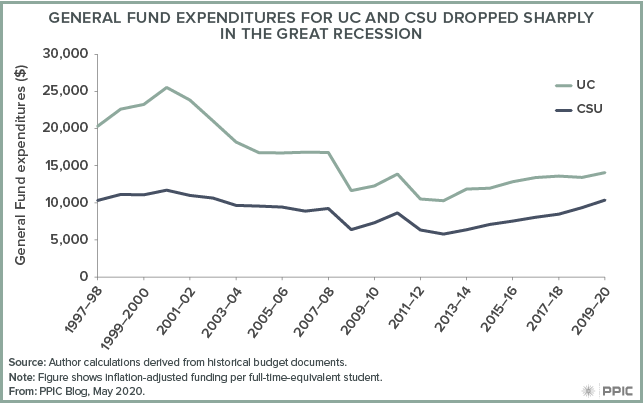
figure - General Fund Expenditures for UC and CSU Dropped Sharply in the Great Recession

Early evidence suggests that the global pandemic could have an even more dramatic fiscal impact on public higher education in California. In the short-term, public colleges face critical revenue shortages: now that students have been sent home and instruction has moved online, revenues from auxiliary enterprises (housing, food, parking, etc.) have evaporated. In addition, UC has suspended elective surgeries at its medical centers and is incurring costs associated with research and treatment of the coronavirus. CSU has projected revenue losses of $337 million for the spring semester, while UC projects a $500 million loss for the month of March alone.

In the longer-term, the systems may find it challenging to raise additional revenues. The percentage of out-of-state students—who pay higher tuition—is now capped at 18% for the five most popular UC campuses, and enrollment of international students is likely to decline due to visa and travel restrictions. Endowment funds are shrinking and tuition increases are controversial. Moreover, unprecedented levels of unemployment will increase demand for federal, state, and institutional financial aid programs.

Governor Newsom’s May budget revision includes a 10% cut for each public higher education system. The revised budget proposal also reduces state financial aid for students who attend nonprofit private colleges from $9,084 to $8,056 per year. The budget proposal does allow UC and CSU to redirect some restricted revenues and to refinance debt at historically low interest rates. However, without additional revenue–whether through federal or state support, or tuition increases—it will be difficult to improve access, quality, and student success in the coming years.[/vc_column_text][/vc_column][/vc_row]

Covering the Real Costs of College

Faced with the state’s high cost of living, California college students struggle to secure adequate food and housing. Even amid one of the largest and longest economic expansions in state history, 33% of students are housing insecure and 35% have low or very low food security, according to a California Student Aid Commission survey of 150,000 college students. As the state seeks to meet economic demand by producing more students with degrees and certificates, the full cost of college remains a barrier to progress.

Governor Newsom and the legislature have recognized the need to reform state financial aid programs to address the full cost of college. The 2019–20 state budget provided $41 million in ongoing funding to help colleges address food and housing insecurity, $19 million to support rapid rehousing programs, and increased the number of competitive state grants for non-traditional students from 25,750 to 41,000.  Additionally, the legislature increased the maximum award amount that students with children pay for non-tuition college costs from $1,672 to about $6,000.

However, broader reform of the state grant aid program remains elusive. Two recent bills sought to expand eligibility for Cal Grants by eliminating current age, time out of high school, and high school GPA requirements. The bills also sought to provide additional non-tuition aid to community college students and students in career education programs.  The bills did not make it to a vote; however, they will be re-examined in the next legislative session. Estimated at $2 billion per year, proposed reforms would nearly double the annual cost of the program.

Consequently, the California Student Aid Commission, the agency that distributes financial aid, intends to streamline these proposals to constrain costs while increasing access. Higher education is a vital tool that increases economic and social mobility; ensuring all students have equal access to an affordable education is paramount to modernizing California’s economy. An equitable and financially viable approach to financial aid will be critical if the state’s booming economy slows in coming years.

Should Applying for College Financial Aid Be a High School Requirement?

A majority (58%) of Californians consider affordability at the state’s public colleges and universities a big problem, according to a 2018 PPIC Statewide Survey. Requiring all high school students to apply for financial aid could help more students pay for college.

Currently, around 60% of high school students in California complete the federal application for financial aid (FAFSA)—a student’s gateway to receiving federal grants and loans, as well as state aid. The remainder of students are unlikely to receive aid, even though there’s evidence that many of them would probably have qualified.

Requiring students to apply for aid may result in greater numbers of high school graduates enrolling in college, which could increase California’s college-going rate of 64% (2017–18). Earlier this year, a bill was introduced in the California Legislature that would require students to complete a financial aid application before graduating from high school.

Louisiana was the first state to have such a requirement, starting in 2017–18. The state saw FAFSA completion rates increase from 48% to 84% between 2015 and 2018, and college-going numbers increased by 12.6% (from 22,200 to 25,000) in the same time frame. Texas and Illinois are following suit, with the requirement taking effect in those states in fall 2019 and fall 2020, respectively.

California needs more college graduates to meet the increasing demand for highly skilled workers—and the proposed bill could make a difference if it increases access to college, especially for lower-income students. In addition, better financial support during college can reduce students’ debt load and might help more students complete their programs. Improved access to college and higher graduation rates would set more students up for success in the workforce and benefit the state’s economy.

New Federal Data Sheds Light on Student Debt in California

For the first time ever, the federal government has released data on loan debt for college graduates by type of degree and field of study. The data includes federal loans from three programs (Direct Loans, Federal Family Education Loans, and Graduate PLUS Loans) for students graduating in 2014–15 and 2015–16. This release is especially timely in light of national discussions about the cost of college–with some Democratic presidential candidates arguing for debt-free college and loan forgiveness. In just those two academic years, more than 300,000 Californians graduated from college (with degrees ranging from PhDs to vocational certificates) with debt. The total amount of federal debt among those graduates exceeded $10 billion.

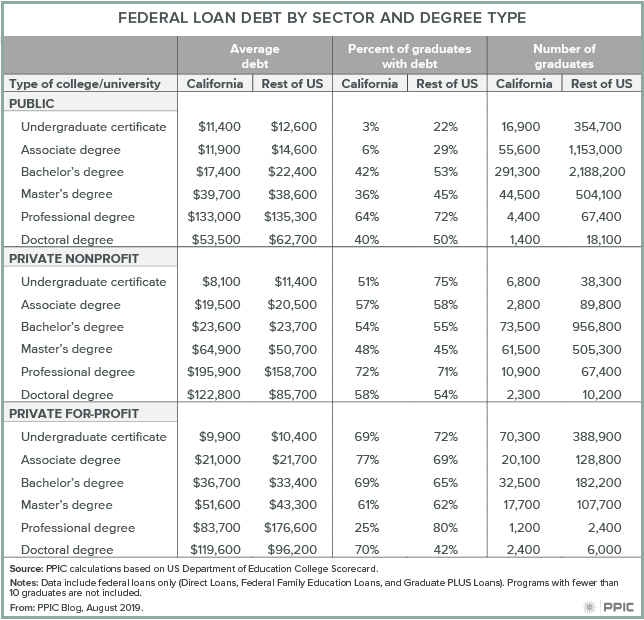
Some of the findings from the recently released data are not surprising. For example, undergraduates at public colleges and universities in California are less likely to take on debt than their peers in the rest of the country. And when students in California do take on debt, the amounts tend to be lower. Federal loan debt for Californians earning bachelor’s degrees at UC and CSU averages $5,000 less than at public universities in the rest of the country ($17,400 versus $22,400). And undergraduates in California are less likely to take out federal loans (42%) than their peers in the rest of the country (53%). Only 6% of associate degree holders from the state’s community colleges have federal loans, compared to 29% of public community college graduates in the rest of the country. Students at California’s public colleges and universities are also less likely than their counterparts at the state’s private institutions to take on debt, and those who do take out loans graduate with less debt.

Other findings are striking. In California and the rest of the nation, graduate students tend to have far higher loan amounts than undergraduates, with professional degree holders incurring the most debt—generally well over $100,000. The most common professional degrees are in law, medicine, and dentistry. Graduates of professional schools at private nonprofits in California incur the most federal loan debt—almost $200,000. In general, graduate students at California’s public universities are less likely to take on debt, and their loan amounts are lower than those for students at private colleges. Even so, graduate students at public institutions are incurring large amounts of debt.

table - Federal Loan Debt by Sector and Degree Type

Large debt levels among graduate students reflect higher tuition for many programs. For example, tuition and fees at UC Berkeley’s law school are almost $60,000 for 2019–20, compared to less than $20,000 for academic graduate programs such as English. High demand for many graduate professional programs coupled with expectations of earnings premiums account for both the higher tuition and students’ willingness to take on debt.

Policies to address student debt must be mindful of which students take on debt, the range of institutions and areas of study, and the ability of students to pay back their debt. These are critical concerns in putting college graduates on the path to economic mobility and long-term financial security.

Coping with High Housing Costs in College

California’s housing crisis affects college students around the state. Over the past eight years—even as tuition has been stable at California’s public colleges and universities—the cost of attending college has risen because housing costs have gone up. Most students at California’s community colleges and in the California State University system pay more for housing than they do for tuition. At the University of California, housing costs are on par with tuition (for those who pay full tuition).

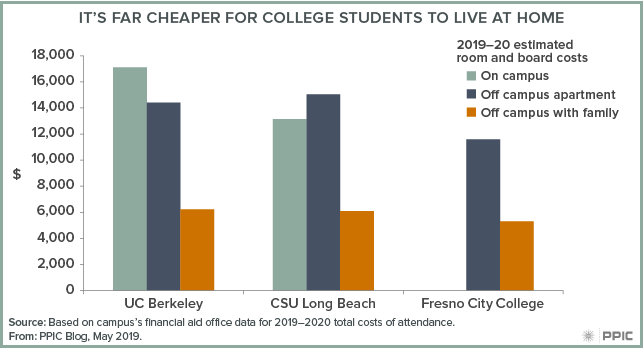
One way students limit their housing costs is by living with their parents or other family members. For most students, living at home is much cheaper than living in housing provided by the university or in an apartment off campus. Housing costs vary across systems, but in every case living with family is much less expensive than other housing options. And the savings are large—as much as $10,000 a year.

figure - It’s Far Cheaper for College Students to Live at Home

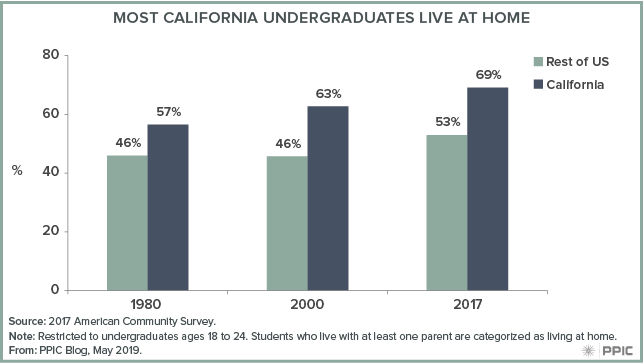
In fact, the large majority of California undergraduates do live at home (69% in 2017), and that share has been increasing over the past few decades, according to the American Community Survey. Moreover, California college students are substantially more likely to live at home than their counterparts in the rest of the nation.

figure - Most California Undergraduates Live at Home

Partly, this difference reflects the mix of colleges in California. Community college students are especially likely to live with parents—not surprising given the broad geographic coverage of this system. And CSU students are more likely to live at home than UC students. But the difference in living situations between California students and their peers nationwide almost certainly reflects California’s higher housing costs.

Living at home while attending college can be a great way to reduce costs. But it also has a downside. Research suggests that students who live at home are less connected to their college—and less likely to graduate.

California’s colleges and universities cannot solve the state’s housing crisis, but many of them are working to expand on-campus housing opportunities. They are also working with the state to develop ways to expand grants to cover housing costs as well as tuition. The governor’s proposed budget includes $40 million to provide emergency housing support for UC and CSU students (including those struggling with homelessness).

With no quick solution to the high cost of housing in California, thoughtful actions will be critical to providing support to college students across the state.

State-level Strategies to Reduce Student Debt

As college costs have increased, the total amount of loan debt in California has risen. At four-year colleges and universities in California in 2016, 40% of first-time, full-time students took out loans to help pay for their education, according to federal data.

The average debt for California students who attend four-year public and private nonprofit schools is nearly $22,800. Repaying college debt can be a big challenge, in part because the federal landscape for repaying loans is extremely complicated. To reduce student debt, state policymakers are actively thinking about new ways to help students repay their college costs.

In 2018, nearly half (47%) of borrowers enrolled in the federal “standard repayment” plan. Under this plan, a graduate makes fixed monthly payments over the course of ten years, paying down the entire loan with interest. Regardless of income level, a graduate with a loan of $22,800—the average amount—would, at 5% interest, face payments of about $240/month. For those in less well-paying occupations or who face very high monthly payments, this kind of plan can be financially challenging.

Another option is income-based repayment, which is often more financially manageable—but a much smaller share (29%) of borrowers enrolled in an income-based program in 2018. Monthly payments might start at 10% of discretionary income, but payments increase if the graduate starts earning more. Under these plans, borrowers generally pay smaller monthly amounts over a longer period of time.

Possible reasons for lower participation in income-based repayment programs include complex eligibility requirements and missing the deadline for declaring income. Streamlining the federal loan process, including clarifying eligibility criteria, could help make the process less confusing and allow students to make the best financial choices.

At the state level, policymakers are exploring other options to ease the burden of college debt. For example, AB 140 (Cervantes) would authorize the California Student Aid Commission, which administers the state’s financial aid programs, to pay an eligible student’s monthly loan payments for two years. And AB 154 (Voepel) would pilot an “income share” program at one University of California campus and one California State University campus. This program would enable campuses to pay for some of an eligible student’s educational expenses. After graduating, students then repay a portion of their income to the campus.

It’s a positive sign that California policymakers are pursuing state-level strategies to address growing college debt. Establishing an easy-to-use application process and clear-cut eligibility criteria will be key to ensuring that students are able to benefit from these programs. Perhaps most important, more comprehensive financial aid counseling and outreach are necessary to help students make the best choice when repaying their loans.

Proposed Budget Prioritizes College Students in Need

Governor Newsom’s January budget proposal includes $1 billion in new funding for higher education. Much has been made of his plan to cover two years of tuition for first-time, full-time community college students. But that is just one aspect of an overall approach that provides extensive support to a wide variety of students.

Newsom’s proposal increases by nearly 15% the number of “competitive” Cal Grants—a distinct type of support available to students who do not qualify for entitlement grants. Recipients of competitive Cal Grants are often older, non-traditional students. Further, all Cal Grant recipients who have dependent children would receive an additional $6,000 to help with non-tuition related costs. In addition, Newsom’s budget allocates nearly $50 million to programs that address housing and student hunger—and those that provide legal services for undocumented students, staff, and faculty.

The governor’s focus on affordability aligns with Californians’ concerns regarding higher education. According to the latest PPIC survey on Californians and higher education, 58% of all adults noted that affordability was a big problem for California’s public higher education systems; just 14% said that it was not much of a problem. Most Californians also said that higher education should be a high priority for the new governor. This budget proposal suggests that Governor Newsom is listening.

Making Career Education Affordable in California

Secretary of Education Betsy DeVos recently announced plans to eliminate rules put in place during the Obama administration that require career-education colleges to show that the credentials they award lead to gainful employment. In California, these rules have helped shift enrollment from expensive for-profit institutions to public community colleges, which offer career education programs at much lower cost. Indeed, California’s community college system is one of the most affordable higher education institutions in the country.

Many are concerned that eliminating gainful employment rules will lead to a loss of accountability and even a resurgence of enrollment in for-profit colleges. Some of those colleges have engaged in predatory recruiting practices, and many have high dropout rates and exorbitant student debt. In California, there are also concerns about a reversal of recent gains in affordable access to higher education—particularly among groups that have historically been underserved.

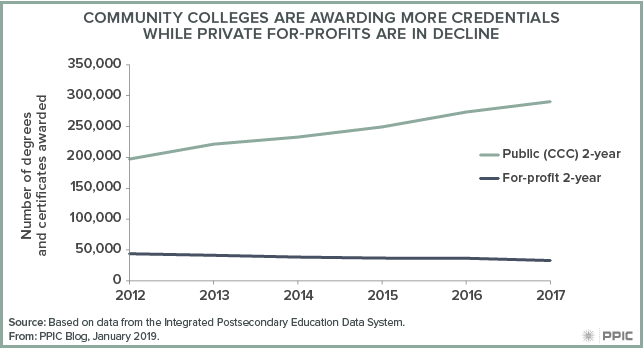
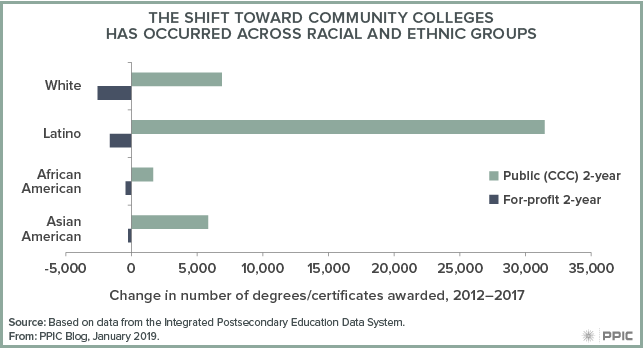
Partly because of the information provided by the gainful employment rules, career education students in California have been increasingly seeking degrees and certificates at the state’s large public community college system rather than at for-profit colleges. Between 2012 and 2017, the number of associate degrees and certificates conferred by for-profit institutions dropped by 25%. In comparison, the state’s community colleges saw an increase of 47%; in 2017, the number of degrees and certificates they awarded was more than eight times the number awarded by for-profit colleges.

Many for-profit institutions have targeted workers looking to get into in-demand fields such as health or family and consumer sciences. These for-profits have marketed options that lead to credentials—known as short-term certificates—that can be earned in less than one year. In 2012, private for-profit colleges awarded almost 21,000 short-term certificates compared to 38,000 awarded at the community colleges. But by 2017 the number of short-term certificates awarded had declined to fewer than 7,000 at for-profit colleges and risen to more than 55,000 at the community colleges. Many of the students who have shifted to the community colleges in recent years are from historically underserved backgrounds (e.g., African American, Latino, older, and low-income students). These students now have opportunities for career education without the hefty price tag attached to programs at for-profit colleges.

The elimination of federal gainful employment rules could have a negative impact on affordable access to career education. However, efforts by California’s community colleges to attract students who might be drawn to for-profit institutions will continue. So too will state rules that make institutions with low graduation rates and high loan default rates ineligible for Cal Grants. These state-level initiatives might not be able to prevent a resurgence of exploitative for-profits, but they could make a difference for many Californians.

Videos: Higher Education Priorities

Last week in Sacramento, PPIC researcher Lunna Lopes outlined key findings from the latest PPIC Statewide Survey, which focuses on higher education. The following day in San Francisco, PPIC president Mark Baldassare and Monica Lozano, president of the College Futures Foundation, talked about the survey’s implications for governor-elect Gavin Newsom.

The survey finds that most Californians think public higher education should be a high priority for the next governor. For Monica Lozano, this is a key takeaway: “Overwhelmingly, Californians said that a four-year degree is essential to the economic vitality of the state. And, as much as we have considered Jerry Brown a real progressive on lots of issues, there is a sense that he did not do enough on higher education.”

Lozano also noted that Californians are focused on helping students succeed. Their concerns are less about access and enrollment capacity and more about student support: student debt, financial aid, and academic and other kinds of support. “The public is putting students at the center of this equation,” she said.

A majority of Californians see affordability as a big problem. In a state with one of the highest costs of living in the country, residents are divided on whether tuition and fees or housing and living expenses are the bigger burden: 45% say tuition and fees, 34% say housing and living expenses, and 17% volunteer that the two are equally burdensome. As Baldassare put it, “There’s more to affordability than tuition and fees.”

Noting that governor-elect Newsom has an ambitious agenda for “cradle to career” education, Baldassare asked how higher education advocates and experts could help the new administration move forward.

Lozano replied, “Our challenge is to actually help them think about the fundamental issues that surfaced in this survey.” For example, most Californians think state higher education funding is inadequate and many support a funding guarantee for UC and CSU. “If the system of financing higher education has to change so that it’s more predictable—so that there’s some sort of a dedicated revenue stream that’s tied to some accountability measures—how would you actually do that?”

More generally, Lozano and Baldassare agreed that the survey shows how highly Californians value higher education; as Lozano put it, “This survey gives the next governor permission to be bold.”

Year-Round Support for Low-Income Students

This summer marked the first time in eight years that summer Pell Grants were available. A need-based award to low-income, first-time undergraduates, the federal Pell Grant promotes access to postsecondary education. A summer component means that eligible students can use their Pell Grants year-round and receive up to one and a half awards in one academic year. For example, a student with the maximum school-year award of $6,095 can now receive a summertime award of $3,047—the total Pell Grant for the year would be $9,412. Unlike a student loan, Pell Grants do not need to be repaid. Previous PPIC work suggests that the availability of summer Pell Grants not only expands summer course enrollment but may also increase retention rates and accelerate time to degree.

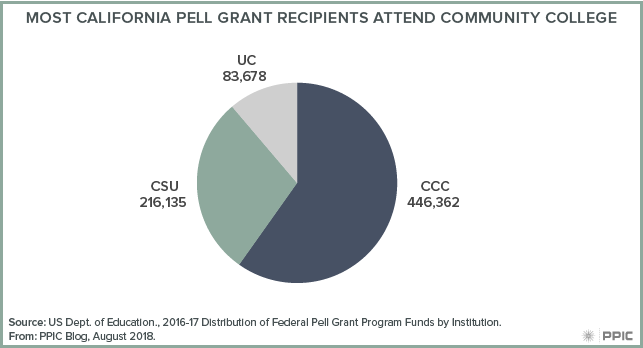
Who is likely to benefit from summer Pell Grants? Of all California students who received Pell Grants in 2016–17, more than 80% attended a public institution. Further, the California Community Colleges (CCC) enrolled the most Pell recipients of all California’s public institutions: about 60%. The California State University (CSU) and University of California (UC) systems enrolled 29% and 11% of recipients, respectively.

Many students at CCC who receive a Pell Grant also receive state aid, most commonly in the form of a California College Promise Grant tuition waiver. This year, the CCC tuition waiver covers summer enrollment fees as well. Applying the summer Pell Grant on top of the tuition waiver at CCC may enable students to cover significant non-tuition costs like housing, which is often a larger expense than tuition itself. The return of the summer Pell Grant makes year-round college attendance more affordable and enables students to make timely progress to their education goals.