Testimony: California Is on Track to Close the Degree Gap

[vc_row][vc_column][vc_column_text]Hans Johnson, director and senior fellow at the PPIC Higher Education Center, testified February 25, 2020, before the Assembly Budget Subcommittee (No. 2) on Education Finance, chaired by Assemblymember Kevin McCarty. Here are his prepared remarks.

At the PPIC Higher Education Policy Center, we have long been concerned about the future of California’s workforce. Would the state have enough college graduates to meet evolving economic demands? We have produced a series of reports addressing the dynamics of this issue.

Five years ago, we projected a shortage of highly educated workers in California. Specifically, our economic projections to 2030 showed that about two in five jobs would require at least a bachelor’s degree, while demographic projections suggested that only about one in three Californians would attain this level of education. This shortfall amounts to 1.1 million bachelor’s degrees.

PPIC noted that to fill this shortfall, the state and its higher education systems would need to act—increasing access, transfer, and completion especially among groups historically underrepresented in higher education, including low-income students, first-generation college students, Latinos, and African Americans.

We identified ambitious targets that—if met—would close the degree gap. Those targets included large increases in access to the University of California (UC) and California State University (CSU), both for first-time freshmen and for transfer students. They also included substantial increases in graduation rates. At the request of the legislature, UC and CSU both issued reports on how they might meet those targets.

Today, I’m pleased to say that California is currently on track to close the gap. The concerted efforts of policymakers, higher education officials—including staff and faculty—and, of course, students have led to these early gains.

State General Fund allocations for each system have increased substantially since the Great Recession, allowing for increased enrollment and renewed efforts to improve student persistence and completion. Both UC and CSU have exceeded PPIC’s closing-the-gap targets. These early gains have reduced the degree gap by almost 80,000.
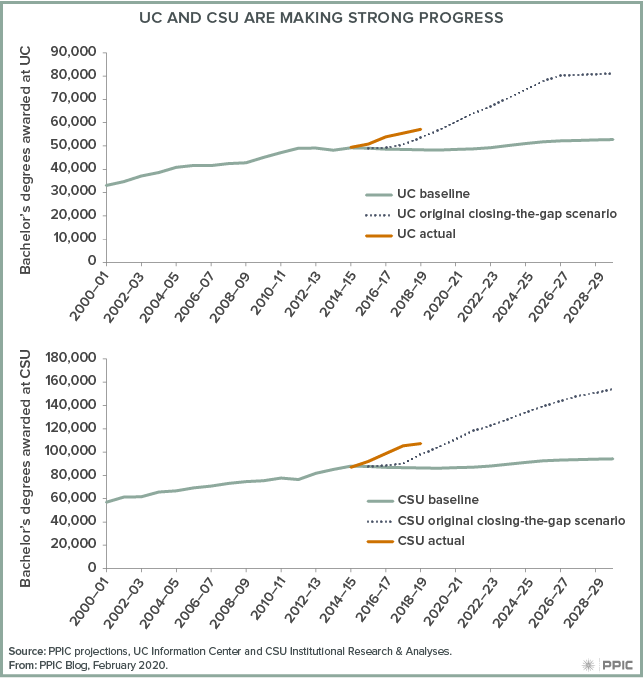
figure - UC and CSU Are Making Strong Progress

Two primary actions have led to these gains.

First, increases in state funding have allowed UC and CSU to enroll substantially more first-time students from California—both freshmen and transfer students. At UC, enrollment of transfer students went up 16% between fall 2010 and fall 2019. Enrollment of freshmen grew 14%. At CSU, enrollment increased 41% for transfer students and 33% among freshmen over the same time period. Notably, UC’s gains occurred primarily in one year, from 2015 to 2016, when the legislature and governor tied a $25 million allocation to increasing enrollment by 5,000 students. In that single year, total first-time enrollment of freshmen and transfer students went up 10%, with gains concentrated among African Americans (36%) and Latinos (25%).
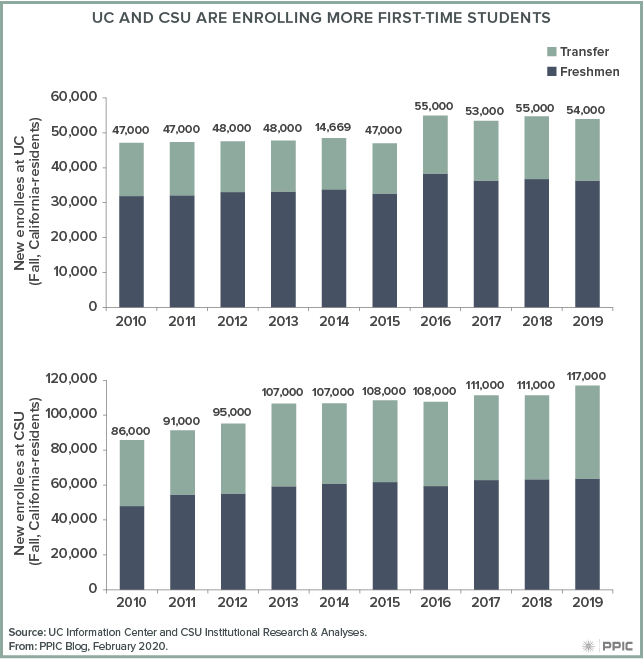
figure - UC and CSU Are Enrolling More First-Time Students

Second, programs to improve student persistence and graduation rates have also paid off—and contributed to enrollment growth. These gains have been especially sharp at CSU, which has received substantial funding from the state to support its graduation initiative. At CSU, six-year graduation rates for California-residency students have increased from 57% for 2009 entering freshmen to 67% for the 2013 cohort. At UC, four-year graduation rates for California-residency students have increased from 62% for 2010 entering freshmen to 68% for the 2014 cohort. (Six-year graduation rates at UC remain very high, around 85%). Graduation rates for transfer students have also increased at both systems.

These early successes are very promising. Still, California needs to build on them if it is to close the degree gap fully. The demand for college remains high. PPIC’s statewide surveys show that the vast majority of parents (79%) want their child to earn at least a bachelor’s degree. College preparation among high school graduates has increased, with the share of students completing the college preparatory requirements of UC and CSU now at an all-time high. And while applications to UC and CSU have levelled off or even declined a bit recently, application levels are still near record highs. All but one UC campus and many CSU campuses already do not have room to admit all eligible applicants.

Looking ahead, strong demand for UC and CSU is likely to continue as college preparation improves and the transfer pathway becomes more efficient and effective. New initiatives, including reforms in remedial education at the community colleges and CSU, have the potential to substantially improve student success rates and boost transfer. New articulation agreements, such as the Associate Degree for Transfer, have streamlined the pathway from community colleges to four-year colleges, especially CSU. (PPIC will be issuing a report on transfer trends later this year.) And an increased focus on improving student outcomes has led to multiple substantive reforms designed to increase persistence and completion at UC and CSU.

Finding ways to accommodate all eligible students is a pressing challenge, but one that must be met in order to ensure a better future for all Californians. Through thoughtful planning—and yes, additional funding—closing the degree gap is possible. Improving access and completion is a necessary and critical component to ensuring that more low-income, first-generation, and underrepresented students enjoy the benefits of a college degree. The early progress I’ve highlighted here has led to greater access and success for underrepresented students, creating momentum to improve the wellbeing of all Californians.[/vc_column_text][/vc_column][/vc_row]

Making Progress on Connecting Student Data across California

California students may fall through cracks in the state’s public education system because K–12 data and college data are not connected. For example, the state and its public universities are currently unaware of students who do not apply to UC or CSU despite being eligible, making it impossible to encourage these students to apply. Connecting education data can help California recognize and improve key transitions in student progress.

The current data system is fragmented across institutions, leaving California as one of eight states without a modernized approach to tracking its educational pipeline. By passing the 2019 California Cradle-to-Career Data System Act, the state is taking action toward linking education data across its many sectors.

As a first step, California has appointed a workgroup that will recommend a framework to the legislature and the Department of Finance within a year. This workgroup will determine relevant data elements to include—variables such as graduation, eligibility, and enrollment—along with when and how to combine data, where to store results, and who governs access to data.

So far the process has been inclusive and transparent, with representatives from all sectors of education, advocacy groups, researchers, technology experts, lawyers, and others stepping forward to serve on committees and advisory groups. Many member organizations of the California Education Data Collaborative, an organization convened by PPIC, are serving in advisory groups. Advisory group meetings are open to the public, and people can find information, meeting materials, and notes on the California Data System website. Public comments are encouraged at all meetings and on the website.

On January 16, PPIC attended its first meeting with the Policy and Analytics Advisory Group, where we discussed use cases around research and accountability, such as analyzing how financial aid offers to high school students impact college outcomes. The advisory group also agreed on a critical first step for the state: evaluation and analysis of student pathways from school to work. Advice from this advisory group and others will help the state’s workgroup make recommendations on January 30 to determine the scope and first phase of the data system.

PPIC will continue to participate in the advisory group and monitor the monthly workgroup meetings; notes and materials will be posted at California Data System, and we will update progress on this blog.

Demand for UC and CSU Enrollment Remains Strong

The number of high school graduates has remained steady for several years, with no expectation of significant increases any time soon. And yet demand for admission to the state’s public universities continues to grow.

A quick look at trends among California’s high school graduates—in particular, their preparation for college—helps explain this paradox. Other sources of enrollment growth, including increases in transfer students and improved retention, also play an important role. Understanding these trends is critical, since annual state funding for the University of California (UC) and the California State University (CSU) depends partly on anticipated enrollment growth.

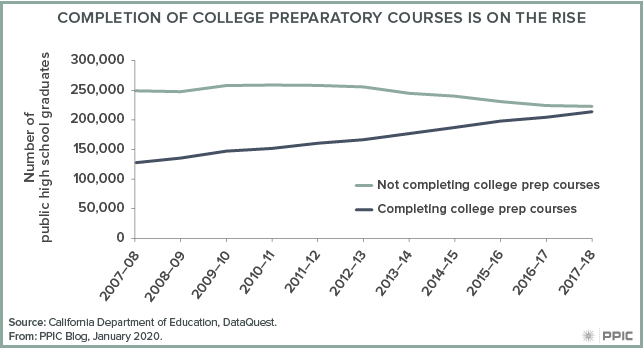
The good news is that more and more of California’s high school graduates have passed the college preparatory curriculum (known as the “A-G” courses) required by UC and CSU. Over the past five years, the number of high school graduates completing the A-G courses has increased 28%, even as the total number of high school graduates has remained largely unchanged.

By 2017–18 (the most recent data available), almost half (49%) of California’s high school graduates had completed the A-G courses, a remarkable increase from just ten years earlier when only about one-third (34%) did so. As a consequence, the number of high school graduates eligible for UC and CSU has reached record numbers.

figure - Completion of College Preparatory Courses Is on the Rise

Of course, enrollment demand depends on more than just new freshmen. The number of students that transfer from the state’s community colleges also adds to enrollment growth. Over the past five years, that number has also grown (up 25% at UC and 14% at CSU).

Improvements in persistence and completion also lead to greater enrollment, as fewer students drop out. At both UC and CSU, persistence and graduation rates are increasing. For example, at CSU the share of freshmen that graduate within six years has increased from 54% (fall 2008 entering cohort) to 62% (fall 2013 entering cohort).

Accommodating this enrollment growth is good for the state. College graduates are in high demand in the state’s labor market and—on average—earn far higher wages than less educated workers. PPIC has projected that demand for highly educated workers will keep growing as the state’s economy continues to change. Finding ways for California students to attend and graduate from college improves their well-being—and that of the state.

Strengthening Career Pathways in California’s Community Colleges

California lawmakers have made large state investments—totaling more than $1 billion over the past five years—to support and expand career education.  As the primary provider of career training in the state, California’s community college system was the recipient of much investment in this area, and their creation of the Strong Workforce program has established an ongoing source of funding to continue this work.

To assist policymakers, practitioners, and students to better understand how career education programs can meet regional workforce needs and connect students to well-paying, in-demand jobs, PPIC has engaged in a multi-year research agenda focused on community college career education pathways. We highlight our work in this area in a recent article, Strengthening Career Pathways in California’s Community Colleges, in Techniques magazine, a national publication that provides career education faculty and practitioners with timely analysis and insights to inform the delivery of high quality career education programs.

The article highlights recent research from PPIC’s Higher Education Center on the structure of career education pathways and their value to the students who complete them. Since many career education students are older than typical college-age students—and are likely to have work or family obligations (or both)—the article also highlights how various reforms being enacted by the community colleges could help students complete career training pathways, with a focus on the new online-only college, CalBright, that began enrolling students for the first time in October 2019.

How Community College Reforms Could Help English Learners

[vc_row][vc_column][vc_column_text]Due in large part to their mission of access and affordability, community colleges play a key role in educating immigrant students, especially those who are English Learners. In 2016–17, more than 58,000 first-time community college students in California enrolled in English as a Second Language (ESL) courses.

For many students, taking ESL courses may be linked to the desire to improve their socioeconomic prospects. Indeed, community college students who earn a credential or transfer to get a four-year degree are well positioned to climb the economic ladder. In an economy that increasingly demands skilled workers, there is tremendous untapped potential in increasing the educational attainment—and economic trajectories—of ESL students.

California’s community colleges have undertaken several reforms that aim to improve student success and close equity gaps. These reforms—spurred by AB 705 and the new Guided Pathways framework—present a ripe opportunity to help more ESL students get on the path to completing college composition, a requirement to earn a college credential or transfer.

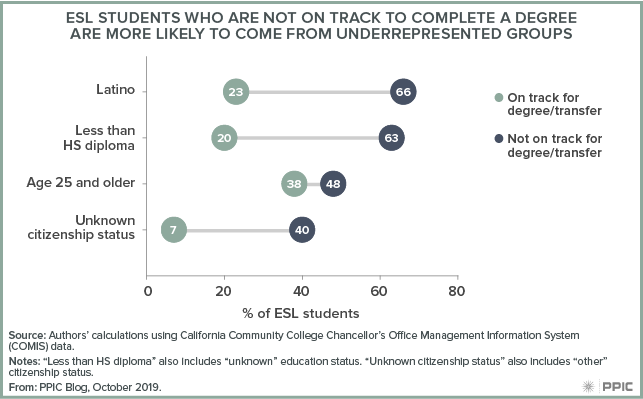
These initiatives are primarily focused on addressing the needs of students who intend to pursue a degree or transfer. However, our most recent research finds that about two-thirds of ESL students (66%) are not on track to do so—and may consequently be left out of the reforms. (We consider students on track if they take any ESL course required to access college composition and at least one course other than ESL or English.)

ESL students who are not on track are more likely to come from historically underrepresented groups. For instance, we find that compared to students taking ESL courses needed for college composition, those not taking these courses are more likely to be older and Latino. They are also more likely to have unknown citizenship status (a possible signal of being undocumented) and to have not graduated high school.

figure - ESL Students Who Are Not on Track To Complete a Degree Are More Likely To Come from Underrepresented Groups

As colleges across the state reform their ESL sequences and programs of study, it will be critical to ensure that all students have the opportunity to earn a degree or transfer. The two-thirds of ESL students currently not on track to do so are the most vulnerable. These students have already taken the major step of enrolling in college. To improve their likelihood of advancing, colleges could provide clearer and more effective ESL sequences and degree and transfer pathways, as well as stronger student supports, including advising, placement, and information about available degrees and certificates.

Some colleges are already working on these issues. Initiatives like the Guided Pathways ESL Milestone certificates at Cypress College—the result of AB 705 and Guided Pathways efforts—present a unique example of how colleges can structure ESL programs and certificates to help English Learners get on a pathway toward a college credential.

Finally, it is important to acknowledge that there are some ESL students who take ESL coursework for reasons unrelated to a degree. As colleges redesign their ESL programs, working alongside non-credit ESL programs, adult education schools, and community-based ESL programs could help ensure that colleges are keeping the diverse needs of ESL students in mind.[/vc_column_text][/vc_column][/vc_row]
Video: Career Education and Economic Mobility in California

[vc_row][vc_column][vc_column_text]

Career education, also known as vocational education or career technical education (CTE), prepares a wide range of Californians for employment and economic advancement. Community colleges are a major provider of career education in California, offering short- and long-term certificates along with associate degrees across a variety of fields of study.

In this video, senior research associate Shannon McConville discusses the importance of career education for California and what new PPIC research says about its economic benefits. Career education credentials can provide substantial earnings gains and also helps create a strong California workforce over the long term.

[/vc_column_text][/vc_column][/vc_row][vc_row visibility=”hidden-phone”][vc_column][vc_video link=”https://youtu.be/5qmlPVWwiEw” el_width=”70″ align=”center”][/vc_column][/vc_row][vc_row visibility=”visible-phone”][vc_column][vc_video link=”https://youtu.be/5qmlPVWwiEw”][/vc_column][/vc_row][vc_row][vc_column][/vc_column][/vc_row]

Integrating California’s Education Data

[vc_row][vc_column][vc_column_text]California needs an integrated data system that connects pieces of the education pipeline that are currently maintained separately.  An integrated system could perform a variety of critical functions and reach a diverse audience of stakeholders. For example, it could provide feedback to educational institutions on student outcomes, even after students graduate. It could also encourage better planning and coordination between educational sectors, increase the state’s ability to evaluate educational programs and policies, and provide students and families with better information about successful educational and workforce pathways.

The state has recently invested $10 million toward planning for this type of system, establishing the California Cradle to Career Data Systems Working Group to “recommend data system structural components, processes, and options” and to “advise ongoing efforts to develop, administer, and enhance the data system” (per Senate Bill 75).

The Public Policy Institute of California has also been focused on this issue, facilitating a group of research and policy organizations interested in the establishment of an integrated student data system in the state. Known as the California Education Data Collaborative, this group has met regularly throughout this year to discuss the opportunities and challenges associated with advancing education through connected data.[/vc_column_text][/vc_column][/vc_row][vc_row][vc_column width=”1/2″][vc_column_text]

The collaborative’s activities are designed to build knowledge and skills among diverse stakeholders involved in improving access, equity, and success across California’s educational systems. As a collaborative, we have engaged with national experts, leaders in successful data systems from other states, policymakers from California, and those with experience in working for an integrated data system in California.

As the state’s California Cradle to Career Data Systems Working Group takes shape, the collaborative is working to:

  • Engage with stakeholders—including students, parents, educators, and institutions—about how to implement a data system that best serves them.
  • Connect with policymakers to ensure that the data system answers critical questions about policies and programs to foster student success.
  • Provide research and advice on how to construct a system that will improve California’s education systems.
  • Examine issues of privacy and security to ensure confidentiality of student records.

[/vc_column_text][/vc_column][vc_column width=”1/2″][vc_column_text css=”.vc_custom_1567624867972{padding-top: 20px !important;padding-right: 20px !important;padding-bottom: 20px !important;padding-left: 30px !important;background-color: #384763 !important;border-radius: 4px !important;}”]

PPIC’s California Education Data Collaborative

California Competes
California College Guidance Initiative
California EDGE Coalition
California Policy Lab
Cal-PASS Plus
The Campaign for College Opportunity
Children Now
CORE Districts
Education Insights Center
The Education Trust- West
First 5 LA
Policy Analysis for California Education
Public Advocates
Public Policy Institute of California
Strategic Education Services
The Institute for College Access and Success
WestEd
[/vc_column_text][/vc_column][/vc_row][vc_row][vc_column][vc_column_text]Establishing an integrated, longitudinal student data system will take a multifaceted, sustained approach. In the long run, the value of this system will lie in the policy questions that can be asked—and answered with confidence—and the ability of practitioners, students, and families to access information that helps them make informed choices. To assess reforms accurately and comprehensively will require strong partnerships, clear long-term planning, identified goals—and good data.[/vc_column_text][/vc_column][/vc_row]

Training California’s Students for Well-Paying Jobs

California’s community college system is the largest provider of career education—also known as career technical education or vocational education—in the state. Career education programs play a critical role in training students, especially underserved and nontraditional students, for jobs that provide solid wages but don’t require a four-year college degree.

How can colleges identify these jobs? In a recent PPIC report, we compare occupational earnings to regional poverty thresholds to assess how future workforce needs connect to well-paying jobs that don’t require a four-year degree. Other work by the Brookings Institute focuses on “opportunity industries,” in which good jobs—those that provide stable employment, middle-class wages, and benefits—represent an above-average share of the industry’s total jobs and are filled by workers with only some college training.

Opportunity industries are largely concentrated in fields that align with many of the community colleges’ career education disciplines, including business, engineering, health, information technology (IT), and public and protective services. A critical question is whether students are successfully completing programs that will prepare them for careers in these fields.

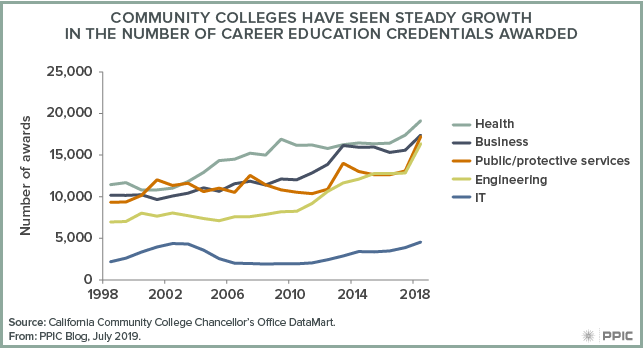
The good news is that over the past 20 years, there has been a consistent upward trend in the completion of career education credentials in California’s community colleges, with major gains observed in the last decade. This increase spans industries. Notably, more degrees and certificates are being earned in health than in any other discipline—this is important since health credentials are especially valuable in increasing students’ subsequent earnings.

Figure - Community Colleges Have Seen Steady Growth in the Number of Career Education Credentials Awarded

But not all credentials are associated with large economic gains. For example, in our analysis of wage returns, we find that career education credentials in business and IT do not provide much of a wage boost.

Furthermore, there seems to be a mismatch between the awards with the most value and the awards students are earning. While awards from longer programs generally tend to confer more value than those from shorter ones, completion of short-term awards has increased in several career education disciplines.

Community colleges and industry partners need to work together to ensure students have a path to well-paying jobs and the tools needed to succeed. As shown in our research, some of that work begins with colleges structuring effective pathways to these industries and clearly communicating the economic returns and opportunities available to students.

Moreover, strong partnerships between community colleges and nearby industries will be essential in creating a bridge between students and their industry of choice. Ultimately, these efforts can help improve the economic well-being of individual students and the state as a whole.

California’s Brain Gain Continues

[vc_row][vc_column][vc_column_text]California’s heyday of rapid population growth—the post-World War II era—was fueled by millions of migrants coming to the state from the rest of the country. Those days are long gone. California’s population continues to grow (through births and international migration), but every year it loses tens of thousands of people to other states. And yet there is one group that California continues to attract: college graduates.

This interstate migration pattern—gaining large numbers of college graduates while losing large numbers of less educated adults—doesn’t happen anywhere else in the country. Over the past five years, California has attracted 162,000 more college graduates (adults with at least a bachelor’s degree) from other states than it has lost. Over the same period, the University of California (UC) awarded about 300,000 bachelor’s degrees at its nine undergraduate campuses. In other words, interstate migration provides California with half as many college graduates as the entire UC system.

figure - California Gains College Graduates While Losing Less Educated Adults

College  graduates  come  to  California  from  all  over,  but  eight  states send California substantially more college graduates than they get in return. Between 2012 and 2017, net gains of college graduates from New York (51,000), Illinois (31,000), Pennsylvania (24,000), New Jersey (20,000), Massachusetts (20,000), Florida (16,000), Michigan (13,000), and Ohio (11,000) totaled more than 186,000. California experienced smaller but still sizable net losses (totaling 80,000) to five states: Texas (29,000), Oregon (16,000), Nevada (13,000), Arizona (12,000), and Washington (10,000).

The new migrants to California tend to be quite young. Indeed, college graduates age 20–29 account for almost all of the net gains. (In contrast, California experiences small net losses of older college graduates.) From a labor market perspective, attracting young college graduates is especially advantageous. Young adults with college degrees are at the start of their careers and provide the state with much-needed highly educated workers.

figure - College Graduates Moving To California Tend To Be Young

In fact, college graduates moving to California are more likely to be employed than those leaving the state. The largest gains are primarily in majors that are in relatively high demand in the labor market, including engineering (33,000), communications (18,000), business (18,000), and computer science (17,000).

The migration of young college graduates to California is a consequence of the state’s growing demand for highly skilled and highly educated workers. But the numbers are not high enough to fully meet the state’s changing needs. Although many college graduates move to California from other states, the most important source of highly educated workers in California are the state’s own colleges and universities. Policies and practices to improve college access and completion in the state will ensure that more Californians are able to help create and benefit from a strong economy.[/vc_column_text][/vc_column][/vc_row]

Video: Career Pathways and Economic Mobility at California’s Community Colleges

About a third of future jobs in California will require more than a high school diploma but less than a bachelor’s degree. By training workers for these jobs, career education—also known as career technical education or vocational training—plays an integral role in meeting California’s workforce needs and improving students’ economic well-being.

At an event in Sacramento last week, PPIC researcher Shannon McConville outlined the findings of a new report on career education and economic mobility, and a panel of experts discussed the implications for students, colleges, and the state as a whole.

McConville noted that completing a career education credential at a California community college confers a 20% wage gain, on average. But economic benefits vary greatly across program areas. For instance, returns to health credentials tend to be substantial, while business and IT credentials yield lower returns.

The panelists began by highlighting current efforts to improve students’ labor market outcomes. Marty Alvarado, executive vice chancellor for educational services at California’s community colleges, explained the system’s “two-pronged approach” to making sure programs connect to in-demand, high-return careers. One area of focus is regional infrastructure, which includes regional labor market centers that provide colleges with data on local industries. The second area includes tools to help students better navigate their program choices, “while also trying to make transparent the earnings projections for students as they move into these career options.”

Supporting students—especially low-income students from underrepresented demographic groups—in completing high-return credentials was another topic of conversation. Alvarado discussed efforts at the community colleges to streamline processes that may be creating “unnecessary barriers for students,” while Assemblymember Autumn Burke emphasized the importance of access to social safety net services so students can focus on their career.

Alma Salazar, senior vice president of the Center for Education Excellence and Talent Development at the Los Angeles Area Chamber of Commerce, noted that all stakeholders need to be involved. “How do we get the system as a whole to take ownership in helping us collectively solve for these problems? . . . It has to go beyond Sacramento. It has to go beyond the system’s leadership. It has to get to the institutional level and the people who work [there], who have to be equally committed.”

While many see the evolving nature of work and increasing automation as challenges, Assemblymember Burke was optimistic about providing a “just transition” for workers who may lose jobs in fast-changing industries. “We can train people for this new economy [and] prepare them now. . . . It’s a shortcoming to worry about losing minimum-wage jobs, because there’s so much opportunity on the other side.”