How Community College Reforms Could Help English Learners

[vc_row][vc_column][vc_column_text]Due in large part to their mission of access and affordability, community colleges play a key role in educating immigrant students, especially those who are English Learners. In 2016–17, more than 58,000 first-time community college students in California enrolled in English as a Second Language (ESL) courses.

For many students, taking ESL courses may be linked to the desire to improve their socioeconomic prospects. Indeed, community college students who earn a credential or transfer to get a four-year degree are well positioned to climb the economic ladder. In an economy that increasingly demands skilled workers, there is tremendous untapped potential in increasing the educational attainment—and economic trajectories—of ESL students.

California’s community colleges have undertaken several reforms that aim to improve student success and close equity gaps. These reforms—spurred by AB 705 and the new Guided Pathways framework—present a ripe opportunity to help more ESL students get on the path to completing college composition, a requirement to earn a college credential or transfer.

These initiatives are primarily focused on addressing the needs of students who intend to pursue a degree or transfer. However, our most recent research finds that about two-thirds of ESL students (66%) are not on track to do so—and may consequently be left out of the reforms. (We consider students on track if they take any ESL course required to access college composition and at least one course other than ESL or English.)

ESL students who are not on track are more likely to come from historically underrepresented groups. For instance, we find that compared to students taking ESL courses needed for college composition, those not taking these courses are more likely to be older and Latino. They are also more likely to have unknown citizenship status (a possible signal of being undocumented) and to have not graduated high school.
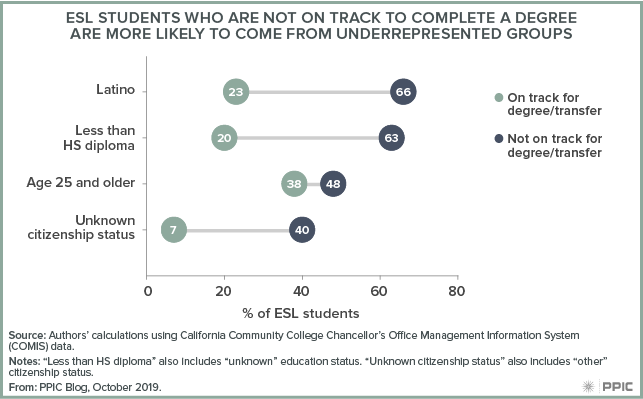
figure - ESL Students Who Are Not on Track To Complete a Degree Are More Likely To Come from Underrepresented Groups

As colleges across the state reform their ESL sequences and programs of study, it will be critical to ensure that all students have the opportunity to earn a degree or transfer. The two-thirds of ESL students currently not on track to do so are the most vulnerable. These students have already taken the major step of enrolling in college. To improve their likelihood of advancing, colleges could provide clearer and more effective ESL sequences and degree and transfer pathways, as well as stronger student supports, including advising, placement, and information about available degrees and certificates.

Some colleges are already working on these issues. Initiatives like the Guided Pathways ESL Milestone certificates at Cypress College—the result of AB 705 and Guided Pathways efforts—present a unique example of how colleges can structure ESL programs and certificates to help English Learners get on a pathway toward a college credential.

Finally, it is important to acknowledge that there are some ESL students who take ESL coursework for reasons unrelated to a degree. As colleges redesign their ESL programs, working alongside non-credit ESL programs, adult education schools, and community-based ESL programs could help ensure that colleges are keeping the diverse needs of ESL students in mind.[/vc_column_text][/vc_column][/vc_row]

Serving California’s Diverse College Students

As part of his cradle-to-career initiative, Governor Newsom has emphasized higher education as a key means of expanding Californians’ social and economic opportunities. From proposing more higher education funding in this year’s budget to supporting two years of free tuition for first-time community college students, many of his initiatives are focused on making college accessible and affordable to more of the state’s residents. For these initiatives to succeed, it will be essential to enroll a broad array of students—in particular, those who have been historically underserved in higher education–and to ensure that more students successfully complete college.

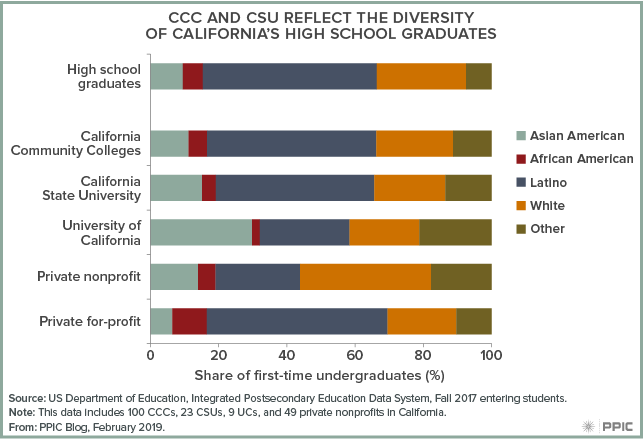
The good news is that the state is enrolling a diverse set of students, especially at the two largest systems, California State University (CSU) and the California community colleges (CCC). Overall, these two systems closely reflect the racial and ethnic make-up of California’s high school population—which is critical given that these two systems are key entry points for African American, Latino, low-income, and first generation college students. UC and private nonprofit colleges in California serve diverse populations, including more first generation and low-income students than their peer institutions in the rest of the country, but they do not reflect the full ethnic diversity of the state’s high school graduates.

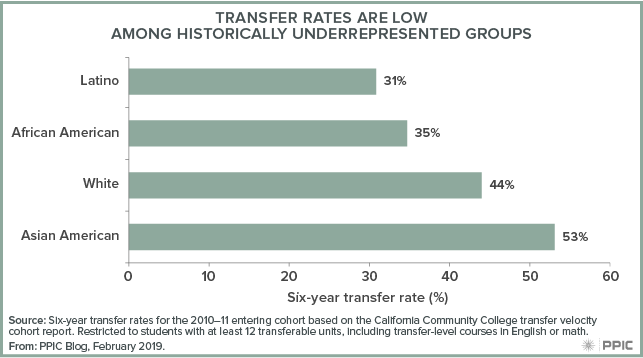
More challenging is helping students to successfully complete a four-year degree. Graduation rates are very high at UC and at most private nonprofit colleges. At CSU, graduation rates have improved dramatically, but even so about 40% of students do not earn a degree within six years. Most students who enter community colleges with the intent to transfer to a four-year college never do so. Transfer rates are especially low for African American and Latino students.

Both CSU and CCC have launched new policies and programs that hold the promise of improving transfer and reducing inequities. For example, community college reforms in developmental—also known as remedial—education will lead to substantial increases in the share of students taking college-level courses in English and math. The Associate Degree for Transfer (ADT) program is making the transition to California State Universities much more straightforward. And the new Guided Pathways initiative provides support services and clear course-taking patterns to community college students to promote success.

These are important steps in the right direction. Renewed interest in Sacramento regarding higher education will help. And Californians are well aware of the stakes. A majority of adults in California (56%) say a four-year college degree is very important for economic and financial success in today’s economy, and 75% believe California’s higher education system is very important to the quality of life and economic vitality of the state.

Reforming Remedial Education in Community College

Reforming developmental, or remedial, education is essential to improving student outcomes in community colleges. Why? Developmental education is supposed to help underprepared students, but currently it may be one of the largest impediments to success. As PPIC research has shown, 80 percent of incoming California community college students—and a disproportionate share of students of color—enroll in at least one developmental course, but relatively few successfully move on to complete a college-level course. The good news is that over the last few years, there has been a tremendous amount of support for reform.

Reforming Assessment and Placement
Assessment and placement reforms generally involve moving away from the traditional reliance on standardized tests and toward a more holistic measure of prior achievement such as high school course grades. Research finds that test-based assessment and placement policies assign many students into remediation unnecessarily. Indeed, students’ high school performance as measured by GPA and course grades—even when self-reported by students—is a much more accurate indication of student readiness. A recent report by the California Acceleration Project shows that the use of high school measures has dramatically broadened access to and completion of college-level math and English courses, significantly reduced equity gaps, and has had little impact on course success rates.

But implementation is key. Several decisions will determine the impact of new policies in increasing access to college-level courses and reducing unnecessary remediation: What GPA or course grades will qualify a student for access to college-level courses? If a college uses multiple measures, how will they be combined into a single placement decision? Will colleges accept students’ self-reports of their GPA and grades? Furthermore, as campuses expand access to college-level courses, it is critical that they provide supports to students who need to brush up on their math or English skills. Guidance provided by the Multiple Measures Assessment Project, the California Acceleration Project, and others will be central to helping colleges make these important decisions.

Reforming Developmental Courses
Changes to developmental coursework can also help more students progress to college-level courses.  Some colleges are transforming traditional developmental education into accelerated pathways that are relevant to students’ programs of study using the design principles of guided pathways introduced by Bailey, Jaggars, and Jenkins, which allow colleges to cluster hundreds of programs of study into a handful of broad areas (e.g., liberal arts, STEM, business, and health). For example, in math, there are statistics, quantitative reasoning, and STEM/precalculus pathways. In English, reforms often entail integrating reading and writing courses and contextualizing classes within broad fields of study. Additionally, colleges have shortened developmental pathways or offered concurrent support courses instead of requiring students to take prerequisites. This reduces the number of students who drop out because they fail to reenroll in long developmental course sequences, while providing just-in-time support to help students succeed in college-level work.

Across the state, PPIC has found that a growing number of developmental education reforms are underway—led by the California Acceleration Project and the Carnegie Foundation, among others. These initiatives are well positioned to implement reforms using the guided pathways framework. Emerging research suggests that providing accelerated math pathways that are more aligned with students’ programs of study helps improve early academic outcomes, including completion of college-level math. Less is known about the impact of developmental English reforms on student outcomes, but recent evidence on compressed and co-requisite English courses is encouraging.

Research and Policy Opportunities
Support for developmental education reform and guided pathways at community colleges has been spearheaded by the multimillion-dollar investments made through the Community College Chancellor’s Office, the governor’s annual budget, and legislative proposals, including AB 705 and SB 539. As colleges continue to adopt and scale placement and course reforms, it will be imperative to assess students’ perspectives and outcomes to determine if new policies improve student success and reduce equity gaps.