Integrating California’s Education Data

[vc_row][vc_column][vc_column_text]California needs an integrated data system that connects pieces of the education pipeline that are currently maintained separately.  An integrated system could perform a variety of critical functions and reach a diverse audience of stakeholders. For example, it could provide feedback to educational institutions on student outcomes, even after students graduate. It could also encourage better planning and coordination between educational sectors, increase the state’s ability to evaluate educational programs and policies, and provide students and families with better information about successful educational and workforce pathways.

The state has recently invested $10 million toward planning for this type of system, establishing the California Cradle to Career Data Systems Working Group to “recommend data system structural components, processes, and options” and to “advise ongoing efforts to develop, administer, and enhance the data system” (per Senate Bill 75).

The Public Policy Institute of California has also been focused on this issue, facilitating a group of research and policy organizations interested in the establishment of an integrated student data system in the state. Known as the California Education Data Collaborative, this group has met regularly throughout this year to discuss the opportunities and challenges associated with advancing education through connected data.[/vc_column_text][/vc_column][/vc_row][vc_row][vc_column width=”1/2″][vc_column_text]

The collaborative’s activities are designed to build knowledge and skills among diverse stakeholders involved in improving access, equity, and success across California’s educational systems. As a collaborative, we have engaged with national experts, leaders in successful data systems from other states, policymakers from California, and those with experience in working for an integrated data system in California.

As the state’s California Cradle to Career Data Systems Working Group takes shape, the collaborative is working to:

  • Engage with stakeholders—including students, parents, educators, and institutions—about how to implement a data system that best serves them.
  • Connect with policymakers to ensure that the data system answers critical questions about policies and programs to foster student success.
  • Provide research and advice on how to construct a system that will improve California’s education systems.
  • Examine issues of privacy and security to ensure confidentiality of student records.

[/vc_column_text][/vc_column][vc_column width=”1/2″][vc_column_text css=”.vc_custom_1567624867972{padding-top: 20px !important;padding-right: 20px !important;padding-bottom: 20px !important;padding-left: 30px !important;background-color: #384763 !important;border-radius: 4px !important;}”]

PPIC’s California Education Data Collaborative

California Competes
California College Guidance Initiative
California EDGE Coalition
California Policy Lab
Cal-PASS Plus
The Campaign for College Opportunity
Children Now
CORE Districts
Education Insights Center
The Education Trust- West
First 5 LA
Policy Analysis for California Education
Public Advocates
Public Policy Institute of California
Strategic Education Services
The Institute for College Access and Success
WestEd
[/vc_column_text][/vc_column][/vc_row][vc_row][vc_column][vc_column_text]Establishing an integrated, longitudinal student data system will take a multifaceted, sustained approach. In the long run, the value of this system will lie in the policy questions that can be asked—and answered with confidence—and the ability of practitioners, students, and families to access information that helps them make informed choices. To assess reforms accurately and comprehensively will require strong partnerships, clear long-term planning, identified goals—and good data.[/vc_column_text][/vc_column][/vc_row]

A California Dream: Less Plastic in the Ocean

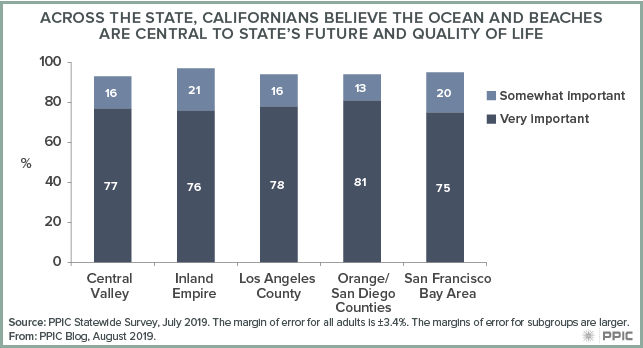
Friday is National Beach Day—an easy day to celebrate in California. The Golden State’s love of beaches is legendary, and as it happens it’s a legend backed by data. The latest PPIC environment survey found that three in four Californians (77%) say the condition of the ocean and beaches is very important to the state’s future economy and quality of life.

figure - Life

Californians are very concerned about a number of threats to their marine environment—including sea level rise, overfishing, and plastic pollution. Overwhelming majorities view plastic and marine debris as a big problem (72%) or somewhat of a problem (18%). Across age, education, income, and racial/ethnic groups, solid majorities say this is a big problem.

figure - Most Californians Say Plastic and Marine Debris along the Coast Closest to Them Are a Problem

The debris comes from diffuse sources. The California Coastal Commission reports that 80% of marine debris comes from land-based sources, such as litter that washes from land to the sea. Rain carries plastic litter of all sizes into the ocean through urban creeks and storm drains.

A growing concern is microplastics, debris that is too small to be caught by existing filters at wastewater treatment plants. This debris can come from personal care products rinsed down drains and synthetic fibers from laundered clothing. It can also come from larger pieces of plastic that end up in the ocean and break down. The most notorious example of this is the Great Pacific Garbage Patch, the eastern part of which is between California and Hawaii.

The problem is particularly acute in California. The San Francisco Estuary Institute reports that San Francisco Bay appears to have more microplastic pollution than other major water bodies in the US. A study by the Monterey Bay Aquarium Research Institute found that Monterey Bay also has high concentrations of microplastics. And scientists are now reporting that microplastics have been detected in Lake Tahoe for the first time, demonstrating the reach of the problem. Plastic is a problem across California’s waters.

Legislators are taking notice, with several bills currently aimed at tackling this issue. The goals are ambitious—for example, Senator Ben Allen and Assemblywomen Lorena Gonzales, both representing coastal areas of the state, have proposed bills that would slash single-use plastic waste in California by 75% by 2030.

While the outcome of such efforts remain to be seen, Californians’ concern about this problem—and their love of the ocean—is sure to drive momentum in the search for solutions.


Democrats View Environmental Policy as Critical in Upcoming Primary

Climate change is becoming a defining issue for voters in next year’s presidential election. According to PPIC’s latest statewide survey on the environment, record-high shares of Californians are concerned about the impacts of global warming, overwhelming majorities disapprove of the way President Trump is handling environmental issues, and most likely voters say presidential candidates’ positions on the environment are important in determining their vote next year.

With California’s presidential primary a little more than six months away, eight in ten likely voters say that the candidates’ positions on the environment are important (44% very, 36% somewhat) in determining their vote. Democratic likely voters (64%) are far more likely than independents (34%) and Republicans (20%) to say candidates’ positions on the environment are very important. In addition to partisan divisions, there are significant generational differences—even within parties, Democratic likely voters age 18 to 44 (76%) are much more likely than those age 45 and older (58%) to say candidates’ environmental positions are very important.

With the environment critical for many Democrats, especially younger voters, whom do they support in the 2020 presidential primary? Among likely voters who are registered Democrats or are Democratic-leaning independents, and who say candidates’ environmental positions are very important, support is greatest for Kamala Harris (19%), Elizabeth Warren (18%), Bernie Sanders (12%), and Joe Biden (11%). (Candidates mentioned are those who polled 10% or higher). Notably, nearly a quarter (24%) of those who say the environment is very important are currently undecided. Here, too, there are differences across age groups. Likely voters age 18 to 44 concerned about the environment name Warren (23%), Sanders (20%), and Harris (15%) as their top primary choices, while those age 45 and older name Harris (22%), Biden (16%), and Warren (15%).

When asked about the Green New Deal, a policy proposal in Congress that aims to address climate change and stimulate economic growth, three in four likely voters who are registered Democrats or are Democratic-leaning independents say that candidates’ positions on the proposal are important in determining their vote (35% very, 39% somewhat). Among those who say positions on the Green New Deal are very important, 20% name Harris and Warren, 14% name Sanders, and 10% name Biden as their preferred candidate. Again of note, 20% of voters who say this is very important are undecided. Likely voters age 18 to 44 interested in the Green New Deal support Warren (27%), Sanders (24%), and Harris (15%), while among those age 45 and older support is greatest for Harris (24%), Warren (16%), and Biden (15%).

figure - Candidates’ Environmental Policies Matter to Democratic Likely Voters

These findings suggest that Californians will place high importance on environmental issues when making choices at the ballot in the coming year. With the next Democratic presidential debate and climate crisis town hall less than a month away, PPIC will be closely tracking the role of climate policies and other salient issues.


Video: A Conversation with Assembly Speaker Anthony Rendon

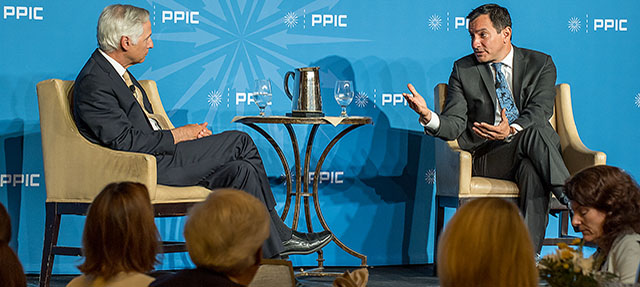
When Anthony Rendon was elected to the California State Assembly in 2012, he thought he would focus on early childhood education. “I came to Sacramento after working in early childhood education for 20 years . . . probably thinking that I would work on that.” However, he continued, “You come here and you realize the extent to which all of these issues impact one another. I think it’s dangerous to isolate any single issues.”

As he noted in his conversation with PPIC’s Mark Baldassare last Thursday, Rendon has focused on many individual measures in this legislative session, including a recently signed bill to modify the criteria for police use of deadly force and a bill to address predatory lending. In the wake of the Gilroy shooting, he has also prioritized a package of gun control bills. He sees these measures as part of a broader focus on improving opportunity for all Californians.

Rendon became Speaker in 2016, when Jerry Brown was governor. At first, he found working with Brown to be “a little frustrating,” but “eventually, we did a lot together. . . . There was a very narrow focus, two or three things—criminal justice reform, climate change, but that was about it. Those are still the things he cares about.” Governor Newsom focuses on a wider range of issues. And, Rendon said, “He’s also more sort of open-ended. He’ll come in and say, ‘Hey, housing, what do you think?’”

One of the issues Newsom cares about is early childhood education—which is still a major priority for Rendon. While Brown “helped us to start down the path” to reinvesting in this area, “now we have a governor who believes that . . . it has a positive impact on families and communities and children.” Newsom’s belief translated into significant funding increases for early childhood education in this year’s budget. “The budget was phenomenal,” said Rendon. Early childhood education is particularly important, in his view, because it’s “not trying to fix something that’s already broken. It’s a way of addressing issues early on, it’s a way of breaking the cycle of poverty.”

Although the Democratic Party controls both the governor’s office and the legislature, Rendon believes it’s important to work with Republicans whenever possible. He sees some common ground on issues such as climate change and education—“the real issues that really impact Californians.” More generally, it is important that state leaders represent all Californians: “I want to be able to tell people . . . ‘I’m working for you.’”


Preparing California’s Rivers for a Changing Climate

This is part of a series on issues facing California’s rivers.

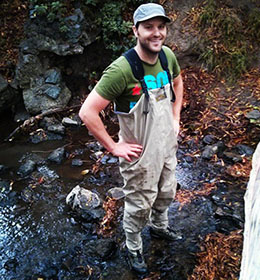
California’s rivers and streams have experienced enormous changes over the past 150 years, and a warming climate brings new challenges. We talked to Ted Grantham—a river scientist at UC Berkeley and a member of the PPIC Water Policy Center research network—about the state of the state’s rivers. Grantham was recently appointed as the first PPIC CalTrout Ecosystem Fellow. Thanks to the donors that helped us launch this program: Gary Arabian, the Morgan Family Foundation, Nick Graves, John Osterweis, and the Rosenberg Ach Foundation.

photo - Ted Grantham

PPIC: Talk about the changes affecting California’s rivers and streams.

Ted Grantham: California’s rivers and streams have experienced so much change since European settlement that they’re considered “novel ecosystems.” Gold mining and logging brought a massive amount of sediment into rivers. Riparian forests that lined Central Valley rivers and extensive wetlands on the valley floor have mostly been converted to farming. Non-native species have been introduced to most of California’s rivers, lakes, and estuaries, which prey upon or compete with native species. Urban rivers across the state have been channelized. And essentially every major river and stream in the state is impacted by a dam. Dams aren’t just barriers to migratory fish, they also alter downstream flows.

We’ve also prevented rivers from being able to move. Rivers are not static features; when given the opportunity, they will dynamically respond to changes in climate. This dynamism is inherent to how rivers work—it’s how habitat is created and maintained for many species. And it’s what makes these systems resilient over time.

Given all these fundamental changes, it’s remarkable that most of the state’s native fish species are still with us, although many are at risk of extinction.

PPIC: How are the state’s rivers expected to respond to climate change?

TG: The most direct change is increasing temperatures. Our rivers and streams will continue to heat up in a warming climate. Even if average precipitation stays the same, we’ll also experience more extremes, with both drought years and wet years more likely to occur. While increasing floods pose risks to some river ecosystems, it’s drought we’re most concerned about. Drought not only reduces the amount of water available for the environment, it also intensifies competition with other water users, making it harder to protect freshwater ecosystems.

Climate change is particularly problematic for cold-water fish such as salmon. In the short term, large dams have the potential to limit warming to some degree because they hold reserves of cold water. For example, Shasta Dam is managed to sustain salmon populations downstream through cold-water releases. But if water gets too warm over time, our ability to sustain cold-water reserves in the reservoir will decline. In the long term, redesigning dams to allow for fish passage or strategically removing dams will give salmon access to cold water in higher elevation streams.

PPIC: How can we prepare rivers for a changing climate?

TG: There are several promising management strategies that are gaining traction and could help build climate resilience in our rivers. Two important ones are securing environmental flows and restoring floodplains.

“Environmental flows” refers to the quantity, quality, and timing of water needed to maintain healthy rivers and ecosystem services that people rely on. In the past, little consideration was given to water needs of the environment. But that is changing and we’re seeing a growing effort to establish legally protected water allocations for environmental benefits. For example, I’m currently involved in the California Environmental Flows Framework, a program to support the development of environmental flow standards in rivers and streams throughout the state.

We’re also seeing more interest in multi-benefit approaches to floodplain management. Most of California’s rivers are disconnected from their floodplains, which have been converted to agriculture and urban uses. This has had huge impacts on fish populations and other species. As the likelihood of extreme floods increases with climate change, reconnecting floodplains is a cost-effective way to reduce flood risk. What’s exciting is that floodplain restoration can be compatible with agriculture and can also provide productive habitats. For example, the Yolo Bypass is primarily managed to protect Sacramento from flooding, but it also supports seasonal agriculture and habitat for birds and fish. Bringing water back to our floodplains can even help replenish groundwater, which is a critical water source in drought years.

The Associate Degree for Transfer May Help CSU Meet 2025 Goals

Students enrolling at the California State University (CSU) as a part of the Associate Degree for Transfer program (ADT) make up a growing share of all CSU transfers—and they are graduating more quickly than other transfer students. The program awards associate degrees and guarantees admission to a CSU campus to community college students who earn at least 60 of the 120 units needed for a bachelor’s degree in a specific major. The ADT aims to cut the amount of time-and red tape it takes to transfer to CSU and graduate with a bachelor’s degree.

Since its inception in 2011, the program has grown rapidly. In 2018, 41% of community college transfers to CSU had an associate degree for transfer, though not all of them started out on an ADT pathway. The number of students who do enter CSU on an ADT pathway has increased tenfold, from 1,089 in 2013 to 10,917 in 2018, and ADT pathway enrollees now account for about one in five transfers to CSU. Currently, the program encompasses more than 30 majors, though offerings vary by community college and CSU campus.

While students who transfer to CSU are generally very likely to graduate, the three-year graduation rate for ADT transfers are 10 percentage points higher than the rate for all transfer students (79% vs. 69%). But about half of students enrolling In an ADT pathway graduate in just two years, which is 16 percentage points better than the overall average for transfers (35%). This suggests that reducing students’ time to degree might be the program’s most notable advantage.

figure - Associate Degree for Transfer (ADT) Students Graduate More Quickly Than Their Peers

The CSU Graduation Initiative 2025 aims to bring two-year graduation rates up to 45% by 2025. Recent experience indicates that the expansion of the ADT could prove helpful: CSU’s two-year graduation rate increased from 31% to 35% from 2013 to 2015, as the share of students on an ADT pathway went from 2% to 12%. Given that one in five transfer students in 2018 were on an ADT pathway, we could see a record number of transfer students graduating in just two years, saving themselves time and money and helping CSU make progress toward its goal.


Video: School Resources and the Local Control Funding Formula

The Local Control Funding Formula (LCFF) was enacted in 2013-14 with three major goals: to simplify California’s K–12 school finance system, increase local control over spending, and provide additional funding to districts with large shares of high-need students—those who are low income, English Learners, homeless, and/or foster youth. At a lunchtime event in Sacramento last Thursday, PPIC researcher Julien Lafortune shared key findings from a new report that looks at increased spending under the LCFF. Then, a panel of experts offered state and local perspectives on the successes and challenges of directing funding to high-need students.

The PPIC report offers new statewide evidence on how school resources have been affected by LCFF; it also examines the extent to which these resources are reaching the highest-need students. It finds that LCFF funding is, for the most part, reaching the high-need students for whom it was intended. But the funding formula imperfectly targets high-need students in lower-need districts.

Kent Kern, superintendent of schools for the San Juan Unified School District, highlighted the challenges of serving high-need students in a district with wide disparities across schools. At 54.5%, his district’s share of high-need students is just below the LCFF’s “high need” funding threshold; however, 19 of its 64 schools have shares of high-need students that are 80% or above. “One of my schools that’s actually at the 99th percentile is a mile away from a school in another district. If we received the same funding as that district got, [our] school would be generating $1.4 million more.”

Not surprisingly, Kern would welcome a change to the LCFF that could benefit the high-need students in his district: “I think there would be some threshold that would allow schools with high-need concentrations to get more money.”

From a statewide perspective, however, the LCFF’s district-level approach is important. Michael Kirst, professor emeritus at Stanford and a key LCFF architect, emphasized the importance of providing additional funding to districts with the highest concentrations of need, to help them address particularly difficult educational challenges: “I would continue to support the theory of concentration, though I realize there are tradeoffs.” Samantha Tran, senior managing director at Children Now, pointed out that when the LCFF was being developed, many stakeholders were concerned that a school-level funding model could create perverse incentives: “If a border line could be drawn that allows for deeper concentration that draws down more state dollars . . . that is not the policy we want in place. We don’t want to perpetuate segregation.”

Asked what they would change about the LCFF, Kirst and Tran agreed on the need for more money as well as greater transparency on spending. Kirst noted that “it takes more than money” to retain teachers and improve student outcomes, but there are clear links between spending and achievement. And Tran said that while she has “no interest in bean counting,” the state needs a clearer understanding of trends in spending and outcomes.

From both the state and the local perspective, the LCFF has been successful in focusing attention on high-need students. As Tran put it, “We’re actually having a conversation about high-need schools . . . that’s a success.” One of the biggest challenges, from Kern’s perspective, is that people expect “too much change too fast. . . . I think we just need to stay the course.”


Video: Understanding Poverty in California

[vc_row][vc_column][vc_column_text]

Despite a booming economy, millions of Californians live in or near poverty. In this video, PPIC research associate Tess Thorman gives an overview of poverty and child poverty in the state, using the latest figures from the California Poverty Measure (CPM).

The CPM is a joint research effort by PPIC and the Stanford Center on Poverty and Inequality that provides a comprehensive look at economic well-being in our state. By accounting for cost of living differences across the state as well as earnings and other family resources—including safety net benefits—the CPM offers valuable insights into the ability of Californians to meet basic needs and be financially secure.[/vc_column_text][/vc_column][/vc_row][vc_row visibility=”hidden-phone”][vc_column][vc_video link=”https://youtu.be/tPh4xE7QLGo” el_width=”70″ align=”center”][/vc_column][/vc_row][vc_row visibility=”visible-phone”][vc_column][vc_video link=”https://youtu.be/tPh4xE7QLGo”][/vc_column][/vc_row][vc_row][vc_column][vc_column_text]To learn more about poverty in California, visit ppic.org/poverty.[/vc_column_text][/vc_column][/vc_row]

Planning for a Drier Future in the Colorado River Basin

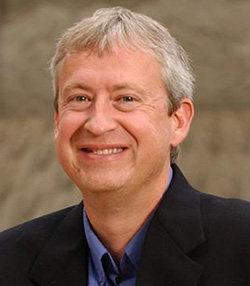
The Colorado River has experienced decades of over-allocation of its waters, making it harder to address the added challenges that climate change is bringing. The recently adopted Drought Contingency Plan (DCP) was an important step toward addressing the basin’s chronic water shortages, but more work is needed to prepare for a hotter, drier future. We talked to Doug Kenney—director of the Western Water Policy Program at the University of Colorado and a member of the PPIC Water Policy Center research network―about managing the basin for long-term water sustainability. Kenney organized a conference in June that covered these issues in depth.

Photo of Doug KenneyPPIC: Talk about the basin’s over-allocation problem.
Doug Kenney: The current problem with the river’s water budget is in the lower basin. For much of this century, California, Arizona, Nevada, and Mexico have consistently pulled about 1.2 million acre-feet more water out of Lake Mead than enters it each year. That’s basically five years of water supply for Las Vegas. You can get away with that much overuse by drawing down reservoir storage—which is what we’ve been doing—but that’s not sustainable. So we need to accelerate efforts to scale back consumption. That’s what the DCP was designed to do—it’s mandated belt tightening.

In the upper basin states it’s a very different situation—water use in Colorado, New Mexico, Utah, and Wyoming is currently at a stable and reasonable level. But future use is expected to increase, while natural inflows are declining as the region continues to warm from climate change. The upper basin states can legally develop more water supplies, but the reality is that water isn’t likely to be reliably available. There’s a disconnect between how much water the upper basin states were promised and how much actually exists.

PPIC: What is needed to achieve sustainable management in the basin?

DK: The primary emphasis has to be on using less water. Given that most water in the basin is used for agriculture, that sector has the greatest potential to save water. Paying farmers to fallow some fields is probably the most appealing option. However, there are legal, financial, and cultural issues to deal with.

In most of the west, efforts to incentivize agricultural demand management have been pretty primitive—with the exception of Southern California, which has had major success trimming farm water use in the Imperial and Palo Verde water districts. Those programs aren’t perfect, but they are happening at a sufficiently large scale to make a significant contribution to addressing the regional water budget problem. In most other places in the basin, these types of programs are much smaller, and there’s a lot of skepticism about scaling these efforts up. The politics are very delicate, as these mechanisms would reallocate water from farms to cities. But you can’t ignore the math or the economics. Some sort of agricultural demand management will have to be a core element of any sustainable water use plan in the basin. The challenge is to do it in a way that is fair and protects the socioeconomic fabric of rural areas.

PPIC: What’s next for the basin’s water planning?

DK: The next steps are big ones. The operation of Powell and Mead is governed by interim guidelines that expire after 2026. Some key arrangements between Mexico and the US also expire then. The states are required to begin negotiating new rules to replace the expiring arrangements no later than 2020. This figures to be a really complex and very politically difficult negotiation, so there’s real interest in setting up the right process to get it done. That’s where many of us are focused right now—identifying the process that gives the negotiations the best chance for success.

PPIC: The DCP didn’t address ecological and health problems at California’s troubled Salton Sea. What’s next for the sea?

DK: At this point it’s about figuring out how to pay for what everyone knows has to be done. I’m convinced we’ve reached a turning point on the Salton Sea. There’s momentum within and outside of California to find a solution. It was disappointing that the DCP didn’t address the issues, but it wasn’t due to a lack of concern or effort—essentially, folks ran out of time. But I hear a consistent message from every sector and state: we need a solution for the sea. There’s an old maxim in this basin: anything is possible if all seven states can agree to it. I’m hopeful that this can apply to the Salton Sea crisis

New Federal Data Sheds Light on Student Debt in California

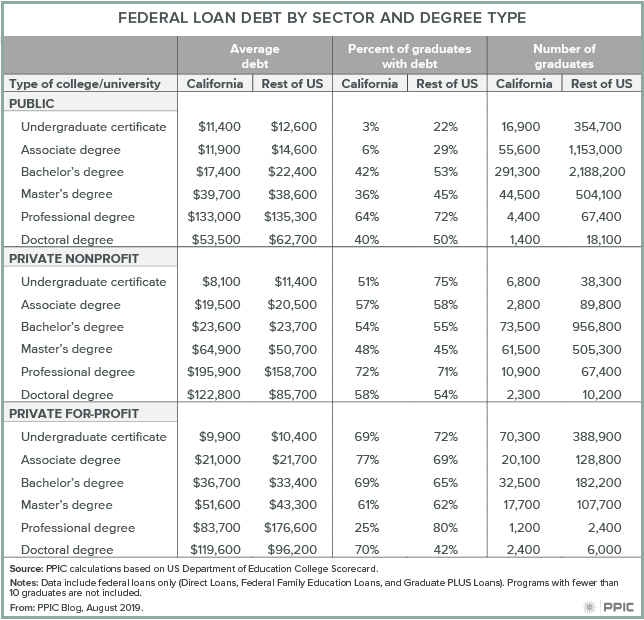
For the first time ever, the federal government has released data on loan debt for college graduates by type of degree and field of study. The data includes federal loans from three programs (Direct Loans, Federal Family Education Loans, and Graduate PLUS Loans) for students graduating in 2014–15 and 2015–16. This release is especially timely in light of national discussions about the cost of college–with some Democratic presidential candidates arguing for debt-free college and loan forgiveness. In just those two academic years, more than 300,000 Californians graduated from college (with degrees ranging from PhDs to vocational certificates) with debt. The total amount of federal debt among those graduates exceeded $10 billion.

Some of the findings from the recently released data are not surprising. For example, undergraduates at public colleges and universities in California are less likely to take on debt than their peers in the rest of the country. And when students in California do take on debt, the amounts tend to be lower. Federal loan debt for Californians earning bachelor’s degrees at UC and CSU averages $5,000 less than at public universities in the rest of the country ($17,400 versus $22,400). And undergraduates in California are less likely to take out federal loans (42%) than their peers in the rest of the country (53%). Only 6% of associate degree holders from the state’s community colleges have federal loans, compared to 29% of public community college graduates in the rest of the country. Students at California’s public colleges and universities are also less likely than their counterparts at the state’s private institutions to take on debt, and those who do take out loans graduate with less debt.

Other findings are striking. In California and the rest of the nation, graduate students tend to have far higher loan amounts than undergraduates, with professional degree holders incurring the most debt—generally well over $100,000. The most common professional degrees are in law, medicine, and dentistry. Graduates of professional schools at private nonprofits in California incur the most federal loan debt—almost $200,000. In general, graduate students at California’s public universities are less likely to take on debt, and their loan amounts are lower than those for students at private colleges. Even so, graduate students at public institutions are incurring large amounts of debt.

table - Federal Loan Debt by Sector and Degree Type

Large debt levels among graduate students reflect higher tuition for many programs. For example, tuition and fees at UC Berkeley’s law school are almost $60,000 for 2019–20, compared to less than $20,000 for academic graduate programs such as English. High demand for many graduate professional programs coupled with expectations of earnings premiums account for both the higher tuition and students’ willingness to take on debt.

Policies to address student debt must be mindful of which students take on debt, the range of institutions and areas of study, and the ability of students to pay back their debt. These are critical concerns in putting college graduates on the path to economic mobility and long-term financial security.