Emergency Child Care for Essential Workers

Of the state’s estimated 5.1 million essential workers, about 1.9 million have children younger than 13. These parents may be having difficulty finding care for their children amid the COVID-19 crisis, with most schools closed and many child care providers shuttered.

To address this need, the California Department of Education issued guidelines last Thursday for temporarily restructuring state-provided child care services. Parents who are essential workers can apply for services during the pandemic even as the state continues to prioritize certain at-risk children regardless of parents’ occupations.

Child care programs that receive state funds are now encouraged to remain open—or to reopen—if they can safely do so in order to care for the children of essential workers. To be eligible, all parents in the household must be essential workers and require child care so they can continue working (for example, they do not have the option to work remotely).

More than half a million essential workers with about 640,000 children younger than 13 could qualify. About 43% of these essential workers have a youngest child between 0 and 4 years old at home, while the rest have older children. Most of these parents work in health-related occupations, which are prioritized in the guidelines to receive child care services.
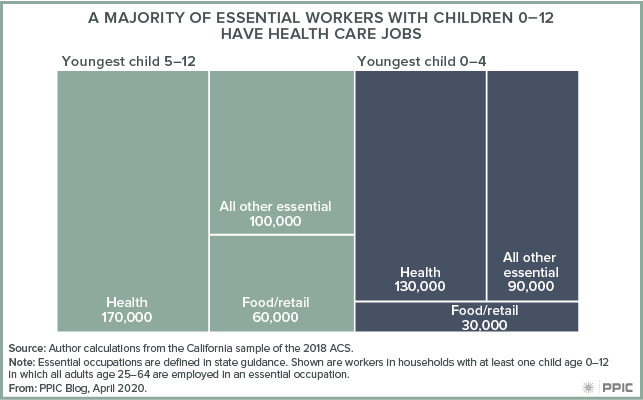
figure - A Majority of Essential Workers with Children 0-12 Have Health Care Jobs

On Monday, Governor Newsom announced that $100 million of the funds allocated in SB 89, emergency legislation to fight the coronavirus pandemic, will go toward funding up to 20,000 more short-term child care slots—and making child care programs safe for those children and their teachers. The CARES act provides federal funds to states for these purposes, so California will recoup these expenditures.

While we don’t know how many state-subsidized programs have remained open, even in the best of times the number of spaces is limited so most children—including those in low-income families—cannot access such care. However, demand for child care is indicated by the number of children in low-income, essential worker families. During this emergency, essential worker families do not need to show they are low income when they seek child care. However, programs are instructed to prioritize families.

About 400,000 children in essential worker families live on incomes below 85% of the state median—the income cut-off for state preschool in normal times. While a majority of parents in essential jobs work in health occupations, most low-income children have parents working in other essential occupations. In other words, tension may arise between serving children of low-income essential workers and serving children of health workers.
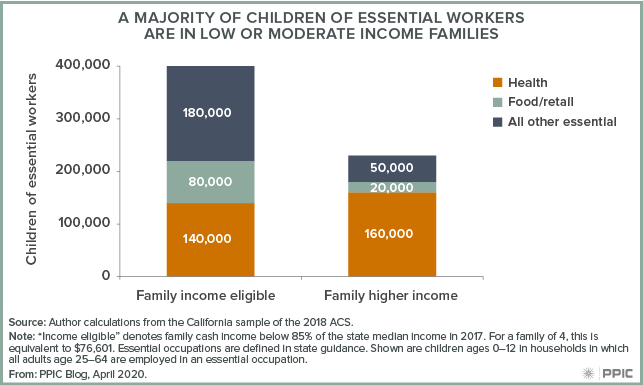
figure - A Majority of Children of Essential Workers Are in Low or Moderate Income Families

In this time of uncertainty, the state has existing capacity to support child care, and it has shifted the goals of state-supported programs to help essential workers meet—and afford—their child care needs. By tracking the response, the state could gain insight into whether it is meeting the needs of essential workers in this difficult time, how to meet these needs in the longer term, and to what extent needs vary across the state.


Video: Understanding Poverty in California

[vc_row][vc_column][vc_column_text]

Despite a booming economy, millions of Californians live in or near poverty. In this video, PPIC research associate Tess Thorman gives an overview of poverty and child poverty in the state, using the latest figures from the California Poverty Measure (CPM).

The CPM is a joint research effort by PPIC and the Stanford Center on Poverty and Inequality that provides a comprehensive look at economic well-being in our state. By accounting for cost of living differences across the state as well as earnings and other family resources—including safety net benefits—the CPM offers valuable insights into the ability of Californians to meet basic needs and be financially secure.[/vc_column_text][/vc_column][/vc_row][vc_row visibility=”hidden-phone”][vc_column][vc_video link=”https://youtu.be/tPh4xE7QLGo” el_width=”70″ align=”center”][/vc_column][/vc_row][vc_row visibility=”visible-phone”][vc_column][vc_video link=”https://youtu.be/tPh4xE7QLGo”][/vc_column][/vc_row][vc_row][vc_column][vc_column_text]To learn more about poverty in California, visit ppic.org/poverty.[/vc_column_text][/vc_column][/vc_row]

1 in 4 Child Care Workers in California Lives in Poverty

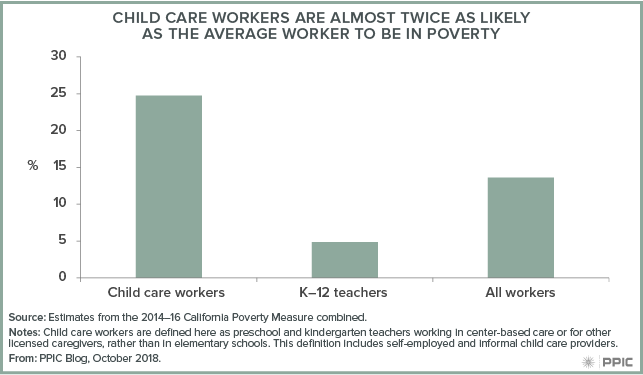
While preschools and child care providers in many parts of California are straining to fill a unmet need, the state’s child care workers are poorly paid and almost twice as likely to live in poverty than workers overall.

California’s child care workers earn significantly less than their school-based counterparts. Given that about 95% of child care workers not based in schools are women, and 53% are African American or Latina (compared with 43% of the overall workforce), women—particularly women of color—are most affected by low pay in the child care workforce.

UC Berkeley found that in 2017, the median hourly wage for child care workers in California was $12.29—just one-third the median wage for kindergarten teachers. Earnings among child care workers track more with low-wage workers across California (defined as those earning less than two-thirds of the median wage). These low wages translate to about a quarter of child care workers living in poverty as compared to 14% of all working adults (ages 18-64)—according to the California Poverty Measure, developed by PPIC and the Stanford Center on Poverty and Inequality.

Low wages are just one piece of the poverty puzzle. Relative to all working adults, child care workers are more likely to have only part-time work (more than a third, compared with less than a quarter of the overall workforce), which is associated with dramatically higher poverty rates than full-time employment. Many have completed some college credit or have an associate’s degree (44%), but just a fifth have a four-year degree, in a workforce where more than a third of working adults have four-year degrees. And while people working in child care are as likely to have children as the average working adult, those who do are more likely to be parenting alone (11%) than the average worker (6%).

The social safety net is an important part of helping child care workers make ends meet. Half of all child care workers benefit from at least one safety net program or tax credit, with the two largest being CalFresh (25%) and the federal Earned Income Tax Credit (37%). Without this assistance, poverty among child care workers would be even higher—2.5 points higher without the Earned Income Tax Credit, and 2.1 points without CalFresh. Minus all major safety net programs, one in three child care workers would live in poverty.

Recent policy changes could start to boost incomes for child care workers. Expanded eligibility for 18–24-year-olds for the state’s new Earned Income Tax Credit, starting in 2019, will specifically help the 20% of the workforce who are under 25. Steady increases in California’s minimum wage could improve earnings of child care workers employed by providers subject to minimum wage laws. Yet many workers are self-employed, providers often operate with limited incomes, and the cost of care itself is already high for low-income families. Minimum wage increases will likely result in a better-paid child care workforce only if they are accompanied by sector-wide changes aimed at making child care both affordable and accessible.

The needs of child care workers will affect efforts to improve and expand California’s complex child care system. While the state and federal governments have begun to increase access to child care with expanded programs and additional funding, improving living standards for child care workers will be a major challenge for California’s next governor.

Poverty in California Is High by Any Measure

The Census Bureau recently released updated income and poverty statistics for the years 2015–2017 combined, including information on the Supplemental Poverty Measure (SPM) for states. The SPM updates official poverty statistics, which are released annually, by accounting for the varying cost of housing across states and the impact of key social safety net programs like federal and state Earned Income Tax Credits (EITCs). According to the SPM, California continues to have one of the nation’s highest poverty rates, neck-and-neck with Florida (18.1%) and Louisiana (17.6%). While California’s poverty rate for 2015–2017 was 19%, the national poverty rate was much lower, at 14.1%.

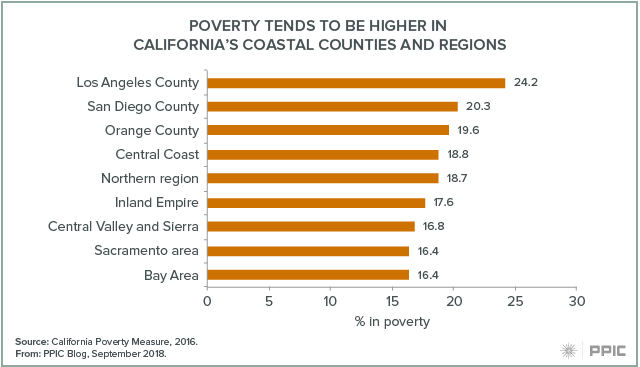
The California Poverty Measure (CPM), a collaborative effort by PPIC and the Stanford Center on Poverty and Inequality, provides additional detail needed to understand our large, complex state. It takes into account both the varying cost of living and the poverty-mitigating role of social safety net programs like the EITC and CalFresh within different regions of California. PPIC published CPM estimates in July indicating that 19.4% of Californians lived in poverty in 2016. Poverty rates are highest in certain coastal areas, including Los Angeles County, where the mix of the high cost of housing, employment opportunities for low-skilled workers, and access to large-scale social safety net programs create particularly challenging circumstances.

Blog figure: Poverty tends to be higher in coastal counties and regions

Despite the important role of social safety net programs, employment is a key factor in determining poverty status. Adults working full time and for the whole year have a poverty rate of just 8.3%, while nearly a quarter (23.5%) of those working less are in poverty. At the same time, employment does not eliminate poverty: 44.6% of working adults in poverty are actually working full time, year round.

Blog figure: Close to half of working poor adults in California are working full time, year round

What can policymakers do to improve the situation in California? The good news is that there are diverse opportunities to address poverty. Moderating housing costs, supporting proven employment and training programs, and vigorously supporting social safety net programs all offer opportunities to improve the well-being of disadvantaged Californians.

Nearly Half of the Working Poor Are Working Full Time and Year Round

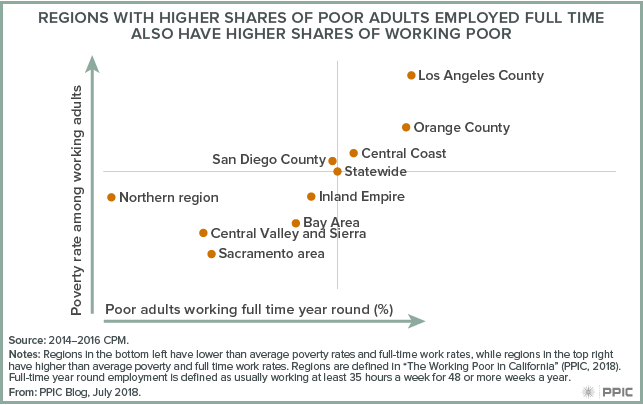
Roughly 2 million out of 16 million working Californians (ages 25‒64) live in poverty, according to California Poverty Measure (CPM) estimates—and nearly half (45%) of these workers are employed full time and year round.

We see a positive association between poverty rates and rates of full-time, year-round employment across regions. In other words, in areas of the state with higher shares of poor adults working full time—including Los Angeles and Orange Counties—the rates of poverty among working adults are also higher.

In those regions, working poverty is clearly not mainly attributable to working insufficient hours. It is driven by wage rates and other factors—measured in the CPM—like the cost of living, necessary expenses, and access to safety net resources (or lack thereof). For many of the working poor, the most promising strategies for improving wages require access to high-quality education and training.

Refundable Tax Credits Ease Poverty in California

Poverty and income inequality have become hot topics in policy circles at the state and national levels. PPIC has been looking at these issues, too—recently analyzing the role that needs-based programs play in helping families make ends meet. In conjunction with researchers at the Stanford Center on Poverty and Inequality we measured poverty in California more comprehensively than the Census official poverty measure does. We found that the federal Earned Income Tax Credit (EITC) and refundable portion of the Child Tax Credit have the biggest impact in moderating poverty rates, relative to other safety net programs.

Both programs are aimed low- and moderate-income families with dependent children. Families must file tax returns to participate in these programs, which are funded by the federal government. (In addition, 25 states and the District of Columbia have their own smaller EITCs, although California does not.) The EITC is fully refundable, meaning that a family with earnings but no net tax obligation (after deductions) receives the full amount of the credit (based on their earnings) in the form of a tax refund. The Child Tax Credit is partially refundable.

Together, the EITC and CTC trimmed the 2011 poverty rate for working age adults from 24.0 percent to 21.4 percent. The child poverty rate dropped even more, from 31.1 percent to 25.1 percent. Put another way, an additional 600,000 California adults and 560,000 children would be considered poor without these programs.

Chart Source: The California Poverty Measure: A New Look at the Social Safety Net.