Video: Preparing California for the 2020 Census

The 2020 census will be a defining moment for California. Much is at stake—including billions in federal funds and the state’s political representation in the US Congress. The lasting impact of an undercount can’t be overstated. Governments, K–12 and higher education institutions, businesses, and nonprofits depend on the census to understand the needs of their communities, target services, and plan for the future.

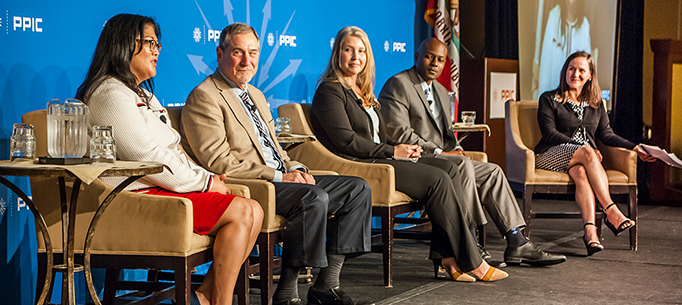
A panel of experts discussed the critical role of the decennial census at a PPIC event in Sacramento on April 24. They examined the challenges of reaching “hard-to-count” communities, the state’s part in ensuring an accurate tally, the impact of the recently-added citizenship question, and more.

The event opened with a wide-ranging conversation between Marc Berman, state assembly member, and Mark Baldassare, PPIC president. One of Berman’s biggest concerns is that California could lose its political clout in DC. The state has “40 million unique stories,” he said, and the census is about “making sure that every voice” gets counted. But the new citizenship question is counterproductive, in his view. We know that adding it “will discourage a lot of people from participating,” he said. “People are so fearful” that it could make a successful census count that much more difficult, he added.

For the first time, the US Census Bureau will try to collect most responses (55%) online, with the rest obtained by mail or in person. John Thompson, former director of the bureau, identified the government’s main rationale for the change—namely, cost. He also detailed best practices for adding a new census question: In the past, he said, the bureau would spend years testing it, partly to craft appropriate messaging and to ensure that residents were comfortable answering it. The new citizenship question did not have that review, a concern Thompson raised with Commerce Secretary Wilbur Ross to no avail.

John Dobard, associate director of political voice with Advancement Project California, discussed ways to involve the state’s hard-to-reach communities. One way to overcome residents’ fear of participation, he said, is to involve trusted leaders in outreach. Otherwise, entire multi-generational immigrant families could be left out.

An undercount could mean a direct hit to essential state services—such as the Children’s Health Insurance Program. In that scenario, young children in poverty would be hurt most of all, said Sarah Bohn, a panelist and PPIC research fellow.

Ditas Katague, the state’s 2020 census director, said her office is steeped in planning for the statewide rollout. Importantly, she said, California needs an “agile, flexible ground team,” and called on citizen volunteers to join state and local agencies, nonprofits, and philanthropic groups to help make that happen.

Are California’s Cities Ready for the Next Drought?

California’s urban areas—where more than 90% of residents live—managed the last drought quite well. How well prepared are cities and suburbs to weather the next long dry spell? Here are two things to know about urban drought preparedness.

Are we backsliding too much on water conservation?

While it’s true that urban water use is not as low as it was at the height of the latest drought in 2015, it is still much lower than in 2013, before Californians were asked to significantly limit their water use. This winter, some media stories highlighted unfavorable month-to-month comparisons—for example, water use in December 2017 was about the same as in December 2013. But what’s lost in this message is that water use in California is normally much lower in winter months, when very little is going to outdoor landscaping. When we smooth out the seasonal differences, water use in 2017 was roughly 13% lower than in 2013—and it has stayed down across all regions of the state (see figure).

During droughts people save water in all kinds of ways, but especially by reducing landscape watering, which in normal years accounts for about half of all urban water use. During the latest drought this saved a lot of water, but it also entailed costs—gardens and trees died and urban landscapes suffered.

Another thing to remember is that the large reduction in urban water use in 2015 and early 2016 was the consequence of state-imposed mandatory rationing. It’s normal for water use to rebound somewhat when rationing is lifted. This also happened after other recent droughts. Generally, though, Californians have been reducing their water use for the past several decades.

What should cities be doing now to prepare for the next drought?

With California’s variable climate, it’s always prudent to be prepared, because the next drought can be just around the corner. Even though urban water utilities have done a good job preparing for past droughts, they can’t rest on their laurels. For example, as cities and suburbs become increasingly efficient with water over the long term, this affects their ability to tighten their belts during droughts. There’s less of a cushion and fewer easy steps that can be done quickly. Utilities will need to address this trade-off by ensuring that some portion of the long-term water savings is reserved in storage for times of drought emergency.

Urban utilities also need to be better fiscally prepared for times when they sell less water. This was a real weakness during the latest drought. The dilemma is that up to 80% of the costs of supplying water to businesses and households don’t change with the amount of water people buy. Utilities still have to maintain their systems, but most of their revenues are based on the number of gallons sold. When you start asking everyone to conserve, you can quickly end up in the red. We recommend that as soon as a utility knows it will have to ask for drought savings, it should inform its customers about how that could affect rates. Some communities have drought surcharges, which work well. The key is to have a plan, communicate in advance, and engage the public in understanding the issue of balancing revenues and costs.

Parents Have High Educational Hopes for Their Children—Can California Keep Up?

The most recent PPIC Statewide Survey on Californians’ views on education finds that the vast majority of parents (83%) hope their children will obtain at least a bachelor degree—in fact, nearly half (48%) want their children to earn a graduate degree. These parental aspirations are relatively constant across race/ethnicity, political ideology, and income. They are also fairly consistent across regions—although, among the regions represented in the survey, parents in the Central Valley are the least likely (77%) and San Francisco Bay Area parents are the most likely (96%) to want their children to earn college or graduate degrees. These parental aspirations may be linked to student course taking and performance in high school. Over the past decade, there has been a 48% increase in completion of the coursework that makes California high school graduates eligible for UC or CSU; in 2015, 43% of the state’s graduating class met this eligibility requirement.

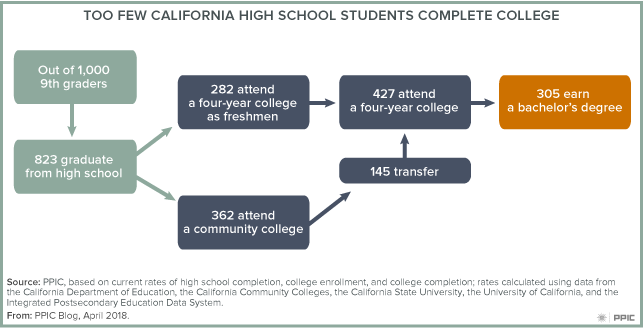
Moreover, these aspirations are aligned with urgent state needs. If current economic and educational trends persist, California will fall 1.1 million bachelor’s degrees short of economic demand by 2030. The state economy is increasingly reliant on high-skill workers, but most K–12 students do not stay on track to obtain a bachelor’s degree, let alone a graduate degree. Previous PPIC research has shown that for every 1,000 9th graders in California, only 305 will earn a bachelor’s degree at UC or CSU.

Parental Aspiration Figure

California has a long way to go in meeting demand for higher education, but there are signs of progress. The state has been reinvesting in public higher education, increasing undergraduate enrollment, and improving student outcomes—and the public education systems are increasingly willing to work together to streamline the higher education pipeline. California will need continued innovation and significant investment in facilities and faculty in order to accommodate the kind of enrollment growth that can keep up with economic demand and individual aspirations. Moreover, given the large share of Californians who see advanced degrees as important, the state may want to begin a more robust discussion about graduate school, along the lines of its recent focus on career technical education.

Commentary: Replenishing Groundwater in the San Joaquin Valley

This commentary was published in the Sacramento Bee on April 18, 2018.

California’s biggest agricultural region also has the state’s biggest groundwater deficit, which has long-term consequences for the region’s economy and farming.

The San Joaquin Valley—where decades of unchecked pumping has depleted reserves, resulting in a long-term deficit of nearly 2 million acre-feet per year—has about a generation to bring its groundwater use into balance to comply with the state’s Sustainable Groundwater Management Act. Storing more water underground through “groundwater recharge” can help, reducing the deficit by about a quarter.

Read the full commentary on sacbee.com 

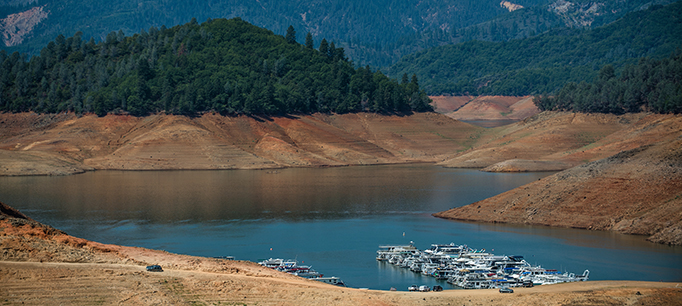
Image above courtesy of Jonathan Parker, Kern Water Bank Authority

California’s K–12 Educational Progress: Good News and Bad News

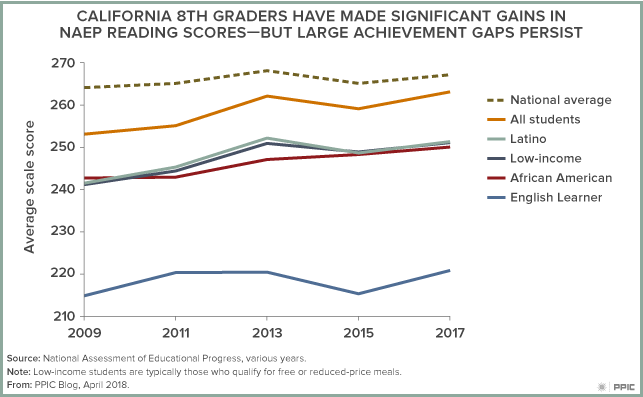
New data on the educational progress of California’s K–12 students offers a mixed picture: there have been sizable gains in grade 8 reading scores, but more work is needed to close achievement gaps for English Learner, low-income, and African American and Latino students.

The data comes from the 2017 National Assessment of Educational Progress (NAEP), commonly referred to as the nation’s report card. Administered periodically in grades 4, 8, and 12, NAEP serves as a common yardstick for states and informs many national policy decisions.

The NAEP results show that the average reading score for California 8th graders has risen from 259 to 263. While the latest score is still below the national average (267), it marks a significant improvement, and the state’s 4 point gain is larger than the 1 point increase at the national level. The increase is driven by improvement at both ends performance scale: fewer students performed at the lowest level and more students performed at the advanced level.

However, there were no significant improvements in grade 8 math and no gains in either subject in grade 4. Also, California did not see any significant narrowing of its student achievement gaps. For instance, the average reading score for Latino students in grade 8 was 27 points lower than that of white students; this gap is not significantly different from the 30 point gap in 1998. Similarly, the average score for low-income students was 28 points lower than that of other students, and that gap is not different than it was as in 1998 (32 points).

Naep Score Figure

The NAEP results provide a useful benchmark of student performance; this is especially important in light of the sea changes under way in California’s public K–12 system. The state revamped its school finance and accountability systems with a focus on improving outcomes among English Learners and other “high-need” students. It also adopted new educational standards in math, English language arts, science, and English language development, and implemented a new assessment system.

A recent PPIC survey finds that a solid majority of adults believe that the financial reforms, in particular, will improve the achievement of English Learners and low-income students. As the reforms take hold, PPIC will continue to monitor their impact.

Tax Day: Californians Feel Overburdened

Tax day is here, and Californians are feeling particularly burdened.

A record-high number of adults (72%) say that California ranks above average or near the top in per capita state and local tax burden compared to other states. This perception is close to the fiscal facts: a Tax Foundation report ranked California’s 2014 state and local tax collections per capita as 13th-highest in the nation.

Taxes are not only perceived to be high, but they are also viewed as disproportionate: a majority of Californians (56%) say they pay more taxes to state and local governments than they feel they should (37% much more, 19% somewhat more). Californians’ views were similar last March (58%), following an extension of income tax increases on high-earning residents. Today, traditionally tax-opposed Republicans (78%) are much more likely than independents (63%) and far more likely than Democrats (47%) to say that they pay much or somewhat more than they should. This perception is also more common across higher-income groups (65% $80,000 or more, 58% $40,000 to under $80,000). Lower-income groups are more divided: among residents with household incomes under $40,000, 47% say they pay more or somewhat more than they should, while 40% say they pay the right amount.

How do these views align with approval ratings of state elected officials? Among those who say they pay much more than they should, 50 percent disapprove of the way Jerry Brown is handling his job, 60 percent disapprove of the California Legislature, and 57 percent disapprove of the way that the state legislators representing their assembly and senate districts are doing at this time.

Nonetheless, legislators are moving forward with more tax proposals. According to a recent California Tax Foundation Report, the state legislature introduced 33 bills and constitutional amendments since the start of the 2017–18 legislative session that could increase taxes and fees by over $269 billion annually, though few are likely to become law. The most expensive proposals include a government-run healthcare tax, a sales tax on services, and a new tax on California businesses. These proposals come in the midst of an election year and expected state budget reserve of nearly $16 billion.

Californians will soon have the opportunity to make significant decisions at the ballot box—choosing new leaders and helping to shape the state’s future. Stay tuned to the PPIC Statewide Survey for timely coverage of this year’s election and Californians’ leadership preferences.

Video: Californians and Education

In the wake of the Parkland, Florida, killings, the latest PPIC survey finds an overwhelming majority of Californians are concerned about a possible shooting in their local schools. But most oppose having teachers carry guns in school facilities.

Lunna Lopes, PPIC researcher, detailed these and other key findings at a Sacramento briefing last week.

When asked about school shootings, 73 percent of California adults and 82 percent of public school parents say they are very or somewhat concerned. Yet two-thirds of adults (67%) and public school parents (68%) oppose allowing more teachers and school officials to carry guns in schools. Strong partisan differences emerge on this issue. An overwhelming majority of Democrats (86%) and a strong majority of independents (69%) are opposed to arming teachers and school officials, while a solid majority of Republicans (60%) favor the idea.

A few other survey highlights include:

  • Californians (65%) support having local school districts declared sanctuary safe zones for undocumented students, but there are deep partisan divisions.
  • California adults and likely voters continue to see the state’s K–12 funding as inadequate. Solid majorities (60%) of likely voters favor local school bonds, while fewer (48%) support local parcel taxes for schools.
  • Across parties, majorities of likely voters agree that gubernatorial candidates’ positions on K–12 education are very important.
  • Among likely voters in the gubernatorial race, Democrat Gavin Newsom maintains his lead (26%), followed by Republican John Cox (15%) and Antonio Villaraigosa (13%). Nearly a quarter of likely voters (22%) remain undecided.

The PPIC Statewide Survey: Reflections at the 20th Anniversary

Mark Baldassare, president and CEO and survey director, and Abby Cook, vice president of communications, at the Public Policy Institute of California have worked on every PPIC Statewide Survey.

This year, the 20th anniversary of the PPIC Statewide Survey, is an important one in California. The state is at the forefront of many major national issues, and our voters will be electing new leaders across the board. Over the past two decades, PPIC has conducted nearly 175 public opinion surveys, interviewing more than 350,000 Californians—allowing us to see how the attitudes of state residents have evolved and providing valuable context for today’s policy landscape.

Our surveys show that Californians have long had a progressive streak when it comes to such topics as environmental protection, gun restrictions, and a woman’s access to abortion. However, views on other key issues have undergone significant change. Among them:

  • The perception that immigrants are a net benefit to California has been steadily climbing. In 1998—the first year of the PPIC survey—46% of Californians said that immigrants are a benefit to California because of their hard work and job skills; 42% said immigrants are a burden because they use public services. Last year, 76% said immigrants are a benefit, while 20% said they are a burden.
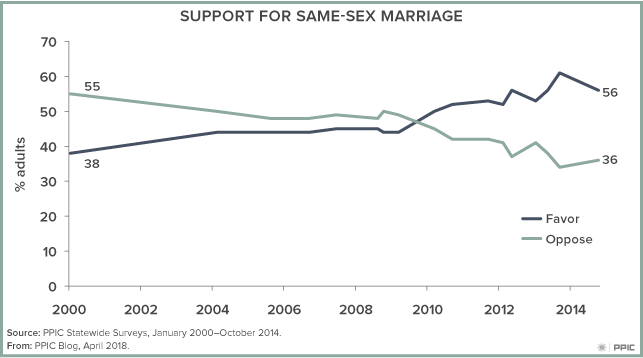
  • Majority support for legalizing same-sex marriage is now the norm. In 2000, we asked whether Californians favored or opposed allowing gay and lesbian couples to be legally married. Just 38% were in favor and most (55%) were opposed. By 2014, opinions reversed. A majority—56%—were in favor and 36% were opposed.
  • State action to combat climate change has evolved from a bipartisan issue to a partisan one. The Global Warming Solutions Act of 2006, landmark legislation that required the state to reduce greenhouse gas emissions to 1990 levels by 2020, enjoyed the support of a strong majority of Californians (65%)—including more than six in ten adults across parties—the year it passed. By 2016, support was similar (69%), but there was a wide partisan divide: majorities of Democrats (80%) and independents (56%) expressed support, while fewer than half of Republicans (44%) did so.

At the same time, the survey shows Californians holding steadfast on other issues:

  • The citizens’ initiative process in lawmaking is highly valued. In 2000, 68% of Californians were somewhat or very satisfied with the initiative process. By 2016, that figure had changed little (64%).
  • Californians express unwavering praise for Proposition 13. In 2003, the 25th anniversary of the landmark ballot measure, 57% of Californians said it had been mostly a good thing. This year, the 40th anniversary, that number remains the same.
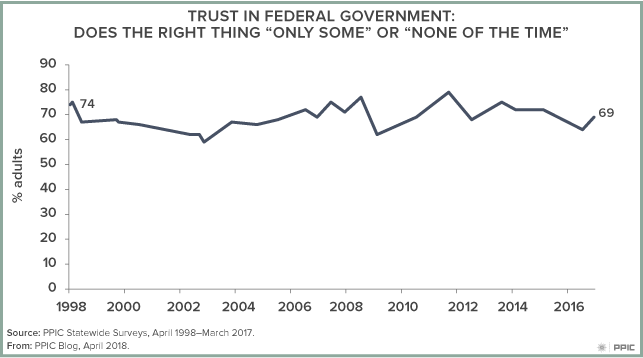
  • Distrust of government is a constant undercurrent in voter sentiments. In April 1998, 74% of Californians said they trusted the federal government to do what is right only some or none of the time. In 2017, a similar percentage—69%—expressed that view.
Above all, the survey has revealed that the most persistent element in California policymaking is what we call the state’s “exclusive electorate.” California voters tend to be older, white, affluent, homeowners, and college educated. Nonvoters tend to be younger, Latino, less affluent, renters, and less likely to be college educated than likely voters. Voters make significant policy decisions at the ballot box—but nonvoters provide a unique perspective on the role of government. At a time when economic inequality has become one of most important policy issues in the state, this divide is a key reason we conduct the PPIC Statewide Survey as we do. Our survey gives all Californians—nonvoters and registered voters alike—a real-time voice on current topics, political leaders, and public institutions.

PPIC is unique in California in its ability to combine state-of-the-art polling with an institutional commitment to tackling major issues affecting Californians. We are often asked about how we conduct the survey and the philosophy behind it. Here is a brief look behind the scenes.

First, our surveys adhere to the high-quality standards set by the most respected nonpartisan polling organizations that conduct national surveys—such as the Pew Research Center, the Washington Post, ABC, CBS, CNN, and Gallup. Like these organizations, we use a random digit dialing (RDD) methodology. Despite changes in the polling landscape, this method remains the most effective way to reach all adults. It allows for random sampling of households within California, meaning that each person in the population has an equal probability of being selected. Our surveys include live telephone interviews with adults (age 18+) in English and Spanish. After each survey is completed, we compare the survey sample to census statistics and make any necessary statistically weighted adjustments to achieve a representative sample.

Second, while our methods remain the same, our approach has changed in response to the challenges of reaching people by phone. Since 2003, we have worked exclusively with interviewing firms that conduct surveys for our national peers. Starting in 2008, we have conducted both landline and cell phone interviews. After the 2016 election, based on extensive analyses of the performance of online surveys and live telephone surveys, we decided to maintain our RDD methodology and increase our cell phone interviewing (65% in 2017, 70% in 2018).

Third, every survey is designed with the intent of delivering accurate, independent, nonpartisan information on the perceptions, attitudes, policy preferences, and ballot choices of California residents. Our core audiences are policymakers, the media, and other engaged Californians—all of whom have come to depend upon the PPIC Statewide Survey as a critical barometer of public opinion in the state. And amid the partisan rancor of political debate, PPIC’s surveys also point out areas of consensus among the state’s diverse residents, providing valuable information to policymakers.

Fourth, PPIC produces a range of products in conjunction with each survey—including blog posts, fact sheets, and a survey report with crosstabs. Large sample sizes (currently 1,700 adults) allow us to accurately report the findings of key subgroups, such as likely voters, partisan groups, major regions, and age, income, and racial and ethnic groups.

Finally, our surveys are free of charge and available to all. We disseminate the findings through outreach activities that include public briefings in Sacramento—videotaped and posted on our YouTube channel—and broad use of social media, where our followers include state legislators, nonprofit and business leaders, and reporters from major media outlets. We also convene forums around the state for constructive discussion of the issues raised in our surveys. As a result, the PPIC Statewide Survey has had a significant impact on informing policymaking, as measured by activities such as bill citations in the state legislature.

We are grateful to many PPIC colleagues who have worked diligently over the years to produce surveys that are timely, relevant, and accessible. For every survey, the staff makes the call on survey methods and questions, and the content of reports and press releases. We benefit greatly from the leadership of the PPIC board of directors, which is dedicated to maintaining the institute’s mission and values, and a survey advisory committee that provides substantive input and expertise. Lastly, we would not have arrived at the 20-year mark without grant support from foundation partners—the James Irvine Foundation for the “Californians and Their Government” survey series and the consortium who fund the annual education and environment surveys. These ingredients make it possible for PPIC to conduct independent, nonpartisan, high-quality polling that provides a voice for the public and likely voters.

The 20th year of the PPIC Statewide Survey is shaping up to be the most important to date. We are monitoring the attitudes of California adults on a host of critical issues while tracking the ballot choices of California likely voters in the 2018 election. We look forward to keeping you well informed during a consequential election year—and into the future.
Testimony: How an Integrated Data System Could Improve Education

Jacob Jackson, research fellow at the PPIC Higher Education Center, testified before the Senate Committee on Education in Sacramento today (April 11, 2018). Here are his prepared remarks:

Thank you Chair Allen, Vice Chair Wilk, and members of the committee for the opportunity to testify today. My name is Jacob Jackson and I am a research fellow at the Public Policy Institute of California. PPIC is a nonprofit, nonpartisan policy research organization and does not take positions on legislation. My comments today are about the potential benefits of a statewide, longitudinal student data system and are based on research that PPIC and others have conducted.

Right now, educational institutions and government agencies already collect plenty of data. The California Longitudinal Pupil Achievement Data System (CALPADS) tracks students from kindergarten through grade 12. Each public system of higher education (the community colleges, California State University, and the University of California) keeps track of its students while they are attending that institution. And the Labor and Workforce Development Agency collects data on the earnings of Californians over time. However, these data sources remain largely separate—which prevents the state from understanding how students move across educational institutions and into the workforce. Below are three key considerations in thinking about the potential value of an integrated data system.

A statewide longitudinal data system could help answer important questions for California. The lack of an integrated data system leaves California unable to answer basic questions about educational progress, workforce development, and equity. Such questions include:

  • Is the state’s educational pipeline working? Who applies to which colleges? Does starting at a community college hurt students’ chances of earning a bachelor’s degree?
  • How does education affect workforce outcomes? In what ways are academic coursework and performance during K–12 related to future earnings? What are the economic returns to different Career Technical Education (CTE) pathways?
  • Are state interventions working? Are districts that receive extra funding through the Local Control Funding Formula getting better at sending students to college?
  • Are state investments paying off? What are the impacts of early childhood education on long-term educational and economic outcomes?

College and career readiness is one area where a longitudinal data system could help inform policy. The Common Core State Standards and the Smarter Balanced assessments are aimed at preparing K–12 students for college and career success. PPIC projects that California will face a shortfall of 1.1 million college graduates if current trends in college-degree production and demand for college-educated workers persist. Getting students ready for college is an important goal for the state. In fact, California’s K–12 scorecard will soon start holding districts accountable for their college and career readiness. The College Career Indicator contains metrics about high school course completion and standardized test measures. But due to the lack of linked data, high schools do not actually know which of their students go to which colleges, whether students need remediation once they get there, and whether students succeed in their academic goals. High schools also lack data on if or when students enter the workforce and how successful they are in their career. A statewide longitudinal data system can connect high school performance with outcomes in college and career, which could in turn provide schools, researchers, and policymakers the feedback they need to improve college and career readiness policies and programs.

Though our current ability to link data across sectors is limited, doing so has already produced important insights. Occasionally, researchers or institutions can link together data on a project-by-project basis. Here I list two examples that uncovered important insights and that would not have been possible without longitudinal data. First, PPIC researchers Sarah Bohn and Shannon McConville’s work on Career Technical Education in health fields linked educational data from the California Community Colleges Chancellor’s Office with earnings data from the state’s Unemployment Insurance system. Their work showed that CTE credentials in health generally have sizeable economic returns. The research also indicated which certificates result in higher wages and showed that earning multiple, short-term credentials yields significant economic returns. My own research with Michal Kurlaender and Scott Carrell of UC Davis connected community college data to high school data to show that incoming student characteristics play a big role in determining college-wide outcomes and rankings. These findings are especially important given the initial conversations around performance funding for California’s community colleges.

It is clear that a statewide longitudinal data system could provide new information and insights that are not currently available or possible. There still may be concerns about organization, privacy, security, costs, and ownership of the data, but if the state is willing to meet those challenges—as many other states have done—this tool could help California evaluate and improve its system of education. Linking K–12, college, and earnings data would allow policy experts to determine which policies and programs produce the best and most efficient outcomes for students, colleges, and the state as a whole.

3 Things to Know about California Droughts

The erratic weather in recent months—a dry winter followed by “atmospheric rivers” that packed a punch in March and April, capped by a poor report on the state’s snowpack—hasn’t exactly offered a clear picture for drought watchers. In fact, there is no universal definition of when a drought begins or ends. Here are three things about droughts that every Californian should know.

Rain, snow, and water in storage are the conditions that define a drought in California.

Technically speaking, a drought is simply having less precipitation than normal. But California’s climate is so variable—indeed, it’s the most variable in the nation—that our “normal” is often either very wet or very dry. We also have an annual, seasonal “drought” from late spring through early fall.

To cope with this variability, we’ve developed a massive storage system and conveyance networks to move water to places where it is scarce and demand is high. Thanks to this elaborate water system, California can face one or two much drier-than-normal years without major disruptions.

California’s mountain snowpack has historically provided “free” seasonal storage for meeting summer irrigation needs. About a third of the state’s annual water supply is stored as snow in the Sierra headwaters. Large reservoirs across the state capture melting snow and release it during our dry summers. Experts have recently begun referring to a new type of drought—“snow drought”—to define years when reduced overall precipitation coincides with unusually warm winters. The winter of 2015 was a good example, with the all-time lowest snowpack in recorded history. Unfortunately, this is becoming more frequent due to the warming climate, and it has big implications for water management because our current system isn’t designed for this shift from snow to rain.

Accounting for these conditions, most of California is not expected to be in a drought this year. Precipitation levels have been low—somewhere between “dry” and “below normal”—and the snowpack is about half of average, but the large reservoirs are still in good shape after the 2017 deluge.

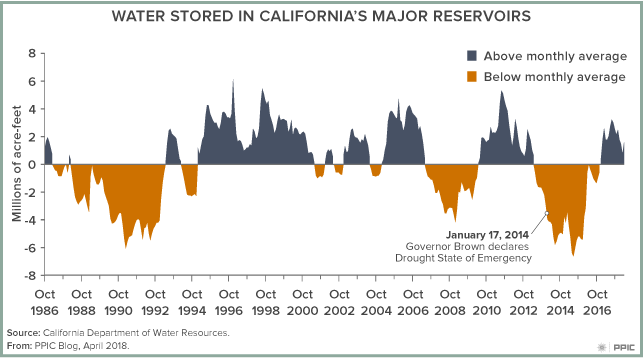
But this might change relatively quickly. As the figure shows, during successive dry years we rapidly draw down storage in reservoirs. By year two or three of a drought, reservoir releases are cut back and water scarcity becomes a problem, particularly in many agricultural regions. Groundwater helps reduce the impacts of drought, but it isn’t sufficient for extended droughts, and significant cutbacks in water use are required.

Drought vulnerability varies across the state.

California suffers a statewide drought only rarely, and the impacts of drought vary. Southern California is a relatively dry region, but it imports half of its water from Northern California and the Colorado River basin, both of which provide more reliable supplies. The central coast, which is not well connected to the statewide water system, relies much more on local precipitation and storage, which means it has a higher vulnerability to drought than other regions. In many areas, groundwater helps offset the loss of surface water during droughts. But long-term overreliance on groundwater—especially in the San Joaquin Valley—has led to negative effects, including dry wells, sinking lands, increased costs of groundwater pumping, and reduced supplies for future droughts.

Planning and preparing for drought can make a big difference. Our research has found that California’s cities and suburbs are the most drought-resilient areas of the state, thanks to significant local and regional investments in diversified water supplies.

Drought is not our only—or biggest—water problem.

Droughts worsen many of California’s water problems and heighten awareness of a number of other issues. But drought is not the underlying cause of critical, chronic problems facing California, such as difficulties accessing safe drinking water, our aquatic ecosystem crisis, or the unsustainable use of groundwater. Perhaps we put too much emphasis on drought―which is, after all, a natural feature of the state’s climate―and not enough on other critical issues.