The PPIC Statewide Survey: Reflections at the 20th Anniversary

Mark Baldassare, president and CEO and survey director, and Abby Cook, vice president of communications, at the Public Policy Institute of California have worked on every PPIC Statewide Survey.

This year, the 20th anniversary of the PPIC Statewide Survey, is an important one in California. The state is at the forefront of many major national issues, and our voters will be electing new leaders across the board. Over the past two decades, PPIC has conducted nearly 175 public opinion surveys, interviewing more than 350,000 Californians—allowing us to see how the attitudes of state residents have evolved and providing valuable context for today’s policy landscape.

Our surveys show that Californians have long had a progressive streak when it comes to such topics as environmental protection, gun restrictions, and a woman’s access to abortion. However, views on other key issues have undergone significant change. Among them:

  • The perception that immigrants are a net benefit to California has been steadily climbing. In 1998—the first year of the PPIC survey—46% of Californians said that immigrants are a benefit to California because of their hard work and job skills; 42% said immigrants are a burden because they use public services. Last year, 76% said immigrants are a benefit, while 20% said they are a burden.
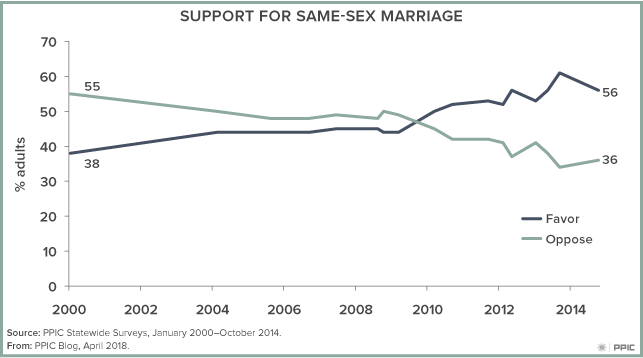
  • Majority support for legalizing same-sex marriage is now the norm. In 2000, we asked whether Californians favored or opposed allowing gay and lesbian couples to be legally married. Just 38% were in favor and most (55%) were opposed. By 2014, opinions reversed. A majority—56%—were in favor and 36% were opposed.
  • State action to combat climate change has evolved from a bipartisan issue to a partisan one. The Global Warming Solutions Act of 2006, landmark legislation that required the state to reduce greenhouse gas emissions to 1990 levels by 2020, enjoyed the support of a strong majority of Californians (65%)—including more than six in ten adults across parties—the year it passed. By 2016, support was similar (69%), but there was a wide partisan divide: majorities of Democrats (80%) and independents (56%) expressed support, while fewer than half of Republicans (44%) did so.

At the same time, the survey shows Californians holding steadfast on other issues:

  • The citizens’ initiative process in lawmaking is highly valued. In 2000, 68% of Californians were somewhat or very satisfied with the initiative process. By 2016, that figure had changed little (64%).
  • Californians express unwavering praise for Proposition 13. In 2003, the 25th anniversary of the landmark ballot measure, 57% of Californians said it had been mostly a good thing. This year, the 40th anniversary, that number remains the same.
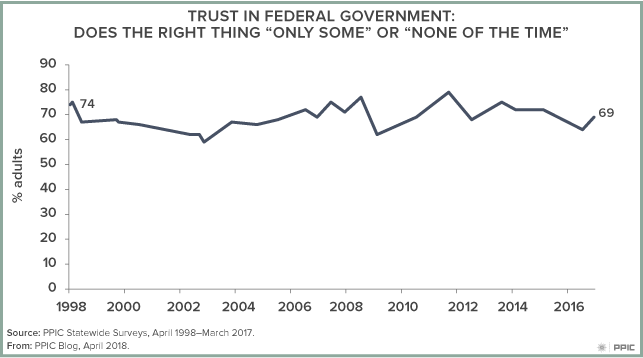
  • Distrust of government is a constant undercurrent in voter sentiments. In April 1998, 74% of Californians said they trusted the federal government to do what is right only some or none of the time. In 2017, a similar percentage—69%—expressed that view.
Above all, the survey has revealed that the most persistent element in California policymaking is what we call the state’s “exclusive electorate.” California voters tend to be older, white, affluent, homeowners, and college educated. Nonvoters tend to be younger, Latino, less affluent, renters, and less likely to be college educated than likely voters. Voters make significant policy decisions at the ballot box—but nonvoters provide a unique perspective on the role of government. At a time when economic inequality has become one of most important policy issues in the state, this divide is a key reason we conduct the PPIC Statewide Survey as we do. Our survey gives all Californians—nonvoters and registered voters alike—a real-time voice on current topics, political leaders, and public institutions.

PPIC is unique in California in its ability to combine state-of-the-art polling with an institutional commitment to tackling major issues affecting Californians. We are often asked about how we conduct the survey and the philosophy behind it. Here is a brief look behind the scenes.

First, our surveys adhere to the high-quality standards set by the most respected nonpartisan polling organizations that conduct national surveys—such as the Pew Research Center, the Washington Post, ABC, CBS, CNN, and Gallup. Like these organizations, we use a random digit dialing (RDD) methodology. Despite changes in the polling landscape, this method remains the most effective way to reach all adults. It allows for random sampling of households within California, meaning that each person in the population has an equal probability of being selected. Our surveys include live telephone interviews with adults (age 18+) in English and Spanish. After each survey is completed, we compare the survey sample to census statistics and make any necessary statistically weighted adjustments to achieve a representative sample.

Second, while our methods remain the same, our approach has changed in response to the challenges of reaching people by phone. Since 2003, we have worked exclusively with interviewing firms that conduct surveys for our national peers. Starting in 2008, we have conducted both landline and cell phone interviews. After the 2016 election, based on extensive analyses of the performance of online surveys and live telephone surveys, we decided to maintain our RDD methodology and increase our cell phone interviewing (65% in 2017, 70% in 2018).

Third, every survey is designed with the intent of delivering accurate, independent, nonpartisan information on the perceptions, attitudes, policy preferences, and ballot choices of California residents. Our core audiences are policymakers, the media, and other engaged Californians—all of whom have come to depend upon the PPIC Statewide Survey as a critical barometer of public opinion in the state. And amid the partisan rancor of political debate, PPIC’s surveys also point out areas of consensus among the state’s diverse residents, providing valuable information to policymakers.

Fourth, PPIC produces a range of products in conjunction with each survey—including blog posts, fact sheets, and a survey report with crosstabs. Large sample sizes (currently 1,700 adults) allow us to accurately report the findings of key subgroups, such as likely voters, partisan groups, major regions, and age, income, and racial and ethnic groups.

Finally, our surveys are free of charge and available to all. We disseminate the findings through outreach activities that include public briefings in Sacramento—videotaped and posted on our YouTube channel—and broad use of social media, where our followers include state legislators, nonprofit and business leaders, and reporters from major media outlets. We also convene forums around the state for constructive discussion of the issues raised in our surveys. As a result, the PPIC Statewide Survey has had a significant impact on informing policymaking, as measured by activities such as bill citations in the state legislature.

We are grateful to many PPIC colleagues who have worked diligently over the years to produce surveys that are timely, relevant, and accessible. For every survey, the staff makes the call on survey methods and questions, and the content of reports and press releases. We benefit greatly from the leadership of the PPIC board of directors, which is dedicated to maintaining the institute’s mission and values, and a survey advisory committee that provides substantive input and expertise. Lastly, we would not have arrived at the 20-year mark without grant support from foundation partners—the James Irvine Foundation for the “Californians and Their Government” survey series and the consortium who fund the annual education and environment surveys. These ingredients make it possible for PPIC to conduct independent, nonpartisan, high-quality polling that provides a voice for the public and likely voters.

The 20th year of the PPIC Statewide Survey is shaping up to be the most important to date. We are monitoring the attitudes of California adults on a host of critical issues while tracking the ballot choices of California likely voters in the 2018 election. We look forward to keeping you well informed during a consequential election year—and into the future.

Video: Mark Baldassare & John Myers Discuss the PPIC Survey

For the first time since the start of the PPIC Statewide Survey, Californians ranked the drought as the most important issue facing the state. And that was not the only “first” for this survey. PPIC presented it in Sacramento Thursday in a new format. Mark Baldassare—PPIC’s president, CEO, and survey director—was interviewed onstage about the findings by John Myers, senior editor of KQED’s California politics and government desk.

In addition to the drought, Baldassare and Myers covered a long list of topics that were raised in the survey, including taxes, vaccinations, marijuana, University of California tuition, distrust in government, and voter turnout. Myers also raised a theme he explored in his report on the survey for KQED: Despite an improving economy and Californians’ support for the governor’s ideas about the budget, their outlook on the direction of the state remains gloomy.

Video: The Future of Local Taxes

The parcel tax is unique to California, said economist Jon Sonstelie, because it is a revenue alternative that navigates the constraints of Proposition 13. Sonstelie, PPIC Bren Fellow and a professor at UC Santa Barbara, evaluated the tax in his new report Parcel Taxes as a Local Revenue Source in California and presented the results last week in Sacramento. He noted that between 2003 and 2012, cities, school districts, and local districts put 691 parcel tax proposals to fund services on the ballot, and 53 percent received the two-thirds vote required for passage. Most of these taxes were relatively small. The median was $60 for cities, $96 for school districts, and $68 for special districts.

Following the presentation, a panel discussed the future of local taxes in an era of increasing local authority. Patrick Murphy, PPIC research director, moderated the discussion. Participants included Michael Coleman, principal fiscal advisor to the League of California Cities; Robert Gutierrez, director of the California Tax Foundation; and Marianne O’Malley, managing principal analyst on state and local finance at the Legislative Analyst’s Office

Dividing California’s Higher Education Pie

The tuition increase recently approved by the University of California Regents has ignited a debate about how the state allocates money for higher education. A brief look at the history of state funding can provide some much-needed perspective.

Each higher education system—UC, the California State University, and the community colleges—receives substantial funding from the state. Most of the remaining funds for instruction come from tuition paid by students. (In this analysis, we look at allocations from the state General Fund and property taxes so that we can compare institutions across time.)

Since 1965, the share of higher education funding provided directly by the state has shifted from the four-year systems to the community colleges. In the mid-1980s, the community colleges received about a third of the state allocations to public higher education institutions. In 2014‒15, the community colleges got more than half of the pie. Meanwhile, the share allocated to CSU and especially UC has been shrinking. UC’s share fell from 38% in 1965 to 24% in 2014‒15, and CSU’s share declined from 25% to 22%. The governor’s proposed 2015‒16 budget includes a funding increase of $843 million to the state’s public colleges and universities—71% ($600 million) of which would go to the community colleges.

The large increase in state allocations to community colleges is linked to increased enrollment. But enrollment has increased just as much at UC and CSU. Indeed, on a full-time equivalent basis, UC, CSU, and the community colleges each serve about the same share of the state’s public higher education students today as they did 50 years ago. So what explains the shift in the share of funding from UC and CSU to the community colleges?

The short answer is Proposition 98.

After Proposition 13 passed in 1978, the state’s community colleges—which unlike UC and CSU relied partly on property taxes—saw a sharp reduction in their share of state and local support. Ten years later, voters passed Proposition 98, which guaranteed K–12 schools and community colleges a minimum percentage of the General Fund and property tax revenue. Proposition 98 guarantees that K–12 schools and the community colleges get about 40% of these allocations—and about a tenth of that share goes to the community colleges. Some have argued that Proposition 98 acts as a funding ceiling for K–12 schools and community colleges, but it also serves as a floor.

UC and CSU lack the same funding protection. While many budget areas outside of higher education are at least partially protected by dedicated funding streams, court orders, or matching federal funds, UC and CSU are vulnerable when state revenues decline. The universities have faced disproportionately large cuts in their general fund allocations during times of economic hardship. From this vantage point, a funding floor—even one that doubles as a ceiling—is preferable to a funding drop-off.

The three higher education systems also receive indirect forms of state support such as Cal Grants, fee waivers, and middle-class scholarships. Grant aid has increased for students at all institutions of higher education in California. Our best estimates suggest that community college students receive slightly more of these state funds (41% of the total in 2011‒12), than UC students (40%) and much more than CSU students (18%).

The debate over higher education funding could benefit from a clearer understanding of how the pie is divided. But the most important issue for the state’s young people is that the pie is not keeping pace with demand. Our four-year colleges have record numbers of applicants and the shares of students who are academically qualified to attend them have increased. The future prosperity of Californians and their state depends on access to higher education. To address these issues, policymakers need to focus on improving vocational programs and pathways from community colleges to four-year colleges and improving access and enrollment at UC and CSU.

Notes (TOP FIGURE): 2012-13 to 2014-15 numbers are from the governor’s budget; earlier data is from the California Postsecondary Education Commission. We include property tax allocations which are a component of the state’s obligation to community colleges pursuant to Proposition 98.

Who Likes Proposition 13?

One of the most remarkably stable trends in California public opinion is the strong majority support for Proposition 13, even as the state’s demographics and politics have changed dramatically. This historic citizens’ initiative had the immediate fiscal impact of lowering property tax rates, restricting annual property tax increases, and raising the bar for local special taxes to a two-thirds majority vote. It also fundamentally changed the state-local relationship in California and ushered in the national tax revolt. Its supporters are shaping our fiscal choices today—even though many were not old enough to vote when the measure passed 36 years ago.

Proposition 13 passed in June 1978—toward the end of Jerry Brown’s first term as governor—with a 65 percent yes vote. Our most recent poll finds that 63 percent of likely voters today say that Proposition 13 has been mostly a good thing—as majorities have said since we began asking this question in 2003.

Among Proposition 13’s supporters today, about half were not old enough to vote, and 14 percent were not even born in 1978. As a group, they are mostly whites and homeowners, with annual household incomes of $60,000 or more. But they are also politically diverse. Supporters are evenly divided along party lines, with four in 10 Democrats, four in 10 Republicans, and two in 10 independents or other party members in this camp. More than half describe themselves politically as middle-of-the-road or liberals, while 45 percent say they are conservatives. About half live in the San Francisco Bay Area or Los Angeles.

What unites Proposition 13 supporters? One of their signature features is their higher level of distrust in state government. Large majorities say that the state government wastes a lot of the taxpayer’s money, believe that the state government is run by a few big interests looking out for themselves, and say that they trust the state government to do what is right only some time or none of the time. Six in 10 say that the state is headed in the wrong direction, disapprove of the way that the state legislature is handling its job, and rate the state budget situation in California as a big problem. Most say they would prefer to use the budget surplus to pay down the debt rather than restore social services. They are evenly divided when asked if they approve or disapprove of Governor Jerry Brown’s job performance—however, seven in 10 are in favor of his budget plans and approve of a rainy day fund plan that is going to the voters in November.

Proposition 13 supporters register the most consensus when asked about who should make choices for the state budget today: 83 percent want the California voters to make some of the decisions about spending and taxes at the ballot box, while only 13 percent want the governor and legislature to make all of the decisions.

Perhaps the most enduring contribution of Proposition 13 is that it has given the voters a significant and growing role in fiscal policymaking. Voters will decide the fate of the rainy day fund proposal, as well as a multibillion-dollar state water bond also scheduled for the November ballot.

When voters cast their ballots this year, it is important to be aware of the mindset of the sizable and politically diverse coalition of Proposition 13 supporters: a suspicious view of state government and a cautious approach to spending—even in the context of a strengthening fiscal and economic recovery in California.

Trouble Ahead for Local School Ballot Measures?

This commentary first appeared on EdSource.org on April 30, 2014.

The elections this year offer the first statewide look at Californians’ willingness to raise revenue for their local schools since passage of Proposition 30, the tax initiative to benefit education that voters passed in November 2012. While it’s too early to know how many local school districts will test the waters by placing a construction bond or parcel tax on the ballot, there are undercurrents in our new survey that spell trouble ahead for local school ballot measures. In short, the public’s sense that schools are in crisis has diminished.

Our annual PPIC Statewide Survey on Californians and Education shows that likely voters view fiscal conditions in education as generally improving. The proportion who say that the state budget situation is a “big problem” for California’s K–12 public education has dropped by 10 points—from 72 percent to 62 percent—between April 2012 and today. More importantly, the proportion of likely voters saying that the level of current state funding for their local public schools is “not enough” has also dropped by 10 points between April 2012 and today—from 59 percent to 49 percent. In other words, the likely voters who currently view state funding of their local schools as problematic now make up less than a majority.

In our recent poll, 55 percent of likely voters would vote yes if there was a local school bond on the ballot—just barely meeting the minimum passage level. By contrast, 48 percent of likely voters would vote yes on a local school parcel tax—falling far short of the two thirds needed to pass.

It is important to note that likely voters who are public school parents are bucking these statewide trends: a majority of them view state funding for their local public school as inadequate, and over 60 percent say they would support a local school bond and a local school parcel tax this year. But our poll finds that public school parents make up less than 30 percent of the likely voters who will determine the ballot outcomes.

Since 2001, the statewide passage rate for local school bonds has been 81 percent and for local school parcel taxes, 60 percent, as noted by CaliforniaCityFinance.com and EdSource. This year, those rates may fall. Alternatively, there may be fewer local school ballot measures this year as funding proponents focus on a smaller set of school districts with voter profiles that offer favorable odds for passing these measures. For instance, our poll finds majority support for local school bonds and local school parcel taxes among Democratic, Latino, lower-income, and Bay Area likely voters.

Meanwhile, some legislators have proposed lowering the vote threshold needed to pass these taxes from two-thirds to 55 percent, which requires changing Proposition 13. But since the Democrats lost their supermajority when three of their senators were suspended, the legislature is much less likely to send this change to the voters for approval. Californians are not inclined to make this change anyway. The proportion of likely voters who say that this change to Proposition 13 is a good idea has declined—from 46 percent in April 2011 to just 39 percent today.

It is possible that voter concern about school funding needs will surface later this year, as school districts implement two dramatic changes: the Common Core Standards in the classroom and the Local Control Funding Formula, which provides more money for districts with higher proportions of English Learners and lower-income students. These changes could offer two new avenues to engage voters about the need for local school funding. For now, though, we will be watching for signs that Proposition 30’s passage will make it harder for local school ballot measures to succeed in 2014.

Reforming Proposition 13

In the current legislative session there has been a movement toward making changes in the Proposition 13 tax limits that voters approved in 1978. Democratic legislators have been emboldened to take on some key elements of the so-called “third rail of California politics” after the surprisingly easy passage of the Proposition 30 tax initiative in November 2012.

Voters have already been making changes to the laws that govern the state. Recently, they changed their legislators’ term limits and the legislative redistricting process, lowered the threshold for state budget passage from a two-thirds vote to a simple majority, and changed the partisan primary to a top-two primary. Surprisingly, they also voted to change the once highly popular Three Strikes Law. So, will reforming Proposition 13 be the next big thing?

One Proposition 13 tweak that is a perennial favorite among tax reformers is lowering the two-thirds vote that is needed to pass local special taxes. Proponents argue that this change would allow local governments to more easily raise needed revenues for schools, public safety, transportation, and water projects.

However, the backers of this particular Proposition 13 reform would face substantial opposition among the electorate today. In our January PPIC Statewide Survey, just 44 percent of voters were in favor of lowering the vote threshold from two-thirds to 55 percent, while 51 percent were opposed. These findings are consistent with most of our polling over time.

Looking more closely at the January survey findings, 50 percent of Democrats want to lower the vote threshold to pass local special taxes to 55 percent, but fewer than half of independents and Republicans favor it. Voter support falls below a majority among men and women, renters and homeowners, across age, education, and income groups and the state’s major regions. In other words, proponents of this change would start with less than majority support and need to run an expensive campaign to convince some “no” voters to vote yes. This would be an uphill battle, given that efforts to change Proposition 13 have always faced a well-organized anti-tax coalition in the past.

But there is a Proposition 13 change that has substantial voter support: creation of a “split roll” property tax. Under this proposal, commercial property would be taxed according to current market value and Proposition 13’s strict limits on property tax assessments and annual property tax increases would apply only to residential property. Advocates for this idea argue that business interests have reaped tax benefits that were supposed to be directed at homeowners and that a split roll would generate billions in new revenues for state and local programs.

This proposal has support among 60 percent of voters in our January PPIC Statewide Survey, with majority support among men and women, homeowners and renters, and across age, education, income, race/ethnic groups and the state’s regions. This reform has solid majority support among Democrats and independents, and 43 percent of Republicans also favor it. What gives the proponents pause for mounting an initiative campaign for a split-roll property tax? The likelihood that a campaign against it by well-funded business and commercial interests would succeed. Also, six in 10 voters say that Proposition 13 has been mostly a good thing for the state in our May 2013 PPIC Statewide Survey, making it easy for split-roll opponents to cast doubts about making changes to this popular initiative.

California voters started a national tax revolt when they approved Proposition 13 during Jerry Brown’s first term as governor—and he does not mention taking aim at Proposition 13 as a priority as he seeks a record fourth term. So what may be in store for change-minded voters? In our January poll, voters liked the governor’s plans for a rainy day fund and paying down the debt. We can expect to see legislation and ballot measures reflecting a desire to get the state’s fiscal house in order. In this election year, it seems unlikely that the state’s politicians will challenge the voters’ longstanding love affair with Proposition 13.