Video: Legislative Leaders Look Ahead

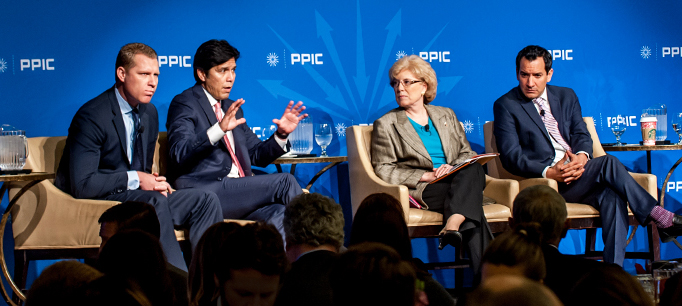
Despite their political differences, California’s legislative leaders have similar views of the state’s most pressing challenges. In a conversation facilitated by PPIC this week in Sacramento, the two top legislators from both major parties provided a preview of the issues they expect to tackle this session. With the impact of federal policy changes still unclear, the legislative leaders focused on longstanding challenges.

Asked to list the top issues the legislature and governor need to work on this session, Anthony Rendon, the Democratic speaker of the state assembly, named housing and transportation—topics he heard about repeatedly as he campaigned around the state. He said he saw the impact of a housing and transportation crisis first hand when walking precincts in the Inland Empire. “If you knock on someone’s door at 7:00, 7:30 p.m., they’re not home yet. They’re still on the freeway.”

Jean Fuller, the Republican leader of the state senate, sees the top issues as affordability in California generally and jobs. “We are concerned about housing, but we are also very concerned about jobs.” She noted that in her district, which stretches from Visalia to Twenty-Nine Palms, there is double-digit unemployment.

Kevin de León, the Democratic state senate president pro tem, said the past legislative session had been particularly productive; he highlighted minimum wage, gun safety, and climate change legislation. In this session, he said, “we have to deliver on the issues of housing and transportation and the issue of economic growth.”

For Chad Mayes, Republican leader of the assembly, poverty is the number one issue in the state, which has the highest poverty rate in the nation. “If you use that as a performance measure for how well our board of directors—the state legislature—is doing, I think you’d have to say we have been failing.” He added: “We’re failing, in large part because of housing costs.”

The speakers acknowledged major policy differences. But they pointed to past successes in bridging them as a sign that they can do so again.

“Things are not broken here, in comparison to DC,” said de León.

Automatic Voter Registration Is No Panacea

This commentary was published on Tuesday, May 5, 2015, in the Sacramento Bee.

California voter turnout has reached record lows. Only 18 percent of 24 million eligible adults cast ballots in the June 2014 primary and only 31 percent last November. As a result, state lawmakers and good government groups are searching for new ways to increase participation in elections.

One proposal that is gaining traction—and was discussed at a recent Public Policy Institute of California event with Secretary of State Alex Padilla and other officials—is to import an automatic voter registration system from Oregon.

There’s no question that such a system would swell California’s voter rolls. But would it significantly increase turnout? That’s much less clear.

(continue reading at sacbee.com)

Testimony: Four Important Questions about Voting in California

PPIC research fellow Eric McGhee was invited to testify about voter turnout in California last week before a joint hearing of the Senate Committee on Elections and Constitutional Amendments and Assembly Committee on Elections and Redistricting. Here are his prepared remarks.


California’s voter turnout in 2014 hit record lows in both the primary and the general elections. I’d like to put that turnout in broader context, and give some thoughts on potential solutions. In doing so, I’m going to briefly answer four questions:

  1. Who votes, and who doesn’t?
  2. What does California’s turnout look like over time and compared to the rest of the country?
  3. What are some of the reforms that have been tried in the past, and how well have they worked?
  4. What are the other possible reforms out there that have yet to be tried in California?

Who votes and who doesn’t?

California’s electorate does not look like the state as a whole. Compared to non-voters, California’s voters are older, whiter, more educated, less likely to have recently moved, more likely to be homeowners, and more partisan. They are also wealthier, though most of the difference in income between voters and non-voters is a function of the more powerful effects of other factors such as age and education. And, PPIC research by Mark Baldassare has shown that non-voters have different opinions on important policy issues. In particular, they tend to be more supportive of a larger role for government.

These differences are very similar to what one would find in the rest of the country, but California’s profile on all of these dimensions is at one extreme. The state is relatively young, relatively mobile, with an especially large non-white population.

Beyond all these demographic and attitudinal issues looms citizenship. Citizenship is a much more important issue in California than in other states, given the large non-citizen population we have here. It particularly affects the Latino and Asian American communities. That said, it is becoming a less important issue over time, since virtually all the population growth in these communities is now among native-born citizens.

What does California’s turnout look like over time and compared to the rest of the country?

California’s turnout has dropped between 10 and 20 points in the last 30 years. It’s important to break this problem into two separate parts: the registration rate among those who are eligible to vote, and turnout among the registered population. Identifying which is the bigger problem will help us know which problem to target first.

Compared to other states, California’s registration rate has been slipping. By contrast, turnout among the registered has been consistently higher than in other states, and has been holding up better over time. These numbers are not yet available for 2014, and California’s turnout will likely be low relative to other states that year. But overall, California lags other states in registration, not turnout.

That’s not to say that turnout among the registered is without problems. It has been declining in absolute terms, at least outside of fall presidential elections. But if we are going to tackle one problem in particular, registration may be a good place to start. In addition to being a problem more specific to California, it may be more amenable to broad reform. It amounts to little more than an administrative hurdle, and as detailed below, it is certainly the easiest one to take permanently off the table through more sophisticated data management.

What are some of the reforms that have been tried in the past, and how well have they worked?

In a report last year, I explored the effect on turnout and registration of two reforms to the registration process that California recently adopted to make the process easier. The first was online registration, which allows voters to conduct the entire registration process online without ever needing to mail in a paper form. The second is conditional registration, which allows voters to register and vote simultaneously in a single trip to the county registrar, and to do so after the official close of registration, up to and including Election Day. Online registration was used for the first time in the middle of the 2012 campaign season, so my analysis was about evaluating a reform that had already been implemented. Conditional registration, on the other hand, will probably not be implemented until 2017, so my analysis was about examining the effect of similar reforms in other states.

Online registration was wildly popular, accounting for over half the new registrants in the last month of the 2012 fall registration period. However, the results of the analysis of online registration suggested that the vast majority of these people likely would have registered to vote anyway. They probably got excited by the new system and registered earlier than they might have, but that didn’t significantly increase the total volume of registrations.

Conditional registration (often called “same day” or “Election Day” registration in other states) has been heavily used in the other states that have adopted it. There are often huge surges of use right before Election Day. As with online registration, however, almost all of these people would have registered anyway. The conditional registration system simply allowed them to register later. In terms of getting new voters to the polls, the policy has had more mixed results, with high-end estimates of an increase in turnout of about 4 percentage points.

The challenge for California is that even if all the users of conditional registration would have registered anyway, there will still be a lot of those people. That makes for a late surge in registrations that must be processed, and on a scale that other states have not faced. Elections are administered at the county level, and California has six of the 20 most populous counties in the country. Los Angeles County by itself is 40 percent larger than the largest state that has adopted a conditional registration system up to this point (Wisconsin). Thus, California will have to handle a significant portion of its conditional registrants through a small number of very large counties. The state needs to be prepared.

What are the other reforms that have yet to be tried?

Probably the biggest reform to registration that has not yet been tried in California is automatic registration. This is a system where voters who engage with government in some other capacity (usually by getting a drivers’ license at the DMV) and provide enough information to be registered are put on the voter rolls by default. They would then be given the option to remove themselves if they wanted but would otherwise remain registered.

Though automatic registration would be a big change, it is not quite as radical as it sounds. The state already tries to give residents the option to register at the DMV and other agencies (not always with perfect success), so automatic registration would just be a more insistent and systematic form of the same policy. Moreover, the drivers’ license and voter registration lists are on the verge of being linked already, thus easing many of the potential technical hurdles.

Would automatic registration solve California’s turnout problem? No, because low registration is about more than administrative hurdles. Many of the people who do not register are expressing a deeper disengagement from politics and public life. For example, North Dakota has no voter registration at all but falls far short of 100 percent turnout. Thus, automatic registration would need to be followed up with constant engagement to truly leverage the new system. What it would do is ensure that something closer to 100 percent of California citizens would be available for engagement without any further administrative steps along the way.

Automatic registration could also help the state deal with the surges of late registrants it will likely see under the conditional registration system. With voters added to the rolls throughout the year as they acquired or updated drivers’ licenses, there would be far fewer voters who would need to use the conditional registration system at the eleventh hour, making it more manageable for county registrars.

In the end, automatic registration is only one potential solution to voter turnout problems in California. Many others can and should be considered, and after all stakeholders have weighed in, an automatic registration itself may not prove to be the best fit for California. A bill proposing an automatic registration system has been introduced by Assemblywoman Lorena Gonzalez, so there will be a real opportunity to have a robust debate on the issue. That alone will be a healthy step forward for California.
Can Preregistering Teens Boost Voter Turnout?

California has been struggling lately with voter engagement. Turnout in the 2014 statewide elections, both in the primary and the general, set record lows. Turnout among young voters was especially bad. A recent report from Mindy Romero of the California Civic Engagement Project showed that an abysmal 8% of 18 to 24 year olds cast a ballot in 2014. As Paul Mitchell of Political Data Inc. dryly noted, “In California, an 18- or 19-year-old was more likely to be arrested this year than actually vote in one of the statewide elections.”

In this environment, California has been exploring and adopting all sorts of policy changes to improve turnout. One of these is preregistration: the practice of allowing voters who are not yet old enough to vote to place a flag in the system that will activate their registration as soon as they come of age. California has had preregistration for 17-year-olds since 2009, and for 16-year-olds since last year. However, neither reform will go into effect until the state completes work on a new voter registration database in 2016.

Most of the conversation around this reform has focused on making it easier to get more young people registered by expanding the window of opportunity for doing so. Yet interesting new research suggests there may be more to the reform than meets the eye.

In a recent paper in the prestigious American Journal of Political Science, John Holbein and Sunshine Hillygus of Duke University find that young people who enter the voter rolls through preregistration vote at higher rates than young people who register the traditional way. Depending on how it is measured, the boost in youth turnout is anywhere from a modest 2% to a whopping 13%. While theirs is not the first research to suggest an impact from preregistration (see, for example, this report by Michael McDonald of the University of Florida), Holbein and Hillygus go to great lengths to isolate the causal impact of the reform itself. Thus, we can be pretty confident that the effect they find is real.

This is a very intriguing result. It suggests that there is something about the act of preregistration that makes young people more likely to follow through and cast a ballot. Even more amazing, the boost in turnout measured by Holbein and Hillygus came years after the young people first signed up.

What could be producing this effect? Though the authors can’t say for sure, they speculate that it may have something to do with the way young people participate in the preregistration program. Preregistration often occurs at special school events where there is a certain fanfare around the process. Such fanfare is likely to impact teenagers with extra force, since they are actively shaping their own political identities. In other words, this paper may tell us as much about the potential benefits of civic education in high school as it does about preregistration itself.

More generally, the research also reminds us that total turnout is not a good way of assessing the performance of reforms. California’s turnout has been horrible lately, and any single reform is not likely to alter that basic truth. But if we can identify reforms that improve matters at the margins, then enough of them might add up to a more substantial effect.

A Move to Raise Turnout in LA

Turnout in the most recent Los Angeles City Council election was almost impossibly low: slightly less than 9% of registered voters, or about 150,000, cast ballots. Governance of a city of almost four million was in the hands a group that could squeeze into the Rose Bowl.

And yet this same select club did something on Election Day that all but guaranteed their membership will grow. The days of the “Rose Bowl electorate” are numbered.

LA City Council races fall in the spring of odd-numbered years and don’t coincide with state and federal elections. The City Council races also have voter turnout that is 20 or 30% lower than in state and federal races in neighboring years. The explanation for the difference is not complicated. Visibility and excitement are powerful drivers of turnout. Elections that receive attention across multiple media outlets—such as those for Congress and the presidency—create a buzz that voters find harder to ignore. To expect a similar buzz for stand-alone local races is to require a volume of coverage that those races almost never receive.

What makes the most recent City Council election so unusual is that two extraordinary measures, City Charter Amendments 1 and 2, were also on the ballot. They proposed moving City Council and school district elections to coincide with the federal and state elections that draw more voters to the polls. Even more amazing, the small, dedicated group who voted on these measures passed them by a 3-1 margin, effectively taking a step to end their own privileged position in city and school district politics.

Will this actually increase participation in these local races, or will voters get “ballot fatigue” and opt out when they get to the end of longer ballots? In a 2002 Public Policy Institute of California report, Zoltan Hajnal, Paul Lewis, and Hugh Louch concluded that about half the difference between local and federal turnout can be attributed to election timing. That suggests that the timing change will prompt most voters to weigh in on local elections, even if they are drawn to the polls by higher profile congressional or presidential contests.

The problem of low turnout in LA will not be solved by this policy change. There are clearly other factors driving turnout down, factors that consistently place LA County near the bottom of the turnout list in all elections. But in passing Charter Amendments 1 and 2, voters in LA have taken an important step toward encouraging higher participation in city elections, one that deserves serious consideration by other cities as well.

Are Some Counties Bucking the Low-Turnout Trend?

A record-low 31% of Californians eligible to vote cast ballots in the November election, according to data finalized by the secretary of state Friday. (I prefer to use the share of residents eligible to register rather than the share of registered voters because it better captures the true potential electorate. But my use of this share does not affect the conclusions I draw here.)

But turnout was not so low everywhere. In fully 35 of California’s 58 counties, turnout was above the previous statewide low (36%, in 2002). And in two very small counties—Alpine and Sierra—turnout was actually higher than 50%.

The high-turnout counties were generally rural. Total turnout in the 20 smallest counties in the state was 39%, compared to just 27% in the 5 largest. Also, turnout tended to be lower in Southern California and the Central Valley. All 12 counties with turnout below the statewide average—Fresno, Imperial, Kern, Kings, Los Angeles, Merced, Riverside, San Bernardino, San Joaquin, Stanislaus, Tulare, and Yuba—are in one of those two areas.

All the same, it would be a mistake to see low turnout as a regional problem. In every single county, turnout was at least 4 and as many as 17 percentage points lower in 2014 than in 2010. In fact, since 1990, turnout in gubernatorial elections has declined in every county except those same two outliers, Alpine and Sierra.

In short, whatever has been depressing turnout in California’s gubernatorial elections seems to have a fairly broad geographic scope. Participation is better in some counties than others, but turnout has been sliding in all areas of the state.

California Politics and the Future

Jim Brulte, chair of the California Republican Party, says Governor Brown is “clearly the master of Sacramento.”

Jennifer Medina, national correspondent for the New York Times, says the governor hasn’t talked much about poverty or income inequality— an issue his Republican opponent used in the election this year.

And Garry South, longtime Democratic strategist, says the governor needs to take on the tough issue of fiscal reform because this can only be done by a Democrat.

These are a sample of comments from a panel of experts speaking at a briefing hosted by PPIC in Sacramento this week. The discussion focused on the challenges and opportunities ahead for the governor and legislature. The event began with a presentation of the results of the new PPIC Statewide Survey by Dean Bonner, associate survey director. The survey included a wide range of topics, including tax reform, health care, climate change, and the approval ratings of state leaders.


California’s Future Challenges and Opportunities

PPIC hosted a day-long series of conversations this week about creating a better future for our state and highlighting the choices we need to make today to do so. After a keynote address by Nancy McFadden from the governor’s office, panelists from government, business, and philanthropy discussed California’s challenges and opportunities before a large audience in Sacramento and online. They tackled difficult topics, such as improving economic opportunity and increasing citizen engagement in government. And they discussed ways the state can build on its strengths—an improving economy, a diverse population, and a history of reform and innovation.

We will post videos of all of the sessions soon. In the meantime, we want to share the opening remarks prepared by PPIC researchers. They set the context each session:

We hope their insights will pique your interest and inspire you to watch the conference videos when they become available.

California’s Voter Turnout Problem

Voter turnout in California’s 2014 midterm election was awful. It looks to have hit a new low, with about 42 percent of registered voters deciding to cast a ballot. The previous low came in a 2002 race between Bill Simon and Gray Davis that everyone at the time agreed marked a low point for engagement and interest.

But are these numbers really so bad? Can we put them in some broader context that makes them look better? We can try, but it turns out that when we do, it only makes them look worse.

First, turnout as a share of registered voters tells only half the story. It ignores all the Californians who were legally eligible to vote but didn’t even bother to get registered in the first place. If we’re worried about citizen engagement, then ignoring these people is a problem. When they are included in the calculation, turnout drops to 31 percent—5 percentage points below the previous low and 17 points below the average for midterm elections since 1922.

The problem is still more dire when we stack California against the rest of the country. The graph below shows midterm turnout among eligible voters in California and the United States as a whole (the U.S. numbers come courtesy of Michael McDonald and his United States Elections Project).

As the graph indicates, national turnout was low this year (about 36%), but it wasn’t too far out of line with the trend since the 1970s, which has been a little low but flat. California’s midterm turnout, by contrast, has been in a fairly steady decline since the mid-1950s. Our recent turnout is 5 points below the national number, despite the fact that many other states did not have any statewide election (and the national average includes California itself).

Before we conclude this is a California problem, it’s useful to see the same graph for presidential elections.

It looks about the same—fairly flat national turnout and falling California turnout since the 1970s—until roughly the last 20 years. During this most recent period, California’s decline has stopped, and turnout in both California and the nation has even increased a little.

Taken together, these graphs rule out some explanations. The problem is not California’s political reforms like the redistricting commission or the top-two primary, because the gubernatorial decline predates those changes (which came in 2012). But it’s not something immutable about California, either, because it’s nothing a few exciting presidential elections can’t fix. In fact, what’s interesting is how good California’s turnout used to be compared to the rest of the country, and therefore how new it is to have a California with turnout that is actually below the national average.

To get at the answer, we will need to understand what has been different about recent presidential elections in California, and why higher turnout for them has not extended to gubernatorial races. Is turnout decline the natural state of things, from which presidential contests have departed? Or is higher turnout the more reasonable expectation, from which gubernatorial turnout is an aberration? Both accounts seem reasonable, but it’ll take further study to pull the two apart.

New Era for Initiatives?

California’s exceptional nature was on display again last Tuesday, as Democratic candidates swept the statewide races while Republicans scored big victories in the national midterm elections. An analysis by my PPIC colleagues Eric McGhee and Daniel Krimm shows that the state’s legislative races were closer this time around and a few competitive seats switched parties. In the end, though, the California Legislature and U.S. House delegation remain firmly in the Democratic column.

The exit polls confirmed what we reported in 2014 PPIC pre-election surveys and analyses of likely voters’ profiles. The 15 point voter registration gap between Democrats and Republicans (43% to 28%) narrowed somewhat in this midterm election but not by enough to challenge the deep-blue nature of California politics. The final voter tally is still weeks away, but this election year will likely stand out in California history for record-low turnouts in both the June primary and the November general election.

The search for the cause of voter apathy has mainly focused on the governor’s race, but I would like to call attention to another exceptional feature of this election: the drop-off in state propositions and citizens’ initiatives, which have often captured media attention and voter interest in the past. It may mark the beginning of a trend with profound implications for voter engagement and state policymaking.

This year, there were only eight state propositions on the June and the November ballots, including four legislative measures, three citizens’ initiatives, and one referenda. Both legislative measures on the June ballot, Propositions 41 and 42, passed with more than 60 percent of the vote and little fanfare. On the November ballot, two legislative measures, Propositions 1 and 2, also garnered more than 60 percent of the vote. Governor Brown sold them as a package with a “Save Water, Save Money” campaign, tapping into concerns about the state drought and budget shortfalls. Proposition 47, a citizens’ initiative on criminal sentencing, passed with almost 60 percent at a time when fear of crime does not loom large among Californians. The three measures that failed—two citizens’ initiatives on health care, Propositions 45 and 46, and a referendum on Indian gaming, Proposition 48—faced well-funded opponents. Although money was clearly a factor in the outcomes on ballot measures, the $151 million in total spending represents a down year for the campaign consultants in the California initiative business.

To place this year in context, there were 100 state propositions on state ballots between 2003 and 2013, including 68 citizens’ initiatives, 25 legislative measures, 6 referenda, and the governor’s recall. Total spending for and against the 68 citizens’ initiatives was about $1.8 billion. In fact, since the Proposition 13 era began in 1978, the numbers of state propositions and citizens’ initiatives in midterm and presidential election years has never been lower than in the 2014 election cycle. Why the dramatic change in voter decision making at the ballot box?

One contributing factor is SB 202, which had the intended consequence of keeping citizens’ initiatives off the June primary ballot for the first time in decades. Passed by the legislature and signed by the governor in late 2011, this law limits citizens’ initiatives and referenda to the November election, when more voters typically cast ballots. A PPIC report pointed to another potential effect of the law: turnout could fall by 3 to 7 points without initiatives on the primary ballot. While the legislature can still place its proposals on the primary ballot, as it did with Propositions 41 and 42 this June, these measures can lack the sizzle and drama of initiative campaigns. In other words, SB 202 could have the unintended consequence of lower primary turnout.

SB 202 was expected to result in more initiatives on the November ballot, but that did not happen this year. It is possible that some interest groups shied away from the ballot because their causes were more likely to succeed in a primary with a smaller, older, and more conservative electorate. Others may have decided to wait until the presidential election in November 2016 because their causes are better aligned with a larger, younger, and more liberal electorate. Or maybe initiatives have simply become too expensive, even for the interest groups that operate in this arena. In any case, fewer initiative campaigns gave Californians fewer reasons—and fewer televised reminders—to vote this fall.

Because of another new law, SB 1253, we can expect further declines in the number of initiatives on state ballots. Passed by the legislature and signed by the governor this fall, the law offers proponents more opportunities to amend and withdraw their measures, and it requires the legislature to hold public hearings to review initiatives. These types of process changes have strong public support in PPIC Statewide Surveys. By allowing time for reconsideration and providing opportunities for collaboration between initiative proponents and the legislature, SB 1253 may result in fewer citizens’ initiatives and more legislative measures—which would be a throwback to the pre- term limits era before 1990. Such a trend might improve the initiative process, but it could also make elections less interesting for voters.

An early test of SB 1253 will be the marijuana legalization initiative that is on course for the November 2016 ballot. A previous marijuana legalization initiative failed with a 46 percent yes vote in 2010. The October 2014 PPIC Statewide Survey found that 50 percent of likely voters are in favor of legalizing marijuana, so it is far from certain that a 2016 initiative would pass.

Will legislators and proponents search for a compromise before the initiative goes to the voters? Legislators may want to find ways to connect with younger voters in 2016, while proponents may want to bypass costly and risky campaigns. Another reason to think there may be a compromise: the pass rate for legislative measures (71%) has been much higher than the pass rate for citizens’ initiatives (38%) over the past 40 years. If a deal is struck on this high-profile, controversial issue, initiative compromise leading to legislative measures could become the new hybrid model for making policy at the ballot box.

How will voters respond to primaries and general elections with fewer citizens’ initiatives on the ballot? It seems likely that presidential elections will still hold their interest, but primaries and midterm elections might be less compelling. In other words, tinkering with the citizens’ initiative process may unintentionally produce new historic lows in voter turnout. Looking for other tools to engage Californians in elections while improving the initiative process will keep secretary of state–elect Alex Padilla busy over the next four years.