How Did California’s Voter Registration Rate Get So High?

The most recent report on voter registration from the California Secretary of State offers startling news: the registration rate is now just above 80%, the highest it’s been before a primary election since World War II. With several months to go before the registration deadline, this rate is all the more remarkable considering the state’s population, which compared to other states is younger, more mobile, and less acculturated to voting—in part due to the high number of immigrants. As a result, eligible voters in California are especially challenging to mobilize.

What explains this incredible number? First, national politics has helped draw in new voters over the last decade. In the early 2000s, the state’s registration rate languished below 70%. Two presidential elections—the race between Barack Obama and John McCain in 2008, and the one between Hillary Clinton and Donald Trump in 2016—helped elevate that rate to about 76% heading into the 2018 election.

Second, the state implemented an important reform in April 2018. The California New Motor Voter (CNMV) program takes a fairly aggressive approach to registering eligible residents at the Department of Motor Vehicles. DMV customers getting a new driver’s license or state ID, renewing an existing one, or updating an address must now answer voter registration questions to complete their DMV transactions. If they don’t want to register they have to say so explicitly.

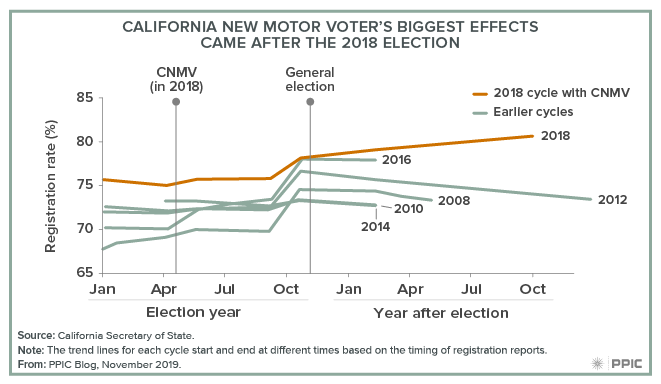
CNMV’s effect has been complicated. It has more than doubled the number of people registering at the DMV, from an average of about 140,000 per month to roughly 370,000. Yet most of these people were not new registrants. In fact, many aspects of registration in 2018 were unexceptional. The figure below compares the registration rate over time in every election cycle between 2008 and 2018. The rate already started higher in 2018—a consequence of the 2008 and 2016 elections. It then increased during the election season, but the increase was in line with previous years.

The real change has come since the 2018 election. In every past cycle, the registration rate has flattened or even fallen in the next calendar year. Excitement fades, and routine file maintenance removes more voters than the number who sign up. But an election doesn’t stop people from using the DMV, so under CNMV people have continued to register. The result is a steadily widening gap between registration now and registration at the same point in past cycles.

figure - California New Motor Voter’s Biggest Effects Came After the 2018 Election

It’s not clear from this gap whether more people will register by the 2020 election than would have without CNMV. Americans already seem unusually excited about voting, and enthusiasm often finds its way to the ballot box. Yet higher registration is not the reform’s only potential effect. In pushing so many to fill out a voter registration form, CNMV also helps keep the registration file up to date. This avoids glitches on Election Day that could prevent someone from voting.

Ultimately, whatever the cause, the registration rate is up. This hints at a new future for California. Unregistered Californians have traditionally been younger and more diverse than voters, with different views on policy issues. As the registration rate climbs, more of these residents become part of the voting public. Politics may be forced to change in response.

Is California Turning Even Bluer?

California is already a fairly Democratic state, but in the last two years many have wondered if it has become even more so. In the 2016 presidential election, California was one of a few states that did not shift away from the Democrats. In most of the country, Hillary Clinton garnered a smaller share of the vote than Obama received in either of his campaigns for president—but in California, Clinton improved on Obama’s 2012 vote share by 1.3%, while Donald Trump fell short of Mitt Romney’s share by 5.6%.

Some areas of the state, such as Orange County, have experienced long-term demographic trends that favor the Democrats, yet the swing to Clinton in these places outpaced these trends. Seven of California’s congressional districts are held by Republicans but were won by Clinton in 2016. Just two years earlier, five of those seats favored Republican Neel Kashkari for governor by at least 10 points—in a race that Democrat Jerry Brown won by 20 points statewide.

The 2016 presidential vote therefore marked a big change of fortune for California Democrats, particularly in some districts. Does this mean that these districts have become more Democratic for good, or was the 2016 result a reaction to the personalities on the ballot?

One way to answer this question is to compare the change in the Democratic presidential vote in each congressional district to the change in party registration. Party registration indicates a more enduring attachment—something closer to a permanent change in allegiance. If party registration changed to match the latest presidential vote, it might indicate that something longer-term is afoot.

The figure below compares the change in the Democratic presidential vote between 2012 and 2016 to the change in party registration in the state’s 53 congressional districts from 2014 to 2018. The blue dots indicate Democratic registration change, and the red dots indicate Republican change.

Statewide, the Democratic Party has mostly held steady in registration while the Republican Party has lost ground. We can see this pattern above: the blue Democratic dots are clustered around zero on the vertical axis, indicating little average change, while all the red dots are below zero, indicating a decline in Republican registration. However, our question is whether a larger 2016 surge led to a larger change in party registration by 2018. If this has happened, the blue dots should be higher toward the right side of the graph and the red dots should be lower. We can see such a pattern, but it is weak. Districts on the left have indeed seen both smaller increases in Democratic registration and smaller decreases in Republican registration. Likewise, those on the right have seen larger Democratic gains and larger Republican losses. But the difference is modest.

The districts with the largest Democratic shifts—seen on the far right of the graph—display the expected pattern more clearly. In fact, most of the competitive congressional races mentioned above are represented here. Of the seven races considered most competitive by the Cook Political Report, four are in districts that shifted more than 6 percent toward the Democrats in the 2016 presidential race. All four districts are in or around Orange County: 39 (outgoing incumbent Ed Royce), 45 (incumbent Mimi Walters), 48 (incumbent Dana Rohrabacher), and 49 (outgoing incumbent Darrell Issa). Each of these districts also saw a Democratic registration gain of at least 1.4% and a Republican registration loss of at least 4.4%. So the districts with the most surprising results in 2016 are generally also the places with the biggest Democratic gains in registration.

Overall, these results do provide some support for the idea that the 2016 election marked a more permanent change in the state’s politics. But party registration tends to change slowly, and the patterns we are seeing suggest there may be years to go before any transition is complete.

The End of the Post-Partisan Era?

Last week, a press release from the California Secretary of State touted the record number of 18.2 million California registered voters as a “major milestone.” The new numbers are impressive, but it’s also worth noting that California’s voter registration is in line with its current population trends. Both the number of registered voters and the number of adults who are eligible to vote have increased by about 1 million since September 2012.

What struck me as most significant about the September report—and what went largely without mention in the scant media coverage—is that a partisan shift that has been under way for several years has accelerated during the 2016 presidential election.

In 2004, a year after the recall of California governor Gray Davis, a Democrat, and the election of Republican Arnold Schwarzenegger, there was an 8 point gap between Democratic and Republican registration (43% to 35%). In the 2006 general election, Governor Schwarzenegger was reelected and one other Republican won a statewide race (Steve Poizner for insurance commissioner). In other words, California was a Democratic-leaning state but Republicans could eke out a statewide victory, depending on the partisan turnout and candidates.

When Democrat Barack Obama was running for president in the fall of 2008, the gap between Democratic and Republican registration was 12 points (44% to 32%). During President Obama’s reelection campaign in the fall of 2012, there was similar registration gap between Democrats and Republicans (43% to 30%). Between 2004 and 2012, the Republicans lost about a quarter of a million voters and the Democrats gained about three-quarters of a million voters. The biggest registration increase was among independent (or decline-to-state) voters, whose number grew by a million. With many new voters eschewing party membership, California seemed to be entering a “post-partisan” era. Still, with a double-digit lead in voter registration, Democratic candidates defeated Republicans in all statewide races in 2008, 2010, 2012, and 2014.

This September, the Democratic-Republican registration gap swelled to 18 points (45% to 27%). In a departure from recent trends, Democratic registration saw larger gains than independent registration over the past four years. Moreover, comparing the Secretary of State’s report for January 2016 with the September report, the biggest gain by far was in Democratic registration. This coincides with high interest in the Democratic primary between Bernie Sanders and Hillary Clinton and the unconventional candidacy of Republican Donald Trump. Is this a blip or does it signal the end of the post-partisan era? The Secretary of State’s report after the October 24 voter registration deadline will allow us to track registration trends amid debates, campaigning, and candidate news.

The growing partisan gap raises many questions. Since it’s easier to register than to vote, will new voters cast ballots this fall? With the latest PPIC Survey indicating a lack of competitive statewide races, will the growing Democratic advantage help to pass state propositions on taxes, corrections reform, and marijuana legalization? Will it allow the Democrats to reach their goal of a two-thirds majority in the state legislature? Looking beyond the 2016 election, the voter registration gap could have implications for the future of the Republican Party, the top-two primary, and California’s democracy.

Voter Registration: Not Quite Automatic Yet

The New Motor Voter Act creates a computerized voter registration process for anyone who uses the Department of Motor Vehicles (DMV) to apply for a new driver’s license, renew an old one, or change their address. The law—AB 1461—reduces paperwork and transfers voter registration information electronically from the DMV to the secretary of state. It has the potential to register millions more residents and virtually eliminate one of the most important administrative hurdles to voter participation.

However, the devil is in the details. Whether AB 1461 will result in big increases in registration will depend largely on how the law is implemented. Though the new registration process is sometimes called automatic, it does not actually register anyone by default. At its core, the law simply tells the DMV to transfer information to the secretary of state and then tells the secretary what to do with that information.

Some information is guaranteed to be there. DMV applicants will be required—as they are now—to provide their name, date of birth, address, and the like. If they don’t answer these questions, the process of getting a driver’s license stops.

Other information is less certain. The law adds two pieces of information that together determine whether DMV customers get registered to vote: first, whether they attest that they are eligible to vote, and second, whether they decline to be registered. Customers who attest to eligibility and do not decline will be added to the voter rolls. Yet unlike the other items listed above, applicants don’t currently have to answer either question to get a driver’s license.

Note also the significant difference between the two questions. The eligibility question has the secretary of state looking for a “yes”: DMV customers will not be registered unless they attest to eligibility, which means that any customer who fails to answer the question will not be registered. By contrast, the registration question has the secretary looking for a “no”: customers will be registered unless they do not want to be. That means that those who fail to answer this question will be registered, as long as they also say they are eligible.

It is hard to overstate the importance of this distinction. Research on how people make decisions has consistently demonstrated the power of the default option. People are much more likely to sign up when enrollment is the default option—even when there is an option to decline—than they are when nonparticipation is the default. The option to enroll as an organ donor when getting a driver’s license offers a particularly apt example. Many do not sign up even though it’s not very hard to do, and even if they say they are willing, in principle, to become donors. In one study, 82 percent became donors when they had to opt out explicitly, compared to 42 percent when they had to opt in.

Given this reality, the default option can be critical. If the goal is a large increase in registration, the fact that the eligibility question requires people to opt in should be a cause of concern.

This suggests a solution: the DMV should make a response to the eligibility question a condition for receiving a driver’s license. Some have already called for this approach, which is not as onerous as it may sound. Driver’s license applicants are already required to provide documented proof of legal residence, such as a birth certificate or passport. That’s a much higher hurdle than answering a single question.

In Oregon—which became the first state to adopt automated registration earlier this year—such proof of legal residence is also required, but it’s automatically treated as evidence of eligibility. No additional question is needed. If California were to require a response to its eligibility question, its system would be essentially identical to the one in Oregon on most important dimensions. In fact, by allowing people to opt out up front, the California system would be more transparent and might do a better job of preserving freedom of choice.

The California DMV could go a step further and also require a response on the registration question, thus ensuring that people know they are being registered. There is no reason to think that forcing a choice in this way would limit the law’s impact. The study on organ donor participation mentioned above found that enrollment declined only slightly (from 82% to 79%) when people were asked to make the choice explicitly. It seems fair to expect a similar dynamic with voter registration. Only those firmly opposed to being registered are likely to say “no” to registration, and that group will probably be small.

In short, AB 1461 could result in a legitimately automatic registration system similar to the one in Oregon and many other countries. Such a system would eventually bring the vast majority of eligible unregistered adults onto the voter rolls. But the law’s potential will only be realized if the state truly streamlines the process to make it as easy as possible.

Testimony: Four Important Questions about Voting in California

PPIC research fellow Eric McGhee was invited to testify about voter turnout in California last week before a joint hearing of the Senate Committee on Elections and Constitutional Amendments and Assembly Committee on Elections and Redistricting. Here are his prepared remarks.


California’s voter turnout in 2014 hit record lows in both the primary and the general elections. I’d like to put that turnout in broader context, and give some thoughts on potential solutions. In doing so, I’m going to briefly answer four questions:

  1. Who votes, and who doesn’t?
  2. What does California’s turnout look like over time and compared to the rest of the country?
  3. What are some of the reforms that have been tried in the past, and how well have they worked?
  4. What are the other possible reforms out there that have yet to be tried in California?

Who votes and who doesn’t?

California’s electorate does not look like the state as a whole. Compared to non-voters, California’s voters are older, whiter, more educated, less likely to have recently moved, more likely to be homeowners, and more partisan. They are also wealthier, though most of the difference in income between voters and non-voters is a function of the more powerful effects of other factors such as age and education. And, PPIC research by Mark Baldassare has shown that non-voters have different opinions on important policy issues. In particular, they tend to be more supportive of a larger role for government.

These differences are very similar to what one would find in the rest of the country, but California’s profile on all of these dimensions is at one extreme. The state is relatively young, relatively mobile, with an especially large non-white population.

Beyond all these demographic and attitudinal issues looms citizenship. Citizenship is a much more important issue in California than in other states, given the large non-citizen population we have here. It particularly affects the Latino and Asian American communities. That said, it is becoming a less important issue over time, since virtually all the population growth in these communities is now among native-born citizens.

What does California’s turnout look like over time and compared to the rest of the country?

California’s turnout has dropped between 10 and 20 points in the last 30 years. It’s important to break this problem into two separate parts: the registration rate among those who are eligible to vote, and turnout among the registered population. Identifying which is the bigger problem will help us know which problem to target first.

Compared to other states, California’s registration rate has been slipping. By contrast, turnout among the registered has been consistently higher than in other states, and has been holding up better over time. These numbers are not yet available for 2014, and California’s turnout will likely be low relative to other states that year. But overall, California lags other states in registration, not turnout.

That’s not to say that turnout among the registered is without problems. It has been declining in absolute terms, at least outside of fall presidential elections. But if we are going to tackle one problem in particular, registration may be a good place to start. In addition to being a problem more specific to California, it may be more amenable to broad reform. It amounts to little more than an administrative hurdle, and as detailed below, it is certainly the easiest one to take permanently off the table through more sophisticated data management.

What are some of the reforms that have been tried in the past, and how well have they worked?

In a report last year, I explored the effect on turnout and registration of two reforms to the registration process that California recently adopted to make the process easier. The first was online registration, which allows voters to conduct the entire registration process online without ever needing to mail in a paper form. The second is conditional registration, which allows voters to register and vote simultaneously in a single trip to the county registrar, and to do so after the official close of registration, up to and including Election Day. Online registration was used for the first time in the middle of the 2012 campaign season, so my analysis was about evaluating a reform that had already been implemented. Conditional registration, on the other hand, will probably not be implemented until 2017, so my analysis was about examining the effect of similar reforms in other states.

Online registration was wildly popular, accounting for over half the new registrants in the last month of the 2012 fall registration period. However, the results of the analysis of online registration suggested that the vast majority of these people likely would have registered to vote anyway. They probably got excited by the new system and registered earlier than they might have, but that didn’t significantly increase the total volume of registrations.

Conditional registration (often called “same day” or “Election Day” registration in other states) has been heavily used in the other states that have adopted it. There are often huge surges of use right before Election Day. As with online registration, however, almost all of these people would have registered anyway. The conditional registration system simply allowed them to register later. In terms of getting new voters to the polls, the policy has had more mixed results, with high-end estimates of an increase in turnout of about 4 percentage points.

The challenge for California is that even if all the users of conditional registration would have registered anyway, there will still be a lot of those people. That makes for a late surge in registrations that must be processed, and on a scale that other states have not faced. Elections are administered at the county level, and California has six of the 20 most populous counties in the country. Los Angeles County by itself is 40 percent larger than the largest state that has adopted a conditional registration system up to this point (Wisconsin). Thus, California will have to handle a significant portion of its conditional registrants through a small number of very large counties. The state needs to be prepared.

What are the other reforms that have yet to be tried?

Probably the biggest reform to registration that has not yet been tried in California is automatic registration. This is a system where voters who engage with government in some other capacity (usually by getting a drivers’ license at the DMV) and provide enough information to be registered are put on the voter rolls by default. They would then be given the option to remove themselves if they wanted but would otherwise remain registered.

Though automatic registration would be a big change, it is not quite as radical as it sounds. The state already tries to give residents the option to register at the DMV and other agencies (not always with perfect success), so automatic registration would just be a more insistent and systematic form of the same policy. Moreover, the drivers’ license and voter registration lists are on the verge of being linked already, thus easing many of the potential technical hurdles.

Would automatic registration solve California’s turnout problem? No, because low registration is about more than administrative hurdles. Many of the people who do not register are expressing a deeper disengagement from politics and public life. For example, North Dakota has no voter registration at all but falls far short of 100 percent turnout. Thus, automatic registration would need to be followed up with constant engagement to truly leverage the new system. What it would do is ensure that something closer to 100 percent of California citizens would be available for engagement without any further administrative steps along the way.

Automatic registration could also help the state deal with the surges of late registrants it will likely see under the conditional registration system. With voters added to the rolls throughout the year as they acquired or updated drivers’ licenses, there would be far fewer voters who would need to use the conditional registration system at the eleventh hour, making it more manageable for county registrars.

In the end, automatic registration is only one potential solution to voter turnout problems in California. Many others can and should be considered, and after all stakeholders have weighed in, an automatic registration itself may not prove to be the best fit for California. A bill proposing an automatic registration system has been introduced by Assemblywoman Lorena Gonzalez, so there will be a real opportunity to have a robust debate on the issue. That alone will be a healthy step forward for California.