How the Pandemic Has Disrupted Food Chains

The COVID-19 health emergency has changed what we eat and where we eat it. We talked with Dave Puglia, president and CEO of Western Growers (which represents family farms growing fresh produce) and a member of the PPIC Water Policy Center advisory council, about how these changes are affecting California’s agricultural sector.
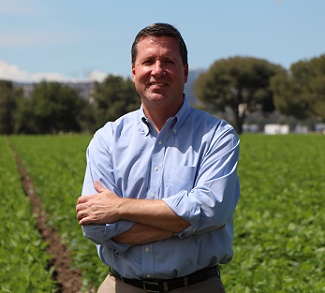
photo - Dave Puglia

PPIC: How has the pandemic affected food supply chains?

DAVE PUGLIA: The pandemic shut down the food service sector—restaurants, schools and universities, hotels—so suddenly and completely that it just blew up supply chains. This caused many farmers to divert their produce from food service outlets to retail markets. That added more confusion to the food chain, as certain commodity prices dropped like a stone due to oversupply, while some other crops did quite well, fueled by people buying more produce that is less perishable. Foods like carrots, onions, and potatoes have been flying off the shelves.

Those first few weeks were incredibly damaging to American agriculture, and particularly the fresh produce industry. California’s desert region was in full swing for harvesting when the shutdowns began. I watched one of my members plow 350 acres of romaine lettuce into the ground. A lot of fresh produce made it to food banks—our members doubled the amount they usually ship to them—but we saw some food banks wave off perishable fresh produce, which requires adequate cold storage space and must be distributed quickly. For growers, transportation was an added cost.

We’re not out of the woods yet. The food service sector is still largely shut down. California’s coastal farms are now starting to harvest. They had to project a month ago how much crop to plant without knowing if restaurants will be open, half open, or still closed. And for those with permanent crops—table grapes, nuts, and stone fruits—their crops are coming. They’ll have to make these same tough decisions about whether it pencils out to pay for the labor, shipping, and cooling costs to harvest their crop. To put it in perspective, harvesting—which includes labor and energy—comprises about half the costs to produce, say, an acre of lettuce.

Farming has always been a risky business, but this has created an impossible guessing game for growers in fresh produce.

PPIC: What can be done to help get more farm products to emergency food programs?

DP: The top priority is to inject capital into the food system now. Ideally, the federal government would increase food purchases so we can deliver more produce to food banks and organizations that serve people in need. The CARES Act began to fund this, but the amount was small—$600 million over six months, across the whole country. That won’t buy a lot of food. The quickest way to help is to dramatically increase funding to this program.

At the state level, increasing the tax credit for food going to food banks could help. Currently, California has a 15% tax credit on the value of produce that the state’s farmers deliver to food banks. Clearly, the state needs every tax dollar it can get, but if we’re trying to keep farmers going so they can continue to grow our food and support the economy, that would be a good way to help.

PPIC: What further steps would mitigate the damage?

DP: The immediate need is for the federal government to expand its agricultural relief package in the CARES Act. The caps on the relief package were not practical for fresh produce, dairy, and cattle. Growers got $125,000 per farmer, which was appreciated—but it’s a very small amount given the losses for the higher value crops, which cost more to produce. For example, a farmer growing romaine lettuce spends about $10,000 per acre. The average-sized lettuce farm is 225 acres; the relief package covered losses for about 12.5 acres of that. Strawberries cost roughly $50,000 per acre to produce; the relief package covered just 2.5 acres of lost production on the average 55-acre farm.

The state has been helpful in crafting practical guidance for continued operation of our farms, which helped the industry implement distancing very quickly. We have a big challenge there, as these folks work and live in close quarters. It was also very helpful that the governor acted quickly on our request to help farmworkers with emergency childcare. These are mostly families where both parents work and don’t have the option of a parent staying home with the kids.

Going forward, I hope that coming out of this crisis we don’t see a raft of new regulatory costs. The cost of doing business in California is already quite high. If the cost of farming here compared to Mexico or Arizona gets much higher, it will incentivize more farmers to relocate.

PPIC: What changes to California agriculture do you envision coming out of this crisis?

DP: Farmers are amazingly adaptive people, and I’m encouraged by the many California farms that are finding new, more efficient ways of operating and producing food because of this crisis.

Will there be fewer restaurants in two years’ time, or will Americans have returned to their previous habits of eating out? No one knows. But growers will adapt to changing demand, and they’ll respond very quickly.

Overcrowded Housing and COVID-19 Risk among Essential Workers

[vc_row][vc_column][vc_column_text]Some Californians face substantial risk of illness within their own households under the state’s shelter-in-place order. Physical distancing and self-isolation can be virtually impossible in crowded homes, threatening the health of entire households. In crowded living conditions, individuals are at higher risk of transmitting infectious diseases, a factor that may challenge the state’s efforts to manage the pandemic while reopening the economy.

As the high cost of housing is a stark reality for nearly two-thirds of Californians, finding affordable housing can mean cohabiting with several other people. California’s overcrowding rate is well above the national average; the share of housing units with more than one occupant per room is 8.3% compared with 3.4% across the nation. Furthermore, overcrowding is much more common among renters than homeowners (13.4% vs. 4.0%), and in Latino households (18.4% vs. 2.4% of white households).

While most Californians have been staying home to reduce coronavirus transmission, essential workers do not have the option to shelter in place. Over one-third of California’s labor force works in essential occupations that require being physically present. Compared to nonessential workers, they are at higher risk of infection because they continue to circulate among others despite the shutdown.

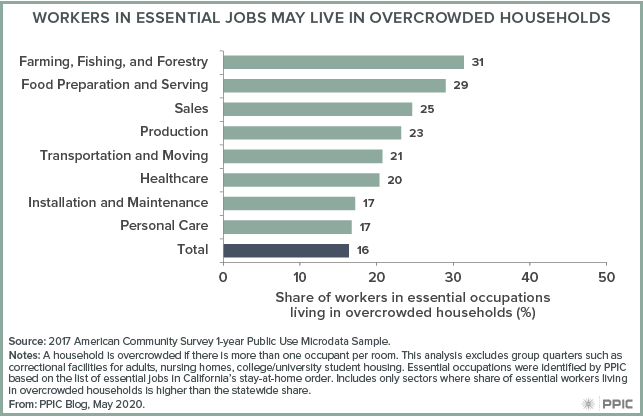
Essential workers are more likely than nonessential workers to live in overcrowded housing—16 percent versus 12 percent. That share is almost double for workers in farming (31%), and food preparation/serving (29%).

Figure - Workers in Essential Jobs May Live in Overcrowded Households

A recent study confirms that essential workers and those in larger households do face a higher risk of contracting coronavirus. It would be ideal to explore the relationship between COVID-19 cases and workers living in crowded conditions. However, inconsistent testing availability across regions makes cases an unreliable measure of the virus’s geographic spread; deaths, which are better measured, are a valuable proxy.

There is a clear link between COVID-19 deaths and essential workers who live in overcrowded homes, though the relationship is muddied by regional differences in terms of the age structure of the population,  underlying health conditions, and other factors. Santa Barbara (25%), Madera (23%), Los Angeles (21%), Orange (20%), and Tulare (19%) counties have the highest shares of essential workers in overcrowded homes. Los Angeles and Tulare are experiencing large numbers of deaths per capita, at 14 and 9 deaths per 100,000 people, but the other counties are not.[/vc_column_text][/vc_column][/vc_row][vc_row max_width=”80″ visibility=”visible-desktop”][vc_column][vc_column_text][infogram id=”1p375951mzw3k9c0mex60d30kdidymqxjlx?live”][/vc_column_text][/vc_column][/vc_row][vc_row max_width=”80″ visibility=”visible-tablet-landscape”][vc_column][vc_column_text]

[infogram id=”1p375951mzw3k9c0mex60d30kdidymqxjlx?live”]

[/vc_column_text][/vc_column][/vc_row][vc_row visibility=”visible-tablet-portrait”][vc_column][vc_column_text]

[infogram id=”1p375951mzw3k9c0mex60d30kdidymqxjlx?live”]

[/vc_column_text][/vc_column][/vc_row][vc_row visibility=”visible-phone”][vc_column][vc_column_text]

[infogram id=”1p375951mzw3k9c0mex60d30kdidymqxjlx?live”]

[/vc_column_text][/vc_column][/vc_row][vc_row][vc_column][vc_column_text]California will lift some shelter-in-place restrictions in the coming days, and more people will leave their homes to work. Examining work and living conditions together can identify areas where people are least able to take effective actions against the spread of the coronavirus. Designing policies to protect the health of workers and their households will be critical to managing COVID-19 while restarting the state’s economy.[/vc_column_text][/vc_column][/vc_row]

Who Lives in California’s Nursing Homes?

Seniors aged 65 and over are the age group most at risk of dying from the COVID-19 virus. As of May 6, according to the California Department of Public Health, seniors accounted for 79% of all COVID-19 deaths (1,894 out of 2,412) in the state. Seniors who live in nursing homes—skilled nursing facilities—are especially vulnerable. But state programs that allow seniors to remain living at home rather than entering nursing homes may help protect California’s most vulnerable population.

Residents of nursing homes make up less than 1% of the state’s population, but account for 39% (929 out of 2,412) of all COVID-19 deaths in the state and 10% (5,604 out of 56,212) of all confirmed COVID-19 cases. And at 78%, the vast majority of nursing home residents are seniors. Health care workers in the state’s nursing homes are also at risk. Seventeen have died and over 3,000 have contracted the disease.

Even as the senior population has grown with the aging of the baby boom cohort, the number of seniors in nursing homes has remained steady. According to the American Community Survey, about 88,300 seniors, or 1.7% of all seniors in California, live in nursing homes in 2018; that’s about the same number as in 2010 (87,500).

Figure - Little Change in Number of Seniors at California Nursing Homes

Women make up the majority of the seniors in California nursing homes (65%). Residents also tend to be very old—43% are age 85 or older—and not married. Similar to the overall senior population, the majority are white (58%). Even so, many residents (32%) speak a language other than English. Los Angeles County, the locus of the pandemic in California, has 35% of the state’s nursing home residents, but 26% of the state’s population.

Almost all nursing home residents have self-care limitations. That is, these seniors have a physical or mental health condition that has lasted at least six months and makes it difficult for them to attend to their own personal needs such as bathing, dressing, or getting around. And at least half (51%) are on Medi-Cal.

However, state and county programs have allowed more seniors to live at home. One such program, In-Home Supportive Services (IHSS), is intended to keep low-income seniors in their own homes rather than in nursing homes. IHSS offers services such as housecleaning, meal preparation, laundry, grocery shopping, personal care services—such as bathing, grooming, and paramedical services—and accompaniment to medical appointments.

Because of this arrangement, even seniors with self-care limitations are increasingly likely to stay in their own homes rather than move to a nursing home. Hundreds of thousands of California seniors receive care through IHSS.

The share of seniors in nursing homes across the rest of the country is about one-third higher than in California. A likely outcome of state efforts to keep seniors in their own homes has been to protect many seniors in this state from exposure to the pandemic.

Lessons from the Pandemic for Addressing Climate Change

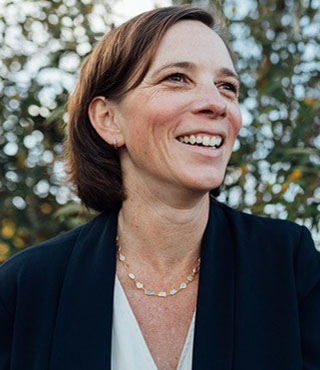
Clear skies and less air pollution. Dramatic drops in harmful greenhouse gases. What can these environmental “silver lining” aspects of the COVID-19 pandemic teach us about addressing climate change? We talked to Louise Bedsworth—executive director of the California Strategic Growth Council, a state agency that brings together multiple agencies to support sustainable communities and strong economies—about the issue.

photo - Louise Bedsworth

PPIC: What has the COVID-19 pandemic taught us about our efforts to tackle climate change?

LOUISE BEDSWORTH: The pandemic has caused us to make a lot of changes quickly, some of which we know are also necessary to tackle climate change—such as the dramatic reductions in travel by car and air. Businesses have implemented telework policies at a scale we’ve never seen before, and meetings that would have taken place in person are now remote. We’ve seen that these sorts of changes can rapidly reduce air pollution and greenhouse gas emissions. Looking ahead, we can think about how to incorporate some of these changes into how we work.

In addition to changes that reduce emissions, we have also seen a number of actions that are important for building resilience. We’re seeing more people out in their communities, walking, biking, and getting outside. And we see people checking in on vulnerable residents, neighbors coming outside to talk to each other, and growing movements to shop at local businesses.

These social connections are really important for building a resilient California—one able to withstand the shocks to come. In the face of a changing climate, we have to reduce emissions, but also ensure that that our people, economies, and ecosystems are resilient in responding to  shocks and stresses. And that means building robust equitable communities that can weather these changes together.

We need to think about how we incorporate these lessons going forward—not just in our efforts to reduce emissions but also in how we’re thinking about building resilience in our communities.

PPIC: Do you see any long-term effects arising from the pandemic’s drop in emissions?

LB: We’ve seen what’s possible. We can make changes that have immediate impacts on air quality and emissions. That’s a really valuable lesson. The next step is figuring out how to make some level of these positive changes stick as we come out of the pandemic. For example, what policies do we need to encourage telework, or to encourage people to continue to drive less and walk more? Enabling just one day a week of telework could reduce commuter travel and associated emissions by 20%.

We also have to focus on how we rebuild our public transit systems, which have suffered steep declines in revenue and ridership. I think we have to be honest about the challenges facing transit systems, not just because of the financial hit they’ve taken but also to address people’s fear of being on crowded transit. How can we maintain these important systems even as we encourage more telework, biking, and walking?

PPIC: What are the economic implications of COVID-19 on the state’s climate change efforts?

LB: The pandemic has highlighted California’s equity challenges. Communities with high levels of poverty, joblessness, pollution, and poor health are bearing the brunt of this illness. We have to address the underlying causes of these inequities. The pandemic underscores the need for stronger efforts to reduce pollution and mitigate the effects of climate change—and for solutions that reduce these inequities.

We have to pay attention to how we rebuild our economy. Let’s put people to work to build more resilient infrastructure and a cleaner economy. Our long-term recovery must include investments that are in line with our goals on climate change and the environment, housing production, and quality job creation.

PPIC: What opportunities should we take from the coronavirus crisis to help address the climate crisis?

LB: We need to continue to focus on building a sustainable, equitable California. This includes building resilience in the state’s physical infrastructure as well as in our social and economic systems. If we don’t remain committed to our environmental goals as we recover from this, it will be harder and more costly to fix these problems down the road. In addition to working to maintain some new workplace practices, we need to prioritize actions that promote equity and sustainability. We must redouble our efforts to build safe and affordable housing located near jobs, schools, and transit and create high quality jobs and job training opportunities.

California can set an example for the world. The state is a leader in addressing climate change, but these changes have to happen globally. California must continue to lead by successfully demonstrating how we can emerge from the pandemic fully committed to sustainability and equity.


Many Low-Income Families Left Out of Federal Stimulus Benefits

As part of the federal response to COVID-19, the IRS has started issuing stimulus checks—to boost consumer confidence—directly to millions of families. For the record number of Californians who have lost jobs, hours, and certainty around their incomes, these payments could come just in time.

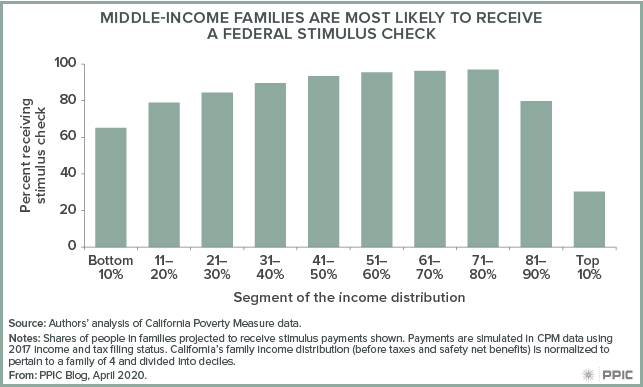
We estimate that about 81% of Californians live in a family that will receive an “economic impact payment,” with the typical family receiving around $2,200. In total, Californians could receive about $26 billion through the program.

However, nearly 20% of families are unlikely to receive a stimulus check. Because the payments phase out as incomes rise, most of these families are above the income cutoff ($99,000 for single tax filers and $198,000 for joint filers without children). But nearly a third are among the state’s lowest income families. In part, this reflects the fact that only people who have filed taxes recently, or who receive either supplemental security income (SSI) or social security, will receive a check.

People with very low incomes are not required to file taxes, and they will not receive stimulus checks unless they actively share their banking details with the IRS. Partly for this reason, our estimates indicate that just 65% of people in families with the lowest 10% of incomes—less than about $22,000 a year for a family of four—are likely to receive a check.

By comparison, 90% to 97% of those in middle-income families—with annual incomes of $52,000 to $176,000—are likely to receive a check.

figure - Middle-Income Families Are Most Likely To Receive a Federal Stimulus Check

Yet even if all Californians who do not file taxes submit their information to the IRS, people in low-income families will still receive checks at lower rates than middle-income families. Because many low-income families include undocumented residents, the entire family is ineligible for these federal payments. If families with undocumented members were eligible, all families from the 11th to 80th percentiles of the income distribution could potentially receive a check.

To help Californians during this crisis, the state’s safety net will need to reach those most affected economically. The temporary expansion of unemployment insurance will provide much more aid to certain low-income families than the federal stimulus payments. And California’s recently announced Disaster Relief Fund, which will use public and private funds to provide up to $1,000 per household to families of some undocumented immigrants, will help to fill in certain gaps. But while replacing wages is important, a response focused only on wages would skip many people in need.

Food assistance programs like CalFresh and school meals are also critical safety net supports because of their wide reach, and expansions are also underway. Along with the federal stimulus payments, these are important steps, but—depending on the length and the depth of the crisis—more remains to be done.

California’s Quick Response to COVID-19 Likely Saved Lives

As of April 21, nearly 5,000 Californians are hospitalized and more than 1,300 have died due to COVID-19, but proactive public health measures may have safeguarded many others. Because the coronavirus spreads exponentially, days matter. And early actions before the statewide shelter-in-place order may have proved especially effective in reducing transmission.

The Bay Area had some of the state’s earliest cases of coronavirus, which spurred a rapid response. Santa Clara was the first county to declare a public health emergency, and large companies in the region asked employees to work from home as early as the first week of March.

Seven Bay Area counties—including Alameda, Contra Costa, Marin, San Francisco, San Mateo, Santa Clara, and Santa Cruz—implemented shelter-in-place orders beginning on March 17. Los Angeles County instituted a comparable order mere days later, but the virus was already spreading rapidly.

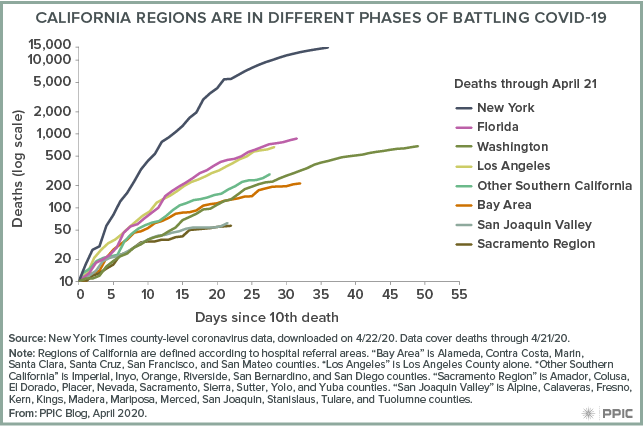
As of now, regions are in different phases of flattening the COVID-19 death curve. In Los Angeles County, the last week of data suggest the number of deaths doubles about every 8 days. That is a faster rate than Florida (12 days), but still far slower than New York in its deadliest week—when deaths doubled almost every day.

Other parts of Southern California also saw a spike, with deaths doubling every 8 days. Meanwhile, at 12 days, deaths in the Bay Area are doubling more slowly, as they are in the Sacramento region at 15 days. Both the San Joaquin Valley and other parts of the state have essentially plateaued at 19 and 32 days.

figure - California Regions Are in Different Phases of Battling COVID-19

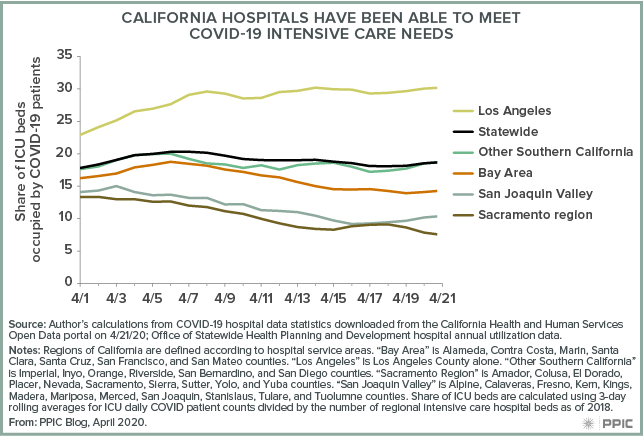
Local policies have also curbed demand for COVID-19 hospital care. Statewide, hospitalizations and ICU beds filled due to COVID-19 have been trending downward for two weeks, but have ticked up slightly the last few days. Certain counties—notably Los Angeles—have continued to see an upward trend in COVID-19 patients in intensive care, although it does seem to be plateauing.

In Los Angeles in recent weeks COVID-19 patients occupied about 30% of total ICU beds, compared to less than 15% in the Bay Area. The San Joaquin Valley and Sacramento regions also seem to be faring well, with about 10% of ICU beds filled due to the coronavirus. Regional estimates of ICU occupancy rates (as of 2018) suggest hospitals can manage current levels of COVID-19 patients while meeting other intensive care needs.

figure - California Hospitals Have Been Able To Meet COVID-19 Intensive Care Needs

Governor Newsom listed clear criteria for reopening the state’s economy in the midst of the global pandemic. All of California will meet certain benchmarks, such as data tracking and scientific advances in testing and treatment, on a single timeline. Others, such as plans for conducting business while social distancing and protecting vulnerable residents, will likely differ by region.

The state acknowledges that communities may reopen at different times based on circumstances. Recent experiences suggest that responsive local policies could help the state reopen while suppressing COVID-19 hospitalizations and deaths.

The Coronavirus Pandemic Will Test the State’s Budget Reserves

As it grapples with the COVID-19 pandemic, California faces an uncertain fiscal future. This global crisis has caused a sharp decline in economic activity, exposing crucial sectors to heightened risk. As discussions continue about when and how to re-open the economy, it is clear that the state will have to respond to significant fiscal challenges.

The good news is that California has made important changes to its reserve policies since the Great Recession. The passage of Proposition 2 (2014) created the Budget Stabilization Account—the state’s rainy day fund—as well as the Public School System Stabilization Account, a separate reserve for K–12 districts and community colleges. In addition, Governor Brown and the legislature created the Safety Net Reserve Fund to shore up Medi-Cal and CalWORKs funding during downturns.

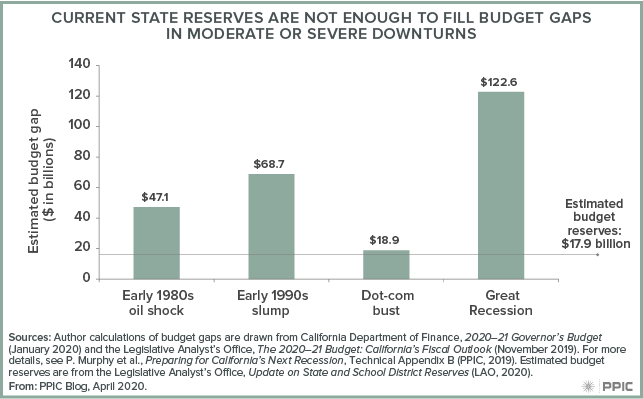
The bad news is that a severe recession is likely to pose significant budgetary challenges. Drawing from the state’s experience during several recent recessions, PPIC estimated the budget ramifications of mild, moderate, and severe recessions and the capacity of state reserves to fill gaps. We found that the state’s reserve balance—estimated to be $17.9 billion—is large enough to withstand a mild recession such as the dot-com bust in the early 2000s.

However, a long and/or severe recession like the early 1980s oil shock (which lasted four years), or the early 1990s slump and the Great Recession—both of which were much more severe and lasted five years—would create large budget gaps and require policymakers to make difficult decisions. (It is important to note that the estimated reserve balance relies on the 2019–20 enacted budget and that it will change when revenue estimates are updated in May.)

figure - Current State Reserves Are Not Enough To Fill Budget Gaps in Moderate or Severe Downturns

In the meantime, the federal government has stepped in. The Families First Coronavirus Response Act includes an increase in the federal share of Medicaid payments and reimbursements to states that are expanding public assistance programs. The Coronavirus Aid, Relief, and Economic Security (CARES) Act provides about $2.2 trillion; some aid goes directly to families, some goes to schools, and some to state and local governments. Additionally, two federal disaster declarations make many of California’s COVID-19 expenditures eligible for at least partial reimbursement.

Governor Newsom has requested additional federal assistance, including flexible aid to state and local governments, a further extension of unemployment insurance benefits, and expanded support for safety net programs, small businesses, K–12 and higher education systems, childcare, and broadband.

The state is also making significant changes to the 2020 budget process. The Department of Finance is drafting a “workload” budget for the May Revision that will set the baseline for the final budget to be enacted in June. This will limit spending increases while allowing for growth in programs—particularly safety net programs—that expect increased demand. The legislature will revisit the budget for an “August Revision” that reflects changes in the state’s financial condition. As these processes move forward, PPIC will continue to monitor California’s evolving fiscal challenges and steps being taken to address them.

Race, Health, and the Risk of COVID-19 Complications

For adults younger than 65, many underlying health conditions are emerging as risk factors that can lead to severe complications of COVID-19. Within this larger population, certain minority groups are under particular threat due to disproportionate rates of such conditions. While California’s overall share of nonelderly adults at risk is relatively low, disparities in health endanger some more than others during this health crisis.

Governor Newsom cited protecting individuals most at risk of COVID-19 complications as a necessary criterion for restarting California’s economy. Though we cannot yet draw conclusions from incomplete data—about one-third of cases and over a tenth of deaths do not have complete data on race and ethnicity—certain risk factors are more prevalent along racial and ethnic lines.

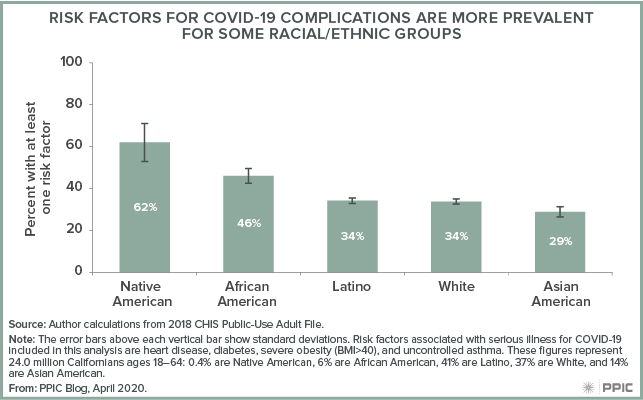
According to the Center for Disease Control, potential risk factors include heart disease, diabetes, severe obesity (BMI greater than 40), and uncontrolled asthma; smoking is also likely to increase risk. In California, over 60% of Native Americans and about 46% of African Americans have at least one of those health concerns. By comparison, roughly one-third of whites, Latinos, and Asian Americans have one or more of these health issues.

Native Americans are diagnosed with heart disease at rates almost four times that of whites (19% to 5%), have higher rates of smoking (51% to 14%), and double the uncontrolled asthma (12% to 6%). African Americans have much higher rates of diabetes (24% to 14%) and severe obesity (12% to 4%) than whites. Asian Americans and Latinos also have higher rates of diabetes (about 19%) compared to whites (14%).

figure - Risk Factors for COVID-19 Complications Are More Prevalent for Some Racial/Ethnic Groups

Due to higher poverty and uninsured rates, minority groups also face more difficulty accessing health care. At the same time, individuals in these populations may frequently hold jobs with a higher risk of exposure to coronavirus.

The California Department of Public Health has begun to publish data on cases and deaths by race/ethnicity. Some counties, such as San Francisco, are doing the same at the local level. While limited testing capacity and incomplete data prevent a true understanding of who is most impacted by the coronavirus, better knowledge of existing health disparities can help California protect and heal its most at-risk members as the state plans its next steps in responding to the public health crisis.

California’s Most Isolated Seniors

Seniors are especially vulnerable during the COVID-19 pandemic. First and foremost, of course, are health concerns. The latest data from the Centers for Disease Control and Prevention show that seniors are twenty times more likely to die of COVID-19 than are people younger than 65 (21 deaths per 100,000 compared to 1 death per 100,000 as of April 15). But seniors also face other significant challenges during this time of shelter-in-place, including social isolation. California’s efforts to support seniors through the pandemic can help counter these challenges.

Studies suggest that social isolation can lead to increased risk of mental and physical health conditions, including depression, cognitive decline, and elevated blood pressure.  Most immediately, isolated seniors might have an especially difficult time taking care of daily living tasks as they shelter at home.

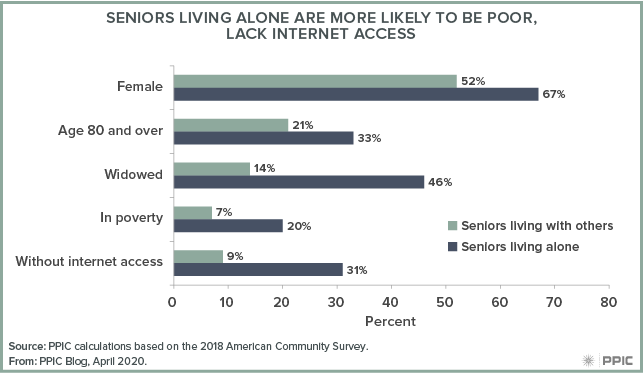
In California, 1.3 million seniors live alone (23% of 5.5 million seniors). They are disproportionately older, female, and widowed. Many have self-care limitations and a relatively large share live in poverty. Regionally, most live in the state’s large metropolitan areas, but many small rural areas of the state have very high shares of seniors living alone.

figure - Seniors Living Alone Are More Likely To Be Poor, Lack Internet Access

Of particular concern are those who do not have internet access. Among seniors who live alone, that’s 400,000 people. Another 40,000 have internet access but no smartphone, laptop, or tablet. They are perhaps the most socially isolated and vulnerable population in the state.

For these seniors, keeping up to date on the pandemic, ordering groceries and medicine from home, and connecting with others are all much more difficult. With libraries physically closed, a common access point to online services for many seniors is now unavailable, compounding the difficulty of overcoming social isolation.

Governor Newsom’s “Stay Home. Save Lives. Check In” campaign “urges all Californians to check in on vulnerable neighbors with a call, text or physically-distanced door knock” and is working with groups like AARP to reach out to older Californians. With many Californians now working from home, the time and opportunity to safely engage with older neighbors have never been greater—or the need more acute.

Emergency Child Care for Essential Workers

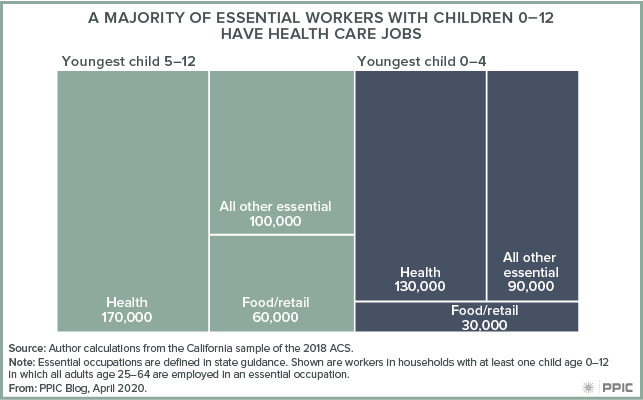
Of the state’s estimated 5.1 million essential workers, about 1.9 million have children younger than 13. These parents may be having difficulty finding care for their children amid the COVID-19 crisis, with most schools closed and many child care providers shuttered.

To address this need, the California Department of Education issued guidelines last Thursday for temporarily restructuring state-provided child care services. Parents who are essential workers can apply for services during the pandemic even as the state continues to prioritize certain at-risk children regardless of parents’ occupations.

Child care programs that receive state funds are now encouraged to remain open—or to reopen—if they can safely do so in order to care for the children of essential workers. To be eligible, all parents in the household must be essential workers and require child care so they can continue working (for example, they do not have the option to work remotely).

More than half a million essential workers with about 640,000 children younger than 13 could qualify. About 43% of these essential workers have a youngest child between 0 and 4 years old at home, while the rest have older children. Most of these parents work in health-related occupations, which are prioritized in the guidelines to receive child care services.

figure - A Majority of Essential Workers with Children 0-12 Have Health Care Jobs

On Monday, Governor Newsom announced that $100 million of the funds allocated in SB 89, emergency legislation to fight the coronavirus pandemic, will go toward funding up to 20,000 more short-term child care slots—and making child care programs safe for those children and their teachers. The CARES act provides federal funds to states for these purposes, so California will recoup these expenditures.

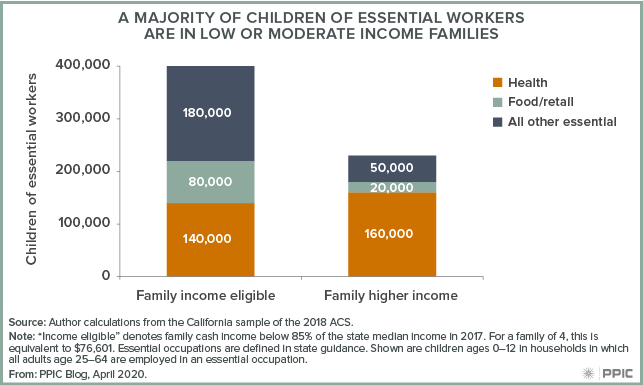
While we don’t know how many state-subsidized programs have remained open, even in the best of times the number of spaces is limited so most children—including those in low-income families—cannot access such care. However, demand for child care is indicated by the number of children in low-income, essential worker families. During this emergency, essential worker families do not need to show they are low income when they seek child care. However, programs are instructed to prioritize families.

About 400,000 children in essential worker families live on incomes below 85% of the state median—the income cut-off for state preschool in normal times. While a majority of parents in essential jobs work in health occupations, most low-income children have parents working in other essential occupations. In other words, tension may arise between serving children of low-income essential workers and serving children of health workers.

figure - A Majority of Children of Essential Workers Are in Low or Moderate Income Families

In this time of uncertainty, the state has existing capacity to support child care, and it has shifted the goals of state-supported programs to help essential workers meet—and afford—their child care needs. By tracking the response, the state could gain insight into whether it is meeting the needs of essential workers in this difficult time, how to meet these needs in the longer term, and to what extent needs vary across the state.