Video: Feinstein on Her Role in a New World

Senator Dianne Feinstein was clear about the challenges ahead for a California Democrat in contentious times.

“Here we are: outnumbered, outvoted, in the West, fairly liberal,” she said.

Speaking before an energetic capacity crowd in San Francisco, Feinstein said her office had received more than a million phone calls about Trump’s cabinet nominees. She described her approach to them: careful evaluation, rather than blanket opposition—an approach too conciliatory for some sign-carrying audience members. Feinstein said that in her role on the Senate Judiciary Committee, she needed to work with the administration officials in charge of national security and felt she could work with Trump appointees James Mattis, defense secretary; John Kelley, secretary of homeland security; and Mike Pompeo, CIA director. But she opposed other nominees because they lacked credentials for the job or they aren’t right for the county, she said. Nevertheless, they went on to win approval.

“The key for me is to figure out how we can begin to win some of these battles.”

Asked about Trump’s nominee to the Supreme Court, Neil Gorsuch, Feinstein wouldn’t say how she would vote. She said she will be particularly interested in his views on gun laws and on women’s reproductive rights.

Feinstein’s visit was greeted by dozens of protesters who marched outside, upset that she had not hosted a traditional town hall. Inside, Feinstein touched on a range of issues from climate change to immigration to health care, in a wide-ranging conversation with Mark Baldassare, PPIC president and CEO. His questions included a number that PPIC solicited online in advance of the event.

Moving up the Health Career Ladder

Upward mobility is inextricably tied to educational attainment in today’s economy. How do California’s educational institutions foster upward mobility for their students when developing their programs of study? One way community colleges across the country are working to do so is through the development of training pathways that allow students to “stack” multiple credentials. The idea is that students can earn certificates or degrees sequentially and move up a career ladder—upward mobility in action. For example, a student who completes a certificate in medical assisting can return to complete additional training and earn a degree in registered nursing—an occupation that offers large wage returns.

Despite the promise of “stackable credentials,” our analysis of students enrolled in health programs at California’s community colleges finds that among those who earn one credential, most don’t go on to get another. We followed the 85,000 students who earned their first health degree between 2000 and 2009. Only 13 percent completed a second health credential within six years. This isn’t terribly surprising since about half of health students in California’s community colleges initially earned an associate degree—the highest level award that is offered. Many associate degrees in health lead to well-paying jobs such as registered nurse or dental hygienist. But even among students who earned a shorter-term, lower-return credential, only 20 percent returned to earn another health credential.

However, the evidence suggests that students who do stack multiple health credentials see sizable economic returns eventually (see figure). Median earnings are similar across the two groups of students before starting their health training programs and while they are in school. The wage trajectories diverge, however, after degree completion. Students completing a single award—most often an associate degree—earn more than $15,000 per quarter just one year after finishing their health degree. In comparison, those completing multiple awards—a shorter-term, lower-return certificate is the most prevalent first degree—earn only $8,000 a year out. This difference narrows considerably over a five year period when students completing a second health credential see a larger gradient in their earnings.

Currently, most students who “stack” health credentials ultimately attain an associate degree in nursing—one of the highest value awards offered in the community college system. It’s plausible to imagine building pathways that allow students to meaningfully stack credentials to other high-value, in-demand careers. But to do so, colleges must carefully align program curricula to ensure that skills gained along the way are sequential or complementary, while at the same time making sure that each credential has standalone value in the labor market. This is not an easy task but one our community college system is currently focused on, given state and federal investment in growing career pathways.

At the same time, community colleges are investing in ways to support students as they explore pathways to well-paying careers. All of these efforts, taken together, hold promise for increasing the number of students who improve their economic standing through engagement with training pathways available through California’s community colleges.

Learn more

Read the report Health Training Pathways at California’s Community Colleges
Visit the PPIC Higher Education Center

The High Cost of Fixing Levees

The crisis at Oroville brought dams to the forefront of state and national discussions about aging infrastructure. Now, as full dams release high flows into rivers hemmed in by levees, this element of the state’s flood management system is in the spotlight.

Many of our levees are very old—much older than most of the state’s dams—and in need of modernization. Nowhere in California is the issue more important—or more challenging—than in the Central Valley, and particularly, the Sacramento-San Joaquin Delta.

The levees of the Central Valley are being tested this winter by sustained high flows. Some have failed, resulting in evacuations—including along the Cosumnes and San Joaquin Rivers. More challenges are in store in the Delta as flood waters move downstream later this week and into the spring.

The scale of modernization needed to avoid damaging floods—particularly as the climate changes and population on the floodplain grows—is vast. At least 1,600 miles of levees line the rivers and flood bypasses upstream of the Delta, forming the federally authorized Central Valley Flood Control Project. The most robust levees in this project protect cities like Sacramento, involving hundreds of millions of dollars’ worth of upgrades. But most of the project has weak and outdated levees that are unreliable in large floods.

The Delta has its own unique network of more than 1,100 miles of levees, which ring islands that lie well below sea level. The Delta levees are the least reliable in the Central Valley and are under threat from sea level rise, continued sinking of the islands, and earthquakes.

The good news for Central Valley levees is that there is consensus that the system needs a substantial upgrade, and there has been significant progress in envisioning what that might entail. In 2006, the legislature instructed the Department of Water Resources to develop a comprehensive plan for improving flood management within the region. The Central Valley Flood Protection Plan—released in 2012 and updated every five years—identifies a range of options, including new infrastructure, updated operation systems, and land use changes that could improve flood protection for the Sacramento and San Joaquin Valleys.

In the Delta, a 2009 law instructed the Delta Stewardship Council to develop a plan for prioritizing state investments in levees, balancing local needs with statewide interests. A draft plan now under review is expected to be adopted later this year.

The bad news is that doing anything about these levees is going to be difficult for three reasons: it would be very expensive, take a very long time to implement, and be very controversial. The Central Valley plan has a price tag of $17–$21 billion over 30-plus years. For the Delta, the council has identified more than $2 billion in high-priority upgrades.

These costs far outstrip the resources of local flood management entities—particularly in the Delta, where low land values and farm revenues make it hard to generate funds for major upgrades. State bonds and some federal dollars have provided key support, but there is still a large gap—in the range of $800 million to $1 billion annually. Indeed, flood management remains one of the water sector’s most prominent “fiscal orphans,” with one of the biggest funding gaps compared to need.

State policymakers will need to assess what is achievable with known or likely resources and make tough choices about priorities based on state interests and public safety. This is not an easy task. There is usually strong local pressure to do something for as many people as possible with the limited funds available. While this approach appears equitable, it is unlikely to yield significant reductions in flood risk. Investments will need to be concentrated to be effective.

As noted in our recent blog post, the silver lining of this winter’s flooding is renewed attention to the urgent need to modernize the state’s flood management infrastructure. These discussions have begun in the legislature. Sustained leadership on this issue will be needed to sustain the urgency to act once the sun shines again. The good news is that the legislature has taken the all-important first step in tackling this difficult but very important problem.

Learn more

Visit the PPIC Water Policy Center flood resources page
Read California’s Water: Paying for Water (from California’s Water briefing kit, October 2016)

Video: An Early Look at Views of President Trump

The January PPIC Statewide Survey asked Californians for to assess their new leaders in Washington and found that just a third of Californians, or 30%, approve of the way President Trump is doing his job. Californians gave Congress a similar rating.

Dean Bonner, associate survey director, presented these and other key findings at a briefing in Sacramento. The survey also examined contentious issues that are the focus of national debate.

  • Solid majorities of Californians favor state action—independent of the federal government—to protect the rights of undocumented immigrants and to address global warming.
  • About half of Californians have favorable opinions of the Affordable Care Act, and a slight majority oppose repealing it.
  • Most Californians—across political parties—say the government should not interfere with a woman’s access to abortion.

The survey also looked at views of Governor Brown’s job performance and his proposed budget. The governor job approval rating is at a record-high 66%. But his budget proposal and his plan to fund maintenance of the state’s roads, highways, and bridges fares less well. Just under half of residents support his budget plan and 41 percent support his transportation proposal.

Learn more

Read the January PPIC Statewide Survey
Learn more about the PPIC Statewide Survey

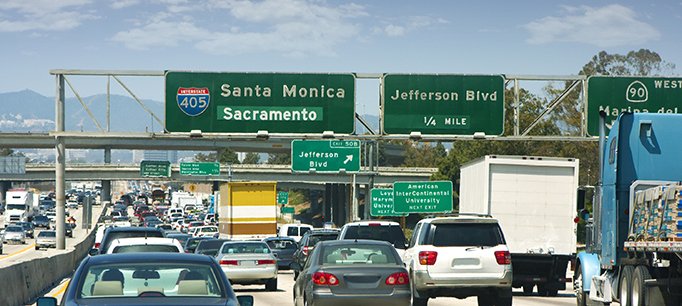
Californians Opposed to Governor’s Transportation Plan

In PPIC’s most recent statewide survey, 61% of Californians say that spending more money on the maintenance of roads, highways, and bridges is very important for California’s future quality of life and economic vitality. At the same time, a majority of Californians (54%) oppose the governor’s proposal to do so. His transportation funding plan would provide $43 billion of additional spending for state and local transportation projects, with money coming from a new $65 vehicle fee and an increase in gasoline and diesel taxes. Republicans are overwhelmingly opposed to the governor’s proposal and independents are divided. Among Democrats, a slight majority (53%) favor the plan while 42% oppose it.

Californians’ reluctance to support the governor’s plan is understandable in light of another survey finding: many are not satisfied with the way transportation funds are being spent now. When asked what is most needed to improve the quality of California’s roads and surface transportation, 51% of adults choose the wiser use of existing funds. This response contrasts with what Californians said when asked a similar question about higher education funding in December. Just a little over a third (36%) said that the wiser use of existing funds alone would significantly improve the quality of public higher education.

Among Californians who oppose the governor’s proposal, 64% say that the wiser use of existing funds is the best way to significantly improve the quality of the state’s roads. Only 30% say that both wiser use of existing funds and more state funding is needed.

Across parties, 80% of Republicans and 69% of independents who oppose the governor’s plan think that the wiser use of existing funds is the best approach. Notably, Democrats who oppose the governor’s plan are far more likely than those who support it to say that the wiser use of funds alone is a way to improve California’s roads, highways, and bridges (55% to 31%). If the governor hopes to win the support of some of those 42% of Democrats who oppose his plan, he will likely have to overcome the perception that transportation funds are not being put to good use now.

Learn more

Read the January PPIC Statewide Survey: Californians and Their Government
Find out more about the PPIC Statewide Survey

Yesterday’s Dams Face Tomorrow’s Floods

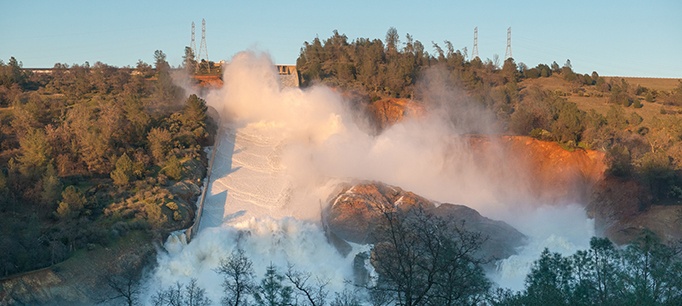
The crisis at Oroville Dam on the Feather River eased yesterday as state officials gained control over the damaged spillway and allowed the more than 180,000 evacuees to return home. Prospects are good that dam operators will be able to control releases through the remainder of the wet season. Now that the immediate crisis is past, we should take the opportunity to review how we manage California’s big dams—and what changes would help us do so more effectively in future.

Water—whether too much or too little—has a way of revealing weaknesses in design and decision making. For Oroville Dam—the tallest dam in the nation—the crisis began with poor maintenance of its main spillway compounded by wholly inadequate design of the emergency spillway, a known problem. But the crisis at Oroville also raise five broader concerns that California will have to reckon with:

  • Aging dams. Most of the state’s 1,400 large dams were designed using slide rules and based on simplistic assumptions about hydrology and earthquakes. These dams are marvels of engineering considering when they were built, but many are in need of major upgrades in infrastructure and operations. California needs a comprehensive plan for evaluating and modernizing these structures.
  • A changing climate. California’s dams must be adapted to address new risks from a changing climate. These dams were built to respond to early- to mid-20th century conditions. The climate has shifted since that time, and the bulk of climate simulations point to significant changes in the near future. Our dry periods are getting both drier and warmer, and our wet periods are getting wetter with more precipitation falling as rain rather than snow. Part of the problem at Oroville is that the warm temperatures have meant there’s more water to manage right now than usual because less of it is staying in the snowpack. The past seven years—which included five years of record warm, dry conditions bracketed by extremely wet ones—is a glimpse into our future. It is time to rethink how we are going to operate and maintain our dams to respond to these changes.
  • Conflicting goals. We may be asking too much of our dams. For example, Oroville Dam provides water supply, hydropower, flood management, recreation, and ecosystem flows for rivers and the Delta. Flood management is in tension with the other services because a mostly empty reservoir—bad for the other services—is the best hedge against floods. By design, Oroville was relatively full when the latest floods arrived, reflecting its top priority (water supply) and compounding flood risk. It may be time to rethink the balance of objectives for all of our large, multipurpose dams.
  • Rigid rules. Adjusting course on dams—whether by changing the infrastructure or the way they are operated—is difficult. Licenses for non-federal dams like Oroville—administered by the Federal Energy Regulatory Commission—last for 30–50 years. These lock in place all aspects of dam operation for several generations and require herculean efforts to overcome. Moreover, flood operations on all dams are mandated by the US Army Corps of Engineers and require an act of Congress to change. When it comes to changing course on dams, institutional inertia is a powerful countervailing force.
  • High cost of improvements. Any change in course is likely to be very expensive. California relied heavily on federal support for construction of many of its large, multipurpose dams. Support ended decades ago and is unlikely to resume in the future. California is going to need a comprehensive funding plan for modernizing its dams and other flood management systems that does not rely on extensive federal support.

Most water crises have a silver lining. The recent drought spurred changes to the way we manage water scarcity in the state, resulting in one of the most important pieces of water legislation—the Sustainable Groundwater Management Act—in many decades. The crisis at Oroville should spur Californians to rethink how we manage our network of large dams. New management approaches, new technology, and new investments to modernize dams will be necessary to adapt to changing conditions, both today and tomorrow.

Learn more

Visit the PPIC Water Policy Center flood resources page
Read California’s Water: Climate Change and Water (from California’s Water briefing kit, October 2016)

Video: Ending the Housing Crisis

Sacramento’s mayor and San Diego’s mayor have different political perspectives, clearly evident in PPIC’s “Building California’s Future” event last week. Their views diverged on issues from high-speed rail to the voting requirements for passage of local transportation tax measures. But the mayors reached some consensus on one issue: the need for more housing and the difficulty of building the political will to end the state’s housing crisis.

“I don’t see the political coalition around housing that I see around transportation,” said Darrell Steinberg, Sacramento’s Democratic mayor.

“I could not agree more,” said Kevin Faulconer, San Diego’s Republican mayor. “It has not gotten the attention it should.”

Asked the single biggest action the state can take this year to help with our housing crisis, both mentioned regulatory reform. Steinberg said robust reform needs to be combined with a source of funding for affordable housing. He said he hoped the state can “combine these two prongs to make it easier to site housing and at the same time provide real funding to be able to subsidize and build affordable housing.”

Faulconer said reform of the 40-year-old California Environmental Quality Act (CEQA) is essential. Those who share his views contend that CEQA lawsuits have been used to slow or stop housing developments, even those deemed environmentally friendly. Faulconer said the business and housing climate are important in attracting businesses to California communities.

“We have to have really clear rules of the road, we have to follow those rules of the road,” he said. “We have to get people through the process in a defined amount of time because time is money.”

Housing was also an important part of the discussion in the panel that followed the mayors’ conversation at the PPIC event. Participants included two county supervisors, Kristin Olsen of Stanislaus County and Joe Simitian of Santa Clara County, as well as Lucy Dunn, president and CEO, Orange County Business Council. John Diaz, editorial page editor of the San Francisco Chronicle moderated.

Upgrading High School Math Requirements

California has not updated its math graduation requirements for 30 years and now lags behind other states in ensuring that high school graduates are ready for success in college and the workplace. Math graduation requirements can affect students’ participation in advanced math courses (e.g., algebra II), which in turn has an impact on their educational and economic outcomes over the long term.

Across the nation, California is one of three states that require only two years of math instruction for high school graduation. Other states typically require three years (27 states and the District of Columbia) or four years (17 states). From 2001 to 2016, 25 states made their graduation requirements more rigorous. In recent years, some states have even incorporated college- and career-readiness components, such as SAT or ACT scores, into their graduation standards. In contrast, California last updated its graduation requirements in 1986.

In the absence of changes at the state level, California’s public school districts and four-year institutions have taken the lead. Most of the state’s districts have independently updated their math graduation standards. During the 2015–16 school year, 63% of unified and high school districts supplemented the state minimum with an additional year of math, although larger districts with more than 20,000 students were somewhat less likely to do so. Moreover, both the California State University and University of California systems require three years of math, including algebra I, geometry, and algebra II (or equivalent).

For many students, taking only two years of math will not adequately prepare them for college and beyond. It’s time for California to update its graduation requirements to better align with district practices and other major statewide efforts to improve college readiness. Increasing the amount of math instruction required for high school graduation can encourage more students to take advanced math courses—which would increase their likelihood of graduating from high school and enrolling in college. It would also reduce the need for remedial education in college.

One concern is that more rigorous math requirements may prevent students from graduating high school. However, evidence from California districts and other states suggests that there is no correlation between high school graduation requirements and high school graduation rates.

Another concern is cost, as the state needs to fund any changes to graduation requirements (e.g., the cost of hiring more math teachers and offering more math courses). However, most districts already require three years of math, suggesting that funding may not be a big constraint. If the state sets higher minimum math requirements, the educational and economic benefits for California students will likely to outweigh the costs.

Learn more

Read the report College Readiness in California: A Look at Rigorous High School Course-Taking

Equity and Remedial Education at Community Colleges

PPIC research has shown that students from groups that are historically underrepresented in higher education are more likely to take a remedial—or developmental—course at some point in their college career. Our research also shows that these students are less likely to complete a college-level course in math or English—and less likely to meet their educational goals. At a time when California faces a shortfall of college-educated workers, this has profound implications for the state’s future. Given that more than half of Latinos and African Americans who pursue higher education attend community college, policymakers need to focus on closing access and achievement gaps.

A recent PPIC report found that 87% of both Latino and African American community college students took at least one developmental math or English course, compared to 70% of Asian and 73% of white students. Likewise, 86% of recipients of fee waivers from the California Community Colleges Board of Governors (BOGW) or Pell Grants—our proxy for low-income status—took at least one developmental math or English course.

A closer look reveals that Latino, African American, and low-income students are likely to be placed in developmental education at lower levels than other groups of students. This requires students to take a longer sequence of developmental courses—up to four semesters’ worth—and dramatically alters college trajectories. African American and Latino students make up 61% of students who enter the developmental math sequence four levels below college ready, but only 41% of students who begin one level below. Similarly, the share of low-income developmental math students who start four levels below college ready (82%) is significantly higher than the share that begin one level below (64%). This means that Latino, African American, and low-income students are more likely to spend valuable time and financial aid on courses that do not count toward a degree or transfer.

Equity issues are apparent not only in students’ participation in developmental education, but also in their outcomes. When we examine the completion of college-level math and English courses among students who started out in developmental education, we find that rates are lower for most underrepresented groups. For example, 39% of Asian students and 30% of white students who took a developmental math passed a college-level math course, compared to 24% of Latino and 14% of African American students. The same pattern holds true for English, where 59% of Asian students and 49% of white students successfully completed a college-level English course, compared to 42% of Latino and 28% of African American students. However, low-income students who enrolled in developmental education courses completed college-level courses (26% math and 45% English) at about the same rate as developmental students overall (27% math and 44% in English).

It is also important to look at the assessment and placement policies that place students into developmental courses. Our research found that these policies vary widely across the state’s 113 community colleges. As a result, some Latino and African American students may be enrolling in developmental education at higher rates, especially in math, simply because they attend colleges that set higher cut-off scores for placement into college courses.

Our recent findings suggest that developmental education, which is intended to help students succeed in college, may actually be contributing to college achievement and completion gaps. A multipronged approach that improves developmental education courses and streamlines assessment and placement policies can lead to more equitable student outcomes.

Learn more

Read Preparing Students for Success in California’s Community Colleges
Read Determining College Readiness in California’s Community Colleges: A Survey of Assessment and Placement Policies
Visit the PPIC Higher Education Center

Immigrants Are Key to the State’s High-Skilled Workforce

Immigrants are integral to California’s highly skilled workforce. As California’s demand for highly educated workers has outpaced the supply produced by its colleges and universities, immigrants have filled the gap. Immigrants now make up a substantial share of the state’s highly educated workers. Today, three of every ten highly educated workers in California is an immigrant, up from one in five in 1990. Immigrants are especially important in the state’s high tech sector, comprising 52% of college graduates who work in computer systems design and services and 57% of those in computer equipment and peripheral manufacturing (findings based on the 2013‒2015 American Community Survey).

Over time, the face of immigration to California has changed. Recent immigrants are more highly educated than immigrants who arrived earlier. In the past, most immigrants arrived from Latin America. But in recent years, most new immigrants to California are from Asia. Because many immigrants from Asia are highly educated, this regional shift has contributed to a change in immigrants’ education levels. Immigrants who have arrived in California in the past five years are among the most highly educated demographic group in the state, with more than half (52%) holding at least a bachelor’s degree, compared to 35% of US-born Californians.

Immigrants to California from the seven countries that are the focus of President Trump’s executive order —Iran, Iraq, Libya, Somalia, Sudan, Syria, and Yemen—also tend to be highly educated. According to the 2015 American Community Survey, California is home to 305,000 immigrants from these countries—35% of the total number of immigrants from these countries in the nation—with most (213,000) from Iran. Altogether, almost half (47%) of adult immigrants (ages 25‒64) from these countries have a bachelor’s or graduate degree, including 54% of those from Iran.

Given the contribution of highly educated immigrants to California’s economy, and especially to the state’s high tech sector, it is no wonder that many companies and state officials have raised concerns about the president’s executive order.

PPIC has projected that California faces a workforce skills gap and needs to increase the number of adults with a bachelor’s degree by an additional 1.1 million to meet workplace demands by 2030. These projections assume that the state will continue to attract substantial numbers of highly educated immigrants from abroad. Restrictions on the flow of those immigrants could exacerbate the projected workforce skills gap—and cause significant damage to the state’s economy.

Learn more

Visit the PPIC Higher Education Center