Trends in Math Reforms at Community Colleges

The landscape of developmental (also known as remedial) math at California’s community colleges has changed dramatically in recent years. With the passage of Assembly Bill 705, community colleges will be required to maximize entering students’ likelihood of completing college-level math and English within a year. This is a critical goal. Our research has shown that developmental course sequences are lengthy, delaying students’ academic careers and sometimes affecting their ability to advance to college-level coursework.

The new law goes into effect in fall 2019, but many colleges have already started implementing reforms to improve the accuracy of placement into developmental education and to shorten developmental sequences while making them more relevant to students. In the 2017–18 school year, 83% of community colleges offered new developmental math courses in addition to or in place of traditional courses. Example course reforms include:

  • Offering statistics pathways for students in majors that only require statistics (e.g., liberal arts and humanities fields)
  • Compressing the traditional multi-course developmental sequence into a single course
  • Providing lab time or supplemental instruction in a co-requisite course while allowing students to enroll directly into college-level math
  • Designing curricula aligned with students’ programs of study
  • Dividing courses into modules that represent discrete math competencies

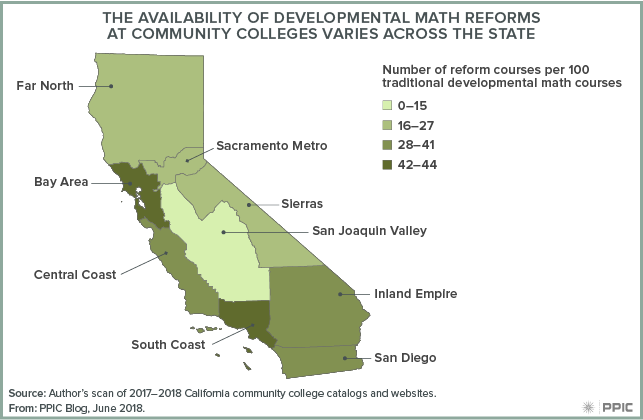
However, the availability of these new courses varies greatly within colleges and across the state. As illustrated in the map below, for every 100 traditional math courses offered in each region of California, less than 50 reform courses are offered, indicating that on the whole reform courses are still not as available as traditional courses. Moreover, reform courses tend to have fewer sections, which further limits enrollment.

Colleges that are adopting course reforms are mostly concentrated in highly populated regions such as the Bay Area and South Coast, which collectively serve about 56% of full-time community college students in the state. In contrast, the San Joaquin Valley stands out as having the smallest ratio of reform to traditional developmental math courses, while serving roughly 10% of full-time community college students in the state. Only six out of the thirteen colleges located in the San Joaquin Valley offer at least one course-level reform.

Although some California community colleges have already implemented developmental math reforms, overall, these efforts have reached only a small fraction of the students that could potentially benefit. Math guidelines for AB 705 are still pending, but the legislation may offer the leverage needed to implement effective reforms at scale and dramatically improve student completion of college-level math courses.
Emergency Departments and the Affordable Care Act

Coverage expansions under the Affordable Care Act (ACA) have resulted in a dramatic decline in the uninsured population in California. Much of the coverage gains have been driven by expanded eligibility for Medi-Cal, the state’s Medicaid program, which has seen a nearly 60% increase in enrollment since January 2014. With this large Medi-Cal expansion comes concerns about controlling costs, ensuring adequate access to care, and supporting the state’s health care safety net.

Monitoring how often people seek care in California’s emergency departments offers important insights—in part because frequent use can signal poor access to other medical care options. Hospitals in some parts of the state have reported growing demand for emergency care services in recent years. In a new study published this month in the journal Health Affairs, we examined emergency department use to understand how things have changed since the implementation of the ACA.

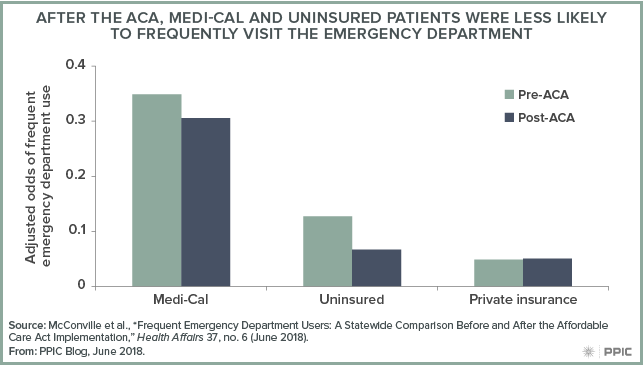
After controlling for factors such as patient age and health status, we found the odds of being a frequent emergency department user—with four or more annual emergency department visits—were significantly lower for Medi-Cal patients after the ACA. The odds of frequent use among the uninsured declined even more, while those with private insurance experienced little change. At the same time, however, there has been an overall increase in both the share and the absolute number of emergency department patients who are frequent users—despite the lower odds of frequent emergency department use after the ACA. We found that frequent users accounted for 7.9% of emergency department patients in the two years before the ACA, compared to 8.5% in the two years after.

Both before and after the ACA, the largest predictors of frequent emergency department use were having a diagnosed mental health condition or substance use disorder. This finding suggests state efforts to better integrate physical and behavioral health services for Medi-Cal enrollees could help lower frequent emergency department visits. Given that Medi-Cal is now the primary coverage source for more than two-thirds of frequent emergency department users, care plans managed by Medi-Cal will be a key player in efforts to manage emergency care moving forward.

In future work, we will be studying in more depth how changes in insurance coverage affected emergency department use across the state—with a particular focus on regions that saw the largest declines in their uninsured rates.

A Path to Progress for the Salton Sea

The Salton Sea—created by a break in a Colorado River irrigation canal more than a century ago and for decades dependent on irrigation runoff for sustenance—has a water problem. The already-shrinking desert lake used to receive a temporary water supply as part of a Colorado River water trading agreement that sent some irrigation water to Southern California cities. But this temporary supply was cut off at the end of 2017, which has worsened environmental and health problems caused by the sea’s declining water levels.

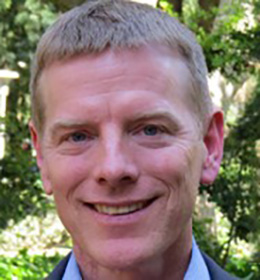
We talked to Kurt Schwabe—a professor at UC Riverside and an adjunct fellow of the PPIC Water Policy Center—about possible solutions. Schwabe helped organize a recent symposium on the sea that explored impacts on local communities, new research, and policy solutions.

PPIC: Why does the Salton Sea need more water right now?

Kurt Schwabe: In 2003 the State Water Board allocated water to temporarily manage the dust and ecosystem problems associated with the shrinking sea. The board set a deadline of 15 years for the state and the parties in the water trading agreement to develop a plan to address these impacts. Although the state is behind in implementing solutions, the water allocation cutoff wasn’t postponed, and now the sea is shrinking at a faster pace. The increase in dust has a direct impact on respiratory illnesses and life expectancy in the region, which raises equity issues.

Another problem is that water salinity is increasing as the sea shrinks. Time is running out for the wildlife the sea supports. As explained by researchers at the symposium, fish populations have crashed and won’t recover, thereby resulting in the loss of birds that depend on the fish. We may see new populations of birds that eat brine flies, yet without an effective management plan those birds will last only about a decade until the sea becomes too salty even for brine flies. In a nutshell, the ecosystem doesn’t have 10 years for us to find a solution. More water and less saline water―similar to the water allocation provided from 2003 to 2017―would slow the decline and buy the state time to further develop or implement solutions.

So it’s time to come up with quick and cost-effective ways to mitigate the problems. Recent passage of Proposition 68 will provide around $200 million to support construction costs in the state’s 10-year plan, but this plan is a short-term and imperfect fix. There’s growing interest in finding ways to import water from elsewhere―but that could take a decade or so to implement, is extremely costly, and does not address the worsening public health and environmental impacts happening now. An obvious near-term solution would be to extend the allocation of water to the sea until the actual rollout of the management plan. It’s a reasonable and quick fix: the conveyance to move water is already in place, it’s a tried and true solution, and it’s very cost-effective.

PPIC: What role could a water market play in managing the sea’s problems?

KS: Water markets could be a longer-term fix to replace the temporary water allocation, and would allow growers to make choices about how to best get needed water to the sea. A market would let farmers choose how best to free up that water—either by installing more efficient irrigation, shifting to less water-needy crops, fallowing land, or some combination of these. From a technical standpoint, a water market could be implemented almost immediately.

PPIC: What are the key stumbling blocks to getting more water to the sea quickly?

KS: The stumbling blocks are mostly political. Water transfer schemes have been used in the region for more than 20 years and typically involve Southern California municipal water agencies leasing water from irrigation districts in Imperial County. This isn’t to say that getting such a fix approved is an easy task, since the politics surrounding California water are notoriously challenging. Yet I would argue that the dire and worsening human health consequences being borne every day by local communities near the sea justify urgent action.

Video: The Impact of Proposition 47 on Crime and Recidivism

Proposition 47, passed by voters in November 2014, has generated considerable debate. By reducing penalties for some lower-level drug and property offenses, Prop 47 marked another significant step toward reducing California’s reliance on incarceration. Supporters of the reform believe that redirecting money that is no longer being spent on incarceration to behavioral health and other treatment programs would reduce recidivism. Opponents feared that Prop 47 would overburden local law enforcement and lead to increases in crime.

A panel discussion in Sacramento last Thursday encapsulated this debate—but also featured significant areas of agreement. PPIC researcher Mia Bird set the scene by outlining a new report, The Impact of Proposition 47 on Crime and Recidivism. The report finds no evidence that Prop 47 has affected violent crime rates but sees signs that it led to a rise in property crime—driven largely by thefts from motor vehicles. The report also finds a decline in recidivism, driven largely by a drop in rearrest and reconviction rates for offenders covered by Prop 47.

Bird pointed out that “Prop 47 likely sent a signal to law enforcement to reprioritize their resources away from arrests for drug possession toward more serious offenses.”

Fresno police chief Jerry Dyer underlined this point. “Whenever you have laws that take away your ability to arrest certain individuals for a felony, and you know there’s no room in the jail for misdemeanants, you shift your resources [toward] violent criminals.”

For George Gascón, San Francisco’s district attorney, “Prop 47 is a mild beginning of a process where we go back and see where we want to put public resources.” He pointed out that the negative impact of high rates of incarceration has been felt primarily in communities of color, and added that recent crime fluctuations need to be placed in the context of historically low crime rates over the past several years.

For Dyer, reclassifying some drug and property crimes as misdemeanors means that there are “no consequences for individuals who are committing crimes.” Dyer also noted that when Prop 47 passed, local law enforcement was still adjusting to the realignment of corrections responsibilities that was enacted three years earlier. The pace of reform has felt like “trying to take a drink of water out of a fire hose.”

While the panelists had differing views on the state’s shift away from incarceration, they agreed on the importance of treatment programs for mental health and substance abuse disorders. Gascón noted that with funding from Prop 47, “communities are beginning to experiment with different ways of treating the drug addiction and mental health issues that drive many crimes.” Dyer agreed, noting that “jail is no place for people with mental health issues.”

Kate Howard, executive director of the Board of State and Community Corrections (BSCC), explained how the BSCC developed a process for allocating 65% of the money saved by reductions in incarceration to local programs. The BSCC sought input from across the state, and the grant steering committee includes several ex-offenders, whose experience with the corrections system was “instrumental.” The first 23 grants were awarded in June 2017. While it is too early to measure their impact, Howard said there is “great reason for optimism.”

Gender Imbalances in STEM Majors

In California and the United States as a whole, women have made strong educational progress over many decades. In 2006, for the first time ever in California, women became more likely to hold a bachelor’s degree than men. Women’s educational advantage over men has continued to grow in the past decade. In 2017, women received 57% of the bachelor’s degrees, 58% of the master’s degrees, and 54% of the doctorates awarded by California colleges. Much of this advantage stems from better preparation: women are more likely to graduate from high school than men and are also more likely to complete the college preparatory courses required for admission to the state’s public universities. Even so, women remain underrepresented in key science, technology, engineering, and mathematics (STEM) majors—in California and across the nation.

Statewide, only a few majors are gender balanced—meaning that half the bachelor’s degrees are awarded to women and half to men. In 2016, according to federal data, among the 22 most popular majors in California’s public and private nonprofit colleges, more than 60% of the bachelor’s degrees in 10 majors and fewer than 45% of degrees in 5 majors were awarded to women. At one extreme, women make up more than 80% of the graduates in consumer sciences, education, liberal arts, social services, and health professions. At the other extreme, only about 20% of bachelor’s degrees in engineering and computer science were awarded to women in 2016.

Because engineering and computer science are associated with strong labor market outcomes, low shares of women in those fields is cause for concern. The proportion of women majoring in these fields has not risen much in recent years: from 2010 to 2016, the share of bachelor’s degrees awarded to women in California increased from 19% to 21% in engineering and from 16% to 18% in computer science.

Efforts to address STEM gender imbalances are under way. For example, an NSF study by UCLA researchers is using longitudinal data across a set of colleges to identify actions that can increase the share of women in computer science. Given California’s high tech economy, the state’s colleges and universities should play a leading role in meeting this challenge.

A Balancing Act for the Colorado River

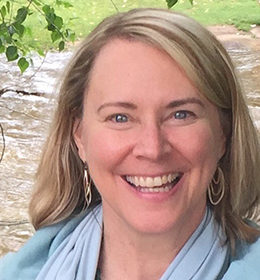
The Colorado River―a critically important water supply for seven western states, including California―has been in drought for nearly two decades. We talked to Bonnie Colby, a professor of natural resource economics at the University of Arizona and a member of the PPIC Water Policy Center research network, about conditions in the basin and next steps for improving shared management of the river.

PPIC: What concerns you most about the river’s condition?


Bonnie Colby: We’re in a more difficult situation than in previous droughts because the major reservoirs—Powell and Mead—are so low. It’s unprecedented in my 35 years of working on water. Low reservoir levels increase the potential for conflict and make it harder to balance supply and demand. But our collective capacity to address these kinds of conflicts is growing as well.

Regionally, groundwater levels are falling dramatically from increased pumping during drought. That strategy brings hazards over time because river flows and groundwater are intricately connected, and overdrafting groundwater reduces water flowing into rivers. California is now working on groundwater sustainability, which is promising. Arizona has done a great job managing groundwater in heavily pumped areas (known as “active management areas”), but there are other places where groundwater use is not regulated to manage overdraft.

PPIC: What are your biggest concerns about current efforts to manage the river?

BC: There’s a fundamental conflict over who’s going to cut back on water use. Cities and environmental groups hope irrigated agriculture will use various proven strategies to free up more water for cities and the environment, giving up use of some of its water for fair payment. Some farmers are willing to cut back for a few years, but many are reluctant to do that indefinitely. No one can be sure whether this drought will extend for years or decades. The overall drying trend in the basin should alert us that the future will not merely repeat past drought patterns. Once we start reducing crop water use year after year in farming regions, it’s hard to maintain the agricultural economy and related infrastructure.

Delays in the “drought contingency plan” process are another concern. These plans lay out commitments by the states regarding specific steps to cut water use and help maintain reservoir levels during drought. Water conflict is a very hard puzzle to solve. It’s difficult to decide which groups will bear the economic pain and impact to their quality of life. If there are cutbacks for multiple years in a row, how drastically should cities be asked to reduce water use? How should we deal with water for golf courses, for farms? Until the states can finalize drought contingency plans, we can’t finalize a number of important policy agreements—for example, new agreements with Mexico over sharing the river’s waters.

PPIC: What are some positive things about the state of the basin?

BC: The state of Colorado has shown a lot of leadership in making arrangements with farmers to use less water without causing significant economic disruption. These on-farm collaborative arrangements are where the basin can make substantial progress. If we put farmers’ and irrigation district managers’ knowledge and experience to use through voluntary collaborative programs, we should be able to reduce farm water 5% while only seeing a 1% drop in farm income, with only minor effects on food and fiber production. Farmers won’t, and shouldn’t have to, do this at their own expense―compensation for farm income losses is necessary.

On another hopeful note, we’ve seen the conversation start to shift so that more people in the region see the river as a connected system, from its headwaters in Wyoming and Colorado to its estuary in Mexico’s Sea of Cortez. There’s more understanding about the importance of changes in snowpack patterns, long-term water scarcity, and other key issues. A better informed constituency is a very good thing for tackling basin-wide challenges.

How Changes in Immigration Affect California’s Workforce

[vc_row][vc_column][vc_column_text]Immigrants are essential to California’s workforce. In the past two decades, as labor market needs have shifted, the composition of recent immigrants (those arriving in the last five years) has changed dramatically. Today, recent immigrants to California are much more likely to hold a bachelor’s or more advanced degree than in the past—and in fact are now more likely than US-born Californians to do so.

While the number of recent immigrants to California fell by 24% between 2000 and 2016, the number of highly educated immigrants rose by 41%. In 2016, about half of recent immigrants held at least a bachelor’s degree. Highly educated immigrants work in every major industry in the state and comprise about 30% of the highly educated workforce.

These changes in educational attainment coincide with other shifts in immigration patterns. A large portion of the decline in immigration to California can be attributed to the falling numbers of immigrants arriving from Mexico. In 2000, over half a million recent immigrants came from Mexico. By 2016, that number fell by more than 70% to less than 150,000 people.

Now, China has slightly edged out Mexico as the leading country of origin, and these top two countries are followed by India, the Philippines, and Vietnam. Immigrants from China and India tend to be highly educated: in 2016, 47% of recent immigrants from China—and around 80% of recent immigrants from India—had at least a bachelor’s degree. The interactive below allows you to further explore changes in education levels over time among recent immigrants overall and from these five countries.

The sharp increase in highly educated immigrants and the decline in less-educated immigrants reflect the changing labor market in California. Unemployment rates for workers with at least a bachelor’s degree (3.3%) are about half those of less-educated workers (6.5%). With California expected to face a shortfall of 1.1 million college graduates by 2030, highly educated immigrants are a key component to helping the state address the workforce skills gap.[/vc_column_text][/vc_column][/vc_row][vc_row][vc_column][vc_raw_html]JTNDZGl2JTIwY2xhc3MlM0QlMjd0YWJsZWF1UGxhY2Vob2xkZXIlMjclMjBpZCUzRCUyN3ZpejE1Mjc4Nzg3ODgxNDYlMjclMjBzdHlsZSUzRCUyN3Bvc2l0aW9uJTNBJTIwcmVsYXRpdmUlMjclM0UlMEElMDklM0Nub3NjcmlwdCUzRSUwQSUwOSUzQ2ElMjBocmVmJTNEJTI3JTIzJTI3JTNFJTNDaW1nJTIwYWx0JTNEJTI3RURVQ0FUSU9OJTIwTEVWRUxTJTIwVkFSWSUyMEFDUk9TUyUyMElNTUlHUkFOVCUyMEdST1VQUyUyMCUyNyUyMHNyYyUzRCUyN2h0dHBzJTNBJTI2JTIzNDclM0IlMjYlMjM0NyUzQnB1YmxpYy50YWJsZWF1LmNvbSUyNiUyMzQ3JTNCc3RhdGljJTI2JTIzNDclM0JpbWFnZXMlMjYlMjM0NyUzQkNhJTI2JTIzNDclM0JDYWxpZm9ybmlhc2ltbWlncmFudHNhbmRlZHVjYXRpb25sZXZlbHNfMCUyNiUyMzQ3JTNCSW1taWdyYW50c2luQ2FsaWZvcm5pYWJ5ZWR1Y2F0aW9uYW5kY291bnRyeW9mb3JpZ2luJTI2JTIzNDclM0IxX3Jzcy5wbmclMjclMjBzdHlsZSUzRCUyN2JvcmRlciUzQSUyMG5vbmUlMjclMjAlMkYlM0UlM0MlMkZhJTNFJTBBJTA5JTNDJTJGbm9zY3JpcHQlM0UlMEElMDklM0NvYmplY3QlMjBjbGFzcyUzRCUyN3RhYmxlYXVWaXolMjclMjAlMjBzdHlsZSUzRCUyN2Rpc3BsYXklM0Fub25lJTNCJTI3JTNFJTBBJTA5JTA5JTNDcGFyYW0lMjBuYW1lJTNEJTI3aG9zdF91cmwlMjclMjB2YWx1ZSUzRCUyN2h0dHBzJTI1M0ElMjUyRiUyNTJGcHVibGljLnRhYmxlYXUuY29tJTI1MkYlMjclMjAlMkYlM0UlMEElMDklMDklM0NwYXJhbSUyMG5hbWUlM0QlMjdlbWJlZF9jb2RlX3ZlcnNpb24lMjclMjB2YWx1ZSUzRCUyNzMlMjclMjAlMkYlM0UlMEElMDklMDklM0NwYXJhbSUyMG5hbWUlM0QlMjdzaXRlX3Jvb3QlMjclMjB2YWx1ZSUzRCUyNyUyNyUyMCUyRiUzRSUwQSUwOSUwOSUzQ3BhcmFtJTIwbmFtZSUzRCUyN25hbWUlMjclMjB2YWx1ZSUzRCUyN0NhbGlmb3JuaWFzaW1taWdyYW50c2FuZGVkdWNhdGlvbmxldmVsc18wJTI2JTIzNDclM0JJbW1pZ3JhbnRzaW5DYWxpZm9ybmlhYnllZHVjYXRpb25hbmRjb3VudHJ5b2ZvcmlnaW4lMjclMjAlMkYlM0UlMEElMDklMDklM0NwYXJhbSUyMG5hbWUlM0QlMjd0YWJzJTI3JTIwdmFsdWUlM0QlMjdubyUyNyUyMCUyRiUzRSUwQSUwOSUwOSUzQ3BhcmFtJTIwbmFtZSUzRCUyN3Rvb2xiYXIlMjclMjB2YWx1ZSUzRCUyN25vJTI3JTIwJTJGJTNFJTBBJTA5JTA5JTNDcGFyYW0lMjBuYW1lJTNEJTI3c3RhdGljX2ltYWdlJTI3JTIwdmFsdWUlM0QlMjdodHRwcyUzQSUyNiUyMzQ3JTNCJTI2JTIzNDclM0JwdWJsaWMudGFibGVhdS5jb20lMjYlMjM0NyUzQnN0YXRpYyUyNiUyMzQ3JTNCaW1hZ2VzJTI2JTIzNDclM0JDYSUyNiUyMzQ3JTNCQ2FsaWZvcm5pYXNpbW1pZ3JhbnRzYW5kZWR1Y2F0aW9ubGV2ZWxzXzAlMjYlMjM0NyUzQkltbWlncmFudHNpbkNhbGlmb3JuaWFieWVkdWNhdGlvbmFuZGNvdW50cnlvZm9yaWdpbiUyNiUyMzQ3JTNCMS5wbmclMjclMjAlMkYlM0UlMEElMDklMDklM0NwYXJhbSUyMG5hbWUlM0QlMjdhbmltYXRlX3RyYW5zaXRpb24lMjclMjB2YWx1ZSUzRCUyN3llcyUyNyUyMCUyRiUzRSUwQSUwOSUwOSUzQ3BhcmFtJTIwbmFtZSUzRCUyN2Rpc3BsYXlfc3RhdGljX2ltYWdlJTI3JTIwdmFsdWUlM0QlMjd5ZXMlMjclMjAlMkYlM0UlMEElMDklMDklM0NwYXJhbSUyMG5hbWUlM0QlMjdkaXNwbGF5X3NwaW5uZXIlMjclMjB2YWx1ZSUzRCUyN3llcyUyNyUyMCUyRiUzRSUwQSUwOSUwOSUzQ3BhcmFtJTIwbmFtZSUzRCUyN2Rpc3BsYXlfb3ZlcmxheSUyNyUyMHZhbHVlJTNEJTI3eWVzJTI3JTIwJTJGJTNFJTBBJTA5JTA5JTNDcGFyYW0lMjBuYW1lJTNEJTI3ZGlzcGxheV9jb3VudCUyNyUyMHZhbHVlJTNEJTI3eWVzJTI3JTIwJTJGJTNFJTBBJTA5JTNDJTJGb2JqZWN0JTNFJTBBJTNDJTJGZGl2JTNFJTBBJTNDc2NyaXB0JTIwdHlwZSUzRCUyN3RleHQlMkZqYXZhc2NyaXB0JTI3JTNFJTBBJTIwJTIwJTIwJTIwJTIwJTIwJTIwJTIwJTIwJTIwJTIwJTIwJTIwJTIwJTIwJTIwJTIwJTIwJTIwJTIwdmFyJTIwZGl2RWxlbWVudCUyMCUzRCUyMGRvY3VtZW50LmdldEVsZW1lbnRCeUlkJTI4JTI3dml6MTUyNzg3ODc4ODE0NiUyNyUyOSUzQiUwQSUyMCUyMCUyMCUyMCUyMCUyMCUyMCUyMCUyMCUyMCUyMCUyMCUyMCUyMCUyMCUyMCUyMCUyMCUyMCUyMHZhciUyMHZpekVsZW1lbnQlMjAlM0QlMjBkaXZFbGVtZW50LmdldEVsZW1lbnRzQnlUYWdOYW1lJTI4JTI3b2JqZWN0JTI3JTI5JTVCMCU1RCUzQiUwQSUyMCUyMCUyMCUyMCUyMCUyMCUyMCUyMCUyMCUyMCUyMCUyMCUyMCUyMCUyMCUyMCUyMCUyMCUyMCUyMGlmJTIwJTI4JTIwZGl2RWxlbWVudC5vZmZzZXRXaWR0aCUyMCUzRSUyMDcwMCUyMCUyOSUyMCU3QiUyMCUwQSUwOSUwOSUwOSUwOSUwOSUwOXZpekVsZW1lbnQuc3R5bGUud2lkdGglM0QlMjc2NTBweCUyNyUzQnZpekVsZW1lbnQuc3R5bGUuaGVpZ2h0JTNEJTI3NjAwcHglMjclM0IlMEElMDklMDklMDklMDklMDklN0QlMjBlbHNlJTIwaWYlMjAlMjglMjBkaXZFbGVtZW50Lm9mZnNldFdpZHRoJTIwJTNFJTIwNTAwJTIwJTI5JTIwJTdCJTBBJTA5JTA5JTA5JTA5JTA5JTA5dml6RWxlbWVudC5zdHlsZS53aWR0aCUzRCUyNzUwMHB4JTI3JTNCdml6RWxlbWVudC5zdHlsZS5oZWlnaHQlM0QlMjc3MzBweCUyNyUzQiUwQSUwOSUwOSUwOSUwOSUwOSU3RCUyMGVsc2UlMjAlN0IlMEElMDklMDklMDklMDklMDklMDl2aXpFbGVtZW50LnN0eWxlLndpZHRoJTNEJTI3MTAwJTI1JTI3JTNCdml6RWxlbWVudC5zdHlsZS5oZWlnaHQlM0QlMjc3MzBweCUyNyUzQiUwQSUwOSUwOSUwOSUwOSUwOSU3RCUwQSUwOSUwOSUwOSUwOSUwOXZhciUyMHNjcmlwdEVsZW1lbnQlMjAlM0QlMjBkb2N1bWVudC5jcmVhdGVFbGVtZW50JTI4JTI3c2NyaXB0JTI3JTI5JTNCJTBBJTA5JTA5JTA5JTA5JTA5c2NyaXB0RWxlbWVudC5zcmMlMjAlM0QlMjAlMjdodHRwcyUzQSUyRiUyRnB1YmxpYy50YWJsZWF1LmNvbSUyRmphdmFzY3JpcHRzJTJGYXBpJTJGdml6X3YxLmpzJTI3JTNCJTBBJTA5JTA5JTA5JTA5JTA5dml6RWxlbWVudC5wYXJlbnROb2RlLmluc2VydEJlZm9yZSUyOHNjcmlwdEVsZW1lbnQlMkMlMjB2aXpFbGVtZW50JTI5JTNCJTBBJTNDJTJGc2NyaXB0JTNF[/vc_raw_html][/vc_column][/vc_row]

Encouraging Full-Time Enrollment to Boost College Graduation Rates

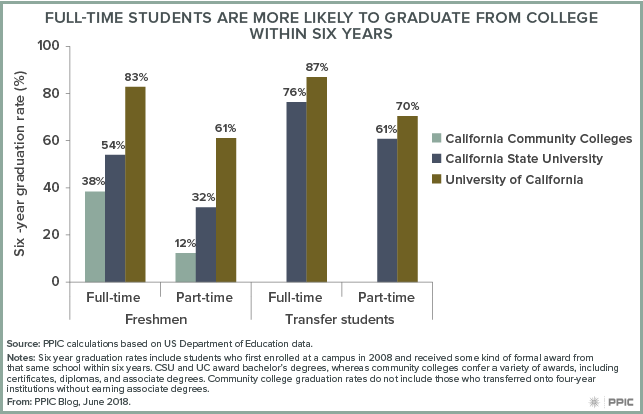
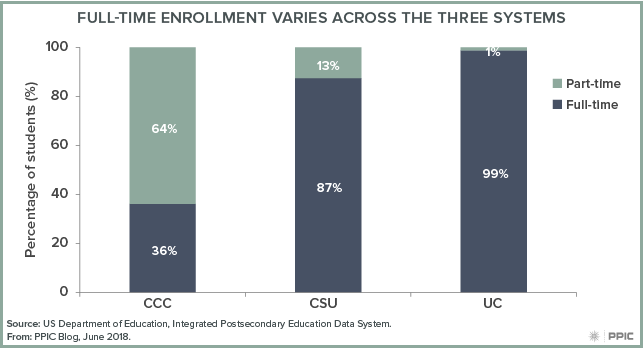
As colleges seek to improve graduation rates, many have focused on increasing the number of students enrolled full time. New data from the US Department of Education show that students at California’s public colleges and universities who first enroll on a full-time basis are much more likely to graduate within six years than students who first enroll part time. These higher graduation rates are observed both for first-time freshmen and for transfer students.

Full-time enrollment varies widely across California’s public systems of higher education. Students at California State University (CSU) and the University of California (UC) are overwhelmingly full time, whereas most students at the community colleges enroll part time. UC requires students to enroll full time (at least 12 units per semester) unless they receive approval for part-time status. Some CSU campuses recently started encouraging students to agree to take 15 units per semester (a full-time course load), as have some community colleges.

Full-time enrollment campaigns (frequently known as “15 to finish”) have been gaining traction across the country. In some states, such as Hawaii and Indiana, more students are completing 15 credits per semester and four-year graduation rates are rising. But messaging and financial incentives aren’t enough to help all part-time students make the transition to full-time enrollment. Community colleges enroll large numbers of nontraditional students who have significant work, family, and other outside obligations. Some of these students may not be able to enroll full time and/or may need holistic supports such as child care services and transportation subsidies in order to succeed. To the extent possible, the state and its higher education institutions should look for ways to help more students enroll full time so that they can progress toward graduation.

How Much Water Is Available for Groundwater Recharge?

The wet winter of 2017 brought an opportunity to test groundwater recharge—the intentional spreading of water on fields to percolate into the aquifer—as a tool for restoring groundwater levels and helping basins comply with the Sustainable Groundwater Management Act (SGMA). This is especially important in the San Joaquin Valley, which has the biggest imbalance between groundwater pumping and replenishment in the state.

A key question for many valley water managers is how much water will be available for recharge in the long term. By law, only river flows in excess of what is required for environmental purposes and to supply existing water-right holders are available for recharge. A recent report by the PPIC Water Policy Center estimated how much water would be available in the San Joaquin Valley over the long term. Two earlier studies—one by two scientists at UC Davis and the other by the Department of Water Resources—estimated a maximum of about half a million acre-feet on average, which is about a quarter of the valley’s estimated deficit. The PPIC study updated these estimates in the context of current conditions and concluded that an average of more than a million acre-feet of San Joaquin River flows may be available.

There are two big challenges to getting more water into underground storage in the valley:

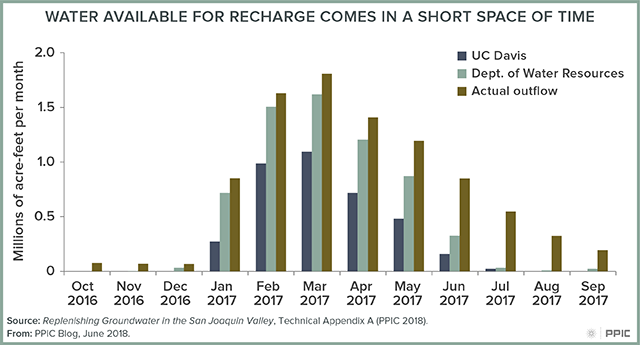
  • Most water for recharge becomes available during short periods. These periods usually coincide with floods, when recharge infrastructure—such as canals, pipelines, and recharge basins—is already working at full capacity. In 2017, for example, more than half of the available water would need to be diverted in February and March, with diversions above 30,000 acre-feet on most days (see figure). To put that into perspective, the California Aqueduct—the state’s largest conveyance system—has a maximum capacity of 26,000 acre-feet per day. While such daily volumes are lower than the overall volume of water moved in the valley during the summer irrigation season, seasonal floods are concentrated in relatively few areas where conveyance limits are likely to be a challenge.
  • Most of the available flows are in the northern half of the valley, while most of the overdrafted basins are in the drier south. This highlights the need to evaluate the capacity of large system-level water conveyance systems, such as the Friant-Kern Canal and the California Aqueduct, to move more water from north to south for recharge purposes.

The State Water Board—which oversees surface water rights—has the last word on this issue. Given the nature of California’s “flashy” river systems—in which very high flows develop rapidly during the winter and spring—the board will need to develop a simple, quick way to determine when river flows exceed water required for the environment and water-right holders.

We can’t count on groundwater recharge to singlehandedly end overdraft in the valley, but efforts to expand recharge in wet years will be helpful. The most pressing issues are to determine how much water is legally available and how best to put this water into the ground. Assessing the infrastructure needed for capturing flows during floods is an essential piece of this puzzle.

Blog figure: Water Available for Recharge Comes in a Short Space of Time


Image above courtesy of Jonathan Parker, Kern Water Bank Authority

PPIC Dedicates the Arjay Miller Room

PPIC dedicated the Arjay Miller Room yesterday at its Bechtel Conference Center—a meeting and learning space at the institute’s San Francisco headquarters. Three generations of the Miller family and many longtime friends and colleagues celebrated Arjay Miller’s life and the opportunity to carry on his legacy. Among the tributes were videos from those unable to attend in person.

As Mas Masumoto—farmer, author, and chair of PPIC’s board of directors—put it, “Within these walls will be lively conversations that I believe will be in the spirit of Arjay and what he wanted so much. This room will encourage constructive dialog about opportunities and challenges facing the state.”

Miller was a giant in the business world who built a legacy through his service to others. He was one of the ten “whiz kids” who left the Pentagon after World War II to resuscitate the Ford Motor Company. He had become president of Ford by the time he was appointed dean of the Stanford Graduate School of Business. There, he brought the first women onto the faculty and expanded the curriculum to include public policy, social issues, and ethics. He also established the Public Management Program, which has trained thousands of public sector managers.

One of Miller’s deepest beliefs was in the power of information to create positive change. It was this conviction—along with an awareness of California’s leadership on important national issues—that led him to cofound the Public Policy Institute of California in 1994. Mark Baldassare, PPIC’s president and CEO, said, “He loved California. He loved public policy. He loved data analysis, and he loved solving problems. So he loved PPIC.”

Miller served as the chair of PPIC’s board of directors from 1995 to 1998 and remained a member of the board until 2006. He was a trusted advisor and generous supporter to the end of his life. By serving as a gathering place for conversation and problem-solving, the Arjay Miller Room honors his contributions to PPIC as well as his commitment to serious analysis and nonpartisan collaboration.