
Proposition 47, passed by voters in November 2014, has generated considerable debate. By reducing penalties for some lower-level drug and property offenses, Prop 47 marked another significant step toward reducing California’s reliance on incarceration. Supporters of the reform believe that redirecting money that is no longer being spent on incarceration to behavioral health and other treatment programs would reduce recidivism. Opponents feared that Prop 47 would overburden local law enforcement and lead to increases in crime.
A panel discussion in Sacramento last Thursday encapsulated this debate—but also featured significant areas of agreement. PPIC researcher Mia Bird set the scene by outlining a new report, The Impact of Proposition 47 on Crime and Recidivism. The report finds no evidence that Prop 47 has affected violent crime rates but sees signs that it led to a rise in property crime—driven largely by thefts from motor vehicles. The report also finds a decline in recidivism, driven largely by a drop in rearrest and reconviction rates for offenders covered by Prop 47.
Bird pointed out that “Prop 47 likely sent a signal to law enforcement to reprioritize their resources away from arrests for drug possession toward more serious offenses.”
Fresno police chief Jerry Dyer underlined this point. “Whenever you have laws that take away your ability to arrest certain individuals for a felony, and you know there’s no room in the jail for misdemeanants, you shift your resources [toward] violent criminals.”
For George Gascón, San Francisco’s district attorney, “Prop 47 is a mild beginning of a process where we go back and see where we want to put public resources.” He pointed out that the negative impact of high rates of incarceration has been felt primarily in communities of color, and added that recent crime fluctuations need to be placed in the context of historically low crime rates over the past several years.
For Dyer, reclassifying some drug and property crimes as misdemeanors means that there are “no consequences for individuals who are committing crimes.” Dyer also noted that when Prop 47 passed, local law enforcement was still adjusting to the realignment of corrections responsibilities that was enacted three years earlier. The pace of reform has felt like “trying to take a drink of water out of a fire hose.”
While the panelists had differing views on the state’s shift away from incarceration, they agreed on the importance of treatment programs for mental health and substance abuse disorders. Gascón noted that with funding from Prop 47, “communities are beginning to experiment with different ways of treating the drug addiction and mental health issues that drive many crimes.” Dyer agreed, noting that “jail is no place for people with mental health issues.”
Kate Howard, executive director of the Board of State and Community Corrections (BSCC), explained how the BSCC developed a process for allocating 65% of the money saved by reductions in incarceration to local programs. The BSCC sought input from across the state, and the grant steering committee includes several ex-offenders, whose experience with the corrections system was “instrumental.” The first 23 grants were awarded in June 2017. While it is too early to measure their impact, Howard said there is “great reason for optimism.”

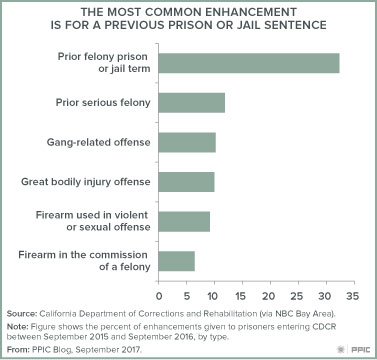 As of September 2016, 79.9% of prisoners in institutions operated by the California Department of Corrections and Rehabilitation (CDCR) had some kind of sentence enhancement; 25.5% had three or more. Aside from second and third strikes, the most common enhancement adds one year for each previous prison or jail term.