
Senate Bill 180, which has passed through the legislature and is currently on the governor’s desk, aims to change a sentence enhancement related to dealing drugs. The bill would repeal the three-year enhancement for a prior conviction related to drug sales, except in cases where a minor is used in the crime. The repeal would affect just 2.3% of the people who entered prison between October 2015 and September 2016. In light of the state’s efforts to downsize its prison and jail populations, however, the bill’s passage could create momentum for similar reforms.
California’s best-known sentence enhancement mechanism is the Three Strikes Law, passed in 1994. The law doubles the sentence of any offender convicted of a second serious or violent crime. A third conviction results in a sentence of between 25 years to life. There are roughly 38,000 second and third “strikers” in California prisons, a little more than one-third of the prison population.
Overall, California has more than 100 separate code sections that enhance sentences based on the current offense or the offender’s record. For example, using a firearm while committing a violent and/or sexual felony adds anywhere from 10 to 25 years. A gang-related felony results in 2 to 10 additional years, depending upon the seriousness of the offense.
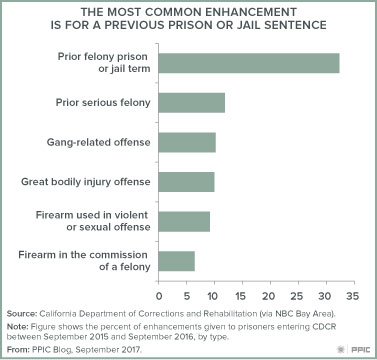 As of September 2016, 79.9% of prisoners in institutions operated by the California Department of Corrections and Rehabilitation (CDCR) had some kind of sentence enhancement; 25.5% had three or more. Aside from second and third strikes, the most common enhancement adds one year for each previous prison or jail term.
Research on sentence lengths offers little support for the idea that the threat of longer sentences deters people from committing crimes. Physically removing a person from society does prevent him or her from engaging in criminal activity, which is part of the appeal of enhancements. However, research shows that this “incapacitation effect” varies across different types of offenders and that longer prison stays are wasteful when applied to people who are “low frequency” offenders.
When considering this bill and similar proposals, the state has the difficult task of balancing the costs of keeping people in custody— in terms of tax dollars spent on expensive prison beds as well as collateral costs borne by families and communities—against the potential cost to public safety.
 Although a number of policies have contributed to this decline, it is largely attributable to two recent major reforms: the 2011 Public Safety Realignment Act, or AB 109, which shifted responsibility for many non-serious, non-violent, and non-sexual offenders to county jail and probation systems; and Proposition 47, which reclassified some drug and property felonies as misdemeanors. Since January 2015, two months after voters approved Prop 47, the prison population has remained below the court-mandated target. That is good news for the state. However, the institutional population is only about 1.1 percent, or 900 inmates, below the target. Given this slim margin—and given the fact that the state still needs to show that it is providing adequate health care—the pressure is still on.
 Voters may well be inclined to see reductions in spending on prisons, and with good reason. California’s corrections budget continues to grow, with the governor requesting $10.6 billion from the General Fund for 2016–17—a historic high. This amount does not include more than $1 billion annually that the state transfers to counties to implement realignment. For 2016–17, the state is projecting the cost of the prison system to be almost $70,000 per prisoner. A significant reduction in the prison population could finally allow the state to stop the use of out-of-state contract beds and possibly close a state prison. These actions could potentially lead to hundreds of millions of dollars in annual savings. Without further reductions in the prison population, it will be difficult for the state to stop using contract beds and remain below the court-ordered population cap.
 Since reaching its peak in 2006 of about 163,000, the institutional prison population has dropped dramatically, by slightly more than 49,000. The court order mandated that inmate population be reduced to 137.5 percent of design capacity, or the number of inmates the facilities were intended to house.
 California has indeed seen a significant decrease in the reliance on incarceration over the last decade through policies like SB 678 and realignment, as well as initiatives like 2012 Proposition 36 (which revised California’s “Three Strikes” law) and Proposition 47. Our total incarceration rate has dropped from about 702 per 100,000 residents in 2006 to about 568. Unfortunately this is not reflected in the state’s expenditures. In fact, spending on corrections is now at a historic high. A look at corrections spending going back to the 1970s shows a long-term increase. In the current budget year, the state is spending more than $12 billion on corrections. In other words, meeting the federally mandated target does not mean that California has solved its incarceration problem.