Senate Bill 180, which has passed through the legislature and is currently on the governor’s desk, aims to change a sentence enhancement related to dealing drugs. The bill would repeal the three-year enhancement for a prior conviction related to drug sales, except in cases where a minor is used in the crime. The repeal would affect just 2.3% of the people who entered prison between October 2015 and September 2016. In light of the state’s efforts to downsize its prison and jail populations, however, the bill’s passage could create momentum for similar reforms.
California’s best-known sentence enhancement mechanism is the Three Strikes Law, passed in 1994. The law doubles the sentence of any offender convicted of a second serious or violent crime. A third conviction results in a sentence of between 25 years to life. There are roughly 38,000 second and third “strikers” in California prisons, a little more than one-third of the prison population.
Overall, California has more than 100 separate code sections that enhance sentences based on the current offense or the offender’s record. For example, using a firearm while committing a violent and/or sexual felony adds anywhere from 10 to 25 years. A gang-related felony results in 2 to 10 additional years, depending upon the seriousness of the offense.
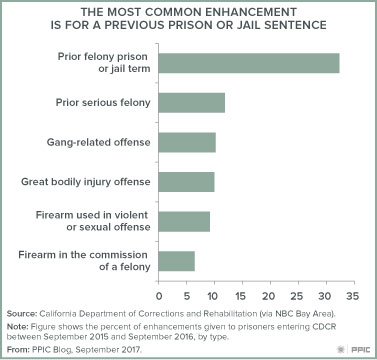 As of September 2016, 79.9% of prisoners in institutions operated by the California Department of Corrections and Rehabilitation (CDCR) had some kind of sentence enhancement; 25.5% had three or more. Aside from second and third strikes, the most common enhancement adds one year for each previous prison or jail term.
Research on sentence lengths offers little support for the idea that the threat of longer sentences deters people from committing crimes. Physically removing a person from society does prevent him or her from engaging in criminal activity, which is part of the appeal of enhancements. However, research shows that this “incapacitation effect” varies across different types of offenders and that longer prison stays are wasteful when applied to people who are “low frequency” offenders.
When considering this bill and similar proposals, the state has the difficult task of balancing the costs of keeping people in custody— in terms of tax dollars spent on expensive prison beds as well as collateral costs borne by families and communities—against the potential cost to public safety.


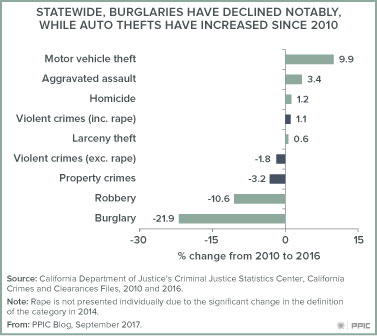 While reforms were unquestionably needed—the state faced a possible federal order to release more than 30,000 prisoners early—critics have voiced concerns that public safety may be negatively affected and have asked whether less incarceration would reverse California’s long-term decline in crime rates.
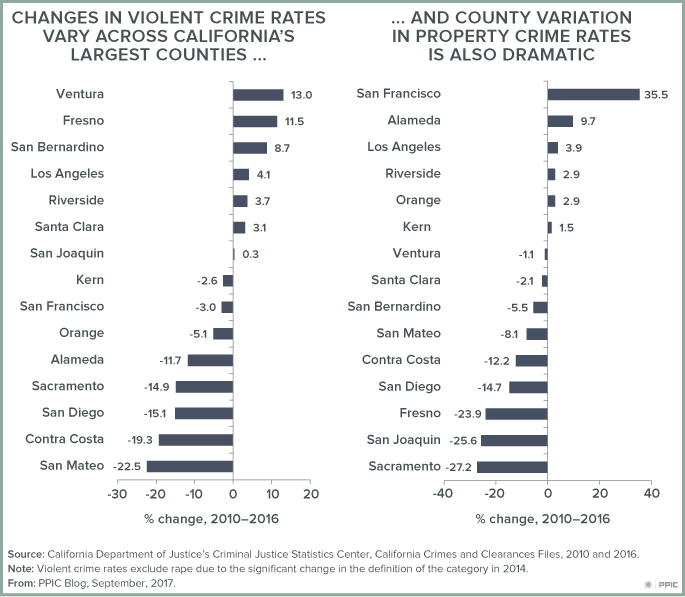 How can we explain these differences? Before rushing to conclusions, there are several questions that need to be answered first. How have reforms affected factors such as arrests and incarceration? Do these differ across counties and what is their relationship to crime rates? Also, California’s crime trends may be affected by factors unrelated to recent reforms. How do statewide trends compare to what other states are seeing? Finally, have California’s reforms improved outcomes for those released from our jails and prisons? If so, this could help lower crime rates in the coming years. Our goal at PPIC is to address these important questions in our upcoming research.
 PPIC: What should every Californian know about storing water?
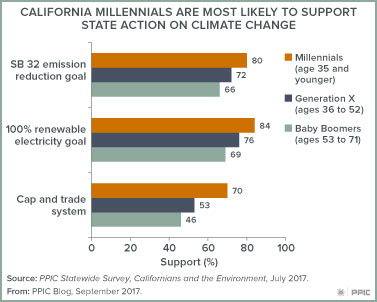 California millennials are about as likely as older adults to expect higher gas prices as a result of state climate change policies (52% millennials, 53% generation X, 55% baby boomers). But among those who expect higher gas prices, millennials are more likely than older adults to support the policies named above. Indeed, 73% of millennials expecting higher gas prices support SB 32, compared to 63% of gen Xers and 59% of baby boomers.


 One of the most important issues for Californians in the first year of the Trump administration is changing federal immigration policy. Immigrants are a significant presence in California, and even more so in Los Angeles County. Los Angeles, the state’s most populous county, is home to more than 10 million people, including more immigrants than any other California county.
 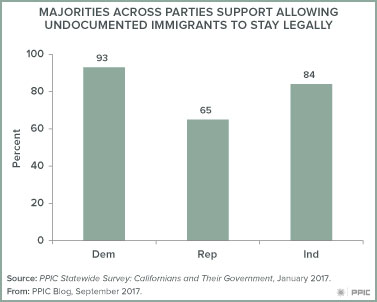 As the federal policy landscape shifted this year, PPIC Statewide Surveys continued to find majority support for a path to citizenship for undocumented immigrants who are living in the US: in our