
[vc_row][vc_column][vc_column_text]Budget cuts for state services are likely on the horizon due to the economic disruption of COVID-19. This means state funding for public higher education may well be reduced—leading to restrictions in access and lowered enrollments. California went through this very scenario during the Great Recession, with thousands of students turning to for-profit colleges in lieu of public colleges.

While some students at for-profit colleges earned a degree, many did not graduate and ended up with large amounts of debt. State and federal government subsequently put restrictions around for-profit colleges, but upcoming changes at the federal level could weaken the federal rules.
The recently announced federal Education Stabilization Fund will disproportionately provide emergency relief funds to private for-profit colleges. In California, only 5% of the state’s undergraduates attend for-profit colleges, but these schools will receive 10% of federal funds.
In contrast, 55% of undergraduates attend the state’s community colleges, which will receive only 34% of federal aid. (That’s because many low-income students who attend community college rely on state aid rather than federal financial aid: these students are not counted in the federal emergency funding formula.)
During the Great Recession in 2008, higher education faced deeper cuts than other state services. With escalating tuition, fewer instructional staff, and a narrow application window, students had less access to the state’s public colleges, especially community colleges.
At the same time, some for-profit colleges began to market heavily, and thousands of students enrolled in expensive programs. By several measures—graduation rates, student debt, loan default rates, and employment outcomes—private for-profit institutions often have poor outcomes. Of course, some colleges have a better track record than others.
People hurt most by the recession—and lack of access to college—were saddled with debt they couldn’t pay back. In response, California and the federal government both instituted new regulations requiring for-profit colleges to be more transparent and accountable.
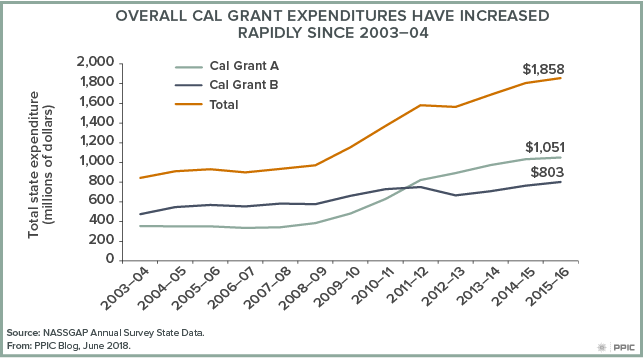
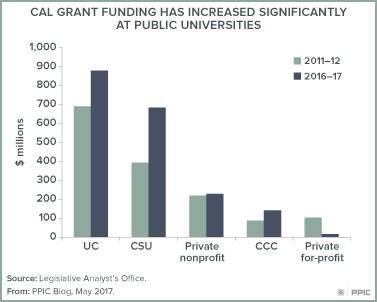
California went a step further than the federal government. The state required colleges to meet minimum standards of graduation and loan default rates to be eligible for Cal Grants, the state’s financial aid program for low-income students. Enrollments in for-profit colleges in California declined, and some of the largest for-profit institutions, like Corinthian and ITT Technical Institute, declared bankruptcy as the economy improved and funding to public higher education was restored.
California policymakers should seek to avoid the mistakes of the last recession by ensuring that access to public higher education is not restricted during this recession. The key is to find ways to limit budget cuts so that public higher education remains accessible to all Californians looking to advance their knowledge and improve their economic well-being.[/vc_column_text][/vc_column][/vc_row]


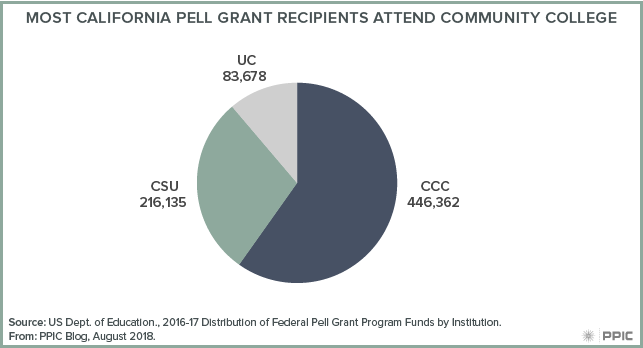

 These mandated minimum funding levels have protected community colleges from the kind of budget cuts that have affected California’s other public higher education institutions. In addition, Governor Brown has prioritized investments in the community college system, which serves 2.1 million students and is the gateway to higher education for the vast majority of California students.



 For those interested in diving deeper into this finding, this chart illustrates the relationship between net price and the yearly income of students after 10 years. Each dot is a university. The CSUs (orange), UCs (dark teal), and in-state private universities (light teal) are marked alongside other universities in the nation (light grey). Nationwide, higher net prices are associated with higher earnings. This isn’t shocking, as we generally associate higher prices with higher-quality universities, which may net students a higher future income. The diagonal line shows typical earnings for a given net price. Universities above the diagonal line have higher-than-average earnings given their net price, and universities below the line have lower-than-average earnings.