Public Higher Education in California Faces a Fiscal Crisis

[vc_row][vc_column][vc_column_text]As the coronavirus pandemic continues to disrupt California’s economy, the Newsom administration is projecting a $54 billion decline in state revenues for the 2021 fiscal year and revising the budget accordingly. California’s public universities—which do not have dedicated funding streams or constitutional protections—face disproportionately large funding cuts. So far, the federal government has provided some emergency relief to mitigate the pandemic’s unprecedented impact on higher education. Without additional support, however, the state’s public colleges might have to reduce student access and services.

During the Great Recession, a drop in state revenues of $40 billion in 2009 led to cuts equaling roughly one-third of state funding for the University of California (UC) and California State University (CSU) systems (on a per student basis). Consequently, tuition doubled at UC and CSU, faculty and staff were laid off or furloughed, and critical capital improvements and maintenance were deferred.

In turn, students faced reduced access to courses, higher student-faculty ratios, increased costs, and fewer support services. As the economy improved, the state was able to increase allocations to the state’s colleges. As a result, UC and CSU admitted thousands of additional students, graduation rates went up, and the number of degrees awarded increased substantially.
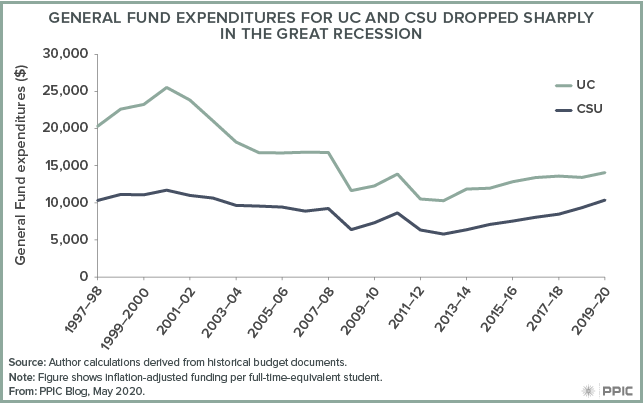
figure - General Fund Expenditures for UC and CSU Dropped Sharply in the Great Recession

Early evidence suggests that the global pandemic could have an even more dramatic fiscal impact on public higher education in California. In the short-term, public colleges face critical revenue shortages: now that students have been sent home and instruction has moved online, revenues from auxiliary enterprises (housing, food, parking, etc.) have evaporated. In addition, UC has suspended elective surgeries at its medical centers and is incurring costs associated with research and treatment of the coronavirus. CSU has projected revenue losses of $337 million for the spring semester, while UC projects a $500 million loss for the month of March alone.

In the longer-term, the systems may find it challenging to raise additional revenues. The percentage of out-of-state students—who pay higher tuition—is now capped at 18% for the five most popular UC campuses, and enrollment of international students is likely to decline due to visa and travel restrictions. Endowment funds are shrinking and tuition increases are controversial. Moreover, unprecedented levels of unemployment will increase demand for federal, state, and institutional financial aid programs.

Governor Newsom’s May budget revision includes a 10% cut for each public higher education system. The revised budget proposal also reduces state financial aid for students who attend nonprofit private colleges from $9,084 to $8,056 per year. The budget proposal does allow UC and CSU to redirect some restricted revenues and to refinance debt at historically low interest rates. However, without additional revenue–whether through federal or state support, or tuition increases—it will be difficult to improve access, quality, and student success in the coming years.[/vc_column_text][/vc_column][/vc_row]

Lessons from the Great Recession Can Protect College Students Today

[vc_row][vc_column][vc_column_text]Budget cuts for state services are likely on the horizon due to the economic disruption of COVID-19. This means state funding for public higher education may well be reduced—leading to restrictions in access and lowered enrollments. California went through this very scenario during the Great Recession, with thousands of students turning to for-profit colleges in lieu of public colleges.

figure - Enrollments Spiked for California For-Profit Colleges during the Recession

While some students at for-profit colleges earned a degree, many did not graduate and ended up with large amounts of debt. State and federal government subsequently put restrictions around for-profit colleges, but upcoming changes at the federal level could weaken the federal rules.

The recently announced federal Education Stabilization Fund will disproportionately provide emergency relief funds to private for-profit colleges. In California, only 5% of the state’s undergraduates attend for-profit colleges, but these schools will receive 10% of federal funds.

In contrast, 55% of undergraduates attend the state’s community colleges, which will receive only 34% of federal aid. (That’s because many low-income students who attend community college rely on state aid rather than federal financial aid: these students are not counted in the federal emergency funding formula.)

During the Great Recession in 2008, higher education faced deeper cuts than other state services. With escalating tuition, fewer instructional staff, and a narrow application window, students had less access to the state’s public colleges, especially community colleges.

At the same time, some for-profit colleges began to market heavily, and thousands of students enrolled in expensive programs. By several measures—graduation rates, student debt, loan default rates, and employment outcomes—private for-profit institutions often have poor outcomes. Of course, some colleges have a better track record than others.

People hurt most by the recession—and lack of access to college—were saddled with debt they couldn’t pay back. In response, California and the federal government both instituted new regulations requiring for-profit colleges to be more transparent and accountable.

California went a step further than the federal government. The state required colleges to meet minimum standards of graduation and loan default rates to be eligible for Cal Grants, the state’s financial aid program for low-income students. Enrollments in for-profit colleges in California declined, and some of the largest for-profit institutions, like Corinthian and ITT Technical Institute, declared bankruptcy as the economy improved and funding to public higher education was restored.

California policymakers should seek to avoid the mistakes of the last recession by ensuring that access to public higher education is not restricted during this recession. The key is to find ways to limit budget cuts so that public higher education remains accessible to all Californians looking to advance their knowledge and improve their economic well-being.[/vc_column_text][/vc_column][/vc_row]
The Coronavirus Pandemic Will Test the State’s Budget Reserves

As it grapples with the COVID-19 pandemic, California faces an uncertain fiscal future. This global crisis has caused a sharp decline in economic activity, exposing crucial sectors to heightened risk. As discussions continue about when and how to re-open the economy, it is clear that the state will have to respond to significant fiscal challenges.

The good news is that California has made important changes to its reserve policies since the Great Recession. The passage of Proposition 2 (2014) created the Budget Stabilization Account—the state’s rainy day fund—as well as the Public School System Stabilization Account, a separate reserve for K–12 districts and community colleges. In addition, Governor Brown and the legislature created the Safety Net Reserve Fund to shore up Medi-Cal and CalWORKs funding during downturns.

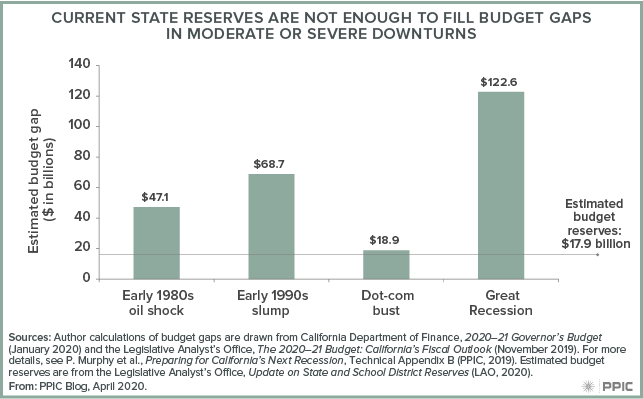
The bad news is that a severe recession is likely to pose significant budgetary challenges. Drawing from the state’s experience during several recent recessions, PPIC estimated the budget ramifications of mild, moderate, and severe recessions and the capacity of state reserves to fill gaps. We found that the state’s reserve balance—estimated to be $17.9 billion—is large enough to withstand a mild recession such as the dot-com bust in the early 2000s.

However, a long and/or severe recession like the early 1980s oil shock (which lasted four years), or the early 1990s slump and the Great Recession—both of which were much more severe and lasted five years—would create large budget gaps and require policymakers to make difficult decisions. (It is important to note that the estimated reserve balance relies on the 2019–20 enacted budget and that it will change when revenue estimates are updated in May.)

figure - Current State Reserves Are Not Enough To Fill Budget Gaps in Moderate or Severe Downturns

In the meantime, the federal government has stepped in. The Families First Coronavirus Response Act includes an increase in the federal share of Medicaid payments and reimbursements to states that are expanding public assistance programs. The Coronavirus Aid, Relief, and Economic Security (CARES) Act provides about $2.2 trillion; some aid goes directly to families, some goes to schools, and some to state and local governments. Additionally, two federal disaster declarations make many of California’s COVID-19 expenditures eligible for at least partial reimbursement.

Governor Newsom has requested additional federal assistance, including flexible aid to state and local governments, a further extension of unemployment insurance benefits, and expanded support for safety net programs, small businesses, K–12 and higher education systems, childcare, and broadband.

The state is also making significant changes to the 2020 budget process. The Department of Finance is drafting a “workload” budget for the May Revision that will set the baseline for the final budget to be enacted in June. This will limit spending increases while allowing for growth in programs—particularly safety net programs—that expect increased demand. The legislature will revisit the budget for an “August Revision” that reflects changes in the state’s financial condition. As these processes move forward, PPIC will continue to monitor California’s evolving fiscal challenges and steps being taken to address them.

Predicting California’s Economic Health

After a record expansion, recent signs suggest the nation’s economy may be softening. Unusual patterns in the bond market, signs of slower growth overseas, and the uncertainty of the ongoing trade conflict with China have all raised fears that a downturn may be on the horizon. Yet it is still unclear whether the country is actually headed for a recession. Moreover, all these signs focus on the United States as a whole (or even the whole world). It would be helpful to have more signs for the California economy in particular.

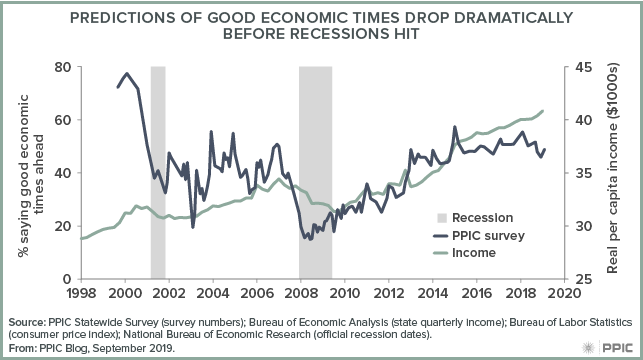
The PPIC Statewide Survey can offer one such sign. The survey has amassed an enormous amount of data on Californians’ views of the economy. For more than 20 years, it has asked survey participants whether they think California will have good or bad economic times in the next 12 months. This question was adapted from the University of Michigan Index of Consumer Sentiment and has been asked of everyone: rich and poor, politically engaged and disaffected, citizen and non-citizen.

Given the broad scope of the survey, in the aggregate these respondents may be good at predicting the direction of the economy. They see what everyone else sees on the news, but they can also report on their own private circumstances and those of close friends and relatives. This might pick up on information that has not yet emerged in official statistics. Indeed, when we look at survey responses alongside recent recessions, an interesting pattern emerges.

The figure below shows the share of survey respondents who have predicted good economic times for California, and plots it against the state’s per capita income and the periods officially labeled recessions. PPIC respondents appear to have anticipated the last two downturns. The share expecting a good economy plunged a few months in advance of each recession and a slide in state incomes. The drop happened a couple months before the 2001 recession, but as much as nine months before the Great Recession.

figure - Predictions of Good Economic Times Drop Dramatically Before Recession Hit

What do the numbers tell us today? The last few surveys have seen a slight drop in the share expecting good times, but the shift hasn’t yet matched the magnitude seen before the last two recessions. At this point the trend is ambiguous, but well worth watching. It can supplement other California-specific information such as the State Fiscal Health Index from the Legislative Analyst’s Office, but a few months earlier. A sharp and sustained drop in Californians’ optimism about the economy may signal dark storm clouds on the horizon.

Record Growth Puts Money in the Bank for California

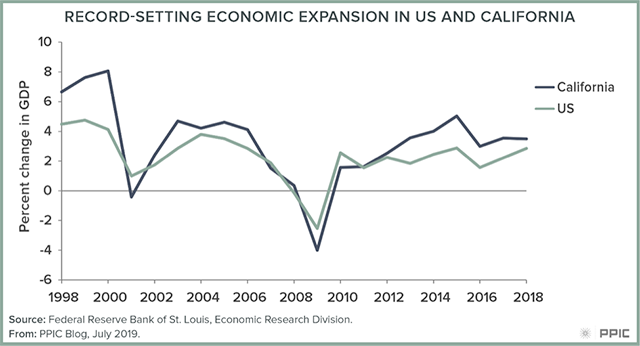
This July marks the longest period of economic expansion in US history. For 121 months and counting, the national and state economies have experienced continuous growth.

Figure: Record-Setting Economic Expansion in US and California

One consequence of this sustained economic growth? An increasing stream of tax revenue flowing into the state’s treasury. This, in turn, has shaped a new state budget that contains record-breaking levels of spending.

In terms of fiscal sustainability, however, the most intriguing element of the new budget may be the dollars that weren’t spent. The budget that the legislature passed and governor just signed includes total budget reserves of more than $20 billion—also a record for the state.

The continued accumulation of budget reserves represents important progress toward preparing the state for an economic slowdown. Because of California’s tax structure, recessions hit the state’s budget particularly hard. Past recessions have caused deep drops in the level of General Fund dollars available, leading to a combination of spending cuts, tax increases, and borrowing to balance the state’s budget.

Building budget reserves should enable California to reduce the impact of a recession. Our estimates suggest that the current level of reserves would allow the state to weather the impact of a mild recession. However, they would be insufficient in the face of a moderate to severe downturn. In other words, there is still work to be done.

None of this matters if the economy never slows down. Just because the economy has gone up for so long, doesn’t mean it must fall—there is no equivalent to gravity when it comes to economics. But history suggests that recessions have a way of interrupting periods of growth. And there are some signs that clouds are gathering on the economic horizon: bond rate curves, drops in consumer confidence, and uncertainty surrounding tariffs and trade. At the same time, the stock market just finished a very positive first half of the year.

Forecasting the timing of the next recession is a much more difficult proposition than asserting that there will be one. The same could be said of California’s earthquakes. But as with earthquakes, the fact that we don’t know exactly when the next recession will hit shouldn’t stop the state from preparing for it.

Highly Educated Workers See Strong Job Gains

Recessions and recoveries have the power to reshape our economy and workforce. In California, the latest recession and recovery have had very different consequences for workers based on their educational attainment levels. During the Great Recession, most job losses occurred among less educated workers, and the subsequent recovery has seen stronger gains for highly educated workers.

After declining to a nadir in 2010 with the Great Recession, the number of employed workers in California has grown substantially, increasing by 1.6 million among adults of prime working age (20 to 64) between 2010 and 2015, according to data from the American Community Survey. During the recovery, the rate of employment growth has been highest for workers with a bachelor’s degree or graduate degree (see chart). Even though high school graduates have also fared relatively well in the recovery, they suffered the most in the recession and recent gains have still not offset the job losses they sustained from 2007 to 2010.

These employment gains reflect the changing nature of our economy. Many of the fastest-growing occupations rely on highly educated workers, such as software developers, computer scientists, and management analysts. But other fast-growing occupations depend on less educated workers, such as taxi drivers and chauffeurs (including those that work for Lyft or Uber) and food preparation workers. Overall, occupations highly dependent on college graduates—those in which a majority of workers in 2010 had at least a bachelor’s degree—experienced a much faster rate of growth (14.1%) than occupations less dependent on college graduates (9.6%).

The changing nature of the state’s economy has also created regional winners and losers. The Bay Area, with its highly educated population, led the state in employment growth, adding more than 400,000 workers overall from 2010 to 2015, with college graduates making up 75% of those job gains (see chart). In contrast, the rate of employment growth was lowest in the San Joaquin Valley, where the demand for and supply of highly educated workers is relatively weak. In the Inland Empire and the San Joaquin Valley, college graduates accounted for only 20% and 17%, respectively, of employment gains.

California’s recovery from the Great Recession highlights the importance of the state’s higher education systems in providing meaningful economic opportunities for workers. Rather than being diminished by the most recent recession and recovery, a college education has emerged as an even more important determinant of labor market success.

Learn more

Visit the PPIC Higher Education Center

What the Unemployment Rate Doesn’t Show Us

California’s unemployment rate is 7.2%, down from 8.4% one year ago and from California’s peak of 12.4% in 2010. California is adding jobs faster than the nation as a whole and now has more jobs than before the recession. Also, the ratio of employment to population is slowly increasing, a sign that more people are reentering the labor force. However, behind these oft-cited statistics, the picture is more complicated.

While California’s economy is improving, the recovery has not been strong or fast enough to keep up with the growth in California’s working-age population. Additionally, the recovery has been uneven across sectors and metro areas, and the unemployment rate is still higher than it was before the recession began. According to the Bureau of Labor Statistics, California has the third-highest unemployment rate in the nation—only Mississippi and the District of Columbia have higher rates. In numerical terms, 1.35 million Californians are looking for work—and more than 35% of them have been looking for at least six months.

High as it is, the unemployment rate does not account for the 7% of California adults who are underemployed—working part-time when they’d rather work full-time. Nor does it count “discouraged and marginally attached” workers—those who have stopped looking for work because, for example, they think there are no jobs available or they don’t have the skills for available jobs. When discouraged and underemployed workers are added to the ranks of unemployed, California’s rate of un- and underemployment (or labor underutilization,” the term used by the Bureau of Labor Statistics) comes to 15.4%—8.2 points higher than the official unemployment rate. In fact, California’s underutilization rate is the second highest in the country (only Nevada’s is higher). Based on underemployment rates, we know that growth is needed not just in the number of jobs but also the number of full-time jobs.

Education is the most important factor in determining who is employed—and fully employed. Workers with college degrees are less likely to be unemployed, underemployed, or to have stopped looking for work. These workers fared better during the recession, an indication that education can be a buffer against the bust cycles of our economy. And education is likely to be increasingly relevant in our future economy: more than two-thirds of new jobs over the next 10 years or so will require at least some college training.

State and federal policymakers are making some investments in training resources for California’s workforce—the California Career Pathways Trust and the federal Workforce Innovation and Opportunity Act are two good examples. The challenge is to do more to ensure that current and future workers are trained for the jobs of both today and tomorrow.

Bay Area Tops in Population Growth Rates

For many decades, inland areas of California have experienced faster population growth rates than coastal areas. Indeed, from 1950 to 2010 the Inland Empire (Riverside and San Bernardino Counties) experienced the most rapid rate of population growth in California. But now, for the first time since the 1860s, the Bay Area—long the slowest-growing urban region—is experiencing faster growth rates than any other region of the state.

Clearly, the Bay Area’s strong economy has led to this growth. With robust job gains and relatively high wages, demand to live in the Bay Area is very high. To some extent, local authorities and builders have responded to this demand with new housing construction, much of it multi-unit housing in densely populated areas. Population growth has been especially strong in Santa Clara and Alameda Counties, but San Francisco and San Mateo Counties are also outpacing the more suburban parts of the Bay Area, such as Sonoma and Solano Counties.

In contrast, inland areas are still recovering from the recession and housing bust that hit them hard at the end of the last decade. Declines in employment and very high rates of foreclosure were centered on these inland regions, including the Inland Empire, the San Joaquin Valley, and Sacramento.

Some might say this is not an important shift in regional growth patterns. After all, at 1.0 percent annual growth, Bay Area populations are not exactly exploding. But growth rates in the Bay Area are twice as high this decade as they were in the previous one, and no one expected the Bay Area to be the fastest-growing region of the state—according to long-term projections, inland areas will have faster growth rates than coastal areas. If recent patterns persist, this conventional wisdom will be turned on its head, and the implications for California’s future—from transportation infrastructure to water demand—could be enormous. As the economic recovery spreads throughout the state, it is reasonable to expect that inland growth will pick up, but to what extent and for how long is highly uncertain.

Chart Source: Author’s calculations based on California Department of Finance data.