Video: Californians and Education

In the era of COVID-19, about eight in ten adults fear getting sick, and 80% expect bad economic times ahead. At a virtual briefing on Thursday, PPIC researcher Alyssa Dykman said the drop in consumer confidence “is unprecedented in the history of the PPIC survey.”

The event featured Dykman, who presented attitudes on K–12 education, funding, and policy preferences along with concerns over the coronavirus pandemic in the latest PPIC statewide survey. PPIC President and CEO Mark Baldassare supplied deeper context for key findings and responded to online questions.

Approval ratings have hit rare numbers: at 78%, approval has surged for Governor Newsom’s handling of K-12 education, and at 92%, public school parents express overwhelming support for school district handling of school closures. COVID-19, however, has shaken support for school bonds, with about half or fewer adults and likely voters saying it’s a good idea now for state government to fund school construction projects.

Baldassare underscored Californians’ concerns around health and finances, stating that two-thirds of adults are worried about both. Many say their lives are disrupted and about half say the stress is affecting mental health.

What do these concerns mean for California schools? “People are giving state leadership and local leadership a lot of leeway in how they respond to the public health and economic crisis,” Baldassare said. But the state will see its first test of this extraordinary support in May, when the governor submits a revised budget that will reflect revenue loss from a sharp economic downturn.

That may also lead to roadblocks for state and local school funding in November. In the March primary, “the defeat of most of the local school bond measures really caught a lot of people by surprise,” Baldassare said. “It was difficult to pass school funding measures.” At the moment Californians are hesitant to commit more funding to schools, which may impact voting on the split-roll property bond measure and others in the November election.

The survey offers several takeaways around planning for California public education. “We’ve never had anything like the school closures that are taking place,” Baldassare said. He reflected that Californians may reconsider the value of teachers going forward, including whether “teachers have the resources they need in order to do the job,” and noted that the public may have “a new understanding of the important and difficult role teachers play every day in the lives of public school children.”

Californians also may now recognize the struggles of vulnerable students, especially in terms of online access.

“It is going to be a test of Californians’ political will,” Baldassare said, “the degree to which we are committed to improving student outcomes, particularly among the large numbers of English language learners and low income students across the state.”

Video: Californians and Their Government

As California’s 2020 Democratic presidential primary draws closer, Elizabeth Warren, Joe Biden, and Bernie Sanders lead the rest of the field by a wide margin. However, many voters say they would consider supporting a candidate other than their current choice. These and other key findings from PPIC’s latest statewide survey were outlined by Rachel Lawler in Sacramento last Thursday.

Likely voters identifying as registered Democrats or as Democratic-leaning independents support Elizabeth Warren (23%), Joe Biden (22%), and Bernie Sanders (21%) at levels well above Kamala Harris (8%) and Pete Buttigieg (6%). No other candidate is preferred by more than 3 percent, and 9 percent say they don’t know which candidate they prefer. More than half of voters who expressed a preference would consider supporting another candidate.

The survey asked about a $15 billion bond for school and college construction that has been approved by the legislature for the March 2020 ballot. It has the support of two in three adults—but only 54 percent of likely voters. This narrow margin of support coincides with concern about the state’s economic outlook. Fewer than half (41% adults, 37% likely voters) expect good times financially in California during the next 12 months.

A potential November 2020 ballot measure that would amend Proposition 13 to tax commercial properties at their current market rate and direct some of the new revenue to K–12 public schools is favored by 57 percent of adults. However, fewer than half (47%) of likely voters favor the measure, and this share is down somewhat from April 2019 (54%). A potential state bond measure to fund water infrastructure is favored by 68 percent of adults and 57 percent of likely voters.

Other survey highlights:

  • Californians are most likely to name homelessness (15% adults, 16% likely voters) and jobs and the economy (15% adults, 13% likely voters) as the top issue facing the state. Other issues named include housing costs, immigration, and the environment.
  • Most Californians view immigrants as a benefit to the state, and half are at least somewhat worried about someone they know being deported as a result of increased federal immigration enforcement.
  • Two in three Californians think the Supreme Court should not overturn Roe v. Wade; more than half think some states are making it too difficult to get an abortion.
  • Half of Californians say they have a disaster plan and six in ten have a disaster supplies kit. Six in ten are very (28%) or somewhat (32%) worried about personal injury, property damage, or a major disruption of their routine as the result of a disaster.


Predicting California’s Economic Health

After a record expansion, recent signs suggest the nation’s economy may be softening. Unusual patterns in the bond market, signs of slower growth overseas, and the uncertainty of the ongoing trade conflict with China have all raised fears that a downturn may be on the horizon. Yet it is still unclear whether the country is actually headed for a recession. Moreover, all these signs focus on the United States as a whole (or even the whole world). It would be helpful to have more signs for the California economy in particular.

The PPIC Statewide Survey can offer one such sign. The survey has amassed an enormous amount of data on Californians’ views of the economy. For more than 20 years, it has asked survey participants whether they think California will have good or bad economic times in the next 12 months. This question was adapted from the University of Michigan Index of Consumer Sentiment and has been asked of everyone: rich and poor, politically engaged and disaffected, citizen and non-citizen.

Given the broad scope of the survey, in the aggregate these respondents may be good at predicting the direction of the economy. They see what everyone else sees on the news, but they can also report on their own private circumstances and those of close friends and relatives. This might pick up on information that has not yet emerged in official statistics. Indeed, when we look at survey responses alongside recent recessions, an interesting pattern emerges.

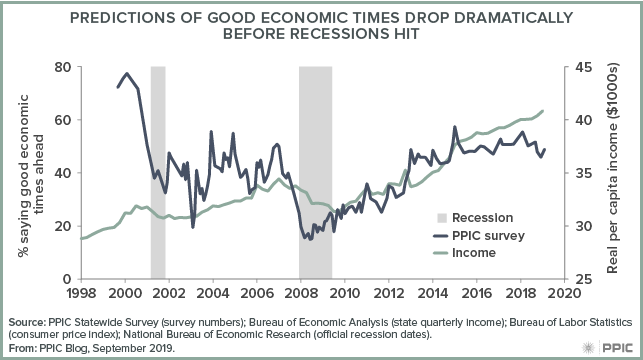
The figure below shows the share of survey respondents who have predicted good economic times for California, and plots it against the state’s per capita income and the periods officially labeled recessions. PPIC respondents appear to have anticipated the last two downturns. The share expecting a good economy plunged a few months in advance of each recession and a slide in state incomes. The drop happened a couple months before the 2001 recession, but as much as nine months before the Great Recession.

figure - Predictions of Good Economic Times Drop Dramatically Before Recession Hit

What do the numbers tell us today? The last few surveys have seen a slight drop in the share expecting good times, but the shift hasn’t yet matched the magnitude seen before the last two recessions. At this point the trend is ambiguous, but well worth watching. It can supplement other California-specific information such as the State Fiscal Health Index from the Legislative Analyst’s Office, but a few months earlier. A sharp and sustained drop in Californians’ optimism about the economy may signal dark storm clouds on the horizon.

Republican Optimism Spikes after Election

Following the November election, Californians’ views on the state of the nation changed only slightly overall—but the opinions of partisans diverged greatly. In our January 2017 survey, only 36% of Californians said that things in the United States were generally going in the right direction. This was a slight decline from October 2016, when 43% were optimistic. In addition, in January, about half (52%) thought that good economic times could be expected in the next year—a slight increase from October (46%).

The mood of partisans changed dramatically after the election of President Donald Trump, with Republicans becoming much more optimistic and Democrats much more pessimistic. Republicans’ optimism about the direction of the nation went up 44 percentage points (17% in October, 61% in January), and their optimism about the country’s economic outlook rose 56 points (27% in October, 83% in January). On the other hand, Democrats became much more pessimistic, with a 37 point drop in optimism about the direction of the nation (57% in October, 20% in January) and a 20 point decline in economic optimism (58% in October, 38% in January). On both measures, independents were more optimistic in January (up 10 points on direction of the nation, up 13 points on economic outlook).

While the partisan differences were the most evident, there were also changes across racial/ethnic groups. Notably, there was a drop in optimism about the direction of the nation among Latinos (down 22 points, from 53% in October to 31% in January) and Asian Americans (down 21 points, from 55% in October to 34% in January). Latinos were also less optimistic about the economic outlook of the nation (down 12 points, from 58% in October to 46% in January), while there was a sharp increase in economic optimism among whites (up 24 points, from 36% in October to 60% in January).

As President Trump works to implement his policies, we will continue to periodically track Californians’ views of the state of the nation as well as monitor partisan and demographic differences.

Learn more

Read the January PPIC Statewide Survey: Californians and Their Government
Find out more about the PPIC Statewide Survey

Worlds Apart: California’s Partisan Divide and the 2016 Election

With the June 7 primary behind us, it’s time to reflect on what we have learned about California’s likely voters as we look ahead to the November 8 election.

The December 2015 PPIC Statewide Survey reported a profound schism between Republicans who wanted “new ideas and a different approach” and Democrats who favored “experience and a proven track record” in a presidential candidate. Last Tuesday’s election provided more evidence of these attitudes. Donald Trump, a businessman with no political experience, won the Republican primary while Hillary Clinton, with a long record of public service, won the Democratic primary. It is now obvious that Californians’ candidate preferences are just one example of a deep partisan fissure that has emerged in the 2016 PPIC Statewide Surveys.

We found another example of this divide when we asked about the mood of the California electorate in 2016. Most Republican likely voters (78%) said the state is going in the wrong direction while most Democratic likely voters (67%) said it is going in the right direction in our May PPIC Statewide Survey. We found a similar divide in views about the direction of the US and about whether California and the US are headed into good economic times or bad ones next year.

The job approval ratings of elected officeholders also largely depend on one’s partisan stripes. President Obama has an 84% approval rating among Democratic likely voters and an 85% disapproval rating among Republican likely voters. This party split is also clear in the approval ratings of the US Supreme Court, California US Senators Barbara Boxer and Dianne Feinstein, Governor Jerry Brown, the California Legislature, and even local House members and state legislators. The only area of consensus is the overwhelming disapproval of the US Congress (84% Republican, 81% Democrat).

There are also large and consistent partisan divides over the role of government. The vast majority of Republicans—83%— want a smaller government with fewer services, while a strong majority—69%—of Democrats say they prefer a bigger government with more services.

Similar partisan differences are evident when Californians are asked about gun laws, government regulation, and economic inequality. While 64% of Republicans say the government goes too far regulating guns, 79% of Democrats say it does not do enough. A majority of Republicans—66%—say government regulation does more harm than good, while 76% of Democrats say government regulation is necessary to protect the public. And 68% of Republicans say the government should not be doing more to reduce the gap between the rich and poor, while 79% of Democrats say it should be.

Last but not least is the partisan gulf on immigration and race. There are also different perspectives on the proposal to build a wall along the entire Mexico border (60% Republicans favor; 87% Democrats oppose) and whether immigrants are a burden (66% Republicans) or a benefit (78% Democrats) to California. Most Republican likely voters (58%) say there is equal treatment in the criminal justice system while most Democratic likely voters (80%) say that blacks and minorities do not get equal treatment.

Looking ahead to the November ballot, there are starkly different views on extending a temporary income tax on the wealthy, with 68% of Republicans opposing the extension of this Proposition 30 tax and 80% of Democrats in favor of it. The results are similar when our survey asked about a state school bond (50% Republicans no, 82% Democrats yes) and marijuana legalization (56% Republicans oppose, 69% Democrats favor).

How will California’s partisan divide impact the November election? Democrats now have an 18-point edge over Republicans in voter registration (45% to 27%).The PPIC Statewide Surveys this year also indicate that independent voters are leaning in the same direction as Democratic voters in their presidential, US Senate, and ballot choices, and their overall outlook, approval ratings, and policy preferences. In this context, the May PPIC Statewide Survey found that the state’s likely voters favor the presidential candidate who stands for experience and a proven track record over the presidential candidate who stands for new ideas and a different approach. Still, Republicans overwhelmingly support their party’s standard bearer and appear to be aligned with his perspectives and policies.

California seems poised to maintain its blue status this fall. However, the geo-political segregation of the state —with Republican pockets of strength in California’s northern, inland, and rural regions—means that federal and state legislators will be elected to represent the views of voters who are worlds apart. Indeed, the political polarization and antipathy of this year’s election may result in a California Congressional delegation that will contribute to Washington gridlock and a California Legislature that will struggle to find common ground on solutions to the many challenges facing California’s future.

Voters More Optimistic, Less Engaged

A lot has changed since Californians cast ballots just four years ago.

Likely voters today are feeling much better about the direction and economic outlook of the state. In October 2010, most (77%) said that the state was headed in the wrong direction. In our latest survey, likely voters are much more positive about the state’s future—although they are still more likely to say wrong direction (54%) than right direction (40%). Similarly, in October 2010 less than a quarter of likely voters (20%) expected good economic times in the upcoming year and far more (65%) expected bad times. Today, the mood is decidedly different, with 42% expecting good times and 47% expecting bad times. In October 2010, most likely voters (59%) named jobs and the economy as the state’s most important issue. Today, just 30% name it as the top issue, which barely keeps it in first place, while 28% name water and the drought. Further, in September 2010 nearly all likely voters (90%) called the state budget situation a big problem—today, that number is 62%.

This year, likely voters are paying less attention to news about the candidates for governor than they did four years ago, when the race involved an open seat and a high-profile contest. In October 2010, an overwhelming majority were very (39%) or fairly closely (50%) paying attention to news about gubernatorial candidates. In our latest survey, just half of likely voters were doing so (18% very, 34% fairly). In addition, there is a big enthusiasm gap. Fewer voters today say they are “more enthusiastic about voting than usual” (53% 2010, 40% today).

In 2010, when many people were tuned into the top of the ticket race, nearly 60 percent of registered voters turned out to vote. With far fewer voters paying attention to the gubernatorial race—and with the lack of a Congressional senate race—what can we expect in 2014? Will concerns about the drought and the state budget drive people to the polls—and if so, how will this translate into votes on Proposition 1, the water bond, and Proposition 2, the establishment of a rainy day fund? Stay tuned to PPIC as we continue to follow the November 2014 election.