Video: Meeting Water Challenges on the Central Coast

The Central Coast has long been self-sufficient in water supply, but the drought has tested the region’s independent streak and helped foster growing cooperation among water agencies and interest groups.

“I would hope that we really start thinking regionally,” said US Rep. Sam Farr, who’s represented the Central Coast for more than 20 years. That was the biggest takeaway message from a wide-ranging panel discussion in Monterey this month, co-hosted by the PPIC Water Policy Center and water supplier California American Water.

The event brought together local experts to discuss the challenges of creating a more diverse water supply, resolving water problems, and protecting the environment.

Groundwater concerns have grown as four years of drought have increased the need for pumping, and saltwater intrusion is a persistent problem.

“In the Central Coast hydrologic region 85 percent of freshwater demand is met by groundwater—and that’s the largest fraction in the state,” said panelist Andrew Fisher, a hydrogeologist with the University of California, Santa Cruz. He noted that climate change will bring fewer but more intense storms, which will mean more runoff and less groundwater recharge. He said that we must put greater effort into recharging groundwater and understanding how much we’re using.

Panelist Norm Groot, executive director of the Monterey County Farm Bureau, discussed a local project to “push the saltwater back to sea” in the Salinas Valley aquifer. He noted that local farmers have been working hard to reduce water use and manage local aquifers more sustainably. Drip irrigation is now used on 60 percent of fields in the Salinas Valley, and another 12,000 acres are using recycled water and have been taken off groundwater pumping, he noted.

Moderator Paul Rogers, environment writer with the San Jose Mercury News and managing editor of the KQED Science Unit, noted that local residents already have some of the lowest water use rates in the state—about 70 gallons per person per day, compared to a statewide average of 97—yet still managed to conserve 29 percent after the mandate was put in place by the governor in April.

Monica Hunter, a board member of the Planning and Conservation League Foundation, noted that despite the area’s efforts to conserve, wells are going dry and small rural communities in the region are facing big water challenges. She noted the need for more data: “We really do not know the magnitude of these problems.”

The region is also rightly proud of its efforts to restore the Carmel River by removing the San Clemente Dam. “People from—I would say not just around California but around the nation—are looking to this region as a test case for removing a dam,” said Ellen Hanak, director of the PPIC Water Policy Center.

Carmel mayor Jason Burnett closed the evening with observations about climate change, conservation, and creative solutions. Sometimes we need to rethink what we used to see as a liability, he said. “Something we discarded is now something we can turn into an asset. You heard talk about stormwater, you heard talk of wastewater and turning those into assets that we can use and use time and time again. We’re already doing that here on the Central Coast.”

The Drought and Californians’ Views on Climate Policy

The California Legislature is considering bills that would expand state efforts to cut greenhouse gas emissions. One, SB 32, would require that California reduce emissions to 80 percent below 1990 levels by 2050. Another, SB 350, would require that petroleum use in cars be reduced by 50 percent, half of the state’s electricity come from renewable energy sources, and buildings double their energy efficiency—all by 2030.

Our July statewide survey examined support for the goals of these bills. We found that strong majorities of Californians favored each of these proposals but that support varied among partisans, with Democrats and independents more likely than Republicans to be in favor. However, a closer look reveals that party registration is not the only driver of these views.

Within the parties and among independents, registered voters who think global warming has contributed to the drought are far more likely to support the ideas in these bills than those who don’t. Among Republicans, solid majorities of those who think global warming has contributed to the drought also support SB 32 and SB 350. Meanwhile, among Democrats and independents who do not think global warming has contributed to the drought, support for SB 350 drops to about half or less.
By the same token, Californians who think climate change is having an impact today are more likely to support these policies than those who don’t think it will have an impact until sometime in the future—and much more likely than those who think climate change will never have an impact.

These findings suggest that Californians who make a connection between climate change and their daily lives are much more likely to support policies to address it. They also suggest that attitudes toward ambitious climate and energy goals are not simply partisan, but that they are related to individual beliefs about the impact of climate change.

Video: What If California’s Drought Continues?

Four years into a historic drought, the environment and some rural communities are most at risk if hot, dry conditions persist. At an event in Sacramento last week, Ellen Hanak, director of the PPIC Water Policy Center, gave an overview of findings from the new report What If California’s Drought Continues, touching on the higher risk of large wildfires, increasing land subsidence from groundwater pumping, and the growing crisis affecting freshwater ecosystems and species. A panel of experts then dove deep into the drought’s perils—and success stories—before a capacity crowd.

Jeffrey Mount, senior fellow at PPIC and a co-author of the report, moderated the panel, which included Wade Crowfoot, deputy cabinet secretary and senior advisor to Governor Brown; Laurel Firestone, cofounder and co-executive director of the Community Water Center; and Kevin Hunting, chief deputy director of the California Department of Fish and Wildlife.

Asked to describe the successes and “pleasant surprises” in the state’s efforts to manage the drought, Hunting said his department has had to redefine success. “In the past success for us would be stable populations, recovering populations of endangered species,” he said. “Unfortunately, we’re in a situation now where success means avoiding extinctions … and really, plugging the gaps in the biggest risk areas.”

He said the agency has also brought creative approaches to managing fisheries and wildlife with a dwindling amount of water, including partnering with private water users to deliver water at critical times to support fish and waterbirds.

Firestone said major strides have been made in state-run efforts to get emergency water supply to rural communities facing water shortages. Beyond the state’s programs, she cited the efforts of volunteer and local agencies in these communities—”local people just trying to help their neighbors.”

Crowfoot gave his short list of drought successes, topped by water conservation across the state. “The real heroes of the California drought are actually everyday Californians,” he said, noting the latest water conservation statistics showing a statewide reduction in water use by over a quarter. He also cited the work of local water agencies, legislation—such as groundwater management reform—that crossed political boundaries, and unprecedented cooperation by state and federal agencies.

The panelists noted that much more needs to be done to both build on these successes—and strengthen efforts to address the challenges of continued drought.

Expanding Education, Reducing Recidivism

This month, the Obama administration unveiled a pilot program to allow access to Pell Grants to those incarcerated in state or federal prison. In addition to expanding access to higher education, this program presents a new opportunity to leverage federal dollars to improve public safety and generate savings in the form of reduced correctional costs.

The federal program complements a bill passed last fall by the California Legislature aimed at increasing educational programming to prison inmates. Authored by State Senator Loni Hancock (D-Berkeley), SB 1391 allocates $2 million to create and fund higher education programs for inmates in four pilot sites, under the leadership of the California Community Colleges Chancellor’s Office and the California Department of Corrections and Rehabilitation (CDCR).

These federal and state policy initiatives come in response to mounting evidence that education—particularly at the post-secondary level—reduces recidivism and related correctional costs. Inmates who participated in education programs had 43% lower odds of reoffending after being released into the community, according to a 2013 RAND report funded by the U.S. Department of Justice. This reduction in recidivism translates to $5 in direct correctional cost savings for every $1 spent on educational programming. Efforts to take advantage of these potential returns are in line with other recent initiatives, such as California’s public safety realignment, that emphasize the use of evidence-based practices to address the state’s historically high rates of recidivism.

However, past efforts to provide educational services to inmates in California—and elsewhere—have not always been successful. Numerous studies have documented the growth of private companies that have profited from providing a range of correctional services—including secondary education, GED classes, and vocational training—with little oversight or evaluation to ensure that public money is well spent. As the federal government makes additional funds available for higher education in prison, some of these service providers will likely seek to expand into post-secondary programming. At the same time, new players, both public and private, attracted by a promising new revenue stream may well enter the field. This means it is critical to ensure that the institutions receiving Pell Grants for inmate education have sufficient and appropriate training, staff, and capacity to offer high-quality college classes and student support services. A 2015 report from UC Berkeley’s Warren Institute and Stanford’s Criminal Justice Center outlines key recommendations for improving and ensuring the quality of inmate education programs, including an emphasis on face-to-face instruction inside prison and transitional programs on the outside for students.

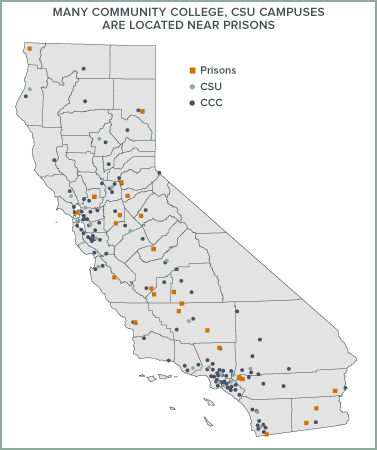
Given their experience in providing a range of educational services, the California Community College (CCC) and California State University (CSU) systems stand out as promising candidates to lead efforts to increase post-secondary education among inmates. The map below shows the close proximity of these educational institutions to prisons across the state.

California currently supports community college education for all low-income students, including inmates, through fee waivers. However, these waivers are not available for students who wish to pursue four-year degrees. These students rely on other forms of aid, including federal Pell Grants. The Pell Grant pilot program presents an opportunity for CSU to begin working with CDCR to leverage federal dollars to expand access to high-quality, onsite higher education for inmates in state prison.

The security and operational constraints of correctional facilities pose unique challenges to service providers. It is likely that even organizations with experience providing quality education programs, such as well-performing state universities and community colleges, may find that they have a steep learning curve when it comes to operating within a prison. Careful planning, detailed oversight, and rigorous evaluation therefore will be critical to ensuring that SB 1391 and the Pell Grant pilot achieve their goals.

Chart Source: California Post-Secondary Education Commission and California Department of Corrections and Rehabilitation.

The Carmel River Gets a Boost

The Carmel River is a shadow of its former self these days, due to overuse of its waters, drought, and dams. But an ambitious project to remove one of its two large dams will bring some life back to the overtaxed river.

The removal of the 106-foot-high San Clemente Dam, now filled with sediment, will be the largest in the state. It will open miles of spawning and rearing habitat for threatened steelhead trout and restore some of the river’s natural flow of sediments. The restoration of sediment flows will support the riparian ecosystem downstream, create gravel beds used by spawning fish, and help replenish sands at Carmel Beach.

The 1920s design of the dam does not meet modern safety standards. Removal of the dam involves many complex challenges, but the biggest by far is managing the 2.5 million cubic yards of sand, silt, gravel, and cobble behind the dam that have displaced all of its water storage capacity. The dam’s remote site precludes removing these sediments mechanically; instead, the project will create a permanent sediment storage area by rerouting the river for half a mile.

Removing San Clemente Dam will help improve habitat, but it isn’t a panacea for all of the river’s problems. Upstream of San Clemente Dam, Los Padres Dam blocks the best spawning and rearing habitat, which is in the Ventana Wilderness Area. Questions still remain about the fate of this dam and fish passage around it. However, removal of San Clemente Dam sets the stage for addressing other aging dams that are ripe for removal around the state.

California has more than 120 reservoirs—most of them small—that have lost at least 75% of their storage capacity to sedimentation. At least three dams in the Coast Ranges are prime candidates for removal: Matilija Dam on the Ventura River, Searsville Dam on San Francisquito Creek on Stanford University property, and Rindge Dam on Malibu Creek. While removing these dams would open up habitat for migratory fish, a key issue hindering their removal is what to do with the decades of sediment accumulated behind them.

Dams are often the principal factor causing degradation of the river ecology. Removing them can often be the single action with the greatest restoration benefits. But other factors affect river health, too, from land use to water abstractions. The Carmel River is not just constrained by dams, it also has been subject to excessive diversions of its waters. Starting in 2017, the river will get increased flows in response to an order by the State Water Resources Control Board to significantly reduce water diversions. Thanks to these efforts, the Carmel River is looking to be a rare success story for the state’s troubled rivers and native fish—and one that is even more important given the huge setbacks the environment has suffered during the drought.

Watch the removal of the dam via webcam.

Learn more about reducing the negative impacts of dams in chapter 5 of Managing California’s Water: From Conflict to Resolution (pp. 228-238).

Video: California’s Aging Population

California is on the verge enormous change. In 2030—when the youngest baby boomers have reached retirement age—the state’s senior population will be nearly twice as big as it is today. It will be more ethnically and racially diverse. And many more seniors are likely to be living alone.

These changes have already begun, and their policy implications are wide-reaching. The state’s growing and changing senior population will require more support services and health care professionals. How is California coping with the challenge? That was the question posed to a panel of experts at a PPIC event in Sacramento last week.

“We could be doing better,” said Assemblymember Cheryl Brown, chair of the Assembly Committee on Aging and Long-Term Care. She said information that can help caregivers is fragmented and not easily accessible.

Her assessment was shared by fellow panelists Karen Keeslar, executive director of the California Association of Public Authorities for In-Home Supportive Services, and Barbara O’Connor, a boardmember of AARP.

But Brown sounded a hopeful note. She predicted that as many more Californians—including legislators—begin care for aging loved ones the issue would become prominent. In fact, Brown and her fellow panelists are or have been caregivers for members of their own families. Keeslar noted the sheer number of Californians who are using in-home support services today—507,000, compared to 90,000 in 1980.

O’Connor advocated new models for senior living to help more Californians live as independently as possible—and not necessarily alone at home. Small senior communities are thriving as alternatives to nursing homes in other states, she said.

“It’s not just nursing home versus staying home,” she said.

Before the presentation, PPIC research fellow Laurel Beck provided an overview of a new report, Planning for California’s Growing Senior Population, which she coauthored.

Central Coast a Microcosm of State Water Challenges

Water challenges around the state are in many ways unique to a particular place, but there are also many similarities and lessons to be learned from place to place. We talked to Richard Frank, a member of PPIC Water Policy Center’s research network, about water management on the Central Coast, where he lives when he isn’t teaching environmental law at UC Davis and directing the school’s California Environmental Law and Policy Center.

PPIC: How are Central Coast water challenges a harbinger for California’s water future?

Richard Frank: First off, even before the current drought, the Central Coast experienced chronic water shortages; we came to a crisis point earlier than the rest of the state. Water shortages are a constant problem here, especially for the Monterey Peninsula—in part because the region isn’t connected to any of the large state or federal water projects. As the Central Coast grapples with trying to achieve water supply self-sufficiency, it’s helping to forge a path for other regions—especially in the southern part of state, which has become far more aggressive at developing regional supplies and reducing reliance on centralized state systems.

Monterey County also reflects an interesting statewide phenomenon. We have a growing divide between a relatively prosperous urbanized coastal zone competing for water with a rural inland area—the Salinas Valley—that is one of most vibrant agricultural areas in the state, and even the nation. We’ve been slowly increasing urban demands for water at the same time that agriculture’s large, steady demands are ever more challenging to meet. I’ve been struck by how this one county illustrates a broader California dynamic—a tale of two states. The classic conflict between Northern and Southern California has become one of urban-coastal vs. inland-agricultural.

Our region is also ahead of the game in the debate about desalination. Monterey and Santa Cruz Counties had been considering a joint project, but in recent months, the alliance has fractured. Monterey is still cautiously proceeding with plans for a desalination plant. Though it is not without concerns, I think it’s the least bad alternative we have. I don’t think we can conserve our way out of major droughts in this region, especially since we’re likely facing a “new normal” of hotter weather and more persistent droughts. We also can’t increase our groundwater pumping indefinitely. We have a big groundwater problem on the Central Coast—over-pumping has caused saltwater intrusion, which is contaminating our groundwater supply. Connecting to state and federal water projects is not a solution. They aren’t able to meet existing demand and can’t expand deliveries, given concerns about water needs for endangered species.

PPIC: What could the rest of the state learn from how the Central Coast has managed its biggest water challenges?

RF: We have a small market-based system for water transfers in urban areas in Monterey. Each property is assigned water credits, which can be traded; we’ve developed something of a robust market in water credits. It’s based on historic use. Each residence gets separate credits for each indoor use of water, and you can’t expand them (for example, add a new bathroom) without additional water credits. It’s a working example of water marketing on a micro-scale. Our market is not as transparent as it should be, though. For example, you can’t go online to see who has credits for sale.

PPIC: What permanent changes do you hope to see come out of this drought?

RF: Some in the Central Coast have adopted a head-in-the-sand attitude about our endemic shortages, and this is something I think the drought is helping to change. For example, we’ve had chronic excess diversion of the Carmel River, to the point that the State Water Board ordered a stop to it. After some resistance, the local water utility was forced to take action and tackle the impending cutbacks on supplies. The desalination project is part of the solution to having cutbacks on this water source. Another positive development is the removal of the outdated San Clemente Dam on the Carmel River; this river restoration is very much a positive development, and a harbinger of a more sustainable future. 

Another positive change is the easing of the disconnect between prosperous coastal communities and inland agricultural areas. I think there is hope for a better relationship between these groups, because the drought is getting people talking more about how to solve our water problems. I am also hoping for a better functioning and more transparent water market. Finally, while we already use some recycled wastewater—for instance, on some golf courses—there’s still a lot of potential for harnessing this resource, including recharging our groundwater basins and helping get them into balance.

Read Richard Frank’s blogs on Legal Planet.

Register for the PPIC Water Policy Center event in Monterey on August 18: Meeting Water Challenges on the Central Coast.

Californians and Climate Change

It’s been nine years since the movie “An Inconvenient Truth” had its debut and AB 32, the “California Global Warming Solutions Act of 2006” was passed by the Democratic-controlled legislature and signed by Republican Governor Arnold Schwarzenegger. Since then, Republicans and Democrats at the federal level have sparred over the scientific evidence on global warming, the government’s role in regulating greenhouse gases, and energy policies that will promote economic growth and well-being. Still, California likely voters’ strong support of AB 32—through good economic times and bad—has barely budged (66% PPIC July 2006, 63% PPIC July 2015).

The July 2015 PPIC poll finds that Californians’ economic fears are part of the reason for their steady support for AB 32—which requires California to reduce its greenhouse gas emissions back to 1990 levels by 2020. Among California’s likely voters, 69 percent say global warming is a threat to California’s economy and quality of life.

Another reason for likely voters’ support for AB 32 is their hope that it may improve the jobs outlook. Asked about the economic impact of state actions to reduce global warming, they are more likely to say the result will be more jobs for people in the state (34%) than to say that the result will be fewer jobs (24%) or that there will be no impact on jobs (29%).

Our polling finds a strong link between likely voters’ fears about the impact of climate change and hopes about state action to address it. Among those in favor of AB 32 today, the overwhelming majority say that global warming is a serious threat to the state’s economy. And a plurality of the supporters of AB 32 say the state’s actions to reduce global warming would lead to more jobs (44%). Less than a third (30%) say these actions would have no effect on job numbers. Just 14% say the result would be fewer jobs.

Californians have not only expressed consistent support for the state’s current goals to curb greenhouse gas emissions, they favor expanding those efforts. Solid majorities of likely voters strongly support three ideas proposed by Governor Brown earlier this year and reflected in SB 350, which is under consideration in the legislature: reducing petroleum use in cars and trucks by 50% by 2030, increasing the use of renewable energy for the state’s electricity to 50% by 2030, and doubling the energy efficiency in existing buildings by the year 2030. Most likely voters also support the proposal in another bill, SB 32, which would require the state to reduce its greenhouse gas emissions to 80% below 1990 levels by 2050.

Once again, strong support of these more ambitious climate goals is tied to the perceived economic effects of both climate change and the state’s actions to address it. Overwhelming majorities of likely voters who favor the new proposals say that global warming is a very serious or somewhat serious threat to the economy (88% reduce petroleum use; 82% increase renewable energy; 85% double energy efficiency; 87% reduce greenhouse gas emissions). Among likely voters who favor these new proposals, pluralities say that California’s actions to reduce global warming will lead to more jobs. Small minorities who favor the new climate change proposals say there would be fewer jobs as a result of actions to reduce global warming.

To reach California’s goals to curb emissions, the state will need to find ways to drastically reduce its greenhouse gases and reliance on fossil fuels. On this topic, the poll finds strong majority support for policies that encourage more electric vehicles and solar power. Overwhelming majorities who favor these policies also view global warming as a serious threat to the economy. Pluralities of those who favor these proposals expect that actions to reduce global warming would lead to more jobs.

PPIC’s surveys have consistently shown that most Californians are aligned with the state’s current efforts and proposed policies, and that they have made up their minds about the perceived economic impacts of climate change and state actions to curb it. Still, the ongoing political debate over what steps to take relies on partisan talking points borrowed from the national arena. There is a shortfall of factual analysis to help leaders—and all Californians—understand the costs, benefits, and trade-offs they are being asked to make. Specifically, will climate change take a greater toll on poor and disadvantaged communities? How will climate change policies improve job prospects in these communities?

As one of the most important issues facing California’s future, climate policy is certainly deserving of a well-informed discussion and a thorough public hearing as new climate-oriented proposals make their way through the legislative process this summer.

Video: PPIC’s Annual Survey on the Environment

As California pursues its goals to reduce greenhouse gas emissions—and considers still more ambitious ones—PPIC’s annual survey on environmental issues asked the state’s residents their views on climate change and energy. At a recent event in the capital, PPIC researcher Lunna Lopes provided the survey findings. Among the key points:

  • Californians see global warming as a serious threat—and most do not think action to reduce global warming will lead to fewer jobs.
  • There is strong support for the greenhouse gas emission reduction requirements in AB 32 and SB 32.
  • Californians favor the energy goals in SB 350, and they also favor state support for solar power and electric vehicles.
  • Many say water is the state’s top environmental issue—but most do not know the reduction targets of their local water district.

California’s Renters in the Dark on Drought Targets

Californians have been asked to cut back their water use since last year, but June marked the first month under the mandatory conservation mandate. Now the numbers are in, and the news was good: statewide we exceeded our goal.

While meeting the mandate is likely on the top of the minds for water managers, most Californians don’t know the details of what is being required of them. It’s not a straightforward cut: each urban water agency has a different conservation target, ranging from 4-36%, depending on a number of factors. While most agencies successfully met their June targets, many will need to conserve more.

The July PPIC Statewide survey found that only 30% of adults know the amount they are being asked to conserve. And it turns out whether you are a homeowner or a renter plays a significant role in your awareness. Notably, homeowners (44%) are more than twice as likely as renters (18%) to report knowing the amount of conservation required. On the other hand, of those who are aware of their conservation target, about half of homeowners and renters (53% each) say it is the right amount. We also find that while solid majorities across both groups say their local water supply is a big problem, homeowners (77%) are much more likely than renters (60%) to hold this view.

In general, renters are less connected to their water use. They often do not pay the water bill, so they may not know how much water they use, and they lack financial incentives to conserve. In addition, renters use less water. Renters are often not responsible for outdoor watering, which accounts for more than half of water use in cities and suburbs. During this drought, state and local agencies have focused more of their effort on reducing outdoor watering, but renters’ water conservation must come mainly from indoor behavior. Since renters make up about 45% of California’s households, this is not a group of water users to ignore as the drought continues.

The more people know about how much water they use, the more likely they are to conserve. Renters often live in multi-unit buildings with one main meter to record the entire building’s use, making it very difficult to parse out how much water is used by individual units. Requiring sub-metering on new multi-unit buildings may help reduce future water use, but it is an expensive investment that won’t result in significant reductions in the short-term.

Infiltrating renters’ awareness and reducing their water use will require different incentives and education efforts—especially since renters are much less likely to follow news about the drought. For example, water agencies should expand public outreach campaigns focused on indoor use and feature them in urban areas with high renter populations. Renters should be encouraged to check for leaks in their toilets and request that their landlords perform leak-checks on the rest of the property. Landlords should also be encouraged to take advantage of available rebates to upgrade to efficient appliances, toilets, and shower heads. There may be more that most homeowners can do to reduce water use, but as a large portion of the population, renters can also play a role in getting us closer to our goals. The drought provides an opportunity to change perceptions of this scarce resource by all Californians.