Sentence Enhancements: Next Target of Corrections Reform?

Senate Bill 180, which has passed through the legislature and is currently on the governor’s desk, aims to change a sentence enhancement related to dealing drugs. The bill would repeal the three-year enhancement for a prior conviction related to drug sales, except in cases where a minor is used in the crime. The repeal would affect just 2.3% of the people who entered prison between October 2015 and September 2016. In light of the state’s efforts to downsize its prison and jail populations, however, the bill’s passage could create momentum for similar reforms.

California’s best-known sentence enhancement mechanism is the Three Strikes Law, passed in 1994. The law doubles the sentence of any offender convicted of a second serious or violent crime. A third conviction results in a sentence of between 25 years to life. There are roughly 38,000 second and third “strikers” in California prisons, a little more than one-third of the prison population.

Overall, California has more than 100 separate code sections that enhance sentences based on the current offense or the offender’s record. For example, using a firearm while committing a violent and/or sexual felony adds anywhere from 10 to 25 years. A gang-related felony results in 2 to 10 additional years, depending upon the seriousness of the offense.
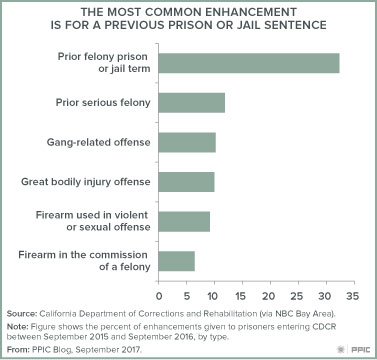
Figure jail sentence enhancementAs of September 2016, 79.9% of prisoners in institutions operated by the California Department of Corrections and Rehabilitation (CDCR) had some kind of sentence enhancement; 25.5% had three or more. Aside from second and third strikes, the most common enhancement adds one year for each previous prison or jail term.

Research on sentence lengths offers little support for the idea that the threat of longer sentences deters people from committing crimes. Physically removing a person from society does prevent him or her from engaging in criminal activity, which is part of the appeal of enhancements. However, research shows that this “incapacitation effect” varies across different types of offenders and that longer prison stays are wasteful when applied to people who are “low frequency” offenders.

When considering this bill and similar proposals, the state has the difficult task of balancing the costs of keeping people in custody— in terms of tax dollars spent on expensive prison beds as well as collateral costs borne by families and communities—against the potential cost to public safety.

Crime Rates Stable Overall, But Some Counties See Big Changes

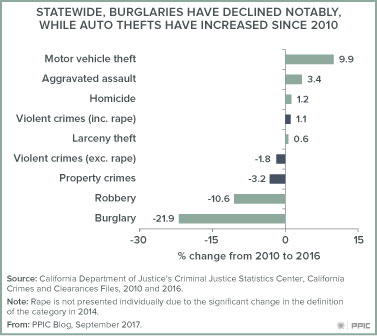
In 2011, California embarked on a series of criminal justice reforms, decreasing the state’s reliance on costly incarceration—and raising fears about the impact on public safety. A look at recently released crime numbers from the California Department of Justice show that while auto thefts are up almost 10%, the state has not seen a broad surge in crime since the reforms started. The violent crime rate is up 1.1% (and when adjusted for an important definitional change, is in fact down about 1%), while the property crime rate is down 3.2%. However, these statewide numbers mask substantial differences across counties.

Prompted by a federal court mandate to reduce the population of the state’s overcrowded prisons, California enacted public safety realignment in 2011. This historic reform shifted the management of lower-level felons from state prison and parole systems to county jail and probation systems. Since then—with the state still unable to meet the federal mandate—voters have passed three significant initiatives: Proposition 36 in 2012, Proposition 47 in 2014, and Proposition 57 in 2016. Due to the combined impact of these reforms, the state’s incarceration rate has declined dramatically and is now at a level not seen since the early 1990s.

While reforms were unquestionably needed—the state faced a possible federal order to release more than 30,000 prisoners early—critics have voiced concerns that public safety may be negatively affected and have asked whether less incarceration would reverse California’s long-term decline in crime rates.
Have reforms affected crime in California? A comparison of 2016 crime rates to those of 2010, the year before any of these reforms were implemented, provides a useful starting point.

The 2016 violent crime rate of 444 per 100,000 residents is up somewhat (1.1%) from the 2010 rate of 439 per 100,000 residents. However, the FBI implemented a change in 2014 that expanded the definition of sexual crimes that constitute rape. According to the FBI’s Uniform Crime Report, the new definition added about 38% to the number of reported rapes in 2014 in California, increasing the violent crime rate by about 8 more violent crimes per 100,000 residents. If we adjust the 2016 violent crime rate accordingly, from 444 to 436 per 100,000 residents, we find that this more comparable measure indicates a slight drop in violent crime (of about 1%) between 2010 and 2016.

The property crime rate in 2016 of 2,545 per 100,000 residents is down 3.2% from 2010 and is the second lowest rate observed since 1960 (the lowest was 2,459 per 100,000 residents in 2014). While the rate of auto theft is up 9.9%, burglaries have been decreasing noticeably since 2012 and are now down 21.9% from 2010. Larceny theft has changed very little (up less than 1%).

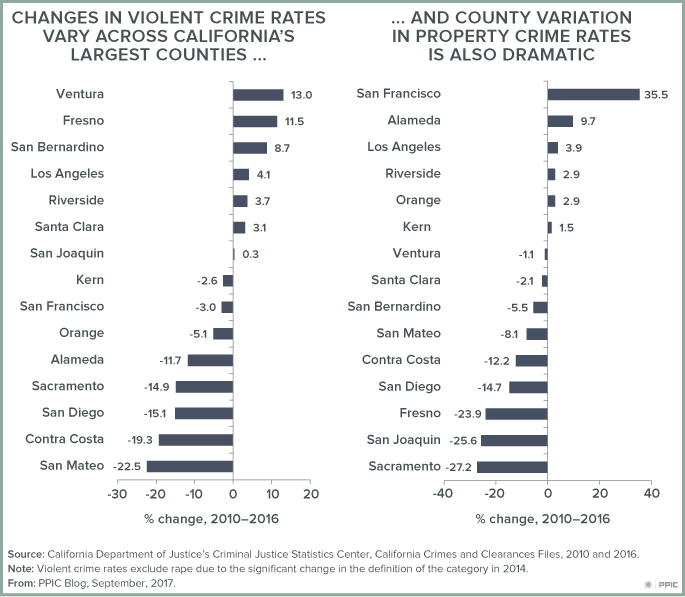
The picture is more complicated at the county level. A look at the 15 largest California counties shows that five saw double-digit drops in their violent crime rates between 2010 and 2016: San Mateo, Contra Costa, San Diego, Sacramento, and Alameda. But Ventura and Fresno Counties experienced increases of more than 10%. And while the property crime rate dropped more than 20% in three counties—Sacramento, San Joaquin, and Fresno—it went up a staggering 35.5% in San Francisco. Alameda County saw an increase of almost 10%.

How can we explain these differences? Before rushing to conclusions, there are several questions that need to be answered first. How have reforms affected factors such as arrests and incarceration? Do these differ across counties and what is their relationship to crime rates? Also, California’s crime trends may be affected by factors unrelated to recent reforms. How do statewide trends compare to what other states are seeing? Finally, have California’s reforms improved outcomes for those released from our jails and prisons? If so, this could help lower crime rates in the coming years. Our goal at PPIC is to address these important questions in our upcoming research.
Video: Reforms Challenge County Probation Departments

Changes in criminal justice policy have significantly altered the role of probation in the state and, as documented in a new PPIC report, have put considerable demands on counties.

The report, California Probation in the Era of Reform, is based on data from 12 counties and describes the changing characteristics of individuals under probation supervision. Viet Nguyen, report coauthor and PPIC research associate, presented the findings at a briefing in Sacramento. Among them:

  • Reforms shifted probation caseloads toward more serious offenders. Public safety realignment—implemented in 2011 and designed to address prison overcrowding—shifted the management of lower-level felons from the state prison and parole systems to county jails and probation departments. After realignment, the number of new probation cases increased steadily because of counties’ new responsibilities in managing two types of offenders: those released from state prison on post-release community supervision and those given “split sentences,” who serve part of their sentence in county jail and then are placed under mandatory supervision. In 2014, Proposition 47—which required that certain drug and property offenses be charged as misdemeanors—resulted in a dramatic decline in new felony and misdemeanor probation cases. But it also further concentrated the probation caseload on individuals who have committed more serious offenses.
  • Jail bookings are common among the probation population, especially for realigned offenders. Nearly half of people placed under probation supervision were booked into county jail within their first year. Realigned offenders had the highest booking rates, were more likely to enter jail multiple times in their first year, and stayed in jail longer than traditional felony and misdemeanor probation cases.
  • African Americans are overrepresented among people under probation supervision. African Americans make up 7.9% of the general population but 22.9% of those entering probation supervision. Overall, the shares of Latinos and whites under probation supervision were similar to their shares in the population, while Asian Americans made up a much smaller proportion of new probation cases.

Learn moreRead the report California Probation in the Era of Reform

Proposition 57’s Impact on Prisons

Proposition 57 creates opportunities for the release of thousands of state prisoners through the expansion of parole eligibility and good conduct and programming credits. When 64% of voters approved the measure in November 2016, there were few details about how it would be implemented. During the 2017–18 budget process, the California Department of Corrections and Rehabilitation (CDCR) outlined implementation plans and population estimates, and now we have a better sense of the potential impact of this measure on the prison population.

Proposition 57 will significantly reduce the number of prison inmates—and, in combination with other statewide criminal justice reforms over the past six years, it will enable the system to keep its inmate population below the court-ordered cap of 137.5% of design capacity. Overall, Proposition 57 is expected to reduce the population by more than 2,600 inmates in 2017‒18, with a net cost savings of nearly $40 million. Long-term estimates put the population impact at 11,500 by 2020–21, for an annual savings of more than $180 million.

CDCR’s new parole regulations exclude prisoners who are serving a term for a violent felony (as defined by Penal Code 667.5), required to register as sex offenders under Penal Code 290, serving life sentences, or on death row. Eligible offenders receive parole consideration after serving full sentences for their primary offenses (their longest sentences). These offenders are no longer required to serve sentence enhancements for gang activity or prior prison terms. The state estimates that this new process—which went into effect on July 1—will reduce the prison population by almost 500 offenders in fiscal year 2017–18.

CDCR has also created additional educational and rehabilitative programming and increased the amount of credits inmates can earn for both good behavior and program completion. For example, in 2015 there were 95 career technical education programs (including training in auto repair, home construction and maintenance, and office technology); now there are 197 programs, with new classes in almost every career tech area.

Good behavior credits were expanded for almost all eligible inmates on May 1, 2017. The expanded programming credits will take effect August 1, 2017. The state estimates that these additional credit earning opportunities will reduce the prison population by more than 2,100 in the 2017–18 fiscal year.

State officials believe that Proposition 57 will allow them to keep the prison population below the cap while maintaining public safety. In addition to monitoring Proposition 57’s effect on public safety, recidivism, and costs, corrections officials and policymakers should pay close attention to the supply, demand, and—most importantly—effectiveness of the education and rehabilitation programs offered to inmates to ensure that the measure’s goals are realized.

Grants Awarded to Combat Recidivism

Proposition 47, passed by voters in November 2014, reclassified a number of drug and property offenses from felonies to misdemeanors. Backers of Proposition 47 argued that spending on prisons should be reserved for only the most violent and serious offenders, with more resources directed toward prevention and support programs.

Sentences were immediately reduced after the measure passed, and both the state prison and county jail populations declined. Between October 2014 and December 2016, the overall prison population dropped by 6,664 inmates (4.9%) and the jail population by 8,545 (10.4%). Although all of that decline cannot be attributed to the initiative, both populations have decreased as intended.

Proposition 47 requires any net state savings from the measure—coming from a decrease in the prison population—to go toward grants and programs for K‒12 schools (25% of savings), victim services (10%), and mental health and substance use disorder treatment (65%). It should be noted that the measure did not require counties to report or redirect any local savings that may come from the change in sentencing.

The measure required that the first transfer of savings occur by August 2016. This first transfer totaled more than $67 million and went to the three agencies tasked with distributing the grants (Table 1). The first grants were awarded this month. It’s estimated that nearly $46 million in savings will be transferred for fiscal year 2017–18. By 2019–20, long-term savings will be $75 million annually.

Administration of grants for those with mental health and substance use disorders is the responsibility of the Board of State and Community Corrections (BSCC). This independent state agency already oversees statewide regulations, inspections, and new construction funding for local jails and juvenile facilities. I focus on the BSCC grant program below because it is the largest category of Proposition 47 savings and is the only grant program that will help current offenders in the criminal justice system. However, it’s important to note that the California Department of Education has recently awarded its first year of grant funding.

All projects funded through the BSCC are required to include some combination of mental health services, substance use disorder treatment, and efforts to work with individuals before arrest or booking into jail. Priority is given to projects that also provide housing-related support and/or other community-based supportive services. At least half of the funds have to go to non-governmental community based organizations.

The BSCC is using the Proposition 47 funds to provide three-year grants, with an estimated $104 million available in funding from June 2017 to August 2020. Fifty-eight public agencies—including superior courts; school districts; district and city attorneys; health and human services; and police, probation, sheriff, and county education offices—submitted proposals. In the end, the BSCC is funding 23 projects across 17 counties, totaling $103.7 million in funding.

Projects are considered small or large depending on their funding level. Fifteen large scale projects (more than $1 million) received funding, including $6 million for the Los Angeles City Attorney’s Office to implement a health-focused drug intervention and pre-booking diversion program in five South Los Angeles locations. Eight small scale projects ($1 million) received funding, including $960,667 for Merced County Probation Department to provide mental health and substance treatment for men up to 24 years old in the Los Banos region.

The goals of these programs are twofold: showing successful outcomes for participants, and giving criminal justice practitioners and policymakers more information on effective tools for evidence-based programming. PPIC will continue to describe and follow these projects in the months and years to come.

Putting the Governor’s Sentencing Proposal in Context

Governor Brown has proposed a ballot measure—the Public Safety and Rehabilitation Act—that could significantly alter sentencing in California. If it qualifies for the ballot—which seems likely—and is approved by voters in November, the measure would allow non-violent felons who have earned enough credits for good behavior to spend less time in state prison. It would also shift the power to determine whether juveniles should be tried as adults from prosecutors to judges. The measure follows the path of decreased reliance on incarceration that California has been on since 2009.

Motivated primarily by a federal court’s 2009 mandate to improve health care and reduce overcrowding in the state’s prison system, California has implemented a number of measures that have considerably reduced the prison population. Since reaching a historic high in 2006, the prison population has dropped by 45,000, a decrease of about 26 percent, and the state’s overall incarceration rate is down to levels not seen since the early 1990s.

Although a number of policies have contributed to this decline, it is largely attributable to two recent major reforms: the 2011 Public Safety Realignment Act, or AB 109, which shifted responsibility for many non-serious, non-violent, and non-sexual offenders to county jail and probation systems; and Proposition 47, which reclassified some drug and property felonies as misdemeanors. Since January 2015, two months after voters approved Prop 47, the prison population has remained below the court-mandated target. That is good news for the state. However, the institutional population is only about 1.1 percent, or 900 inmates, below the target. Given this slim margin—and given the fact that the state still needs to show that it is providing adequate health care—the pressure is still on.

Californians appear to be supportive of lessening penalties for crime and downsizing state prisons. Recent criminal justice initiatives, such as Proposition 36 in 2012 (which revised California’s three-strikes law) and Proposition 47 in 2014, passed by rather wide margins—close to 70 percent and around 60 percent respectively.

Voters may well be inclined to see reductions in spending on prisons, and with good reason. California’s corrections budget continues to grow, with the governor requesting $10.6 billion from the General Fund for 2016–17—a historic high. This amount does not include more than $1 billion annually that the state transfers to counties to implement realignment. For 2016–17, the state is projecting the cost of the prison system to be almost $70,000 per prisoner. A significant reduction in the prison population could finally allow the state to stop the use of out-of-state contract beds and possibly close a state prison. These actions could potentially lead to hundreds of millions of dollars in annual savings. Without further reductions in the prison population, it will be difficult for the state to stop using contract beds and remain below the court-ordered population cap.

Finally, it should be noted that, unlike realignment and Propositions 36 and 47, which implemented changes based on the kind of offenses committed, this measure focuses mainly on the behavior of the offenders. After they earn enough credits for good behavior and achievements in education and rehabilitation, non-violent prison inmates can be paroled and released early. If this incentive is accompanied by effective educational and rehabilitative programs, it could reduce recidivism. More broadly, this measure, combined with the redirection of spending toward cost-effective crime preventive strategies, could help California use its corrections resources more wisely.

Chart source (TOP): California Department of Corrections and Rehabilitation (CDCR) monthly population reports.

Chart source (BOTTOM): California Department of Finance.

Proposition 47 and Crime

Last November, voters approved Proposition 47, which reclassified a number of drug and property offenses from felonies to misdemeanors. As a result, inmate populations have dropped in California’s capacity-challenged state prisons and county jails. Reports of increases in violent crime in some areas have raised concerns, and the significant drawdown in the jail and prison populations—by roughly 17,000 inmates so far—certainly carries the risk of increased crime. But it would be premature to blame Proposition 47 for the uptick.

Proposition 47 helped bring down the prison population by about 8,000 inmates, below the mandated target of 137.5 percent of design capacity (the number of inmates that facilities were designed to house). The target was set by a federal court in 2009 in the wake of lawsuits over prison conditions; at the time, it meant a reduction of almost 40,000 prisoners. The prison population has remained below the target since January 2015. This is a key requirement for the state to regain control of prison health care, which is currently overseen by a court-appointed receiver. The total prison population has dropped by slightly more than 45,000 inmates since it peaked in 2006.

Proposition 47 also helped bring the jail population below the statewide rated capacity (here again, the number of inmates facilities are designed to hold), after three years of increases that were driven by public safety realignment. In stark contrast to the increase of about 11,000 inmates between September 2011 and October 2014, the county jail population dropped by almost 9,000 inmates, or 10.7 percent, between October 2014 and March 2015 (the most recent month of available data).

As we noted above, reports of increased crime in a number of cities and counties in 2015 have fueled concerns about the impact of these population reductions. Between January and August, violent crime in Sacramento was up by 24 percent compared to the same months in 2014. In Riverside County, violent crime was up almost 11 percent in the first six months of 2015. In the City of Los Angeles, it was up almost 21 percent in the same time period.

There are good reasons to be cautious about attributing these upticks to Proposition 47. Crime trends fluctuate frequently and widely and it is challenging to pinpoint specific causes. The first year of realignment provides a good example of this. After a long decline, both violent and property crime in California increased in 2012, the year after realignment was implemented, and many blamed the reform. However, as our careful analysis has shown, there is no evidence that realignment led to more violent crime, and the only uptick that can be attributed to the reform is auto theft. Another reason to be cautious is that other states have seen increases in crime this year—the New York Times recently reported that violent crime, as represented by murder rates, has gone up noticeably in a number of US cities. With all this in mind, at this time we urge against drawing any firm conclusions about Proposition 47’s impact on crime.

Chart sources: (TOP) California Department of Corrections and Rehabilitation, monthly population reports. (BOTTOM) Board of State and Community Corrections, jail profile surveys.

Video: Rating Realignment

Local law enforcement and corrections officials have risen to the challenge of public safety realignment, a panel of local and state officials concluded last week. They also concurred that big challenges remain.

Four years ago, local officials had to adapt—and adapt quickly—to this historic policy shift in California. Prompted by a federal court order to reduce prison overcrowding, the state shifted responsibility for incarcerating and supervising low-level felons from the state to the counties, based on the idea that the locals could do a better job. The panelists at a PPIC event in Sacramento assessed the hurdles they’ve had to overcome and the challenges that remain.

“We’ve adapted and we are adapting,” said Lee Seale, Sacramento County’s chief probation officer. “We’re better as a result of it,” he said, noting that hundreds of offenders are enrolled in drug treatment or other rehabilitative programming who did not get these services before. Among the issues corrections officials are still coping with, according to Seale and the other panelists, is a jail population with many challenges, including mental health issues.

Linda Penner, chair of the Board of State and Community Corrections, serves as the governor’s liaison on realignment issues with county law enforcement officials statewide. When realignment began, she was the chief probation officer of Fresno County. She likened the magnitude and speed of realignment to “drinking from a fire hose.”

“Counties had to demonstrate their nimbleness and creativity,” she said. Initially, case files were transferred from the state to the county using manila envelopes because computer systems were incompatible. The incompatibility problem was resolved in about a year, she said.

Adam Christianson, now serving his third term as sheriff of Stanislaus County, was a realignment skeptic. The governor, he said, knew him as “the difficult sheriff from Stanislaus County.” His county’s jail was already at maximum capacity before realignment began. The jail, built in 1954, had no space for treatment or the programs that realignment’s proponents envisioned as key in reducing recidivism.

Things have changed, he said, and so has the department’s culture. The county is building new facilities with program and treatment areas, classroom space, and a mental health care unit. Partnerships with community-based organizations—which the sheriff says are essential—are helping the county provide program opportunities for offenders.

As a result, he said, “The difficult sheriff from Stanislaus County isn’t so difficult anymore.”

Before the discussion, PPIC senior fellow Magnus Lofstrom presented the findings of Public Safety Realignment: Impacts So Far, which he authored with PPIC research associate Brandon Martin.

Proposition 47 Brought Decreases to Both Prison and Jail Populations

Two major criminal justice reforms—realignment and Proposition 47—have brought California’s incarcerated population down to levels not seen since the mid-1990s. This drawdown in both the state prison and the county jail populations addresses some of the serious capacity challenges the systems have faced.

As of August 2015, the total prison population had dropped by almost 45,000 inmates from its 2006 peak. The majority (about 55%) of the decline was a result of realignment, which was implemented in October 2011 in response to a court order to improve prison conditions by reducing overcrowding. However, it took the passage of Proposition 47 last November—which reclassified a number of felony drug and property offenses as misdemeanors—and building and renting additional prison beds to reach the court-ordered population target of 137.5 percent of design capacity. The prison population has declined by almost 7,700 since November and has remained below the mandated target since January 2015. This is a key requirement for the state to regain control over prison health care—currently, a court-appointed receiver oversees health care in the system.

Proposition 47 appears to have relieved some of the pressure on county jail systems created by the shift of responsibility for lower-level offenders from the state to the counties during the first few years of realignment. The average daily jail population dropped by almost 10,000 inmates after the passage of Proposition 47 last November. As of December 2014, there were about 72,500 inmates in county jails, down from about 82,000 in October. This brought the jail population back under the statewide rated capacity of nearly 80,000 beds. Another sign that Proposition 47 has relieved some pressure is that the number of inmates released early due to housing constraints decreased noticeably (by almost 20% as of December 2014 compared to December 2013), to levels well below those observed in the months before realignment was implemented.

Although we can see that prison population numbers have dropped in each of the nine months since Proposition 47 passed, we need to be more cautious about the measure’s impact on jail population numbers because we only have jail data for the first two months. Also, counties have been working to implement and refine new jail policies and procedures, and these may be having an impact on jail populations. For instance, data through March 2015 for Los Angeles County show that the jail population dipped below 16,000 inmates in December (down from more than 18,000 in October), but rose above 17,000 in January and stayed above 17,000 through March. This increase is related to the sheriff requiring that inmates serve a larger percentage of their sentences before release. We may see similar developments in other counties. Nonetheless, even in Los Angeles there was a noticeable drop in the jail population compared to months before passage of Proposition 47.

Clearly, California is moving away from incarceration, in line with research that has shown that incarceration is not a cost-effective tool for crime prevention, at least not at the high levels in the state before realignment. The changes implemented so far may help improve prison and jail conditions and may also help the state and counties handle their corrections responsibilities more effectively. However, research also suggests that there may be a greater upward pressure on crime with incarceration reductions at lower levels of incarceration, which heightens the need to identify and implement effective crime preventive strategies. As we continue to monitor crime trends, it will be important to determine whether their long-term decline has been reversed.

Expanding Education, Reducing Recidivism

This month, the Obama administration unveiled a pilot program to allow access to Pell Grants to those incarcerated in state or federal prison. In addition to expanding access to higher education, this program presents a new opportunity to leverage federal dollars to improve public safety and generate savings in the form of reduced correctional costs.

The federal program complements a bill passed last fall by the California Legislature aimed at increasing educational programming to prison inmates. Authored by State Senator Loni Hancock (D-Berkeley), SB 1391 allocates $2 million to create and fund higher education programs for inmates in four pilot sites, under the leadership of the California Community Colleges Chancellor’s Office and the California Department of Corrections and Rehabilitation (CDCR).

These federal and state policy initiatives come in response to mounting evidence that education—particularly at the post-secondary level—reduces recidivism and related correctional costs. Inmates who participated in education programs had 43% lower odds of reoffending after being released into the community, according to a 2013 RAND report funded by the U.S. Department of Justice. This reduction in recidivism translates to $5 in direct correctional cost savings for every $1 spent on educational programming. Efforts to take advantage of these potential returns are in line with other recent initiatives, such as California’s public safety realignment, that emphasize the use of evidence-based practices to address the state’s historically high rates of recidivism.

However, past efforts to provide educational services to inmates in California—and elsewhere—have not always been successful. Numerous studies have documented the growth of private companies that have profited from providing a range of correctional services—including secondary education, GED classes, and vocational training—with little oversight or evaluation to ensure that public money is well spent. As the federal government makes additional funds available for higher education in prison, some of these service providers will likely seek to expand into post-secondary programming. At the same time, new players, both public and private, attracted by a promising new revenue stream may well enter the field. This means it is critical to ensure that the institutions receiving Pell Grants for inmate education have sufficient and appropriate training, staff, and capacity to offer high-quality college classes and student support services. A 2015 report from UC Berkeley’s Warren Institute and Stanford’s Criminal Justice Center outlines key recommendations for improving and ensuring the quality of inmate education programs, including an emphasis on face-to-face instruction inside prison and transitional programs on the outside for students.

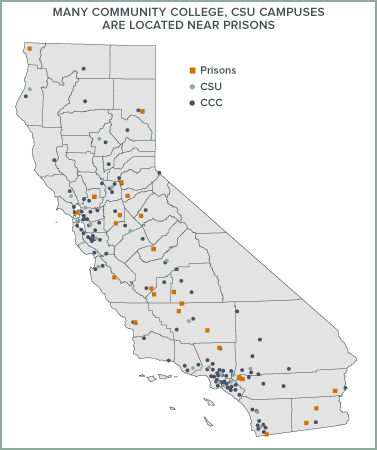
Given their experience in providing a range of educational services, the California Community College (CCC) and California State University (CSU) systems stand out as promising candidates to lead efforts to increase post-secondary education among inmates. The map below shows the close proximity of these educational institutions to prisons across the state.

California currently supports community college education for all low-income students, including inmates, through fee waivers. However, these waivers are not available for students who wish to pursue four-year degrees. These students rely on other forms of aid, including federal Pell Grants. The Pell Grant pilot program presents an opportunity for CSU to begin working with CDCR to leverage federal dollars to expand access to high-quality, onsite higher education for inmates in state prison.

The security and operational constraints of correctional facilities pose unique challenges to service providers. It is likely that even organizations with experience providing quality education programs, such as well-performing state universities and community colleges, may find that they have a steep learning curve when it comes to operating within a prison. Careful planning, detailed oversight, and rigorous evaluation therefore will be critical to ensuring that SB 1391 and the Pell Grant pilot achieve their goals.

Chart Source: California Post-Secondary Education Commission and California Department of Corrections and Rehabilitation.