
State funding aimed at programs and supervision for some jail inmates in jails and others on probation will drop sharply as a result of the COVID-19 crisis. While spending on the state correctional system will decrease less than 1% under recently announced cuts to the California state budget, funding for counties may drop 24%.
Probable cuts now loom over local budgets as well, and spending on local public safety may fall significantly. Although lower jail populations during the pandemic could create budget savings, there may also be a higher need for re-entry and community-based services as released individuals return to communities.
In 2011, California enacted sweeping changes to its correctional system to address federal court orders to alleviate severe overcrowding in the prison system. This public safety realignment shifted correctional responsibilities for tens of thousands of offenders, from state prison and parole systems over to county sheriff and probation departments.
To fund the shift, the state created the local community corrections account, with money drawn from a dedicated portion of state sales tax revenue. Voters issued a constitutional guarantee for that portion of tax revenue when they passed Proposition 30 in November 2012. But while the percentage of revenue was guaranteed, the actual amount of sales tax collected can vary. The amount is now changing because of the COVID-19 crisis.
Counties were meant to use these funds to provide supervision and programming to individuals who were realigned from the state to the counties. More specifically, the state expected counties to fund cost-effective, evidence-based programming that improved offender rehabilitation and public safety in local communities. Such programming might include day reporting centers, expanded jail training programs, or specialized courts that handle individuals with drug dependency or mental health disorders.
Each county had the freedom to implement programs that best suited their situation. Community Corrections Partnerships (CCPs)—headed by the chief probation officer, with representatives from law enforcement, health and human services, and community organizations—provide realignment plans and recommend where to allocate funding.
Realignment funding grew 47% from $930 million in 2012–13 to $1.37 billion in 2018–19. In state budget estimates from before COVID-19, sales tax revenue rose steadily, with the local community corrections fund expected to increase to $1.54 billion for fiscal year 2020–21.
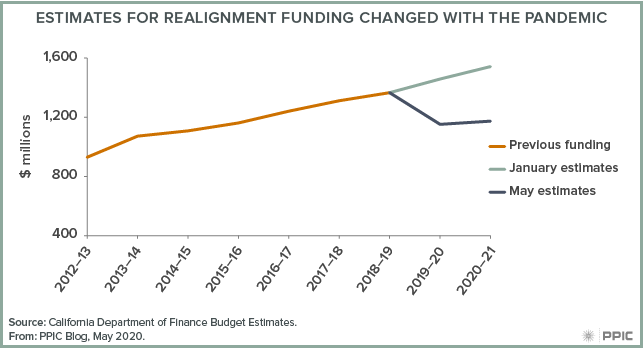
However, the pandemic weakened the economy—in updated state budget estimates, the governor predicted a drop in sales tax revenue of more than 27% for 2020–21. The local community corrections account is now estimated to receive only $1.17 billion—a 24% decrease from the earlier estimate and 14% below the 2018–19 fiscal year.
Because revenues are paid to counties monthly, local agencies will feel the effect of sinking revenues almost immediately. The fiscal situation undoubtedly poses challenges for successful community re-entry programs; it is more important than ever to evaluate policies and programs that to lead to cost-effective solutions.

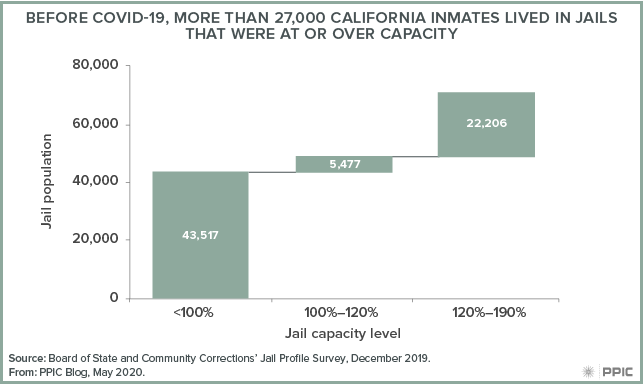
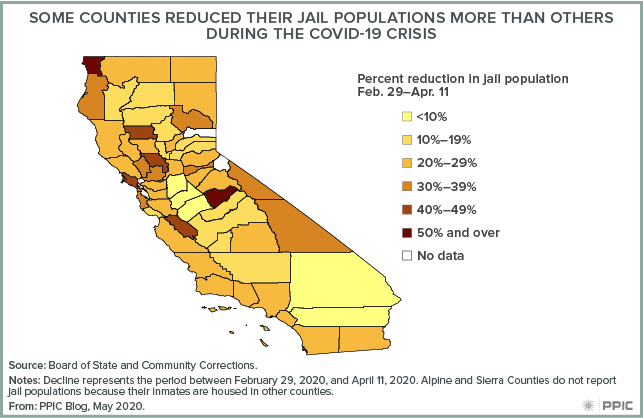




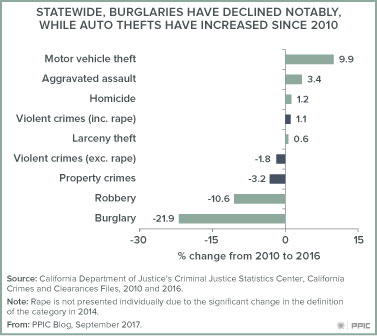 While reforms were unquestionably needed—the state faced a possible federal order to release more than 30,000 prisoners early—critics have voiced concerns that public safety may be negatively affected and have asked whether less incarceration would reverse California’s long-term decline in crime rates.
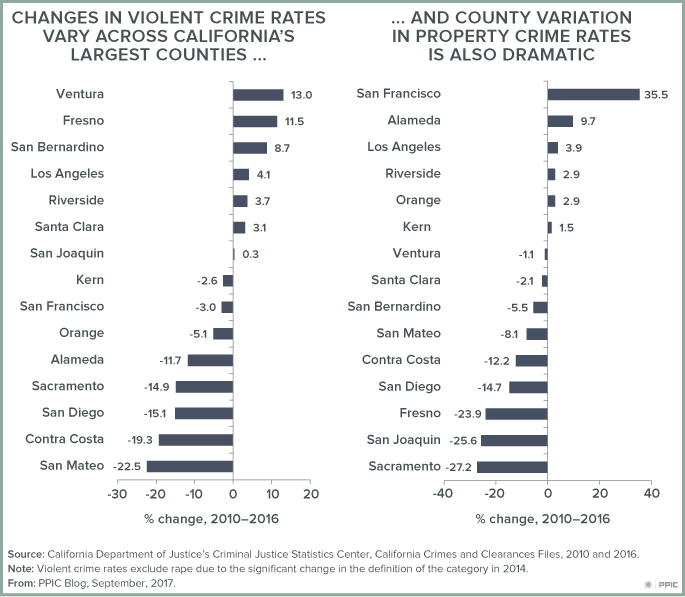 How can we explain these differences? Before rushing to conclusions, there are several questions that need to be answered first. How have reforms affected factors such as arrests and incarceration? Do these differ across counties and what is their relationship to crime rates? Also, California’s crime trends may be affected by factors unrelated to recent reforms. How do statewide trends compare to what other states are seeing? Finally, have California’s reforms improved outcomes for those released from our jails and prisons? If so, this could help lower crime rates in the coming years. Our goal at PPIC is to address these important questions in our upcoming research.
 The measure required that the first transfer of savings occur by August 2016. This first transfer totaled more than $67 million and went to the three agencies tasked with distributing the grants (Table 1). The first grants were awarded this month. It’s estimated that nearly $46 million in savings will be transferred for fiscal year 2017–18. By 2019–20, long-term savings will be $75 million annually.
 In 2014, Proposition 47 reclassified several property and drug crimes from felonies to misdemeanors. These offenses are also committed by a greater share of women than men. As with realignment, Proposition 47 had a greater impact on women than men, and women appear to have more greatly benefited. One year after the proposition passed, the percentage of women in custody for Proposition 47 offenses dropped from 32% to 16%. The percentage of men in custody for Proposition 47 offenses dropped from 22% to 12%. In other words, a greater proportion of Proposition 47 offenders were women, and the share of women in jail dropped by a greater percentage after the proposition. The racial and ethnic composition of female offenders did not change across the reforms.